One of the premiere films of the New Hollywood era, Chinatown (1974) is a seminal and classic neo-noir that continues to endure. Set in 1930s Los Angeles, the film tells a tale of greed, corruption, and decay. This article will cover the film’s story, characters, and themes, in addition to what awards it won and an explanation about its famous ending. So, get ready for a deep dive Chinatown movie analysis!

Watch: The Complex History of "Chinatown"
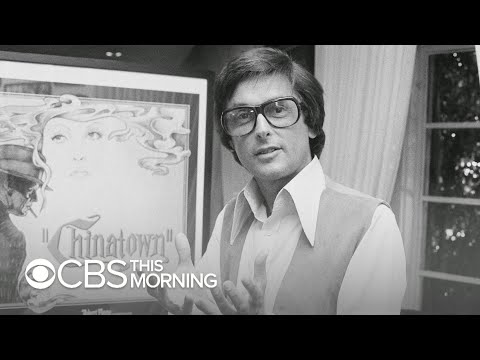

Subscribe for more filmmaking videos like this.
Chinatown English Movie
What is the Chinatown movie about?
Chinatown is a neo-noir film, released by Paramount Pictures in 1974, produced by Robert Evans, written by Robert Towne, and directed by Roman Polanski. It stars Jack Nicholson as private investigator Jake Gittes and Faye Dunaway as Evelyn Mulwray. It also features Perry Lopez as Lieutenant Lou Escobar and John Huston as Noah Cross.
The film Chinatown tells the story of Jake Gittes (Nicholson) learning about a large-scale conspiracy involving water–and who controls it–in 1930s LA. Along the way he gets involved with Evelyn (Dunaway), whose husband and father are part of the city’s Department of Water and Power. Its blend of old and new noir styles made it a hit at the time and continues to make it a Hollywood classic thriller today.
Chinatown 1974 Movie
How did Chinatown get made?
To understand the importance of Chinatown movie, we have to understand the importance of the era in which it was produced. The early 1970s were pivotal years for Hollywood cinema because they marked the advent of New Hollywood; which in simple terms, was a radical film movement that ushered in a new generation of writers, actors, and directors.
This video below from “Ministry of Cinema” explains how New Hollywood came to be and how film movements such as film noir influenced its style.
Chinatown movie Director, Writer, and Lead Actor Were Emblematic of New Hollywood
Robert Towne, Jack Nicholson, and Roman Polanski were three of the forefront faces of New Hollywood. Polanski received critical acclaim for directing movies like Knife in the Water, Repulsion, and Rosemary’s Baby. By 1969, he had become one of the most sought-after filmmakers in the world. However, tragedy struck when Sharon Tate (the wife of Roman Polanski) was murdered.
Towne developed a reputation in Hollywood as one of the industry’s most venerated script doctors. In his early years, Towne consulted on acclaimed screenplays such as Bonnie And Clyde and The Godfather script. In 1974, he was nominated for the Academy Award for Best Adapted screenplay for The Last Detail, starring Jack Nicholson.
A year later he reunited with Nicholson for the Chinatown movie.
Nicholson struggled to find steady work in his early years in Hollywood but broke through in a major way in 1969 with Easy Rider. The following year, Nicholson starred in the film that thrusted him to stardom: Five Easy Pieces. Over the next three-decades-and-change, Nicholson received 12 nominations for acting Oscars.
Chinatown the Movie
Chinatown plot summary
Jack Gittes is a former LAPD officer now private investigator in 1930s Los Angeles. He is hired by a woman claiming to be Evelyn Mulwray; she suspects her husband, Hollis Mulwray, is cheating on her. Hollis, who works for the Department of Water and Power, is followed; he mostly hangs out at reservoirs and near the beach, but is eventually photographed with a young woman. After the news hits the papers, Gittes is confronted by the real Evelyn Mulwray, who threatens to sue.

Chinatown Plot Analysis
Gittes runs into his former partner Escobar–now a Lieutenant–and discovers that Hollis has drowned in one of the reservoirs. He investigates further but is threatened by the Water Department’s hired muscle; he gets his nose slashed as a result.
Evelyn returns to Gittes and hires him to find out who murdered her husband. At the same time, Gittes meets Hollis’s former business partner, Noah Cross–Evelyn’s father–who pays Gittes to locate the woman Hollis was photographed with.
Bit by bit, Gittes learns that land near the city has been getting purchased on behalf of people who are none the wiser. And even though there is a drought, the city keeps dumping water from the reservoir and out to the ocean. He soon concludes that, whatever is happening, it could easily make these new land owners very rich.
Gittes, along with Evelyn, decide to investigate further, but end up running into the Water Department’s henchmen. Gittes spends the night with Evelyn; that same night, he follows her and learns she’s taking care of the young woman Hollis had been with. It’s revealed that this young woman is Evelyn’s sister, Katherine, as seen in the clip below:
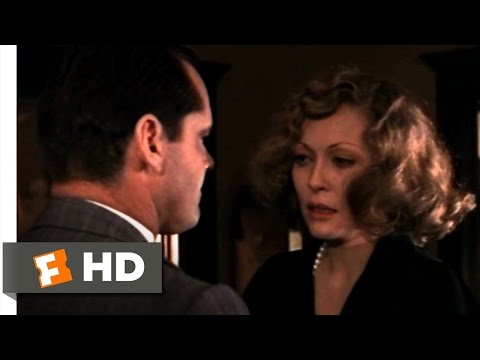
Chinatown Plot Analysis
The woman who had claimed to be Evelyn Mulwray ends up dead and Gittes becomes suspicious that the real Evelyn is behind the murders. When Gittes confronts Evelyn about all this, she breaks down and reveals that Katherine is both her sister and daughter. Intending to keep Noah Cross far away from them both, Gittes does his best to help Evelyn and Katherine get out of town.
Gittes confronts Cross, who admits to virtually every crime Gittes has uncovered during this time. But because Cross is so powerful and rich, he threatens Gittes to take him to both Evelyn and Katherine. Hiding out in Chinatown, Gittes soon finds his associates and himself under arrest by Escobar, who believes Gittes has been withholding evidence, among other things.
Cross attempts to take Katherine away from Evelyn, leading to a skirmish that leaves Evelyn dead and Katherine in the hands of Cross. Escobar lets Gittes and his associates go; utterly distraught, Gittes and his associates leave. Unable to fully let go of what just happened, one of them tells Gittes “Forget it, Jake. It’s Chinatown.”
Related Posts
Character Dies in Chinatown Movie
Chinatown movie ending explained
The Chinatown movie has one of the most famous endings of the New Hollywood era, and its final line is probably the most famous takeaway. Evelyn’s death is a complete tragedy, especially because Gittes did his best to prevent it. The main problem is that Gittes got too involved, which meant he ended up caring too much for Evelyn.

Chinatown Ending
It’s a reminder of his past failings, too; Evelyn ends up dead in Chinatown, a part of town that Gittes used to work in. An ironic echo comes when Gittes mumbles “As little as possible”, which is something he told Evelyn earlier when she asked him what his job was in Chinatown. In other words, Gittes should have kept doing “as little as possible” when it came to Evelyn.
Noah Cross–the film’s main villain–ends up winning in the end. He gets away with murder, owns the ill-gotten land, and now has custody over his daughter/grand-daughter. It ties into the final moments of the film, where Escobar releases Gittes and his associates, saying “I’m doing you a favor.” As Gittes and company leave, Gittes looks back, but is told by one of his associates “Forget it, Jake. It’s Chinatown.”

Forget it Jake, it's Chinatown | Chinatown movie scene
“Forget it, Jake. It’s Chinatown.” is one of the all-time great final lines in cinema. It fully sums up the themes and plot of the film by, essentially, pointing out the futility of everything that happened. Gittes uncovered a conspiracy and tried to help a woman in trouble, but in the end, the woman dies and the conspiracy is kept under wraps. It’s a reflection of Gittes’ own time working as an officer in Chinatown, where he was told to do “as little as possible.” This is why, in the end, he is told to “Forget it”. There’s nothing he and his associates can do; better to move on and be lucky they were let go.
To take it a step further, the Chinatown movie itself is a reflection of the situation Gittes finds himself in. Just like when he used to be a cop in Chinatown, private investigator Gittes would have been better off doing “as little as possible” when it came to the situation with Evelyn and the Department of Water and Power. Not because he was wrong, but because the powers at be were too powerful to take down. And when Gittes tried to do the right thing, he just ended up making things worse.
Did You Know
The ending for “Chinatown” originated with director Roman Polanski. Screenwriter Robert Towne had originally been against it, but Polanski insisted that the film should have a tragic ending.
In an interview with critic Michael Sragow, Towne said “Roman and I never really had any arguments except one, and that was over the ending. And it wasn't that I wanted a happy ending; I had felt that his was excessively melodramatic.” In the end, Towne admitted that Polanski’s revised ending was the right choice.
Chinatown Movie Villains
Is Chinatown based on a true story?
Chinatown is not based on a true story, but it does use real history as its basis. The California Water Wars heavily inspired the story in Chinatown, which involved water being taken from surrounding areas to make the City of Los Angeles what it is today. Like in the film, there was a lot of disagreement and issues with farmers and ranchers outside of the city, specifically in Owens Valley.

How LA Stole It Water | Chinatown movie analysis
Some major differences include the time in which these water wars occurred, which was between 1900s and 1910s, whereas the film is set in the 1930s–specfically 1937. Also, no one in the film is directly based on any actual historical figure; they are, at best, amalgamations of real people or share characteristics with real people.
Chinatown Jack Nicholson
Major characters explained
Jake Gittes
Gittes is an imperfect noir protagonist — a pseudo-hardboiled antihero that wants to see the good in the world but can’t escape its evil. The water and power corruption against San Fernando Valley farmers is just too far reaching. All of this is to say that Gittes is relatable but somewhat unknowable; just like Chinatown. He wants to do the right thing, even as he continues to expose himself to danger. However, in the end, his efforts to expose Los Angeles corruption and help the innocent backfire. He might be set free at the end, but his disillusionment with justice has never been higher.

Chinatown movie Jake Gittes Character Card
Evelyn Mulwray
Evelyn Mulwray is a subversion of the femme fatale, an archetype that usually leads our noir protagonists down a tragic path. While Evelyn does eventually do this for Gittes, the subversion comes in her innocence and sincerity. She genuinely wants no harm to come to Gittes and only wants to ensure the safety of her sister Katherine. At the same time, keeping everything so close to the chest results in misunderstandings that, ultimately, lead to her tragic death.

Chinatown movie Evelyn Mylwray Character Card
Noah Cross
Noah Cross doesn’t get a lot of screentime, but his presence is felt all over the movie. The father of Evelyn and former business partner of Hollis, Cross seems to only care about power. This could explain why he does all that he does in the movie, from murder to business dealings to making sure he gets to keep his granddaughter. Gittes points out to him that he already has enough money, that the Water and Power scheme is unnecessary for someone as rich as him. But of course, Cross is all about power, because controlling the water of Los Angeles means controlling “the future.”

Chinatown movie Noah Cross Character Card
Related Posts
Chinatown movie analysis
Themes in Chinatown movie
Next up on our Chinatown film analysis is taking apart the complex themes that reveal themselves throughout. 1970s cinema wasn’t afraid to push the boundaries to get at something essential about human nature, so let’s dive into some of these fascinating ideas.
Corruption and Power
Chinatown is full of characters who are after power via corruption. You have businessmen making shady deals, police who look the other way, and disregard for human life. In the end, it’s all in the name of power and being part of “the future.”
Wealth and Control
Noah Cross especially is a prime example of a man with so much wealth and control, but wants more. With all of that wealth and control, Cross is able to essentially do whatever he wants and get away with it.
Moral Rot
Most of the characters in the film have experienced moral rot of some kind or another. Noah Cross is the obvious example, with his act of incest and desire for more power being examples. But even a character like Lt. Escobar experiences moral rot, since they continue to work for the corrupt police force. It’s very possible Gittes also faces some additional moral rot by the film’s end.
The Failure of Justice
Ultimately, justice is not served in this movie. Since there is corruption all over Los Angeles, the bad guys who orchestrated multiple murders and shady land deals get away with it. Meanwhile, innocent people get killed and Gittes is unable to help even one person.
Chinatown 1974 movie
Symbolism in Chinatown movie
Gittes’ busted nose is the most obvious and least subtle form of symbolism in Chinatown. He gets his nose cut because he was being nosy, and it stays that way for the duration of the film. However, his injured nose also serves as an obvious and unavoidable symbol of his failures. He’s not an unstoppable hero but a man dealing with forces beyond his control.
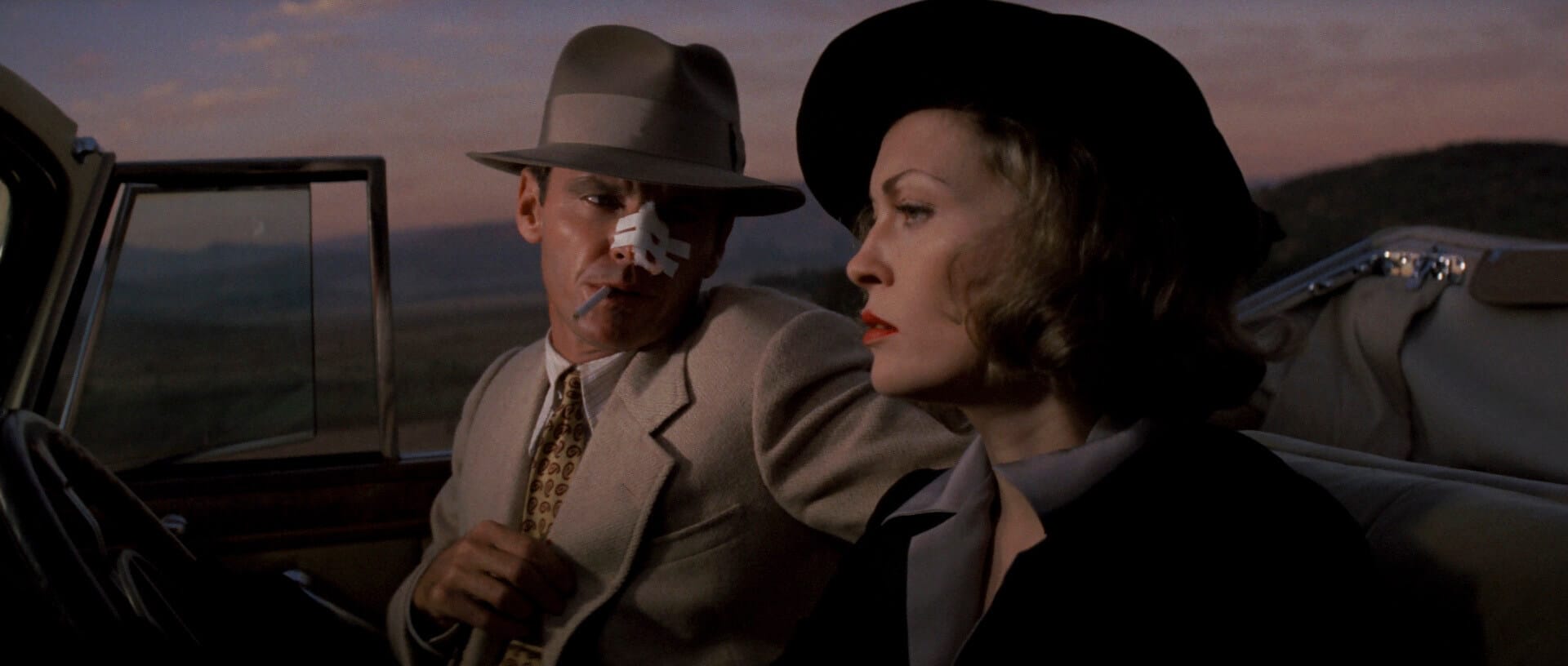
Chinatown movie plot explained
Water is a major symbol, especially since it’s described as the beginning of all life. Amusingly, water is what brings about the deaths of characters, as well as the corruption of others. Hollis, for one thing, is killed via drowning in his own saltwater pond.
Chinatown itself is the most symbolic thing in this movie. While obviously a physical place (and the film’s title), Chinatown also represents a state of mind. Chinatown is an example of corruption, helplessness, confusion, and doing “as little as possible.” In a place like this, heroes are punished, corruption is common, and there is no law.
Chinatown movie analysis
Screenplay breakdown
In the Collector’s Edition of Chinatown, Towne said he was inspired to write the Oscar-winning screenplay after hearing an exchange involving a Hungarian vice cop saying “What did you do in Chinatown? / “As little as possible” as a way to underscore the unknowable nature of whether outsiders help or hurt ethnic communities.
With Towne’s point in mind, watch the clip below and think about why it’s such an important scene for establishing a major theme.
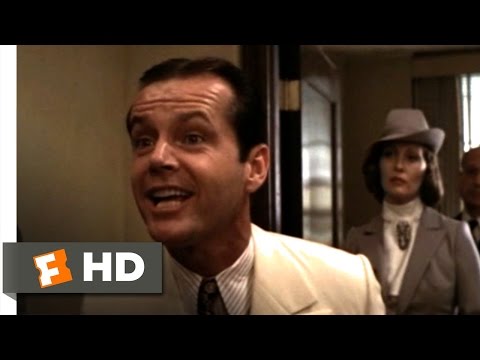
Chinatown Movie Analysis • Chinatown Joke Clip
The “screw like a chinaman” joke is essential to understanding Chinatown because it underscores Gittes’s imperfections. It’s a perfect example of turning something into a stereotype simply for the sake of turning something into a stereotype.
More importantly, it’s a moment of misguided justification for Gittes – a moment for him to express his confusion and resentment towards Chinatown for destroying his ideals of justice. Gittes tells Evelyn that when he was a police officer in Chinatown, he tried to do as little as possible because everything was so corrupt and foreign that he couldn’t tell if he was doing any good.
One of the greatest things about Chinatown is how it takes imperfection and integrates it organically into its story. We’ve already touched on why Gittes is an imperfect protagonist, but there’s a lot more to his character's imperfections than just bad jokes. Take this next scene for instance: notice anything different about Gittes’ face?

Key Chinatown Plot Moments
It may seem inconsequential, but how many times have you watched a show or movie with a protagonist who has bandages covering their face for extended periods of time? It’s incredibly daring to use bandages to obscure a protagonist’s face. You can’t sell a movie if you can’t see their face. It would be one thing if the bandages were just there for the scene where Gittes confronted Evelyn, but they're prominently there throughout.
We see imperfections elsewhere in Chinatown, like when Gittes misinterprets the term “albacore” for “apple core” and “bad for grass” as “bad for glass.” These moments of imperfection are realistic, organic, and nuanced.
One of the more famous imperfections in Chinatown is Faye Dunaway’s flawed eye, which we regard as a visual motif. Evelyn Mulwray is incapable of seeing the world as it is. Her flawed eye serves as a distortion device for coping with a world that’s too painful to see truthfully.
But in the end, her flawed eye is destroyed in a gunfight, which leads to her tragic death.
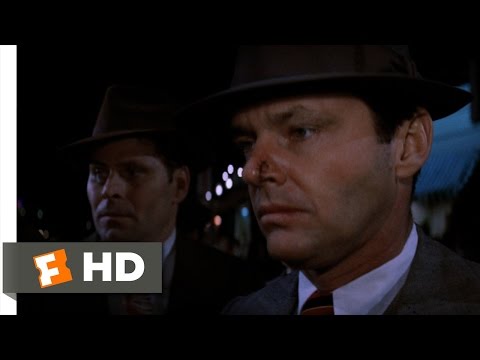
Chinatown Ending
Character flaws are an essential part of writing strong characters. If a character is omnipotent, they won’t have anything to overcome; and there’s little strength involved in getting everything easily.
Trusted by Over 1M Creatives
Screenwriting from draft to set
Write, format, and share your script. Ready for production when you are.

Chinatown movie analysis
Chinatown and the neo-noir genre
Chinatown is an early example of neo-noir, an evolution of the film noir genre. Classic film noir has a definitive look that Chinatown both respects and subverts in a few different ways.

The Neo-Noir Genre in Movies | Chinatown movie analysis
Opening credits
The opening credits are in sepia tone, which is an immediate callback to the films of the 1940s, especially with the way the credits are at the center of the frame. (The film is presented in a wide Panavision anamorphic aspect ratio.)
Aspect ratio
The film’s aspect ratio is itself a subversion of film noirs, which were all in flat spherical aspect ratios. By the 1970s, Panavision had made anamorphic widescreen more easily accessible to all filmmakers. Director Roman Polanski is able to use this wide ratio to further subvert the traditional look of a film noir (in addition to being in color and not black and white).
Pushing boundaries
The very first scene depicts graphic photos of infidelity, which would not have been shown in the original days of film noir. This lets us know that the film is going to show us more than the old noir films ever could.
Evelyn comes off as a classic femme fatale, but she’s really more of an innocent victim in a greater conspiracy. Double subversion comes in her tragic and avoidable death at the end of the film.
The bad guys win
Hollywood films used to have a sort of stipulation that the bad guys couldn’t get away with crimes. Well, the bad guys win in Chinatown, and there’s nothing Gittes can do about it.
A new perspective
One other thing is how the film was made in the 1970s but is set in the 1930s. As a result, it is a unique interpretation of the past through the lens of the (then) present.
Chinatown movie Roman Polanski
Production, cast, and awards
Being a supremely acclaimed film (and one of the best detective movies ever) means Chinatown was nominated and won a number of awards; it continues to get accolades to this day.
Academy Awards
Nominated for 11 Academy Awards but only won 1: Robert Towne for Best Original Screenplay.
British Academy Film Awards
Nominated for 11 BAFTAs (British Academy Film Awards), winning three for Best Direction, Best Actor in a Leading Role, and Best Screenplay
Golden Globes
Nominated for 7 Golden Globes, winning 4 for Best Motion Picture - Drama, Best Actor in a Motion Picture - Drama, Best Director - Motion Picture, and Best Screenplay - Motion Picture.
American Film Institute
Recognized by the American Film Institute in their lists of 100 Movies (19th in 1998, 21st in 2007), 100 Thrills (16th), 100 Heroes and Villains (Noah Cross as Villain at 16th), 100 Quotes (“Forget it, Jake. It’s Chinatown.” at 74th), Film Scores (9th), and Top 10 Mystery Films (2nd).
Related Posts
Chinatown analysis
Why Chinatown movie still matters today
Author Sam Wasson argues in his book The Big Goodbye that Chinatown was the last film of “old Hollywood.” After Chinatown, studios began to allocate more budget towards marketing and merchandising than the things we see on screen. That’s not to say that movies after Chinatown were bad by any means, but rather different, from conceptualization to release.
The 1970s is regarded as one of the best decades in cinema history. It produced hundreds of amazing classics, including but not limited to The Godfather, The Godfather Part II, One Flew Over the Cuckoo’s Nest, Taxi Driver, Annie Hall, The French Connection, and Network – and big blockbusters like Star Wars, Alien, and Jaws.
But there’s an argument to be made that Chinatown was the best of them all. And there are few who would refute that the Chinatown screenplay is one of the greatest screenplays of that decade. Add the direction from Polanski with incredible performances from Nicholson, Dunaway, and Huston, and it’s no surprise the film’s themes and thrills continue to resonate with audiences.
Frequently Asked Questions
Frequently asked questions about Chinatown movie
Chinatown (1974) is a neo-noir thriller set in 1930 Los Angeles. Private investigator Jake Gittes (Jack Nicholson) takes on a case that he thinks is about infidelity but soon learns there’s much more to it. Gittes gets involved in the family and business affairs of Evelyn Mulwray (Faye Dunaway) and her father, Noah Cross (John Huston), leading him into a world of corruption and danger.
Chinatown is not directly based on a true story, but the film was inspired by the California water wars. The film was heavily inspired by the people and events involved in the water wars, including the corruption involved by those in power.
Even though Gittes does all he can to help Evelyn and expose Cross’s crimes, he ends up losing in the end. Evelyn is killed, Cross gets away with everything, and Gittes can only walk away. These corrupt institutions are too big for him to take on, so he should just “forget it.”
The film features an acclaimed Robert Towne screenplay, excellent direction from Roman Polanski, terrific performances from the cast, and a beloved film score from Jerry Goldsmith. Its themes of corruption and futility still resonate with audiences, especially with its bleak and downbeat ending.
The most famous quote from Chinatown is “Forget it, Jake. It’s Chinatown.” The line represents the inability for justice in a corrupt and rigged situation, be it a part of town or society at large.
While nominated for 11 Academy Awards, Chinatown only won one Oscar: Best Original Screenplay by Robert Towne.
While not a traditional disaster film, Chinatown can be considered a disaster film in a more metaphorical sense. The story essentially exposes how greed and political corruption can create a slow-moving societal catastrophe, destroying many lives in its path.
Chinatown has a runtime of 130 minutes (2 hours and 10 minutes). The film was released in 1974.
Chinatown explores themes of power, corruption, and the limits of justice, showing how institutions and wealthy elites can manipulate systems for personal gain. Its bleak ending reinforces the idea that truth and morality don’t always prevail.
Chinatown was inspired by the California Water Wars, particularly the early 20th-century conflicts over diverting water from the Owens Valley to Los Angeles. These real events influenced the movie’s plot about land speculation and control of water resources.
Chinatown’s shocking twist reveals that Evelyn Mulwray’s abusive father is also the father of her daughter, exposing a horrifying secret at the center of the conspiracy. This revelation deepens the film’s themes of corruption and moral darkness.
UP NEXT
Best Jack Nicholson movies, ranked
"Forget it Jake. It's Chinatown" may be the final line in Chinatown, but we're far from finished here. We mentioned Jack Nicholson’s performance in our Chinatown movie analysis, but this was just the beginning of his amazing work. Chinatown is regarded as one of the best of his illustrious career – but did it take the top honor in our list of the best Jack Nicholson movies? Read on to find out.
Up Next: Best Nicholson Movies →

Share your vision with elegant shot lists and storyboards.
Create robust and customizable shot lists. Upload images to make storyboards and slideshows.