Conjunctions are a part of speech that helps sentences flow smoothly. It connects words, phrases, and clauses so ideas feel clear and complete instead of short and choppy. In this guide, we explain what a conjunction is in grammar, the main types of conjunctions, and clear examples you can use in your own writing.
What is a Conjunction in Grammar?
First, let’s define conjunction
First off, what does the word conjunction mean? Before we delve into the different conjunction types and examples, let's first establish the fundamental definition of a conjunction.
Conjunctions in english grammar are one of the eight parts of speech. Their main job is to link parts of a sentence so ideas connect clearly through the English language.
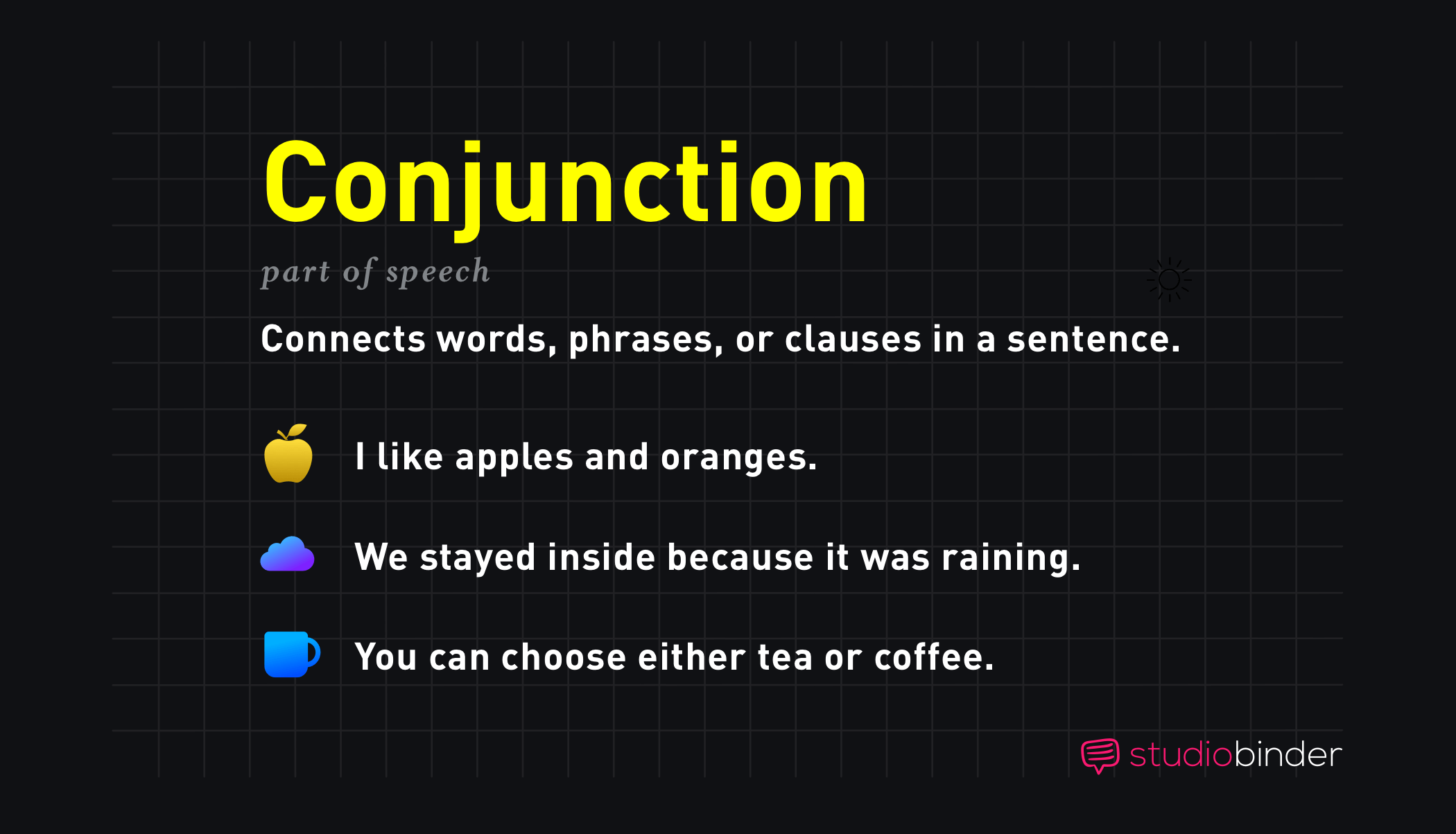
Review the below image and definition to better understand what a conjunction means:
What is a conjunction definition
CONJUNCTION DEFINITION
What is a conjunction in grammar?
A conjunction is a part of speech in English grammar that connects words, phrases, or clauses.
A conjunction works like a bridge between ideas, helping sentences and paragraphs feel complete and easy to read. Conjunctions can join similar elements such as two nouns, two verbs, or two adjectives. They can also connect entire clauses to create longer, more complex sentence structures.
Examples of conjunctions in sentences:
- “I like apples and oranges.”
- “We stayed inside because it was raining.”
- “You can choose either tea or coffee.”
When it comes to using conjunctions, the following video does an excellent job at breaking down the nuances even further.

The basics of conjunctions in grammar
Conjunction Meaning
3 Types of Conjunctions
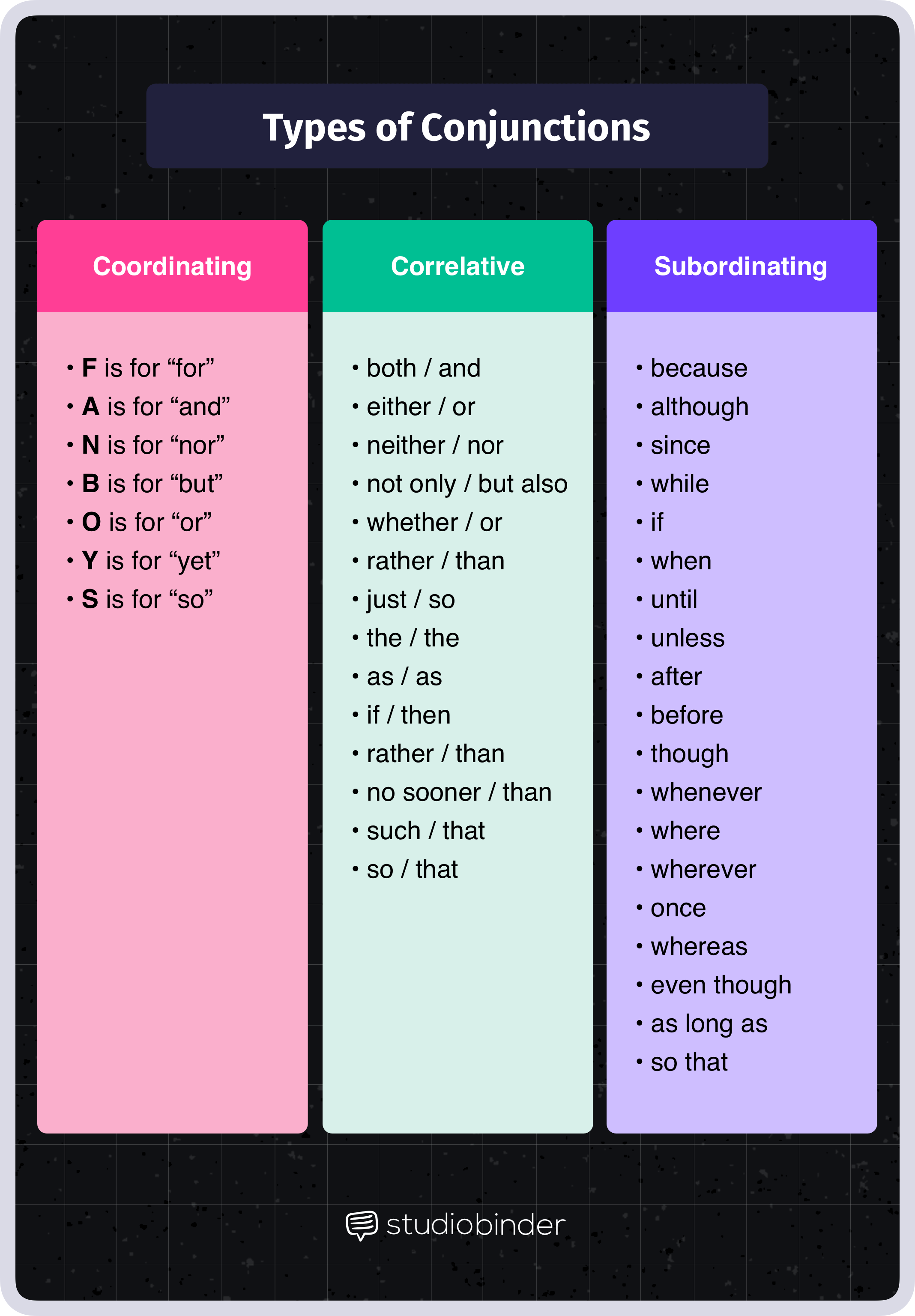
Conjunctions, which are crucial for connecting words, phrases, and clauses, can be categorized into three main types:
- Coordinating conjunctions
- Subordinating conjunctions
- Correlative conjunctions
Types of conjunctions used in grammar
Broadly, conjunctions are words that join, but each type serves a specific purpose in sentence structure. Below are conjunctions in sentences examples that show how each type works in practice.
But to ease us into these examples, let's have this video from The Learning Depot break it all down in their words first:
What is a conjunction - Types of Conjunctions with Examples
Each type serves a distinct purpose in sentence structure and plays a vital role in conveying meaning and coherence in written and spoken English language.
1. Coordinating conjunctions
Coordinating conjunctions join words, phrases, or clauses that are grammatically equal. In other words, they connect two or more items of the same kind.
The seven coordinating conjunctions are often remembered using the simple mnemonic acronym FANBOYS:
- For
- And
- Nor
- But
- Or
- Yet
- So
A sentence with a coordinating conjunction would be: “I wanted to go to the park, but it was raining.”
2. Subordinating conjunctions
Common subordinating conjunctions are used to link a subordinate clause (or dependent clause) to a main clause (or independent clause), creating a complex sentence.
Examples include words like because, although, when, while, if, and since.
For instance, "Although it was raining, we decided to go out."
3. Correlative conjunctions
Common correlative conjunctions are pairs of conjunctions that work together to coordinate different words or phrases.
These pairs include either/or, neither/nor, both/and, not only/but also, whether/or.
For example, in the sentence "Either you finish your homework, or you don't get to play video games," the pair 'either/or' is a correlative conjunction setting up a choice between two alternatives.
When to use each type of conjunction:
Conjunction Type | Sentence Type | Example |
|---|---|---|
Coordinating | Compound sentence | I stayed home, and I watched a movie. |
Subordinating | Complex sentence | I stayed home because it was raining. |
Correlative | Compound or complex | Either we leave now or we miss the train. |
Conjunction-related resources
Examples of Conjunction
What are some conjunction examples?
Conjunctions are crucial for constructing sentences that just feel right. Knowing how to use them correctly can elevate your writing so that it flows smoothly and captivates your readers. Remember, reading is an experience designed by the writer so you have full control to make it an enjoyable journey or not.
Review the chart below, as well as the 3 tips with examples to look out for as you apply conjunctions to your writing.
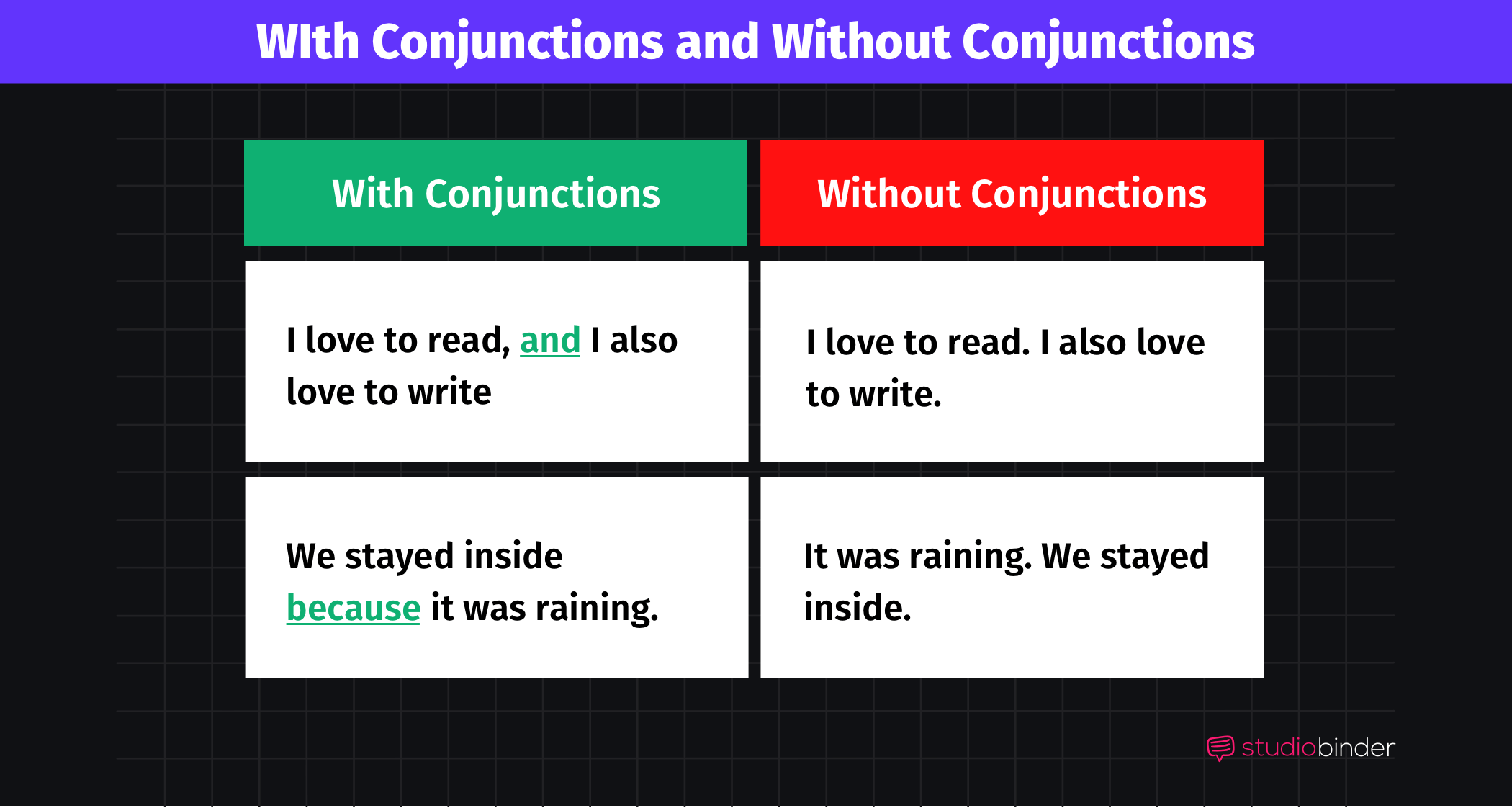
With and without conjunction usage
1. Use Conjunctions to sound more natural
If you're not using conjunctions, your writing may start to sound repetitive. By connecting ideas, phrases, and clauses, even the most basic conjunctions can help your writing sound more natural and less disjointed.
As The Editor’s Manual puts it, “conjunctions link words, phrases, clauses, and sentences, and show a logical relation between them.”
According to the Chicago Manual of Style, as many as 10% of sentences in polished, professional writing begin with conjunctions such as and, but, or so. This shows that conjunctions are not only grammatically correct, but also commonly used to improve sentence flow and emphasis.
Consider the difference of natural flow between these two sentences:
- Without conjunction: "I love to read. I also love to write."
- With conjunction: "I love to read, and I also love to write."
2. Don't overuse conjunctions
While conjunctions are often necessary, it can be easy to overuse them too. Try to rely on your own judgment. Does the conjunction make your sentence too long and confusing? It's better to keep your sentences simple and clear if that's your first instinct.
The example below displays both a helpful and unhelpful use of conjunctions with the same sentence.
- Bad conjunction: "I went to the store, and I bought apples, and I also got some oranges, and I paid with cash."
- Good conjunction: "I went to the store. I bought apples and oranges and paid with cash."
3. Choose the Correct Type of Conjunction
It can be tough to keep all three trypes of conjunctions aligned in your mind. We've found that when you're considering including a conjunction in any of your sentences, it's helpful to remember these 3 simple rules:
- Use coordinating conjunctions to connect equal ideas.
- Use subordinating conjunctions to link dependent and independent clauses.
- Use correlative conjunctions to show pairs or choices.
And for an extra bit of help, you may want to keep these sentence examples in your notes to refer back to:
- Coordinating: "I love apples and oranges."
- Subordinating: "We played outside until it got dark."
- Correlative: "Either you clean your room, or you can't go to the party."
Conjunctions can do more than just connect ideas. They can also reveal how thoughts and ideas relate to each other, such as the examples shown below:
Relationship Shown | Common Conjunctions | Example |
|---|---|---|
Addition | and, also | I like apples and oranges |
Contrast | but, although | I wanted to go, but it was raining. |
Cause and effect | because, so | We stayed inside because it was cold. |
Choice | or, either/or | You can call me or text me. |
Time | when, while, after | Call me when you arrive. |
Condition | if, unless | If it rains, we will stay inside. |
Conjunctions play a crucial role in the English language. They help create connections and coherence within our sentences, making our writing flow nice and smooth. By following these guidelines, you can ensure your writing is clear, engaging, and free from any of the grammatical errors.
To dive even further into conjunctions types and their examples, check out the video below, which breaks it all down in a very straightforward manner.

Types of Conjunctions with Examples
Related Sentence Types
Common Conjunction Mistakes
Common conjunction mistakes
Even though conjunctions are simple, they are often misused. As the grammar expert Professor Scott Mendoza explains, “they connect ideas, control flow, and help readers follow your meaning.” When used incorrectly, these small words can distort logic or leave your message unclear.
Here are a few common mistakes to avoid in your writing.
Comma Splices
With independent clauses a comma splice occurs. This comma splice happens when two independent clauses in a sentence are joined with only a comma without a proper punctuation.
- Incorrect: “I wanted to leave, I was tired.”
- Correct: “I wanted to leave, because I was tired.”
Starting Too Many Sentences With And or But
Starting sentences with and or but is not always wrong, but overusing them can weaken your writing.
Research on student writing shows how frequently conjunctions appear in real sentences. In one academic study, writers used an average of 23.49 conjunctions per essay, with additive conjunctions like and and but appearing most often. This high frequency helps explain why conjunction mistakes are so common in English.
Grammar related resources
Parts of Speech
Conjunctions vs other parts of speech
Conjunctions are sometimes confused with other parts of speech or subject in grammar, especially prepositions and adverbs.
- Conjunctions connect words or clauses
- Prepositions show relationships between a noun and another word
- Adverbs modify verbs, adjectives, or other adverbs
Understanding these differences will help you avoid those pesky grammar errors.
Frequently Asked Questions
Conjunction FAQs
A conjunction is a part of speech that connects words, phrases, or clauses to show relationships between ideas.
Below is a simple list of common conjunction words used in English writing which you can also use alongside other parts of speech or synonyms:
- Coordinating: and, but, or, so, yet
- Subordinating: because, although, since, while, if
- Correlative: either/or, neither/nor, both/and
Here is a list of 12 conjunctions:
- For
- And
- Nor
- But
- Or
- Yet
- So
- Although
- Because
- Since
- While
- Not only
An example of using a conjunction in a sentence would be: “She wanted to leave, but she stayed.”
Conjunctions help writing sound natural and organized by linking ideas logically. Without conjunctions, sentences would limited to simple statements. And while a simple, direct sentence is sometimes the most effective, a more complex sentence using conjunctions is often preferred. Conjunctions give writers the ability to create more complex and interesting sentences. They can combine ideas, create juxtapositions, add a sense of rhythm and so much more.
Up Next
What is a complex sentence structure?
Think of writing like architecture. The good writers understand the "design" element of the medium, and they also know when to make that design simple, complex, or something in between. At the most fundamental level, this design is achieved with sentence structure. Let's dive into conjunctions in our upcoming article on complex sentence structure.
Up Next: Complex Sentences in English Explained →