After two hours of non-stop tension, the Coen Brothers end their 2007 hit No Country for Old Men, in the most unexpected way possible. The hero is dead, the villain is free (with $2 million in cash), and the sheriff describes his dreams to his wife. Cut to black. That’s it.
It’s no wonder why the film’s conclusion is one of the most hotly debated in all of cinema.
In this No Country for Old Men Ending explained article, we’ll dive into:
Ending Breakdown
What happens at the end of No Country for Old Men?
Sheriff Bell (Tommy Lee Jones) arrives at the motel that the hero Llewelyn Moss (Josh Brolin) has been hiding in. Unfortunately, when he gets there, the man on the run is dead. Llewelyn’s bloody body lies next to other dead hitmen and drug dealers. The $2 million from the failed drug deal is nowhere to be found.

The Scenes You See And The Ones You Don't • No Country for Old Men Ending Explained
Sheriff Bell visits Llewelyn’s motel room again later that night. He notices the door’s lock is blown out. It’s a clear sign that the villain, Anton Chigurh (Javier Bardem), has revisited the scene of the crime. However, the psychopathic killer is nowhere to be found.
The last scenes then closely follow Sheriff Bell’s character. He has two important conversations. The first is with his cousin Ellis over coffee. Here he confesses that he feels outmatched by this new and more violent world… while also announcing his retirement. The second is back home with his wife Loretta, sometime after his retirement. They sit across from each other at the kitchen table where Sheriff Bell describes two dreams he had the night before. The film cuts to black when he’s done.
While unexpected, the Coens are masterminding a poignant message. And deconstructing their craft around that message is the best bet to explain the ending of no country for old men.
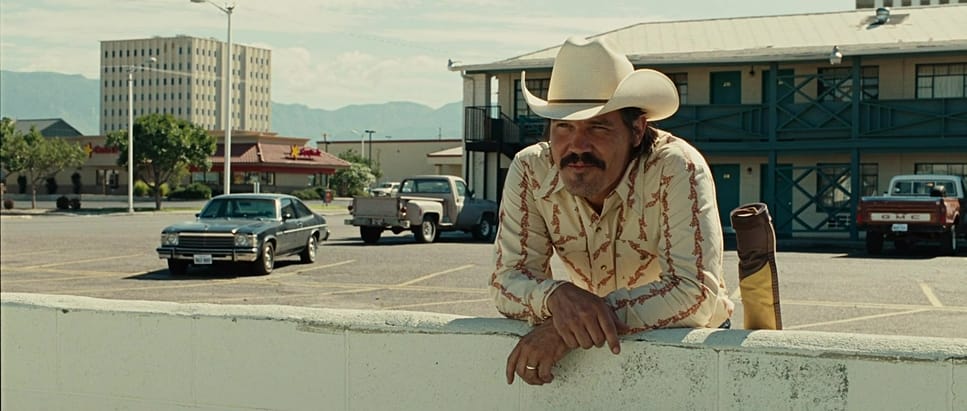
Llewelyn Moss killed off-screen • No Country for Old Men Ending Explained
Why is Llewelyn Moss killed off-screen?
While watching the No Country for Old Men ending, it’s easy to think of Llewelyn as the hero of the story. But in the final act, the Coen Brothers discard him between scenes. There is no grand demise for the character. The Coen Brothers adapted his death directly from Cormac McCarthy’s novel. In the book, Llewelyn also dies in between passages. Both the filmmakers and the author have done this deliberately, because the film’s main character is Sheriff Bell rather than Llewelyn.

Lewelyn Moss Death - No Country for Old Men ending explained
The No Country for Old Men ending reveals the narrative’s central theme: it’s actually the story about a man (Sheriff Bell) who feels he no longer belongs.
It’s also never shown who actually kills Llewelyn. There are multiple gunmen found dead there. We’re also shown previously that the Mexican cartel and Chigurh are hot on his trail. But who deals the fatal blow? Neither the film nor the novel confirm it.
This further supports the meaning of the No Country for Old Men ending further. Llewelyn’s death creates a sense of detachment for us as audience members, similar to Sheriff Bell. He has spent the entire movie trying to catch up to him. When he finally gets close, it’s too late. He can’t save him like he expected to. The world is too chaotic.
Does Anton Chigurh get the money?
Yes, he does. Sure enough, Chigurh recovers all of the money. When Sheriff Bell revisits the motel later that night, he sees the blown-out lock and a vent cover removed from the wall. Earlier in the film, we see Llewelyn’s elaborate strategy to hide the briefcase by placing it inside the air ducts of the motel walls. It’s assumed Chigurh figured out this strategy, and recovered the money later. Just like Llewelyn’s death, the No Country for Old Men ending never shows him finding the case. Everything happens in between scenes.
Does Chigurh kill Carla Jean?
We don’t know… but he most likely did. Chigurh promised Llewelyn that if he didn’t return the cash, he would kill his wife Carla Jean as punishment.
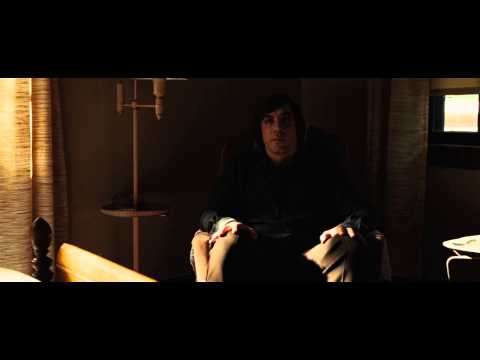
Carla Jean and Anton Chigurh Scene Cut - No Country for Old Men ending explained
After both Llewelyn and her mother’s death, Carla Jean finds Chigurh waiting for her at home. Carla Jean says she’s been expecting him, but that he doesn’t have to kill her. True to form, Chigurh offers her a coin toss to decide whether she lives or dies. Carla refuses to call it because the choice to kill is entirely up to him. Carla Jean is the only character who actively rejects taking part in Chigurh’s game by questioning his philosophy.
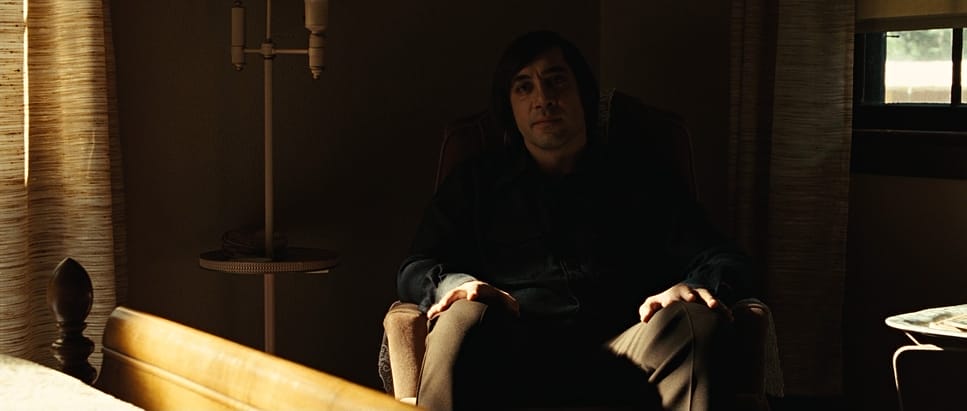
Does Chigurh kill Carla Jean? • No Country for Old Men Ending Explained
The film cuts before we see what happens. The next shot is of Chigurh walking out of the house. He checks the bottoms of his boots and then casually walks off. It’s a small gesture (is he checking for blood?) that heavily implies, yeah, he probably did kill her. The Coens, yet again, have important beats happen off-screen.
It’s important to note: the original novel actually confirms her death. After Chigurh tosses the coin, she calls heads. He reveals tails and then kills her. The film smartly changes this outcome to be more ambiguous. It further supports its themes of how powerless we are in the face of violence.
Anton Chigurh's car accident — what does it mean?
…but Chigurh doesn’t get away so easily. Minutes after leaving Carla Jean’s house, a car runs a red light and T-bones him. It’s a sudden and random accident. Chigurh survives, but is badly injured. His arm is broken and his bone protrudes through his skin. After catching his bearings, he bribes two boys on bicycles for a shirt. He fashions a sling, and then limps away into the sunset before police arrive.

Chigurh's Accident - No Country for Old Men ending explained
In the No Country for Old Men ending, the Coens use irony to further highlight the film’s themes. Things just happen in the world for no reason. Even Chigurh, an absolute force throughout the story, is not immune to chance. The world shows the same indifference that he shows his victims. For a brief second, it seems as if karma has caught up with him.
But even at his lowest, somehow, Chigurh still gets away. In this story, life is cruel and unfair.
Bell’s Dreams
Sheriff Bell's two dreams — the complete breakdown
Sheriff Bell’s final monologue is the emotional and thematic climax of the story, and the true key to having the No Country for Old Men ending explained. While, at first, it may seem as if nothing happens, the entire film has been building towards this moment.
Sheriff Bell explains two separate dreams to his wife, both involving his father:

Sheriff Bell's dreams - No Country for Old Men ending explained
The first dream: losing the money
In Sheriff Bell’s first dream, his father gave him some money. He loses the money. That’s all there is to it.
It’s a short but deep dream. It establishes an emotional architecture. Bell was given something that he could not hold onto. While the dream could be about literal money (the $2 million everyone is after), it more likely symbolizes something deeper. It could be a responsibility, trust, or some type of value passed onto Bell.
This value is something Bell feels like he’s lost in the story. It’s the moral certainty of the world he grew up in. It’s the idea that law and order mean something or that a good man can make a difference. These are certainly the values that his father passed down to him. He’s lost sight of it in the new world.
Before the sheriff can fully absorb the dream’s meaning, he brushes it off. He doesn’t remember it well anyway.
The second dream: fire in the dark
The second dream is the true ending of No Country for Old Men. Sheriff Bell describes it slowly and carefully, still vivid in his mind:
Bell and his father are on horseback, riding through a mountain pass. It’s cold and dark, making it difficult to navigate and see. His father, holding a horn of fire, rides ahead of him. Though his father travels without speaking, Bell is certain that he’s going somewhere to make a larger fire and will wait for him.
But then Bell says he woke up. There’s a beat, and the screen cuts to black. The end.

Sheriff Bell's two dreams Explained • No Country for Old Men Ending Explained
Like most of the film, the dream monologue is lifted directly from McCarthy’s novel. It carries the same thematic weight as it does on the page. Sheriff Bell’s father serves as a symbol. He represents an older, steadier world built on tradition and heritage. There’s a sense of safety that protects Bell during the cold, dark uncertainties of his life. The warmth of fire that his father will build represents legacy, protection, and hope. It’s the promise that the journey has a destination, and therefore, a purpose.
But Bell never makes it to the fire. He wakes up before reaching it. Life continues, unresolved. The now retired Sheriff Bell seems to be losing the fire in his life.
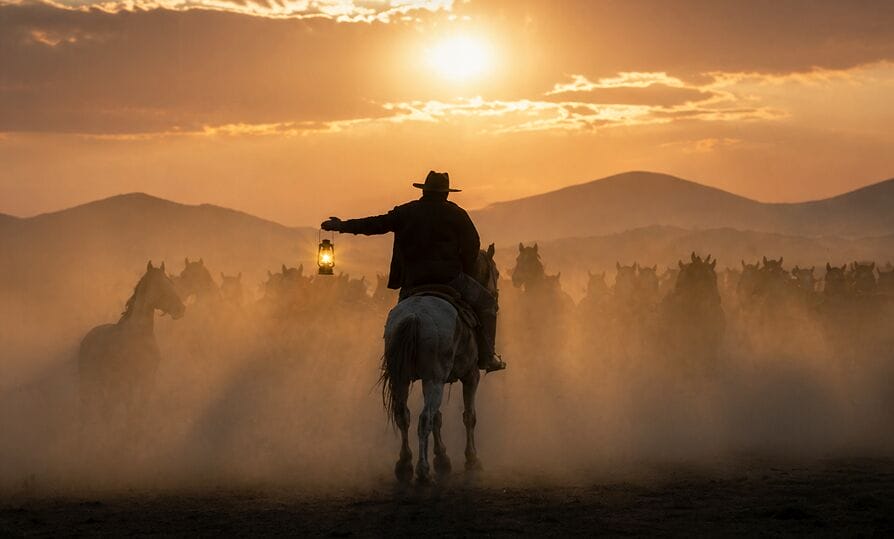
The second dream: fire in the dark • No Country for Old Men Ending Explained
Explain the ending of no country for old men
What does the ending of No Country for Old Men mean?
The key takeaway of the No Country for Old Men ending meaning revolves around morality and indifference. The groundwork for it is laid out through three final sequences:
The coin toss and the illusion of fate
Chigurh’s coin toss is the physical manifestation of his nihilistic philosophy. Earlier in the film, Chigurh tells a gas station attendant that the coin has been traveling twenty-two years to find him. In this twisted ideology, the coin doesn’t just decide someone’s fate, it reveals what was always meant to happen.
However, Carla Jean rejects this thought. The coin has no say. The choice has been Chigurh’s all along. The coin is merely a prop that he uses to avoid moral responsibility. He’s rationalized his killings through destiny. But what do you expect from a psychopath?
The car accident that happens to Chigurh immediately after especially undercuts his philosophy. It’s randomness—real randomness—that challenges his theatrics. The universe doesn’t operate on fate vs. free will because it’s completely indifferent.
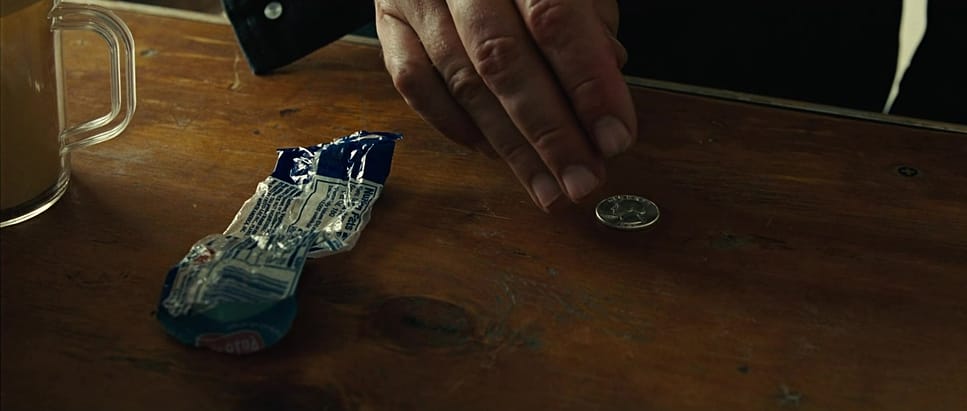
The coin toss and the illusion of fate • No Country for Old Men Ending Explained
Evil cannot be stopped — only outlasted
The No Country for Old Men ending avoids cliche. Good does not triumph over evil. Anton Chigurh survives and gets the money. He’s never caught or brought to justice by the good Sheriff Bell.
Both the film and the book make it abundantly clear that chaos and violence are forces of nature rather than easily solved problems. Sheriff Bell can’t stop Chigurh any more than he can stop a hurricane or wildfire. Law and order are meaningless in the face of such a nihilistic ethos. Values and tradition are becoming lost as a default state of society.
Bell is confronted with this sobering reality by the end of the film. Has the world always been this chaotic?
The world has no place for old men
No Country for Old Men: the title is also the film’s main thematic spine. Even though Llewelyn Moss and Anton Chigurh have more screen time, Sheriff Bell has the most complete narrative arc as the true protagonist of the story. The sheriff is an heir of the old world, where honorable values are passed down through generations. His father and his grandfather were both lawmen. They can be seen as symbols of an ethical code. However, the world around Bell accelerates faster than his moral compass can comprehend.
The title of the book and film are taken from the opening line of W.B. Yeats’ 1928 poem, Sailing to Byzantium.
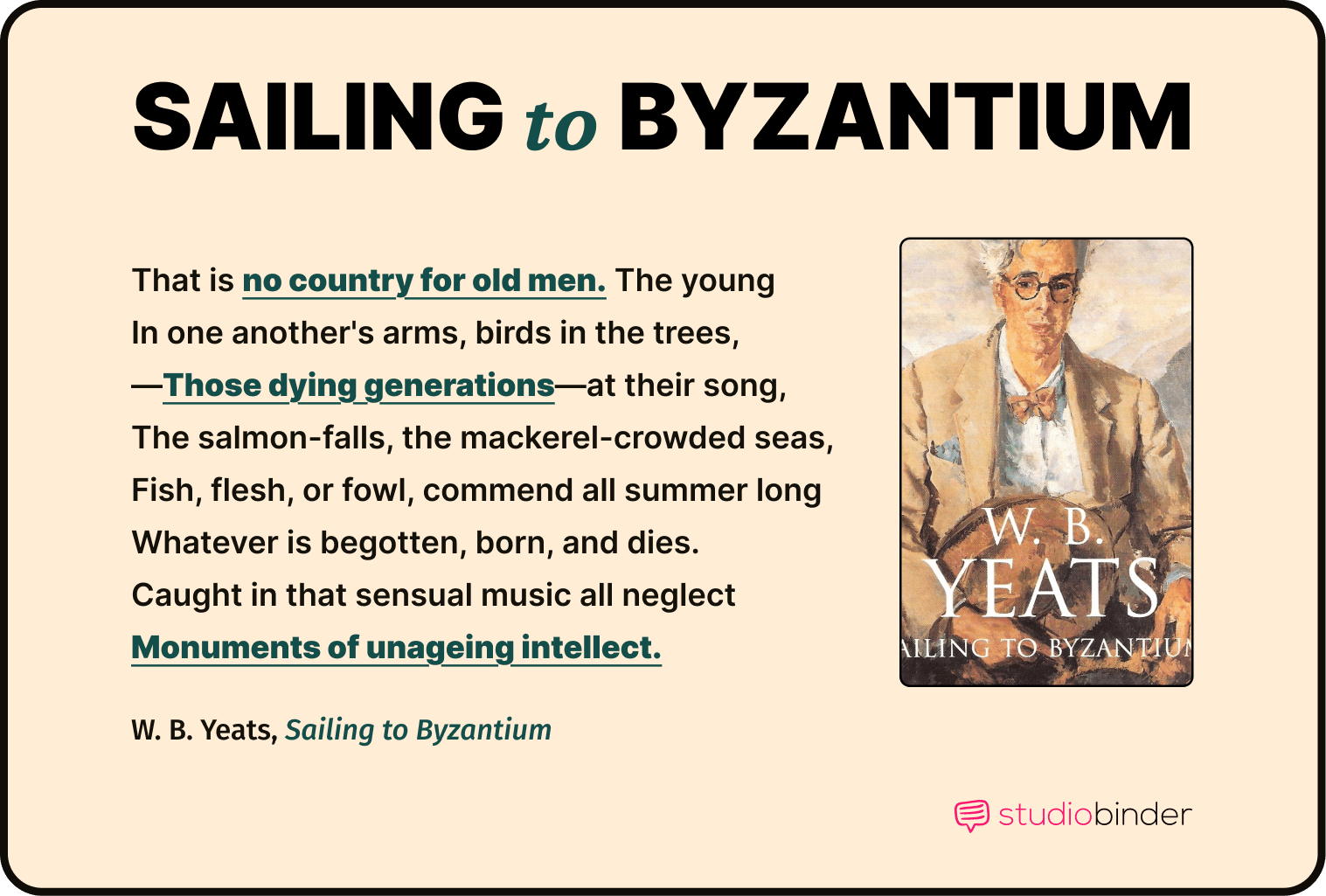
The world has no place for old men • No Country for Old Men Ending Explained
The poem represents the speaker’s dismay that he is aging out of the world, which is youthful and full of vigor. Though he longs to be part of it, he is tethered to a physical body that is decaying.
Likewise, both the No Country for Old Men film and the book parallel this suffering through an idealization of America after the Wild West era. Bell’s view of Old America is one of honor and respectability. These principles were able to tame the lawlessness of this time, when outlaws and bandits reigned supreme. From Bell’s point-of-view, the “respectability” of American society was seen as an honorable way to live for decades. However, the new world he now finds himself in is brutal and cold. It is indifferent to the values of old.
Sheriff Bell’s retirement is an honest acknowledgement of this truth, rather than a defeat.
Ending of no country for old men explained
Why the Coen Brothers ended it the way they did
Faithful to Cormac McCarthy's novel
The Coens adapted McCarthy’s 2005 novel almost scene-for-scene. The small differences, such as Carla Jean’s fate, are decisions by the Coens to create ambiguity to sharpen the film’s central theme of a world of indifference.
In interviews, Joel and Ethan Coen have spoken about not needing to improve McCarthy’s prose as it already excelled at visually telling the story. They treated writing the screenplay adaptation as an act of restraint rather than reinvention.
Coen Brothers' Writing Advice - No Country for Old Men ending explained
Knowing what to change from a film adaptation’s source material is just as important as knowing what to keep. For screenwriters and filmmakers, there’s a strong lesson in craft within No Country for Old Men’s evolution from a book to a movie.
Refusing the genre's demands
For a film that doesn’t let up on the suspense throughout its runtime, The Coens did something daring in the film’s final act. Rather than operate like a traditional thriller, where the hero and villain have a final confrontation, they instead keep the focus on Sheriff Bell’s conversations. By keeping the final pages of McCarthy’s novel intact, they keep us as an audience in a similar headspace to Sheriff Bell.
The No Country for Old Men ending has no neat resolutions. Sometimes the world makes no sense. We must learn to process it because that’s life. The film wants to challenge our beliefs about the morality of the world.
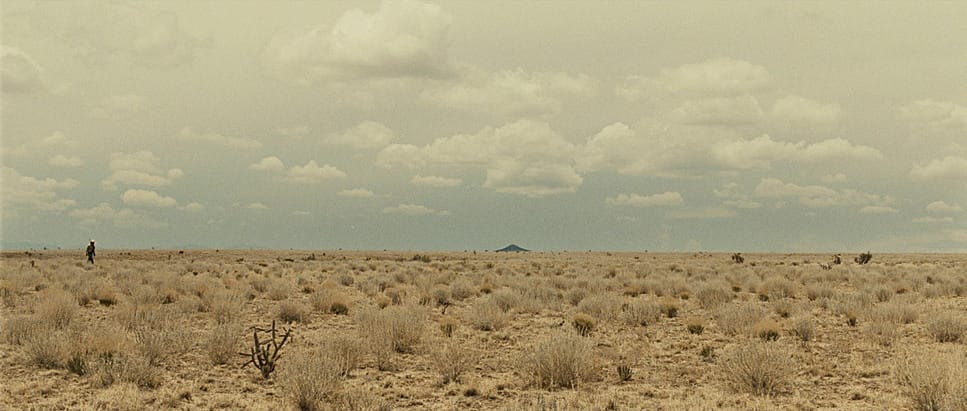
Refusing the genre's demands • No Country for Old Men Ending Explained
What the Coens leave out — and why that's the point
Lastly, the Coens use ambiguity to their advantage. Llewelyn’s death. Chigurh finding the money. The result of the coin toss with Carla Jean. Any form of a conventional climax is thrown out of the window.
Showing these moments would suggest that the world has logic, shape, and reason. But the Coens withhold what they can precisely to argue against this. Each omission is a directorial statement about violent indifference. It’s a simple technique that clearly encapsulates the film’s message.
That's the No Country for Old Men ending meaning at its core: in the real world, things cannot always be solved.
However, much like Sheriff Bell’s second dream, it’s up to us as audience members (and society) to keep the fire burning for those who come after in the dark and cold.
So that hope remains.
Frequently Asked Questions
No Country for Old Men questions
We actually don’t know who dealt the fatal blow to Llewelyn. The most likely answer is the Mexican cartel. Earlier in the film, they independently track his wife Carla Jean and her mother. Later on after the motel shootout, multiple gunmen in similar attire are found dead alongside Llewelyn. While Chigurh ends up at the motel, he may have arrived after the killing. Both the film and novel leave the answer ambiguous. Ultimately, who killed Llewelyn doesn’t matter. This new, violent world kills indiscriminately.
Nope. Chigurh survives the random car accident and limps away, injured, before police arrive. He is never caught or confronted. It’s the film’s most deliberate refusal of genre convention. The hero dies, the villain gets away, and the story’s central character is left with an unresolved mystery.
The coin toss is Chigurh’s method of externalizing his violence to fate rather than his own choice. It allows him to rationalize a murder as something that was always meant to happen. Carla Jean exposes his flawed thinking. The choice has always been his. The coin is merely a prop for avoiding moral responsibility, disguising the question of fate vs. free will as something already decided.
Sheriff Bell has two dreams and both are meant to be a catharsis to the film’s story. The lost money in the first dream represents lost values. The fire of the second dream represents the safety of the old world. Bell doesn’t remember the first dream well, and wakes up before seeing the fire in the second dream. Both represent Bell's loss of hope and optimism. The world is becoming more chaotic than he can handle.
The title of the film comes from the opening line of W.B. Yeats’ 1928 poem Sailing to Byzantium.
In the poem, the “country” is the physical world of youth and sensation that the aging speaker feels excluded from. In McCarthy and the Coens’ adaptation, it means modern America, which is becoming a landscape of random and escalating violence. Morality is lost and the values of old are no longer fit for this world.
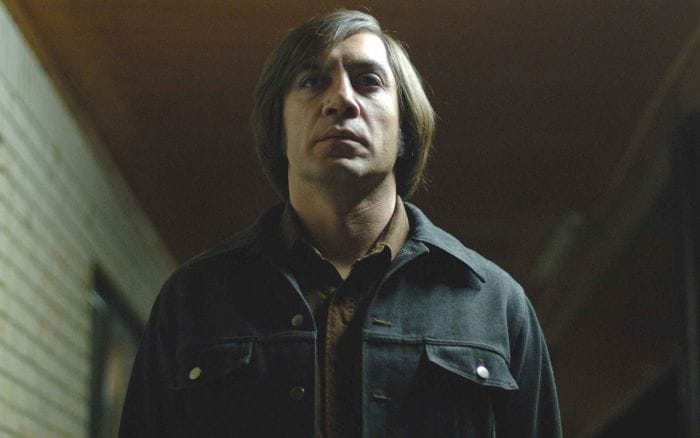
UP NEXT
Anton Chigurh Analysis
And there you have it, the No Country for Old Men ending explained. If you want to understand why Anton Chigurh works as one of cinema’s most unsettling villains, and what the Coens and McCarthy were building with him, read our full character analysis. We break down his philosophy, his most revealing quotes, and the craft decisions that make him terrifying.
Up Next: Anton Chigurh — Character Analysis, Quotes & What Makes Him Work

From script to production. Write, collaborate, and produce all in one place.
Write scripts online for free. Track versions. Share for feedback and approval. When you're done transition seamlessly to script sides, shot lists, storyboards, schedules, breakdowns, call sheets and more.