It used to be that sequels could rarely ever be considered as outstanding as the original movie in a franchise. But times have changed and with change comes a new perspective: maybe Die Hard with a Vengeance is the best Die Hard movie of all.
So, let’s dive into the surprisingly well-crafted film that is Die Hard 3 and talk about the exciting screenplay, the underrated Die Hard villain, and John McTiernan’s endlessly watchable directing.
Die Hard Overview
What is Die Hard with a Vengeance?
Before we jump into this action movie analysis, let’s set the table properly. Die Hard with a Vengeance released in 1995 and is the second sequel to the original Die Hard film. The core filmmaking concept behind this movie was to remove the action hero lead character, John McClane, from the single-location setup of the last two films and throw him into a sprawling urban action film.
Vengeance leans heavily into a “race against time” format, with action sequences built around riddles and shifting objectives rather than a static siege, giving it a more kinetic, almost procedural rhythm. Through the introduction of sidekick Zeus Carver, the story blends action with a fresh sense of character friction and social commentary.
It can be argued (in our opinion at least) that Die Hard with a Vengeance is one of the best movie sequels of all time because it successfully evolves the formula without abandoning the core appeal of the series. It reflects a mid-90s trend toward larger-scale action filmmaking while maintaining a focus on clever twists and character banter. As a result, it stands as both a continuation of the franchise’s identity and a reinvention that influenced how later action sequels approached scope and structure.
Then of course there’s the cast. Bruce Willis returns as John McClane, Jeremy Irons gets his ‘new mysterious villain’ on with Simon Gruber, and Samuel L. Jackson joins in as the streetsmart Zeus Carver.
Subscribe to StudioBinder on YouTube • Die Hard With A Vengeance
Now let’s break the essentials of the plot down.
Plot overview
A ruthless bomber who refers to himself only as “Simon” starts detonating explosives throughout New York City. He makes demands in the form of a ‘Simon Says’ game that he intentionally has John McClane participate in.
As McClane scrambles to keep up, the game’s circumstances pair him with Zeus Carver, a Harlem shopkeeper who gets pulled into the chaos and becomes his unwilling partner. As the games get more and more dangerous, Simon’s true plan is revealed to be a massive Federal Reserve gold heist that the ‘Simon Says’ games are being used as a decoy for.
Cast and crew
Released in 1995, the Die Hard with a Vengeance cast and crew is what truly redefined the franchise’s dynamic. Part of the movie’s evolved quality comes from director John McTiernan, the first film’s director who returns to the franchise after sitting out on directing Die Hard 2.
The screenplay is the second part of what really turns the volume up on the franchise. Jonathan Hensleigh is credited as the official writer, while ‘story by’ goes to Hensleigh and Roderick Thorp. The Die Hard with a Vengeance cast, crew and writers are so much of what makes it such an entertaining watch.
Related Posts
Movie Script
The Die Hard with a Vengeance script
The Die Hard with a Vengeance script is built for maximum escalation, and it’s what makes it so entertaining to engage with. Hensleigh’s screenplay turns the entire city into a moving puzzle, generating a breakneck momentum.
This stark imbalance becomes the film’s core tension mechanism. Action cinema often thrives on giving the hero obstacles, but systematically stacks them: limited time, incomplete information, shifting locations, and moral pressure. The greater McClane’s disadvantage, the more each small success feels earned.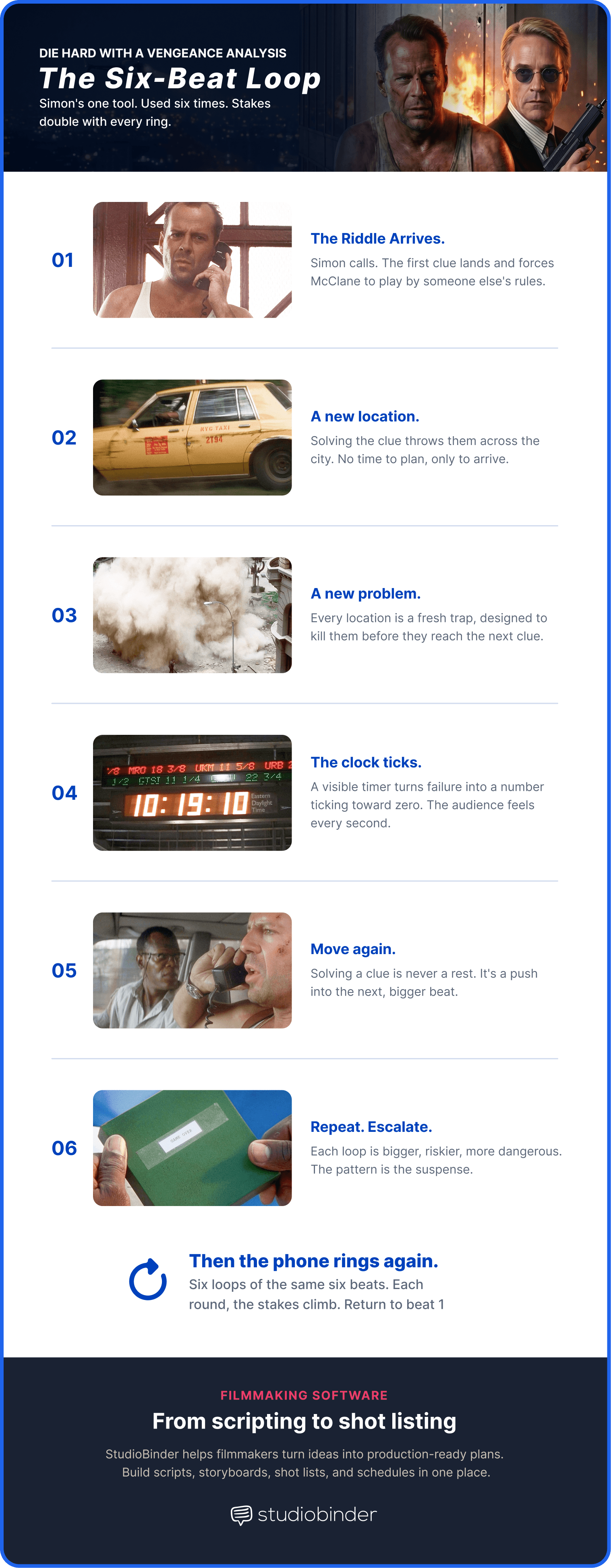
The Six Beat Loop of Die Hard with a Vengeance • Die Hard With A Vengeance
The Simon Says structure
The ‘Simon Says’ device acts as the screenplay’s core engine in a sense. Rather than fall into familiar escalating action beats like the Die Hard 2 screenplay does, the games become a sort of problem solving pressure cooker that entices those main action beats, making them feel earned rather than by the numbers.
The villain of the Die Hard 3 story feels all-encompassing, almost like The Riddler from Batman mythos, as he drives the story from one puzzle to the next. This structure reinforces McClane’s reactions throughout the runtime. It makes our main hero responsive because Simon is the holder of information in a sense, leaving McClane and his unconventional sidekick to catch up. This is a whole new evolution of suspense from the cat-and-mouse set up of the original Die Hard, and it just feels natural.
How the screenplay sustains momentum
The most obvious structural shift from Die Hard is spatial. The original film has McClane climbing, hiding, and eventually reclaiming territory within a single building. Here, the geography is horizontal and constantly shifting: subways, streets, parks, tunnels, and waterways turn New York City into a sprawling game board. It gives the Die Hard with a Vengeance cast something to really work with.
Because there’s no fixed location, the screenplay generates momentum through fast movement. Every solved riddle brings us immediately to another location, another constraint, another ticking clock. The result is an action screenplay structure where the narrative never settles to let us catch our breath.
Hensleigh positions the larger heist early enough that the audience senses a second layer beneath the chaos. The school bomb threat, for example, pulls massive police resources away from Wall Street, retroactively revealing the riddles as strategic misdirection rather than some random cruelty. This creates dramatic irony: the film’s urgency is real, but its purpose is hidden, maintaining that intriguing air of mystery.
McClane's disadvantage as a dramatic engine
One of the screenplay’s smartest structural choices is that it starts McClane at his lowest point. He’s suspended from the NYPD, hungover, and disconnected from his previous victories. Basically, the script strips him of the authority and control he had in earlier films.
From there, every scene compounds his disadvantage. He’s navigating unfamiliar terrain, forced into an unprofessional partnership he didn’t choose, and facing a film antagonist who controls both the information and the rules of engagement. Simon’s designing the entire race in a way.
For an even deeper loving dive into the script of Die Hard with a Vengeance, check out the below episode of The Rewatchables, where Bill Simmons and friends dissect the movie top to bottom.

Die Hard 3 on Ringer Movies • Die Hard With A Vengeance
Simon vs Hans
Simon Gruber vs. Hans Gruber

McClane and Simon meet • Die Hard With A Vengeance
The key differences between Hans and Simon
Alan Rickman as Hans Gruber is defined by precision. His plan is contained, methodical, and entirely focused on a single location, the Nakatomi Plaza. His menace comes from control: he understands the space, anticipates resistance, and executes with calculated efficiency.
Simon, by contrast, is expansive and performative. He turns all of New York City into his personal stage. His menace comes from unpredictability, like constant movement, shifting targets, and the illusion that anything could happen next.
The targeting itself reflects this shift. Hans targets a place; Simon targets a person. By centering the conflict around McClane directly, it’s forcing him to participate, to solve, to respond. Vengeance creates a more personal, ongoing confrontation rather than a contained standoff.
McClane & Zeus/die hard with a vengeance 3
John McClane and Zeus Carver
The introduction of Zeus Carver is one of Die Hard with a Vengeance’s most important structural decisions. By pairing McClane with a civilian who doesn’t trust or admire him, the film shifts from an internal survival story to an external, character-driven dynamic. Their partnership acts as the film’s emotional core, grounding the high-stakes action in conflict and (highly entertaining) cooperation.
How the partnership changes the dynamic
Zeus is both comic relief and a functioning part of how the screenplay generates tension. In the first Die Hard, McClane operates largely alone, with his vulnerability expressed internally through radio conversations with Al Powell. Here, that interiority is externalized. Zeus gives McClane someone to argue with, challenge, and explain himself to in real time, which keeps scenes active and dialogue-driven even in the middle of action.
Samuel L. Jackson plays Zeus as sharp and skeptical, which prevents the partnership from slipping into hero worship. He questions McClane’s decisions, pushes back on his authority, and often forces him to think more clearly under pressure. That friction is essential to keeping the dynamic honest and prevents McClane from feeling in control, even when he’s technically leading.
The screenplay also directly engages with racial tension, particularly in their early interactions. Zeus doesn’t trust McClane, and the film doesn’t smooth that over for easy camaraderie. Instead, it uses that discomfort as part of the character work, allowing their relationship to evolve through shared experience rather than some unearned instant alignment. That choice adds texture and stakes to the partnership beyond the mechanics of the plot.
For a little taste of what Zeus brings to a scene right alongside McClane, relive the high tension phone conversation with Simon below.

A talk with Simon scene • Die Hard With A Vengeance
McClane in Die Hard 3 vs. Die Hard 1
McClane’s characterization shifts significantly between the two films, and that shift is central to how Die Hard with a Vengeance functions. In the original, he’s resourceful and relatively in control, an outsider in the building, but one who quickly learns the terrain and begins to outmaneuver his opponents.
In Die Hard 3, he starts from a much weaker position. He’s pulled into the situation against his will, with no control over the environment or the rules. Instead of initiating action, he reacts to it, moving from one crisis to the next, usually with incomplete information.
That change reframes him as less of a traditional action hero and more of a working problem-solver under extreme pressure. He’s still competent, but never comfortable, and rarely ahead.
The result is a more human version of McClane, a lead who isn’t the obvious hero of the situation, but the only person available who can keep up long enough to survive it.
Best Scenes
The best scenes in Die Hard with a Vengeance
Now we’re going to jump into three separate scenes from Die Hard with a Vengeance. For each one, we’ll investigate the basics of what happens, why it works, and what filmmaking decisions made it possible. Let’s dive in John McClane style!
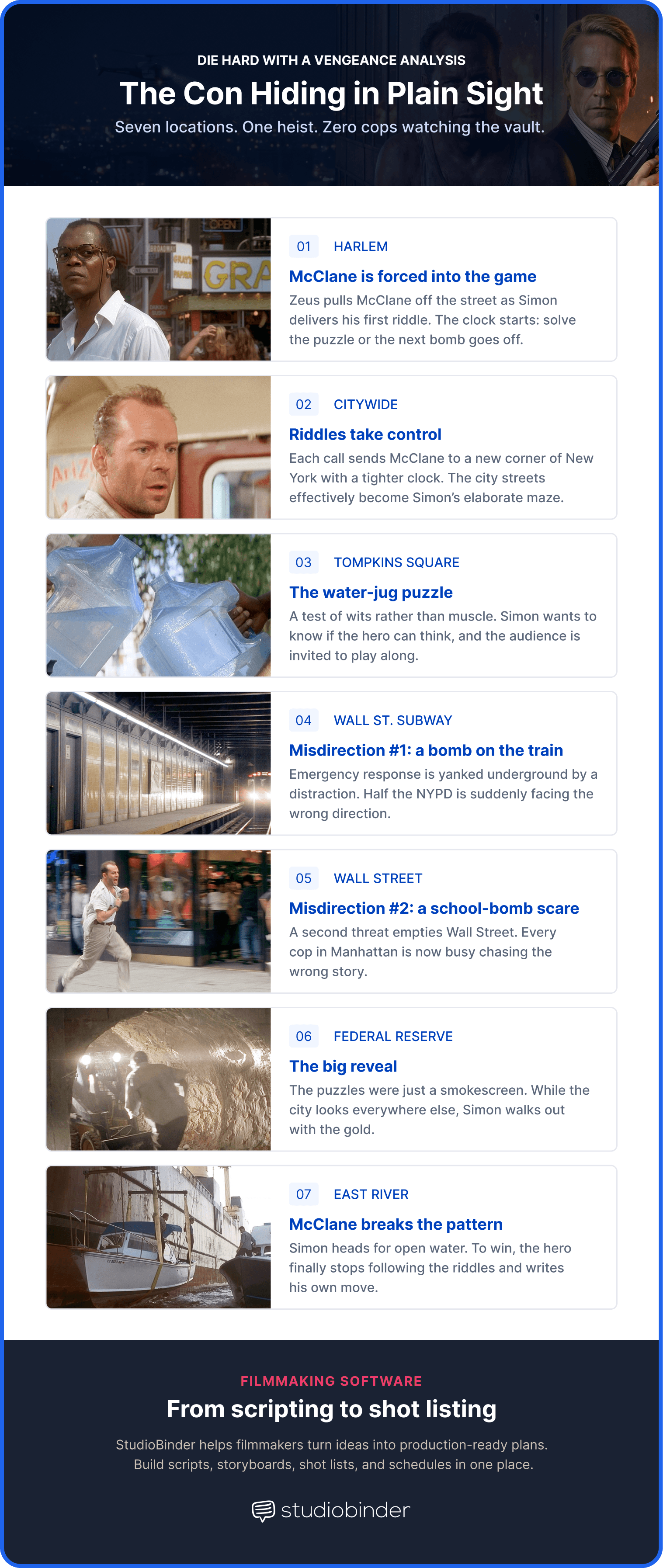
The Con Hiding in Plain Sight • Die Hard With A Vengeance
The Harlem opening
The first “Simon Says” task immediately establishes the film’s core idea, that our hero McClane has no control. Forced to stand in Harlem wearing a racist sign, he’s placed in a situation he can’t hope to fight or outmaneuver. This is a sharp inversion of the traditional action hero introduction, stripping him of authority and placing him at the mercy of the environment.
The scene also introduces Zeus in a way that feels organic and character-driven. He steps in not out of heroism, but self-interest. He wants to defuse a volatile situation in his own neighborhood. That choice grounds the partnership in realism and tension from the start.
Just as importantly, the sequence builds suspense socially before it does physically. The danger comes from human reaction, not explosions or gunfire. This signals early on that this film will generate tension through character and context just as much as action.

Harlem opening scene • Die Hard With A Vengeance
The Wall Street bomb
The discovery of the bomb in the school marks a tonal shift where the game stops feeling like a controlled puzzle and becomes something more urgent and dangerous. The stakes expand beyond McClane and Zeus, civilians, particularly children, are now directly in harm’s way, raising the emotional and moral pressure on every decision.
McTiernan amplifies this through cross-cutting, interweaving multiple threads: the ticking bomb, McClane racing against time, and the frantic evacuation of the school. This editing compresses time and creates simultaneity, making the sequence feel relentless without sacrificing clarity.
It’s also a clear example of McTiernan’s approach to action construction. Rather than relying solely on spectacle, the tension is built through structure. It’s all about how information is revealed, how time is managed, and how parallel actions collide at the moment of resolution.

Bomb in school scene • Die Hard With A Vengeance
The aqueduct finale
The final act of Vengeance hinges on a structural reveal: the “Simon Says” game was never the end goal, but a smokescreen for the Federal Reserve gold heist. This twist reframes the entire film in retrospect.
The riddles, bombs, and citywide chaos weren’t escalating toward destruction, but functioning as carefully timed distractions. Importantly, the audience experiences this realization alongside McClane, which reinforces the screenplay’s commitment to keeping him reactive and one step behind.
The confrontation that follows is notably restrained compared to the operatic climax of the original film. There’s no towering fall like Hans Gruber’s; instead, Simon’s defeat plays out quickly and at a distance, emphasizing resolution over spectacle.
Whether that reads as underwhelming or intentionally subversive depends on perspective. In our opinion, it aligns with the film’s focus on misdirection and strategy, and that’s why we love it.
Visually, John McTiernan stages the finale in open, expansive geography, with rivers, aqueducts, and wide outdoor spaces. This is a deliberate contrast to the tight corridors and vertical confinement of Nakatomi Plaza. Just as the action screenplay structure expands outward, so too does its climax, reinforcing the idea that this installment operates on scale and movement rather than containment.

Climax scene • Die Hard With A Vengeance
McTiernan Direction
John McTiernan's direction
John McTiernan’s return to the franchise highlights a clear evolution in how he approaches action filmmaking. In Die Hard, his direction is defined by tight camera framing and spatial clarity.
Hallways, vents, and office floors are shot to emphasize confinement, often aligning the camera closely with McClane’s perspective. The result is a claustrophobic experience where the audience understands the geography as intimately as the protagonist.
In Die Hard with a Vengeance, that approach opens up dramatically. McTiernan trades vertical confinement for horizontal sprawl, using wide shots and moving camera work to capture the scale of New York City.
Sequences like the taxi chase through Central Park or the subway explosion are staged to emphasize motion and unpredictability, with the camera no longer tethered to a single point of view shot. The city itself becomes a character. It’s alive, chaotic, and constantly shifting.
He also leans more heavily on cross cutting to build tension. Rather than isolating action within a single space, McTiernan cuts between multiple simultaneous threads, like McClane racing to solve a riddle or Zeus navigating obstacles and civilians reacting in real time. This creates a layered sense of urgency, reinforcing the idea that McClane is being pulled in multiple directions at once.
Visually, McTiernan creates a deliberate contrast between hero and villain. McClane is almost always in motion. He’s running, driving, scrambling through unpredictable environments, while Simon is frequently framed in controlled, composed settings, calmly delivering instructions.
That contrast reinforces the power dynamic at the heart of the film: chaos versus control.
Related Posts
Better Than Die Hard?
Is Die Hard with a Vengeance better than Die Hard?
It may be a hot take, but we think Die Hard with a Vengeance is just a little bit more ambitious than Die Hard, making it the best Die Hard movie of them all. Before you get your pitchforks out, let us make our final case.
The screenplay structure is more complex, using the “Simon Says” framework to create momentum and red herrings, while the McClane/Zeus partnership adds a richer, more dynamic character layer.
Jeremy Irons’ Simon Gruber introduces a different kind of villain, less physically present and more structurally dominant. And McTiernan’s direction reflects a filmmaker pushing beyond the contained mastery of the original into something broader and more technically demanding.
All that said, we know that Die Hard remains a near-perfect execution of a simpler idea starring Bruce Willis. Its contained setting, clear stakes, and precise alignment between hero, villain, and location give it a level of purity that’s hard to match. Hans Gruber’s plan, the Nakatomi Plaza setting, and McClane’s character arc all operate in perfect sync, creating a film that feels airtight in its construction.
Ultimately, Die Hard with a Vengeance makes the stronger argument on a craft level for us. It’s just bigger, riskier, and structurally more inventive. But Die Hard will always endure as the more iconic film thanks to its simplicity and precision. Which one is the “better” film in the Die Hard franchise will really just depend on what you value more, elegance or ambition.FAQ
Die Hard FAQs
Yes, Die Hard with a Vengeance is the third film in the Die Hard franchise, continuing John McClane’s story after Die Hard (1988) and Die Hard 2 (1990).
Simon Gruber is played by Jeremy Irons, portraying the brother of Hans Gruber from the original film. Jeremy Irons brings a new sense of mystery and intrigue to the role.
On craft grounds, Die Hard with a Vengeance makes the stronger case, with a more ambitious screenplay structure, and a psychologically driven villain. It expands the formula in ways that feel deliberate and technically impressive. That said, Die Hard remains superior in its containment and clarity of stakes. Not to mention how culturally iconic it is!
You can read the original Die Hard screenplay on StudioBinder’s script library, while Die Hard with a Vengeance is available through WGA resources and various online screenplay databases.
UP NEXT
Die Hard Screenplay
So, maybe you agreed with our burning hot Die Hard with a Vengeance take, or maybe (and admittedly more likely) you disagree and need to jump into a deep dive on the original movie now as a palette cleanser. Well, that we can provide. Click the link below for a fun exploration of the original Die Hard screenplay!
Up Next: Die Hard Script: Screenplay PDF Download & Analysis→

From script to production. Write, collaborate, and produce all in one place.
Write scripts online for free. Track versions. Share for feedback and approval. When you're done transition seamlessly to script sides, shot lists, storyboards, schedules, breakdowns, call sheets and more.