The magic of The Sopranos characters is how they change throughout the seasons. Whether they are a regular through the show’s six seasons, like Tony, Dr. Melfi, or Christopher, or are a fleeting seasonal character (no spoilers yet), each one brought a new element to the world and felt like they had a whole life before they came into the story. They expanded the world of the show, revealed new parts of other characters, and forced them to change.
Use this sopranos character list as a guide to how each one connects to Tony’s world. There can be a lot of characters to keep track of, so here is a sopranos character list covering the key Sopranos characters – who they are, what they want, and how they add to the drama and comedy of The Sopranos.
CHARACTER OVERVIEW
The main Sopranos characters
The show centers around Tony Soprano, the boss of the DiMeo New Jersey crime family. But the greatness of the show lies in his many lives..his family life, his criminal circle, and his secret life whether it's with his goomars or his therapy sessions with Dr. Melfi.
The ensemble cast surrounding Tony brings each of these worlds to life. David Chase, the creator of The Sopranos, wrote the sopranos main characters based on these different parts of Tony's life so that nearly every character can reveal a different perspective of Tony's world and psychology.
Take a look at The Sopranos characters below:
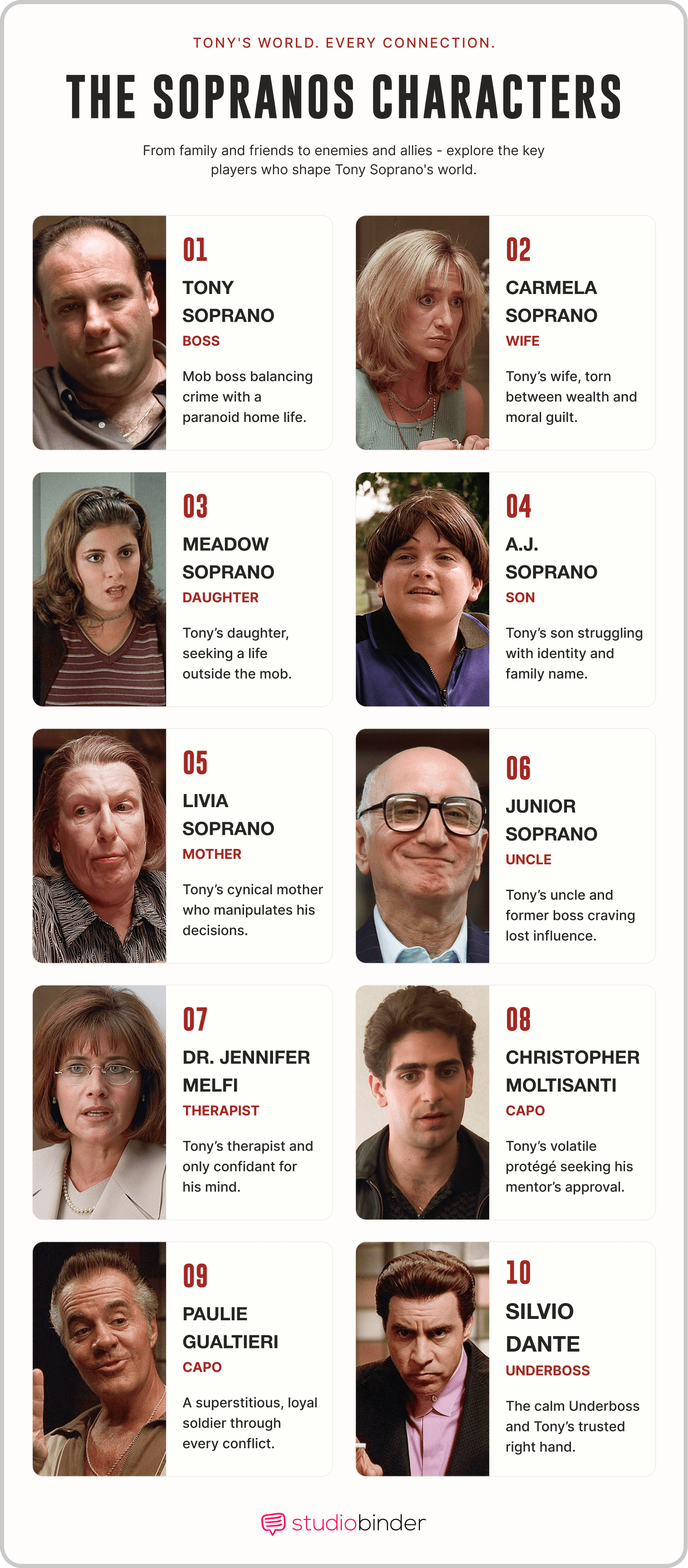
The Sopranos Characters • Sopranos Characters
BLOOD TIES
The Soprano family
Tony is a rather domesticated gangster with a wife and two kids in a large suburban home in New Jersey. He has in-laws, worries about his kids' college prospects, and cleans his pool. These Sopranos characters, throughout the series, toe the boundaries of their personal life and professional life with some, like Uncle Junior, completely bouncing back and forth.
1. Tony Soprano (James Gandolfini)
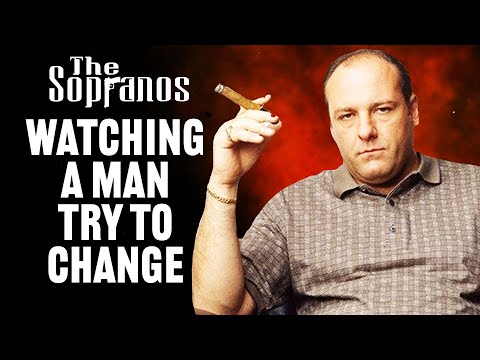
At the center of it all is Tony Soprano, the mob boss antihero who became one of the most influential protagonists in television history. His greatness as a character lies in his complexity and humanity (not to be confused with morality). James Gandolfini brings every dimension of that to the screen.
Tony is a gangster, a murderer, and an adulterer, but he also loves his family and provides for them. He often shows it in between scenes of robbing or ordering a hit on someone. He's brilliant at his job of running the operations of a criminal organization, but he constantly deals with the pressure of keeping his work and family life from imploding.
The Sopranos: How Tony Soprano Evolves & Devolves Psychologically • Sopranos Characters
Tony's therapy sessions with Dr. Melfi start the show off and become the show's structural backbone, giving the audience direct access to Tony's inner life while making clear that insight, for Tony, is not a path to change.
Tony Soprano is played by the late James Gandolfini, who won three Primetime Emmy Awards for the role. His performance is revered and has changed television forever.
2. Carmela Soprano (Edie Falco)
Carmela Soprano is Tony's wife of twenty years. To varying levels, she's aware of what Tony does for a living and subtly acknowledges it and chooses to stay, as it provides financial security and a little extra on top of that.
The show does not muddle her complicity in it, and it becomes a huge plot point. Her main concern is raising their children and keeping the home. Edie Falco's portrayal of Carmela Soprano earned multiple Emmy nominations. Her contentions with Tony lie in his other immoral vices that have to do with his loyalty and honesty with her and their marriage.
Carmela Soprano's character arc across the series tracks the slow erosion of her ability to justify the life she has chosen and her desire to take more agency in it.
3. Meadow Soprano (Jamie-Lynn Sigler)
Tony's daughter — and the show's most critical character of generational moral inheritance. She's a high-achiever who ends up going to Columbia University to study law. She's critical of her parents and is suspicious of her dad being in the mafia early on in the series.
Her arc is one of progressive compromise where she starts the series idealistic, principled, and critical and ends it engaged to a lawyer who works for mob-adjacent clients, having made her peace (or at least accommodating the idea) with her family's place in the world.

Meadow: Are You In The Mafia • Sopranos Characters
4. A.J. Soprano (Robert Iler)
A.J. is Tony's son and the show's argument about what happens when privilege meets emptiness. Raised in the wealth his father killed for, but without any of the structure (or the violence) that gave Tony's life a twisted kind of purpose, he grew up unlike his father in every way.
He's soft where Tony is hard, aimless where Tony is driven. Tony didn't want A.J. in "the life," and he got his wish. The only thing is he didn't expect it to result in a kid with no direction, no work ethic, and a creeping depression he inherited from his father. Tony has moments where he shows up as a father, but he doesn't hide his frustration. At one point Tony even says "I'm supposed to get a vasectomy when this is my male heir? Look at him" right in front of A.J.
A.J.'s arc cycles through passive phases — spoiled teenager, wannabe tough guy, depressive, activist who briefly cares about the war in Iraq, club promoter — and none of them stick. He's searching for an identity and keeps coming up empty. The show gets a lot of mileage out of playing him for comedy (the laziness, the entitlement), but his suicide attempt in Season 6 reframes everything.
He's one of the main people that come to mind when thinking about The Sopranos characters.
5. Junior Soprano (Dominic Chianese)
Corrado 'Junior' Soprano, or Uncle June, is Tony's uncle. In season one, he's the antagonist who eyes the boss position and feels he deserves it over Tony. This feud ends with Tony agreeing that Uncle June be installed as nominal boss of the DiMeo family.
Behind the title, Tony holds the real power and runs the operation with less heat and attention from the feds. Junior grows to resent this arrangement and conspires to have Tony killed. The fatal feuds within blood lines is a classic one within the genre.
However, in later seasons, Junior forgoes the archetype. He undergoes a trial and shows signs of dementia, which overtakes him completely. Junior shoots Tony at the start of Season 6 believing, in his confusion, that Tony is an old enemy. The act is both the climax of their decades-long conflict and a gutting anti-climax to Tony's fears - the boss is nearly killed not by a rival, but by his demented uncle.
6. Livia Soprano (Nancy Marchand)
Livia Soprano is Tony's mother. She's the show's most insufferable character and exists to antagonize everyone around her. She's a woman of immense emotional cruelty (especially to Tony) who weaponizes helplessness, victimhood, and guilt. David Chase has said Livia is based partly on his own mother.
In Season 1, Livia conspires with Junior to have Tony killed in a way that is so subtle that she could talk her way out of being liable or even aware of what is going on. There's no end goal to her action other than planting a fatal seed fueled by her lifelong malice toward her son. The horror is in the ordinariness of her evil.
Before getting deeper into The Sopranos characters, we need to delve into the inner workings of Tony's mind:
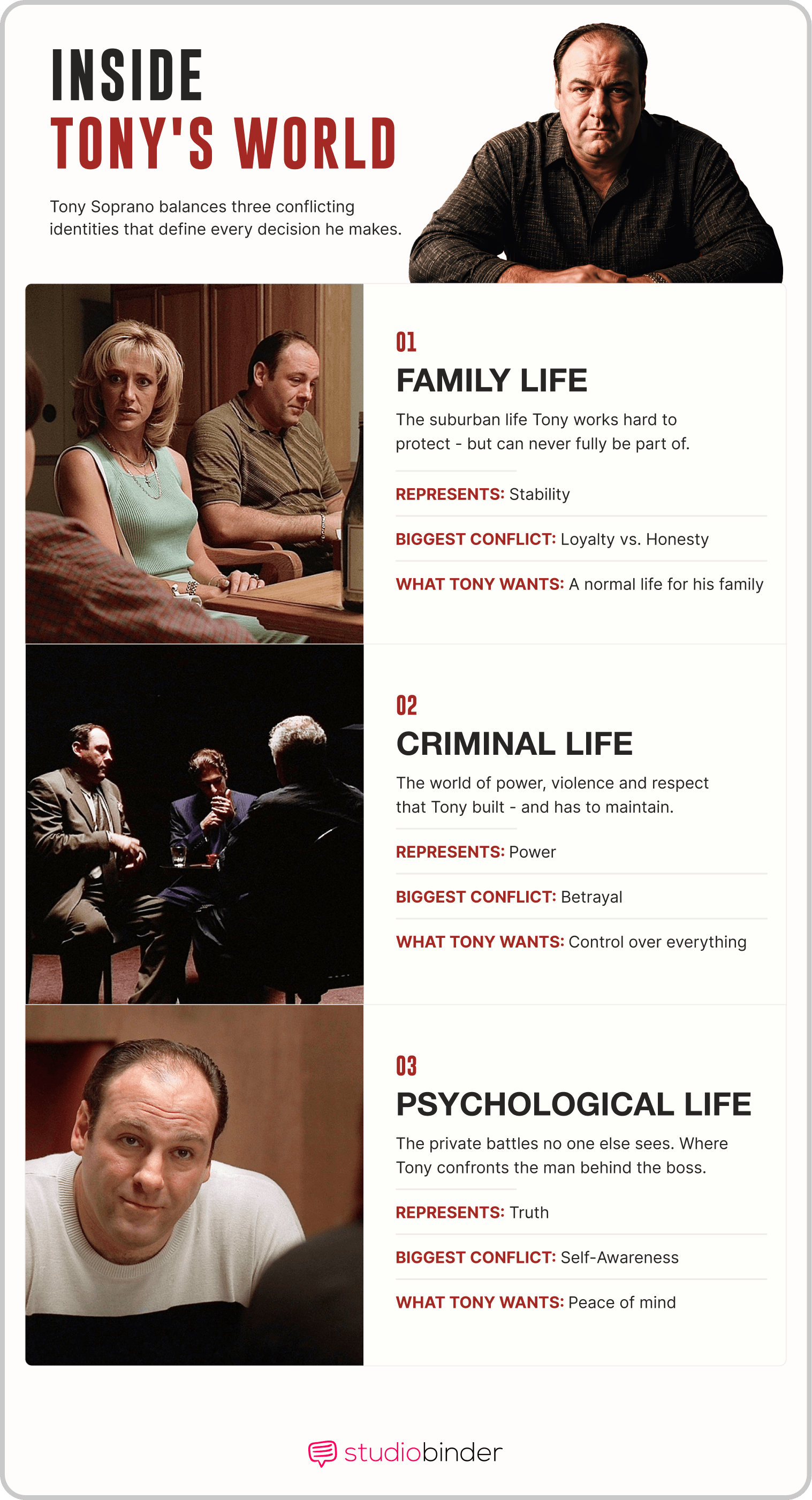
Inside Tony's World • Sopranos Characters
THE INNER CIRCLE
Tony's inner circle
Outside of his own family, Tony has a work family — the men he (slightly) trusts to execute his orders and operate his business. They are capos and long-time friends through their work. But that doesn't mean there isn't conflict.
7. Christopher Moltisanti (Michael Imperioli)
Chris is Tony's nephew by marriage. He soon becomes Tony's chosen successor just between the two of them — making him one of The Sopranos characters with the most significant arc in the series.
He wants to keep things within the family. He's also the show's most tragic character. Tony has high expectations of Chris, like a son he's grooming for the crown. Their relationship is the show's central emotional bond and its central act of destruction.
Christopher suffers from drug addiction and it soon defines him more than anything else. Tony enables it, ignores it, and ultimately uses it as justification when he kills Christopher Moltisanti in Season 6 after a car accident.
Tony killing Christopher is the show's most morally repugnant moment. Tony threatens Christopher earlier in the series with death if he doesn't get his act together. But the way Tony finally kills the person he once loved and believed in is so cold, it made Tony irredeemable to many fans. He grieves briefly, then moves on. This is who Tony is.
If you're studying The Sopranos characters for your own writing or production, StudioBinder's free character breakdown template is a useful tool for mapping out character traits, relationships, and arcs the way a professional writers' room does.
Related Posts
8. Silvio Dante — Steven Van Zandt
Silvio Dante, or 'Sil', is Tony's consigliere and his most loyal soldier. As the right hand of the operation, he's a man of few words who Tony respects and relies on for perspective. He also manages the Bada Bing strip club that stands as the family's operational grounds.
Van Zandt (also known as Little Steven, of the E Street Band) plays Silvio Dante with a deadpan quality that makes even the character's violence feel cool, calm, and collected.
9. Paulie Walnuts (Tony Sirico)
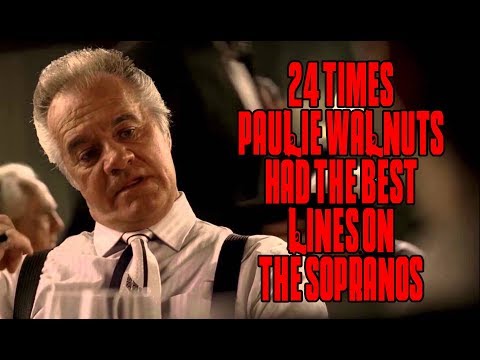
Paulie Gualtieri, known universally as Paulie Walnuts, is a capo in Tony's crew. He's probably the funniest character in the whole show and the most vain. Paulie is a man of intense superstition, paranoid loyalty, and homicidal short temper who generates some of the show's best quotes.
Paulie is one of the few main characters who survives the series — a fact that feels like its own kind of joke. The most absurd man in the room is the last one standing.
24 Times Paulie Walnuts Had The Best Lines On "The Sopranos" • Sopranos Characters
10. Bobby Baccalieri (Steve Schirripa)
Bobby Baccalieri is a gentle giant. Originally a part of Junior's crew, he grows to work with Tony as a genuinely kind soul in a world that treats kindness as weakness. He marries Janice Soprano (Tony's sister) and rises to become a capo.
Bobby's most important line — 'You probably don't even hear it when it happens, right? Suddenly you're just gone' — spoken to Tony in 'Soprano Home Movies' (S6E13) — becomes the series' clearest piece of foreshadowing about Tony's death.
11. Dr. Jennifer Melfi (Lorraine Bracco)
Dr. Melfi is not part of the criminal world or family world but her presence shapes the show's entire structure and how we perceive its antihero.
Dr. Jennifer Melfi (Lorraine Bracco) is Tony's psychiatrist. She's intelligent and professional and becomes drawn into Tony's world as she sees him as any other patient to help. Later in the series, this becomes more complicated as she continues the sessions, implicitly driven by her own fascination with him. When you start thinking about The Sopranos characters, she's a key figure that always comes to mind.

Tony's First Therapy Session With Dr. Melfi • Sopranos Characters
Dr. Melfi and her relationship with Tony are what made the show so unique among a saturated, Italian-American gangster genre in film and television. Her questions, perspectives, and insight humanize Tony in a way that keeps us emotionally invested in his choices.
Melfi ends up terminating treatment with Tony in the final season after reading research showing that therapy can make sociopaths more effective, not more moral. Her exit catches many off guard, including Tony. Over six seasons of sessions, the only lasting outcome is that Tony is better at managing his crew.
Lorraine Bracco was nominated for the Primetime Emmy for Outstanding Supporting Actress in a Drama Series multiple times for the role.
THE ADVERSARIES
The antagonists
The Sopranos lasted six seasons, and with each season change, the story cycled through a few new characters who challenged Tony and stood in his way. While we already touched on how his mother and Uncle June were primary antagonists in the early seasons, there are a few other Sopranos characters who served as main antagonists and stood in the way of his operation.
12. Ralph Cifaretto (Joe Pantoliano)
Ralph is probably the show's most genuinely hateable character and a test of how far Tony can be pushed. He works as a capo under Tony's operation. He earns a lot, which is the only reason Tony puts up with his sadistic violence and insufferable banter. Their relationship exists as this push and pull — Tony hates him but he makes him so much money.
It gets even more complicated when Ralph dates his sister Janice. Eventually, Ralph's arc leads him to sharing a racehorse, Pie-O-My, with Tony. After Pie-O-My dies in a questionable fire, Tony blames Ralph and kills him. The scene is the show's clearest example of Tony's moral priorities: he avenges a horse before he avenges a person. It sets off a chain of rumors that make Tony's crew question his judgment.
13. Richie Aprile (David Proval)
Richie enters in Season 2, fresh out of prison expecting the same status, if not better, than what he had before he was locked up. The former boss of the family, Jackie Aprile, was Richie's brother. But when he gets out, he finds a world that has moved past him, and reacts with escalating violence and resentment toward his enemies and allies.
Richie is killed mid-season in the most unexpected way possible. He starts dating Janice and punches her in the face during an argument. Janice shoots and kills Richie. Tony, who has already set in motion a hit on Richie, is called in to clean up the mess. It's one of the bigger plot twists in the early seasons.

Janice Kills Richie Aprile • Sopranos Characters
14. Phil Leotardo (Frank Vincent)
Phil Leotardo becomes the boss of the Lupertazzi crime family (New York). He's been around as a capo, but when he becomes the boss he becomes rigid in principle and holds a vengeance for the murder of his brother — killed by Tony's cousin Tony Blundetto. He wages a full-on war against Tony's family in the final season and the violence leads to the death of many main characters.
Phil is the only antagonist who actually succeeds in dismantling Tony's organization. He kills Bobby, nearly kills Silvio Dante, and forces Tony into hiding. He is eventually killed through a negotiated hit - but not before costing Tony nearly everything. These events domino into the series' final scene, which is largely read as the moment Tony's past finally catches up with him.
CULTURAL LEGACY
What made The Sopranos characters so enduring
When writing The Sopranos, David Chase and his writers room drew on historical research and personal experience. The result were Sopranos characters that existed just outside of the archetype. They were generally cinematic characters, but were written with enough nuance and history that made them feel genuinely real. Like real people, each character carried a central contradiction.
The characters in The Sopranos never get clean resolution — and that ambiguity is the point. And again like real life, the show never really resolved them. No character in The Sopranos is purely sympathetic or purely monstrous, and that ambiguity is what draws us in.
The sopranos main characters are exactly what made the show so enduring. The plot, while well written, almost came secondary. The ensemble cast and their relationships were what kept audiences watching — the characters in The Sopranos were the show. Their lives, desires, fears, and histories weave in and out of each other scene to scene making each moment layered.
The Sopranos characters are defined clearly by what they want and can't have:
- Tony wants both power and peace
- Carmela Soprano wants a clean conscience
- Christopher wants recognition
- Paulie wants certainty
- Junior wants respect.
None of them get it. The show's drama lives in the gap between what these characters want and what their world allows.
Related Posts
Frequently Asked Questions
Questions about the Sopranos characters
Tony Soprano is one of the best sopranos characters in television history, driven by James Gandolfini's performance and the extraordinary complexity built into the role. Paulie Walnuts is also a fan favorite for his dark comedy and the show's best one-liners.
Lady Gaga is not in The Sopranos TV series. This question likely refers to The Many Saints of Newark (2021), the Sopranos prequel film. Lady Gaga is not in that film either.
Livia Soprano is high on the list — a mother who conspires to have her own son killed and weaponizes her maternal role for emotional abuse. Ralph Cifaretto is the most sadistically violent: he kills a pregnant stripper, allegedly burns down a stable to kill a racehorse, and is one of the few characters Tony kills out of something that looks like moral outrage rather than necessity.
Among the main and recurring cast, notable deaths include Richie Aprile, Big Pussy Bonpensiero, Jackie Aprile Jr., Ralph Cifaretto, Adriana La Cerva, Tony Blundetto, Christopher Moltisanti, Bobby Baccalieri, and Phil Leotardo. The show's body count is one of the highest in prestige drama history — but unlike many crime shows, the deaths are rarely cathartic.
The Sopranos ended with one of the most debated final scenes in television history. The cut to black in the diner during the show's final moments is widely interpreted — with considerable textual evidence — as the moment of Tony's death: the point-of-view cuts, the suspicious man in the Members Only jacket, and the pattern of POV shots throughout the episode all point to Tony being shot. David Chase has been deliberately evasive about confirming this reading, which is by design. The show earned its ambiguity; a clean resolution would have betrayed everything the series built.
UP NEXT
At the center of it all is Tony Soprano.
characters in television history, but what exactly makes him work? Check out our full character analysis of the boss up next.

From script to production. Write, collaborate, and produce all in one place.
Write scripts online for free. Track versions. Share for feedback and approval. When you're done transition seamlessly to script sides, shot lists, storyboards, schedules, breakdowns, call sheets and more.