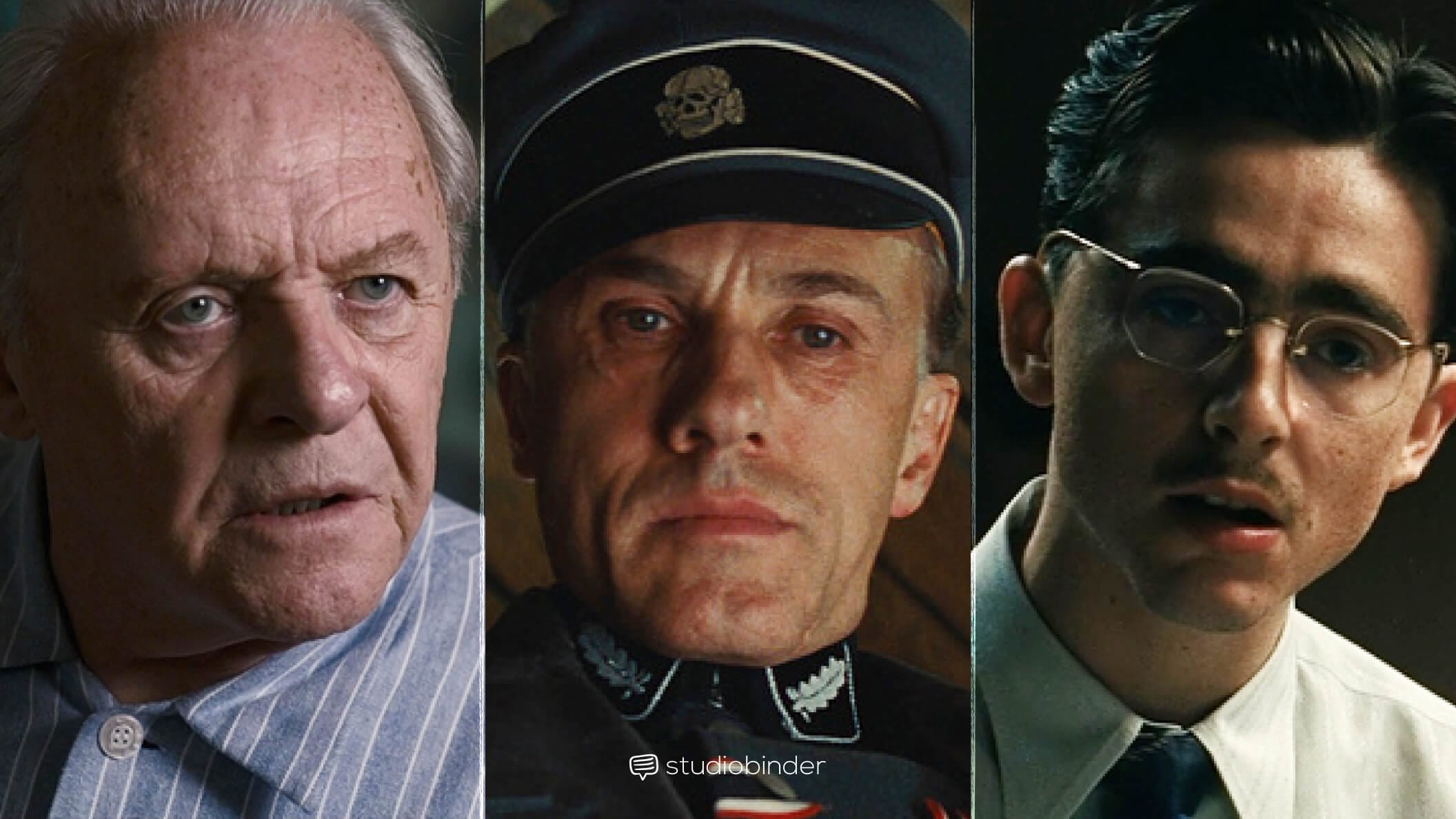
Great acting often looks effortless. It feels natural, immediate, and real. But that ease is built through precise and demanding acting training. One of the clearest systems for achieving that is the meisner technique. The core idea is simple. Actors must live truthfully under imaginary circumstances. Instead of performing emotion, they respond to what is happening in front of them.
The Meisner acting technique has shaped generations of stage and film actors. It remains widely taught in conservatories and studios around the world. This guide breaks down what is the meisner technique, how it works, and how it compares to other acting techniques.
Meisner method definition
What is the Meisner Technique?
So what is meisner technique at its core? It is an acting approach that trains performers to respond truthfully to their scene partner in the moment. The focus is not on creating emotion internally. It is on reacting to what is actually happening.
At its core, the Meisner acting technique shifts attention outward. The actor's reality comes from the other person, not from self-generated feeling.
Its central principle is clear. Acting is "living truthfully under imaginary circumstances."
Related Posts
Sanford Meisner biography
Who was Sanford Meisner?
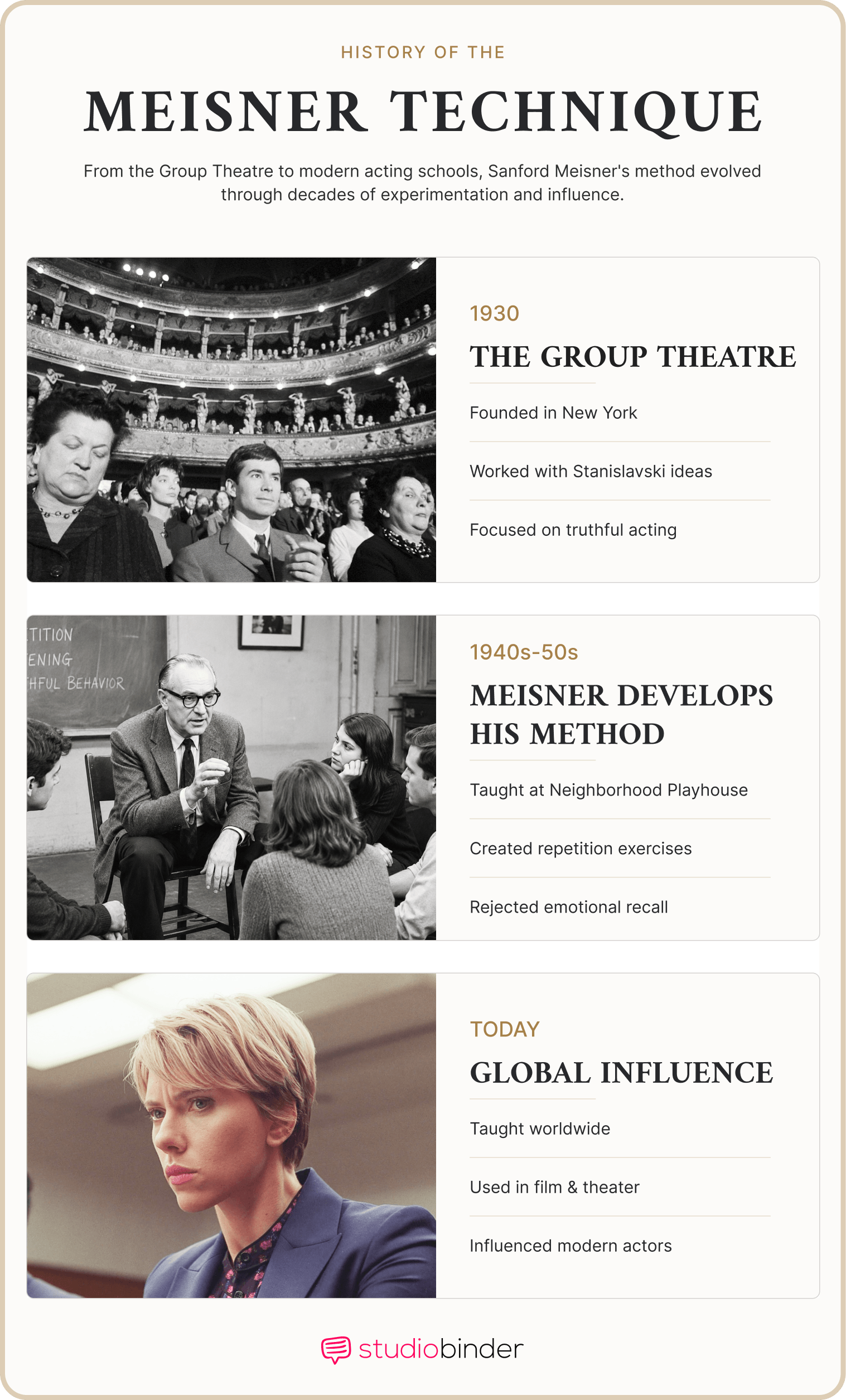
Sanford Meisner was a founding member of the Group Theatre in New York. He trained alongside artists influenced by the Stanislavski system.
He spent decades teaching at the Neighborhood Playhouse. There, he developed the Sanford Meisner technique through direct classroom work with actors at every level of experience.
He broke from Lee Strasberg and method acting. That split defines the technique. Meisner rejected emotional recall as the primary tool and focused instead on real-time response.
The Sanford Meisner technique became one of the most influential approaches in American acting training. His students went on to shape film and theater for decades.
Take a look into the graphic below to learn about the history of the meisner acting technique:
History of the Meisner Technique • The Meisner Technique
Truthful acting principles
Core principles of the Meisner Technique
The meisner technique is built on a few core ideas. Each one shifts the actor away from performance and toward genuine reaction.
Living truthfully under imaginary circumstances
This is the foundation of the Meisner technique.
"Imaginary circumstances" are the facts of the script. The setting, the situation, the relationships. "Living truthfully" means responding to those conditions as if they are real.
The key point is this. The actor is not showing emotion. The actor is experiencing it in response to what is happening. This principle applies whether the actor is performing a monologue or working with a scene partner in a tightly blocked two shot.
The repetition exercise
The repetition exercise is the core drill of meisner technique exercises.
Two actors face each other. One makes a simple observation. The other repeats it. The phrase continues back and forth.
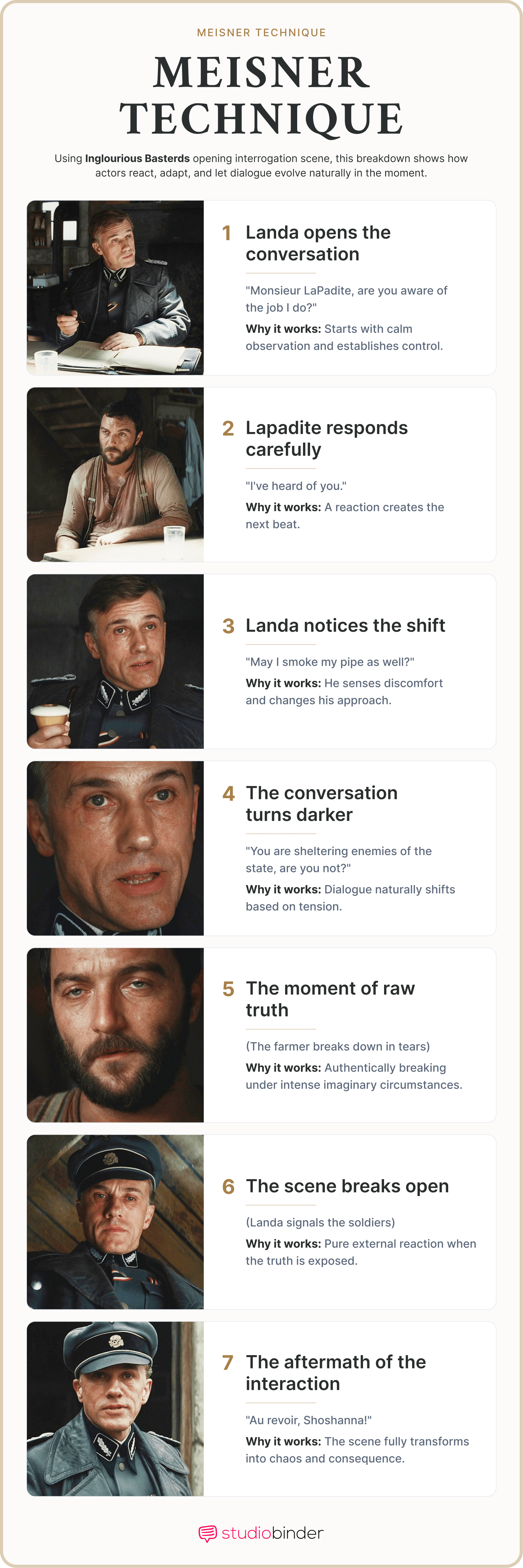
A great example of the Meisner technique is from the dairy farm scene in Inglourious Basterds. This is where SS Col. Hans Landa begins interrogating French dairy farmer Perrier LaPadite. Take a look at the graphic below to see how it played out, beat by beat:
Breakdown of the Inglourious Basterds Meisner Technique • The Meisner Technique
The words only change when something real changes between them.
The goal is not the words. The goal is attention. The actor must track the partner moment by moment.
Emotional preparation
Emotional preparation happens before the scene begins.
The actor enters with a specific emotional state. This might come from imagination or personal stimulus. But once the scene starts, that preparation is dropped.
From that point on, the actor responds to the partner.
This separates the Meisner technique from emotional recall. The emotion is not maintained. It is replaced by real interaction.
Instinct over intellect
The Meisner technique trains actors to stop thinking and start responding.
The first impulse is often the correct one. Overthinking leads to performance rather than truth.
Actors are encouraged to act on instinct. This creates spontaneity and a kind of controlled improvisation within the scene.
The result is behavior that feels alive rather than planned.
Repetition exercise acting
Meisner Technique Exercises
The Meisner acting technique is not theoretical. It is built through repetition and interaction. The exercises are simple on the surface, but they force a shift in how actors work.
Each one removes control. Each one trains response instead of performance.
Actors who are used to planning will struggle at first. That is the point. The Meisner technique exercises break habits and replace them with instinct.
The repetition exercise
The repetition exercise is the foundation of Meisner technique exercises. It is where most acting training in this method begins.
Two actors sit across from each other. One makes a simple observation. The other repeats it. The phrase continues back and forth.
At first, nothing seems to happen. The words feel flat. Then something shifts.
The tone changes. A glance breaks. A pause appears.
When that happens, the words change.
The focus is not language. It is behavior. The actor must track the other person moment by moment.
This is where the technique begins to work.
Example: Tracking real change in a partner
Two actors sit opposite each other. One says, "You seem distracted." The other repeats it.
At first, it's mechanical. Then the second actor becomes defensive. The tone shifts.
The first actor reacts to that change. The words adjust. The scene begins to live.

The Meisner Technique Complete Overview • The Meisner Technique
The exercise teaches attention. It forces the actor to stop performing and start observing.
This is the core of the Meisner acting technique.
Knock on the door
In this exercise, one actor is deeply engaged in an activity. Another actor knocks and enters.
The interruption is not planned.
The goal is to test whether the actor is truly doing something. If the activity is real, the interruption creates a real response.
If it is fake, the scene collapses.
This exercise exposes the difference between doing and pretending to do. It is one of the most revealing meisner technique exercises in early training.
Independent activity
The actor performs a task with real difficulty and stakes.
The task must matter. It must require focus and effort.
This builds a genuine inner state before the scene begins.
When another actor enters, the response is shaped by that state. It is not manufactured in the moment.
Related Posts
Acting styles comparison
Meisner vs. other acting methods
The Meisner technique is often taught in rehearsal rooms, but it also carries into the pre-production process.
Actors do not work in isolation. Film directors shape scenes. Writers build behavior into scripts. This is where the technique connects to filmmaking tools.
This makes it easier to test how Meisner-based responses will play out across a full script.
The technique stays focused on the moment. The film production process gives that moment structure.
Instead of planning emotion, teams can map interaction:
- Scene objectives
- Character actions
- Shifts in behavior
Meisner vs. Stanislavski
The Stanislavski system focuses on internal work. Actors imagine the given circumstances in detail to generate truth.
The Meisner technique shifts focus outward.
Instead of building emotion internally, the actor responds to the partner. The partner becomes the primary stimulus.
Meisner vs. Method Acting
Method acting, often linked to Lee Strasberg, uses emotional recall.
Actors draw on personal memories to access feelings. This can involve sense memory and emotional recall.
The meisner technique rejects this as the main tool.
It focuses on present moment acting. Emotion comes from interaction, not memory.
Both aim for truth. The difference is where that truth comes from.
Related Posts
Famous Meisner actors
Who uses the Meisner Technique?
The Meisner technique has been used by many working actors. Their performances share common traits: close listening, quick reactions, and a quality that feels discovered rather than rehearsed.
Diane Keaton
Diane Keaton trained at the Neighborhood Playhouse under Meisner. Her performances are often built on listening rather than projecting.
This training clip shows actors working in a Meisner-based scene. Notice how behavior shifts in real time rather than being pre-planned.

Mister Manners Lessons we can learn from Diane Keaton • The Meisner Technique
The key is attention. The actor reacts to what is happening, not what was rehearsed.
Robert Duvall
Robert Duvall is one of the clearest examples of the Meisner acting technique used in film. His work feels controlled but never rigid.
He trained directly under Meisner and often spoke about using the technique to ground emotion in behavior.

Robert Duvall on acting. •. The Meisner Acting Technique
The performance comes from interaction, not internal display.
Sam Rockwell
Sam Rockwell's work often feels spontaneous. His performances shift quickly, but they remain grounded.
This is a key outcome of Meisner training. The actor stays flexible and responsive.

Sam Rockwell on acting • The Meisner Technique
The result is behavior that feels discovered rather than performed.
Naomi Watts
Naomi Watts has spoken about using Meisner principles early in her training. Her performances often rely on subtle shifts rather than overt expression.
This aligns with the Meisner acting technique focus on small, real reactions.

Naomi Watts on acting (the do's and don'ts) •. The Meisner Technique
The smallest shift can change the direction of a scene.
Why this matters
These examples show a pattern.
The Meisner technique does not create a single acting style. It creates a way of working.
Actors trained in it listen closely, react quickly, and avoid over-planning. That is why the technique appears across genre conventions and performance styles. It adapts to the actor rather than shaping them into one form.
The technique is now taught globally. It is used in both theater and film. Its focus on responsiveness makes it adaptable across mediums.
Professional actor training
How to study the Meisner Technique
The Meisner technique is difficult to learn alone. It requires a partner and consistent practice.
Most actors study in a conservatory or studio. Training usually lasts one to two years. The first year focuses on repetition and impulse. The second introduces text and character development.
The main text is On Acting, written by Meisner with Dennis Longwell. It documents classroom exercises and progression. It remains one of the essential acting books for serious students.
Self-study has limits. The repetition exercise depends on another person. Without that interaction, the technique loses its core.
Why you cannot shortcut it
The Meisner acting technique works by breaking habits.
Most actors arrive with the same instinct. They try to control the scene. They plan how they will feel. They decide how a moment should play.
The training removes that control.
This takes time. There is no quick version of the repetition exercise. It only works through repetition.
Actors often struggle early on. That struggle is part of the process.
Working with a partner
The Meisner acting technique depends on interaction.
Every exercise requires another person. The partner becomes the source of behavior. This changes how actors think about scenes.
Instead of asking, "What should I do here?", the question becomes, "What is happening right now?"
That shift is the core of the Meisner acting technique.
Applying the work to scripts
Once the basics are in place, the technique moves into scene work.
Actors still prepare. They still understand the script. But they do not fix the performance in advance.
Instead, they identify objectives, understand relationships, and enter with a clear starting point. Then they respond.
Oftentimes, directors will build a beat sheet to track the emotional arc of each scene.
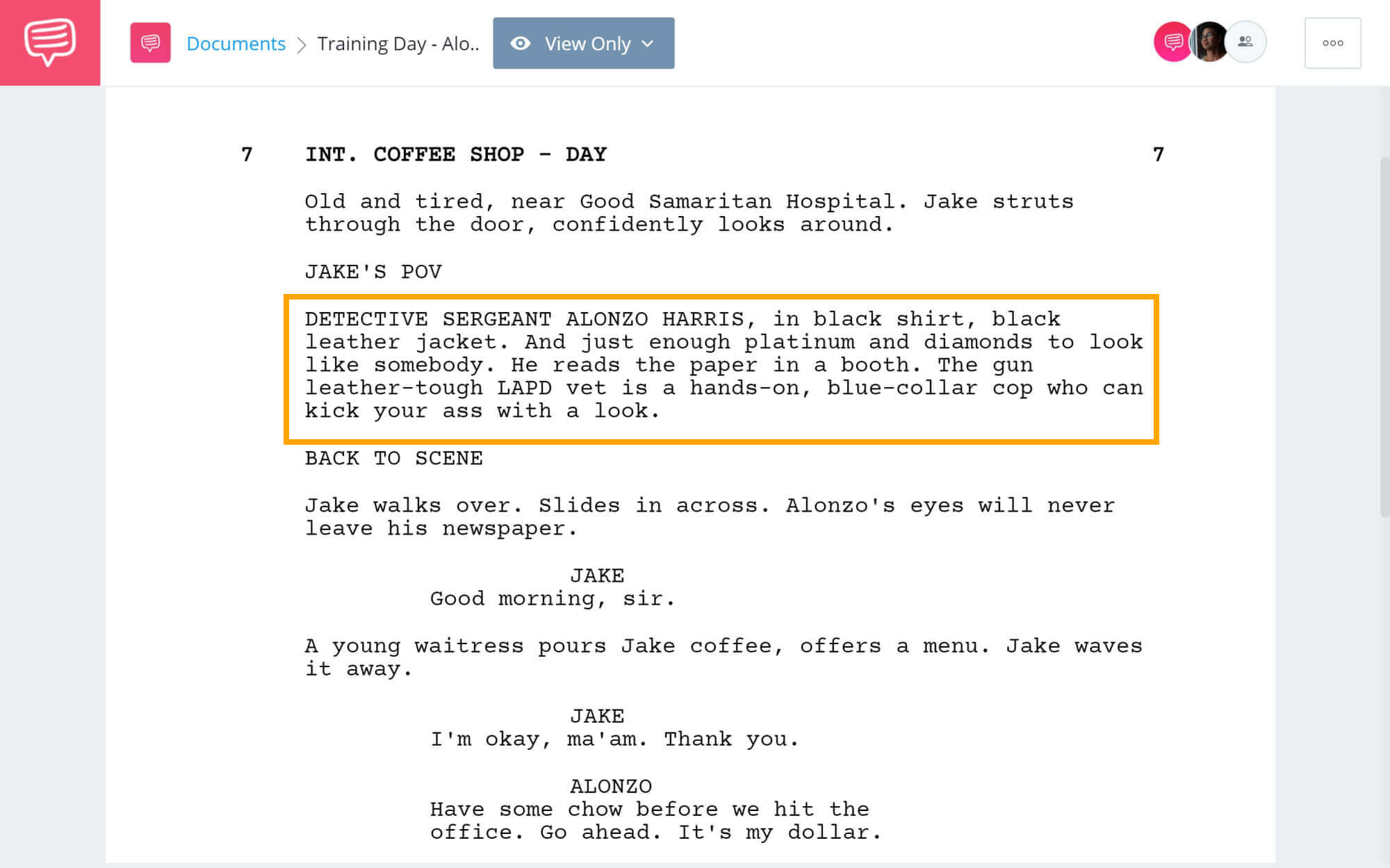
For actors, script sides are provided to track the dialogue and stage instructions for their specific character.
With StudioBinder's screenwriting software, you can reorder script sides and pages on your own terms. This way you can keep track of a single character's emotional journey throughout the entirety of a script.
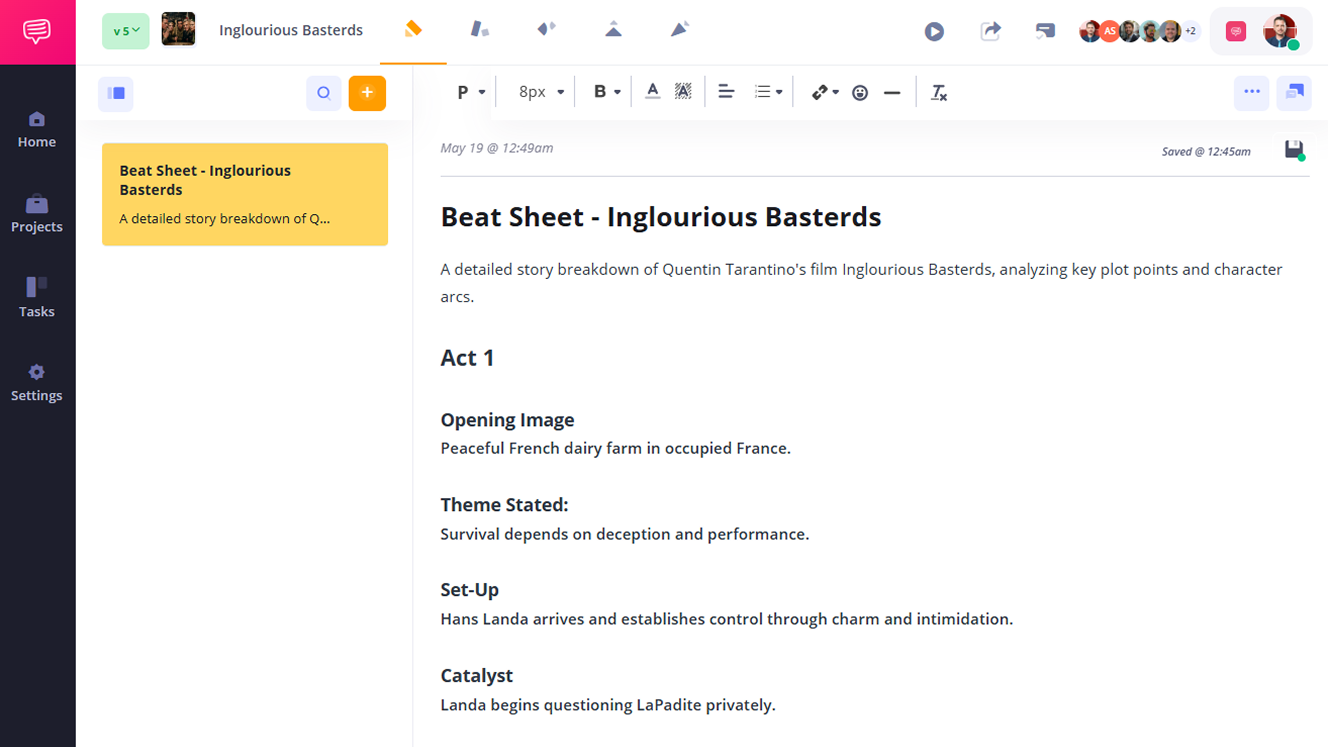
Script Sides Software • The Meisner Technique
Frequently Asked Questions
Questions about the Meisner Technique
It is an acting approach that trains actors to stop creating emotion and start responding to their partner. Attention moves outward. Behavior becomes reactive rather than planned.
The main meisner technique exercises are the repetition exercise, where actors repeat observations and track real change in their partner; knock on the door, where an interruption forces an unplanned response; and independent activity, where a task with real stakes creates genuine inner focus before a scene begins.
Most programs run for two years. The first year builds repetition and impulse. The second introduces text and performance. Progress is not linear. The technique develops at different speeds for different actors.
Method acting draws on personal memories and emotional recall to generate feeling. The Meisner technique generates emotion through real-time response to a scene partner. Both aim for truth, but Method goes inward while Meisner goes outward.
Not fully. The repetition exercise requires a partner. You can study the theory through books like On Acting and watch demonstrations, but the technique only activates through live interaction with another person.
Yes. The technique's emphasis on small, real reactions translates well to camera work, where close-ups capture every micro-expression. Many of the most natural screen actors trained in the Meisner method.
The Stanislavski system asks actors to imagine given circumstances in rich detail. The Meisner technique shifts focus from internal imagination to external response. The actor's truth comes from the partner, not from solo preparation.
UP NEXT
Meisner Technique vs. method acting
The Meisner Technique trains actors to work outward. Attention stays on the partner. Emotion comes from real interaction in the moment.
Method Acting moves in the opposite direction. It builds performance from internal experience, memory, and emotional recall.
Both aim for truth. They just reach it from different places.

From script to production. Write, collaborate, and produce all in one place.
Write scripts online for free. Track versions. Share for feedback and approval. When you're done transition seamlessly to script sides, shot lists, storyboards, schedules, breakdowns, call sheets and more.