When it comes to writing research papers, a thesis statement should always be included. But what is a thesis statement? We’ll answer that, as well as provide examples of what a thesis statement would look like for a range of topics.
Thesis Statement Definition
What is the definition of a thesis statement?
This is where we will provide a definition of what’s a thesis statement, which you can reference whenever you’re working on your own thesis statement.
THESIS STATEMENT DEFINITION
What is a thesis statement?
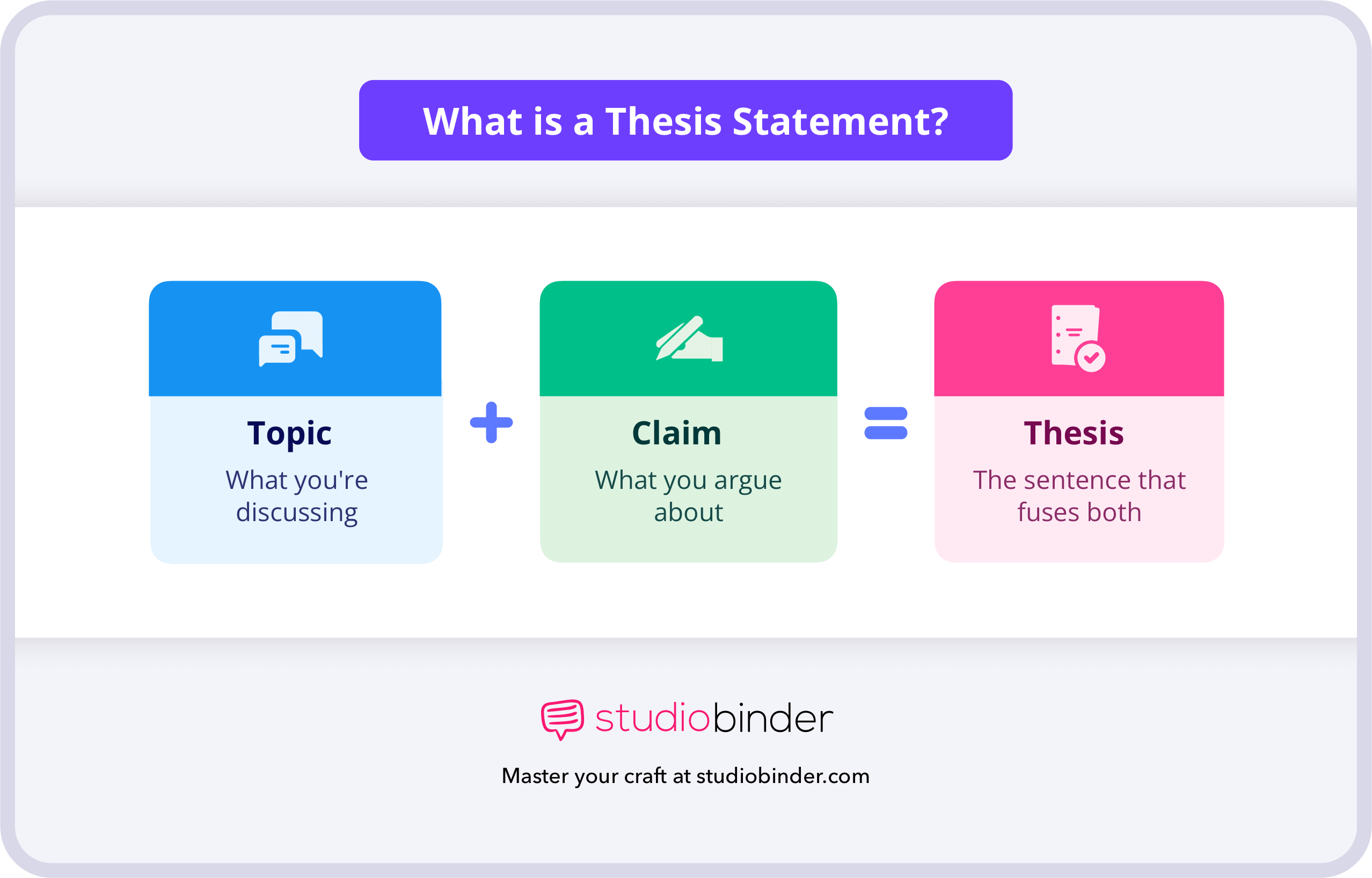
A thesis statement is a primary argument that is explained and defended in the body of an essay. A thesis statement is featured at the beginning of an essay, usually as the final sentence or two of the introduction. It exists as a concise summary of your argument before you spend the rest of your paper elaborating and explaining.
A thesis statement can also be seen as your paper’s “main idea”. As a “main idea”, your thesis statement primarily exists to let the reader know what will be discussed and covered in your essay.
It also functions as a reminder for you the writer, so that you understand what it is you’re arguing.
Thesis Statement characteristics:
- A brief sentence or two explaining your main topic/idea.
- An argument that is explored and defended in the body of a long-form essay.
- Providing a problem with a solution or observation, i.e. “because of X, Y” or “X happens because of Y.”
As said in the ‘How to Write a Thesis Statement’ page from Indiana University, “Almost all of us look in an essay for a one or two-sentence condensation of the argument or analysis that is to follow.”
It is important to understand that a “thesis statement” is not the same thing as a “thesis.” These two terms are often used interchangeably, but they don’t really mean the same thing at all. Aside from using the same word, the main thing “thesis statement” and “thesis” have in common are that they are both about presenting a core position and defending it.
While a “thesis statement” is a brief sentence or two that is part of a larger piece (i.e. an essay or research paper), a “thesis” is itself a larger work, such as a very long paper, an in-depth book, or even a short film.
Due to the way essays are in academic writing, a thesis can also include a thesis statement. As a result, while not exactly the same, these two terms can overlap with each other.
What is a Thesis Statement
Related Posts
What is a Thesis Statement
What is the purpose of a thesis statement?
Being your essay’s central argument, strong thesis statements let your readers know what you will cover and the position you are taking.
A strong thesis statement:
- Clearly states your main idea
- Establishes your position
- Guides the direction of your paper
- Sets expectations for the reader
- Defines the topic and scope of your discussion
In short, your thesis is the main idea of your essay. Every paragraph that follows should support, explain, or develop it. This goes for any kind of essay (high school, journalism, etc.).
Trusted by over 1M creatives
StudioBinder for production teams
Everything you need for a successful shoot: call sheets, shot lists, scripts, and more.

Thesis Statement Elements
What are the elements of a strong thesis statement?
An effective thesis statement has several key characteristics:
1. It is clear and specific
It is crucial to avoid vagueness and instead focus on making a strong, precise claim in the introductory paragraph. This implies that the thesis should articulate the central argument or main point of the essay, ensuring that readers can easily understand the core position without any confusion or ambiguity.
Weak: Social media affects society.
Strong: Social media increases political polarization by reinforcing users’ existing beliefs through algorithm-driven content.
2. It is arguable
A thesis should assert a claim that someone could reasonably disagree with, avoiding the inclusion of facts or obvious statements.
Not arguable: Water boils at 100°C.
Arguable: Government regulation of social media platforms is essential to safeguard democratic discourse.
3. It is focused
It centers on a single, cohesive idea rather than unrelated subjects.
4. It can be supported with evidence
You should be able to back up your thesis with credible research, trusted sources, specific examples, and/or logical reasoning.
5. It answers the assignment question
If your essay has a prompt or research question, your thesis must directly respond to it.
Writing A Thesis Statement
How do you write a good thesis statement?
Follow these steps to craft a strong thesis statement:
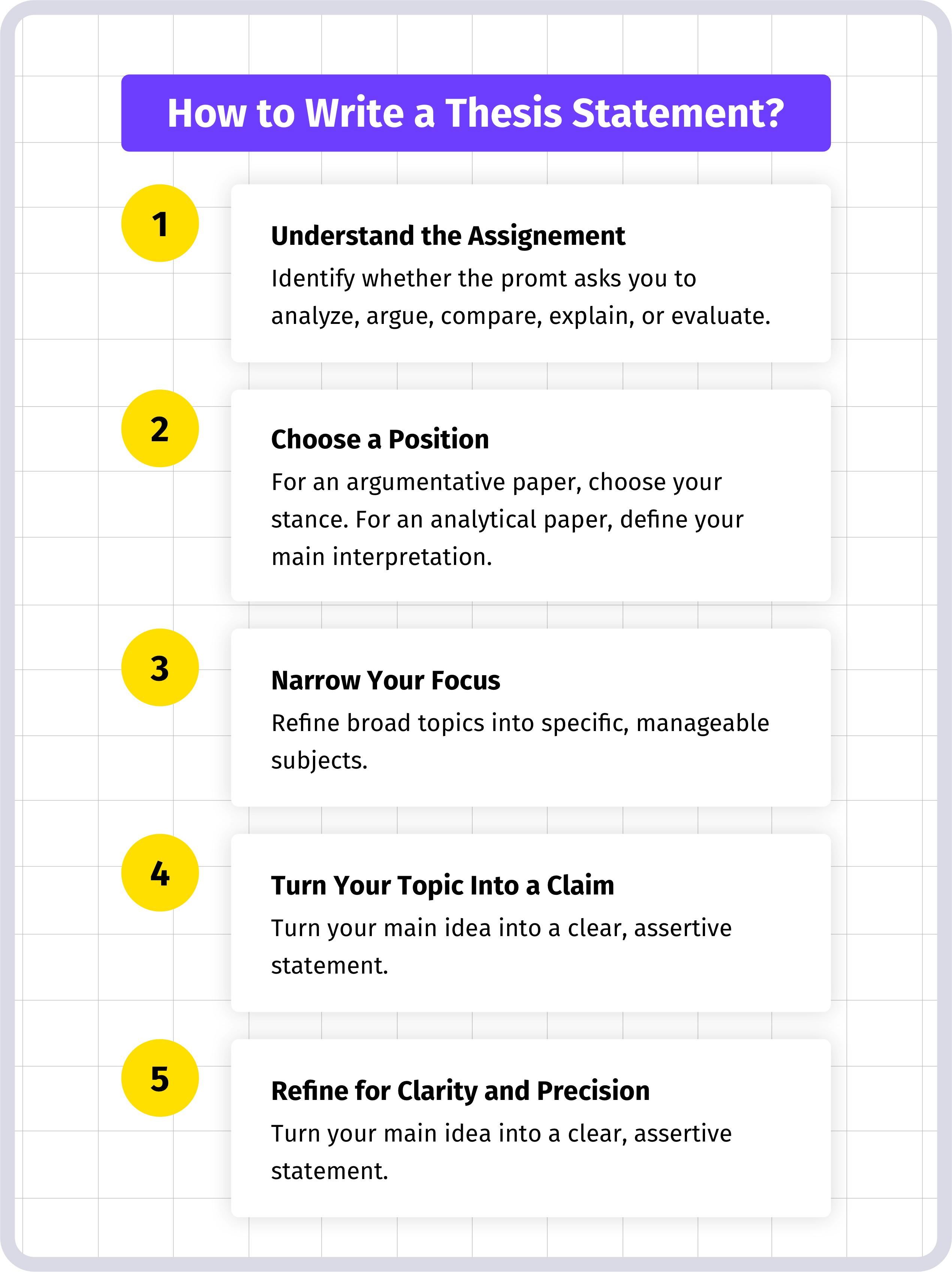
1: Understand the Assignment
Carefully read the prompt and identify whether you're being asked to analyze, argue, compare, explain, or evaluate.
2. Choose a Position
If writing an argumentative paper, decide which stance to take. If analytical, determine what your main interpretation will be.
3. Narrow Your Focus
Avoid broad topics and narrow your subject until it's highly specific.
4. Turn Your Topic Into a Claim
Convey your main idea as a clear and concise assertion.
Topic: Climate change
Claim: Governments must invest in renewable energy to prevent economic and environmental harm.
5. Refine for Clarity and Precision
Eliminate unnecessary words to ensure your sentence is straightforward, concise, and confident. Most thesis statements are concise, usually one sentence long, and are typically placed at the end of the introduction. Editing and revising your thesis throughout can help make sure it's as straightforward as possible.
Related Posts
Best Thesis Statement
Checklist for crafting a thesis statement
Use this checklist to evaluate your thesis and its statements:
- Does it clearly answer the assigned question?
- Is it specific rather than broad?
- Does it make a claim rather than state a fact?
- Could someone reasonably disagree with it?
- Can it be supported with evidence in the rest of the paper?
- Is it concise?
- Does it avoid vague language?
- Does it avoid announcing the paper (e.g., “In this essay, I will…”)?
- Does it pass the “So what?” test — does it matter?
If you can answer “yes” to all of these, your thesis is likely strong, and it answers the question you're aiming for directly. If not, you may have a working thesis that needs some readjusting.
Thesis Statement Meaning
What are some thesis statement examples?
The best way to explain what’s a thesis statement, its structure, and how it works is through example. As said in ‘Thesis Statements’ page from University of Kansas, “In the thesis statement you are not simply describing or recapitulating the material; you are taking a specific position that you need to defend.”
Now we will provide a few examples here of what a good thesis statement usually looks like.

Thesis Statement Example • How to Write a Strong Thesis Statement
Expository Thesis Example
Let’s say you want to write an essay about the cost of paper, inking, and printing affecting the price of books. Your statement could simply be “books are more expensive now” and that would make sense as a topic, but that’s not an effective thesis statement. You would instead want to write:
“Due to the rising costs of production, book prices have gone up over the last few years.”
You could also write:
“The price of books has risen steadily over the years due to the rising costs of paper, inking, and printing.”
“Your thesis statement must be specific—it must cover only what you will discuss in your paper and must be supported with specific evidence.” - Purdue OWL, The Writing Process

How to Write a Thesis Statement
Analytical Thesis Example
But not all thesis statements will be based on cold hard facts. Maybe you want to write a video essay about how the film Ghostbusters is pro-business bent.
A thesis statement for that could be:
"Ghostbusters portrays a pro-business perspective by featuring its protagonists as business owners who rescue the city by challenging government bureaucrats."

Thesis Statement Example • Ghostbusters Subtle Metaphor
Argumentative Thesis Example
Even the most simple ideas can be expressed through a strong and concise thesis statement:
“With its combination of festive music, themes of family, and a plot literally being set on the titular holiday, Die Hard stands as a prime example of a Christmas movie.”
There are endless topics that can be covered, meaning there are many ways to put together a thesis statement. The most important elements are specificity and clarity.
Specificity meaning “a specific and focused topic or argument” and clarity meaning your topic or argument is “clear and understandable.” In this way, you avoid making a thesis statement that is overly vague or general sounding.
Trusted by over 1M creatives
StudioBinder for production teams
Everything you need for a successful shoot: call sheets, shot lists, scripts, and more.
Thesis vs topic
Thesis Statement vs Topic Sentence
A thesis statement and a topic sentence both guide the structure of an essay, but they serve different purposes. The thesis statement presents the main argument of the entire piece. Topic sentences introduce the main idea of individual paragraphs that support that argument.
The thesis typically appears near the end of the introduction and acts as a roadmap for the reader. Each body paragraph then begins with a topic sentence that connects back to the thesis by developing one of its supporting points.
For example, consider this thesis:
- "Social media has reshaped modern politics by accelerating the spread of information, amplifying public voices, and increasing political polarization."
A topic sentence supporting this thesis might look like this:
- "One way social media has transformed political discourse is by allowing news and political messaging to spread instantly across global audiences."
Together, the thesis and topic sentences create a clear structure that helps readers follow the argument from introduction to conclusion.
Thesis Statements Mistakes
What are the most common mistakes when writing thesis statements?
1. Being too vague
"Technology plays a crucial role in the field of education."
This lacks specificity and doesn’t seem focused.
2. Stating a fact instead of an argument
“The Civil War ended in 1865.”
This is true and thus not arguable.
3. Being too broad
“Social media has fundamentally reshaped the world.”
This topic is too vast to be adequately covered in a single paper.
4. Being too narrow
“My high school cafeteria changed its menu in 2022.”
This may not provide enough substance for a full argument.
5. Writing a question instead of a statement
“Should governments regulate artificial intelligence?”
Instead, turn it into a claim:
“Governments should regulate artificial intelligence to prevent ethical and economic harm.”
6. Announcing the Paper
“In this essay, I will discuss the causes of pollution.”
Instead, try:
“Industrial expansion and inadequate environmental regulation are the primary causes of modern urban pollution.”
Related Posts
Change Thesis
Can a Thesis Statement Change?
In many cases, a thesis statement evolves during the writing process. Early drafts often begin with a working thesis, which is a preliminary idea that helps guide research and organization. As you gather evidence and refine your arguments, the thesis may become more precise or focused.
This revision process is a normal part of developing a strong argument. A thesis that starts out broad can become more specific as you clarify your main point and identify the most important supporting ideas.
For example:
Working thesis:
"Technology has changed education."
Revised thesis:
"Digital learning platforms have transformed modern education by expanding access to courses, enabling personalized learning, and connecting students with global resources."
Refining your thesis helps ensure that your final statement clearly communicates your paper’s central argument. In most cases, the strongest thesis statements are the result of revision, reflection, and a deeper understanding of the topic that develops throughout the writing process.
Frequently Asked Questions
Common questions about thesis statements
A thesis is a document, project, or other work that is created and submitted for completing a university-level program, resulting in a post-graduate degree.
A thesis is a document, project, or other work that is created and submitted for completing a university-level program, resulting in a post-graduate degree.
A thesis statement should only be one or two sentences; most thesis statements are one long sentence.
A thesis statement contains your main argument and ideas that you will explore and elaborate on in your essay/paper.
A thesis statement usually goes somewhere in the introduction of an essay, usually near the end.
Up Next
Different types of writing styles
Now that you have a good idea of what a thesis statement is, dive into the different types of writing styles. We cover an assortment of writing styles, including examples and additional links to learn more.
Up Next: Different Types of Writing Styles →