You’ve collected sources, read multiple articles, and done plenty of homework. It looks like you have everything you need to write your academic research paper; now you just need to find your argument. And in academic papers, an argument takes the form of a thesis statement. This article will cover examples and tips on how to write a thesis statement, one that works for both you and your readers.
Thesis Statement Definition
How to define “thesis statement”
Before we can explain how to write a thesis statement, first we must define the term “thesis statement.”
THESIS STATEMENT DEFINITION
What is a thesis statement?
A thesis statement is the central claim of your essay and the position you will argue and support with evidence. Placed at the beginning of your paper, it is a concise summary of the argument you will explore in your essay. A thesis statement can also be seen as a “main idea”, since your thesis statement primarily exists to let the reader know and remember what will be discussed and covered in your essay.
Thesis statement characteristics:
- A sentence laying out your argument.
- Providing an argument that is defended in the body of your essay.
- Stating a claim and backing it up, i.e. “because of X, Y” or “X happens because of Y.”
Strong Thesis Statement
Why is a thesis statement important?
A thesis statement is more than just a sentence at the beginning of your essay. It’s the foundation for your entire argument. Without a clear thesis, your essay lacks focus; with one, every paragraph has purpose.
A strong thesis statement:
- Organizes your ideas and keeps your writing focused
- Gives your reader a clear roadmap of what to expect
- Helps you decide what evidence belongs in your paper
- Prevents you from drifting off-topic
If your essay feels unclear, the problem is often an unclear thesis. A clear and well-defind thesis statement keeps both you and your reader on track.
Where does a thesis statement go?
In most academic essays, the thesis statement appears at the end of the introduction. After you introduce your topic and provididing the necessary background or context, your thesis presents the main argument you will defend in the body of your essay.
In longer research papers, your thesis may evolve as your research develops, and that’s normal. Many writers begin with a “working thesis” and refine or adjust it once their ideas are clearer.
As a general rule: Introduce the topic → Provide context → Present your thesis.
Related Posts
Writing the Thesis
What are some thesis statement examples?
Before explaining how best to write a thesis statement, we want to provide a few examples. In this way, you have an idea of what a thesis statement tends to look like. This is also helpful for giving you ideas on how to structure your own thesis statement.

How to Write a Strong Thesis Statement · Persuade the reader
How to write a thesis statement example
What are the types of thesis statements?
The type of essay you are writing always determines how your thesis is structured and what it will include. How to write a good thesis statement really begins with figuring out an interesting topic to explore in your writing. Consider these broad approaches below.
Argumentative Thesis:
Takes a clear position and defends it with evidence.
Analytical Thesis:
Breaks down an idea or work and explains how it functions.
Expository Thesis:
Explains a topic or concept without necessarily arguing a position.
Writing a strong thesis really means knowing what's expected. Understanding the type of paper you’re writing will help you craft a thesis that fits your assignment's purpose, expectations, and scope.
The following examples are argumentative thesis statements, each presenting a clear, specific, and debatable claim that requires evidence and support. Trust us, this is important for how to write a thesis statement.
How to write a thesis statement example
1. School sports
Let’s say you want to talk about the importance of sports in schools. You can focus on how sports encourage both exercise and bonding for the students. A thesis statement for a paper about the importance of sports in schools could read like this:
“Sports are an important extracurricular activity for students that shows them the merits of teamwork while also being a great source of exercise.”
Why it works: This thesis clearly takes a position and provides two specific benefits, teamwork and exercise. That can be supported with the clear evidence you provide in the body paragraphs.
By outlining these focused points, it gives the reader a clear roadmap of what the essay will argue and what to expect from it.
Argumentative thesis statement example
2. Public transportation
What if you live in a city in need of better infrastructure? You think your city could benefit from more public transportation options, especially in the more urban areas. A thesis statement covering this topic could look like this:
“More public transportation options, like buses and trains, would make our city easier to traverse for both tourists and locals alike.”
Why it works: This statement makes a clear, debatable claim about expanding public transportation and identifies who benefits from it (tourists and locals).
It establishes a focused direction for an essay while still allowing space for supporting data and examples.
How to write a good thesis statement
3. Movie theater experience
Finally, you think the movie theater going experience is an important and vital component to both cinema and social connectivity. Well, this could be read as a mere opinion, so how do we turn that into a topic that can be argued and explored? A thesis statement for this might be:
“The moviegoing experience allows viewers to connect with both the film on the screen and the people around us in the audience via a communal and focused experience.”
Why it works: This thesis turns a somewhat personal opinion into a defendable claim by explaining how the movie-going experience fosters a sense of communal connection.
It moves beyond a purely subjective opinion and suggests a broader cultural impact that can be explored more closely.

How to Create a Thesis Statement · How to write a proper thesis statement
Thesis statement examples
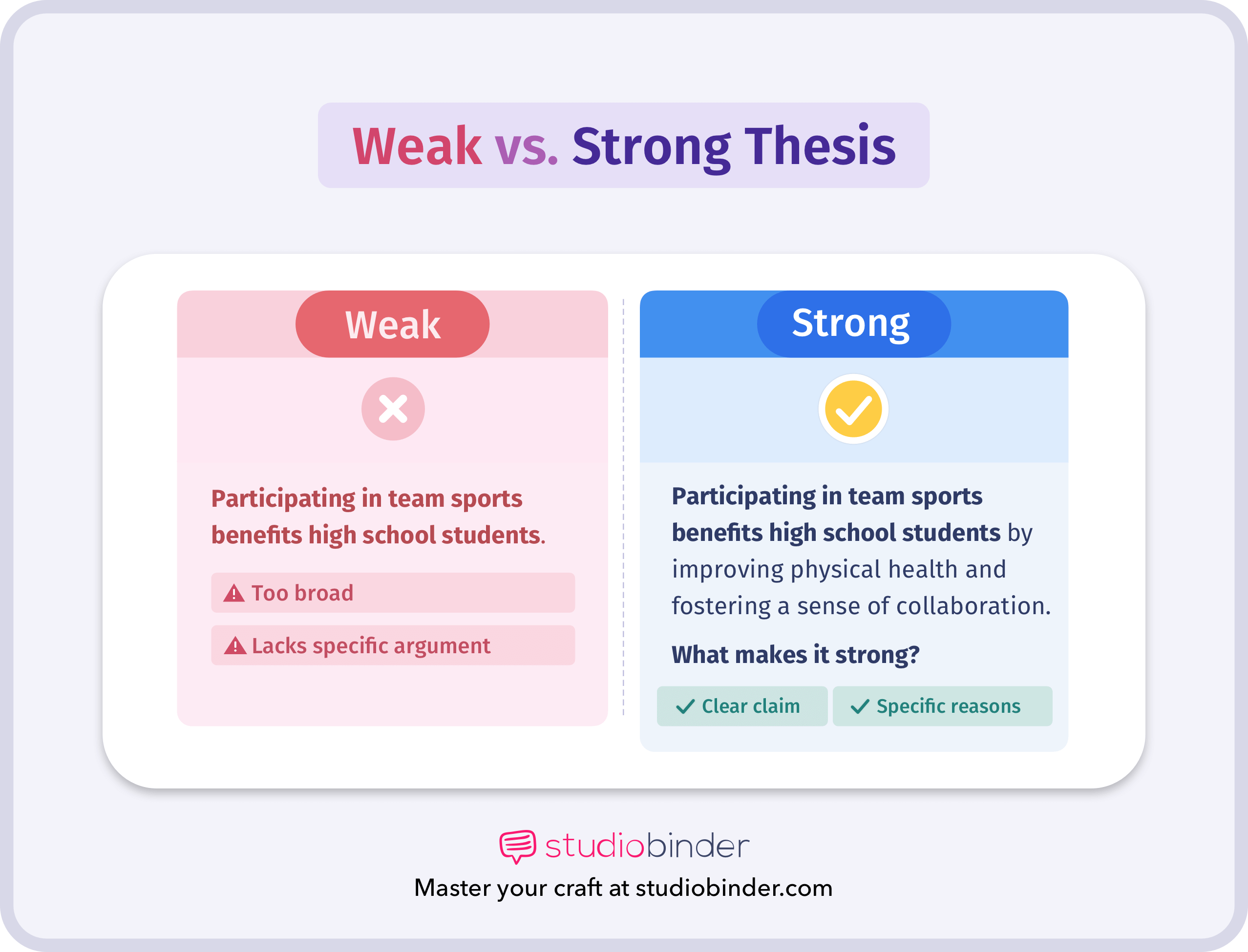
Strong vs. weak thesis statements
Understanding the difference between a strong and weak statement is vital, as it will help improve your own writing. The below examples should help you better understand how to write a good thesis statement.
Weak Thesis Example:
“Public transportation is very important nowadays.”
Why it’s weak: This statement is too broad and doesn’t present a clear argument. Most people probably would agree with it, which means it isn’t debatable.
Stronger Version:
“Expanding public transportation in urban areas leads to reduced traffic congestion and lowers pollution on all levels.”
Why it works: This version makes a specific, arguable claim and outlines two clear points that can be supported with evidence.
Weak vs Strong Thesis · Developing a thesis
Related Posts
How do you write a thesis
How to write a thesis statement
Now that we’ve provided a few examples, let’s move onto the actual steps for writing a thesis statement.
Here, we'll walk through a step-by-step approach to help you develop a thesis statement of your own.

How to Create a Thesis Statement · How to write a proper thesis statement
1. Choose an Argument
Finding your argument is the first step in how to write a proper thesis statement. This one is relatively straightforward, as you simply have to choose your topic. You can pick just about anything, since it works as the starting place for your thesis statement. For this exercise, we will choose the following topic: movie theaters should keep concession prices low instead of high.
2. Question the Argument
How to write a thesis statement runs up against the issue of “So what?”, which is another way of investigating the “how” and “why” of an argument. In other words, your thesis statement should not leave the reader wondering “So what?”
“Movie theaters should keep concession prices low instead of high” is a good starting point, but now we have to ask why. Doing so will let us create a stronger argument. For this argument, we can mention that having low prices also means that movie goers are more likely to buy concessions.
One possible point against this is that movie theaters want to make money, which is why concessions are so pricey. We can counter by saying that lower prices will result in more purchases, which will result in higher profits than if prices remained high.
3. Specify the Argument
We know that our argument is that movie theaters concessions should be low priced. But in order to have an effective thesis, we have to be more specific.
For this topic, we can bring back that counter argument and have our thesis statement say “Lower concession prices at movie theaters will be more attractive to movie goers, leading to the higher profits for industry overall.”
Another possible thesis statement could be “Movie theaters should keep concession prices low so that customers feel more encouraged to purchase them, resulting in higher profits in the long run.”
Regardless of how you word it or what additional points you want to mention, specifying your argument is key. Remember, your thesis statement will be weak if you keep it too vague or general.
By having your thesis statement be specific, you can better explain your argument and have readers understand your point of view.
4. Refine the language
After specifying your argument, revise the wording so it’s clear, concise, and direct. Remove vague phrases and unnecessary filler. A strong thesis should be precise and easy to understand on first read.
5. Make sure it’s arguable
Finally, ask yourself whether someone could reasonably disagree with your statement. If the answer is no, your thesis may be too obvious or factual. A strong thesis presents a claim that invites discussion and requires evidence.
Related Posts
Best Thesis Statement
How to know if your thesis statement is strong
After drafting your thesis, test it using these questions:
- Does it clearly answer the assignment or prompt?
- Is the claim arguable rather than just factual?
- Is it specific and focused?
- Can it be supported with specifc evidence?
- Does it clearly pass the “So what?” test?
Sometimes you have to refine your thesis multiple times before finalizing your paper; doing so can also improve your writing overall. So if your thesis fails one of these checks, revise it.
How to write a strong thesis statement
5 common thesis statement mistakes
Now you know the basics of how to write a thesis statement. Once you’ve chosen, questioned, and refined your argument, you need a focused and organized space that makes drafting your thesis statement clear, efficient, and manageable.
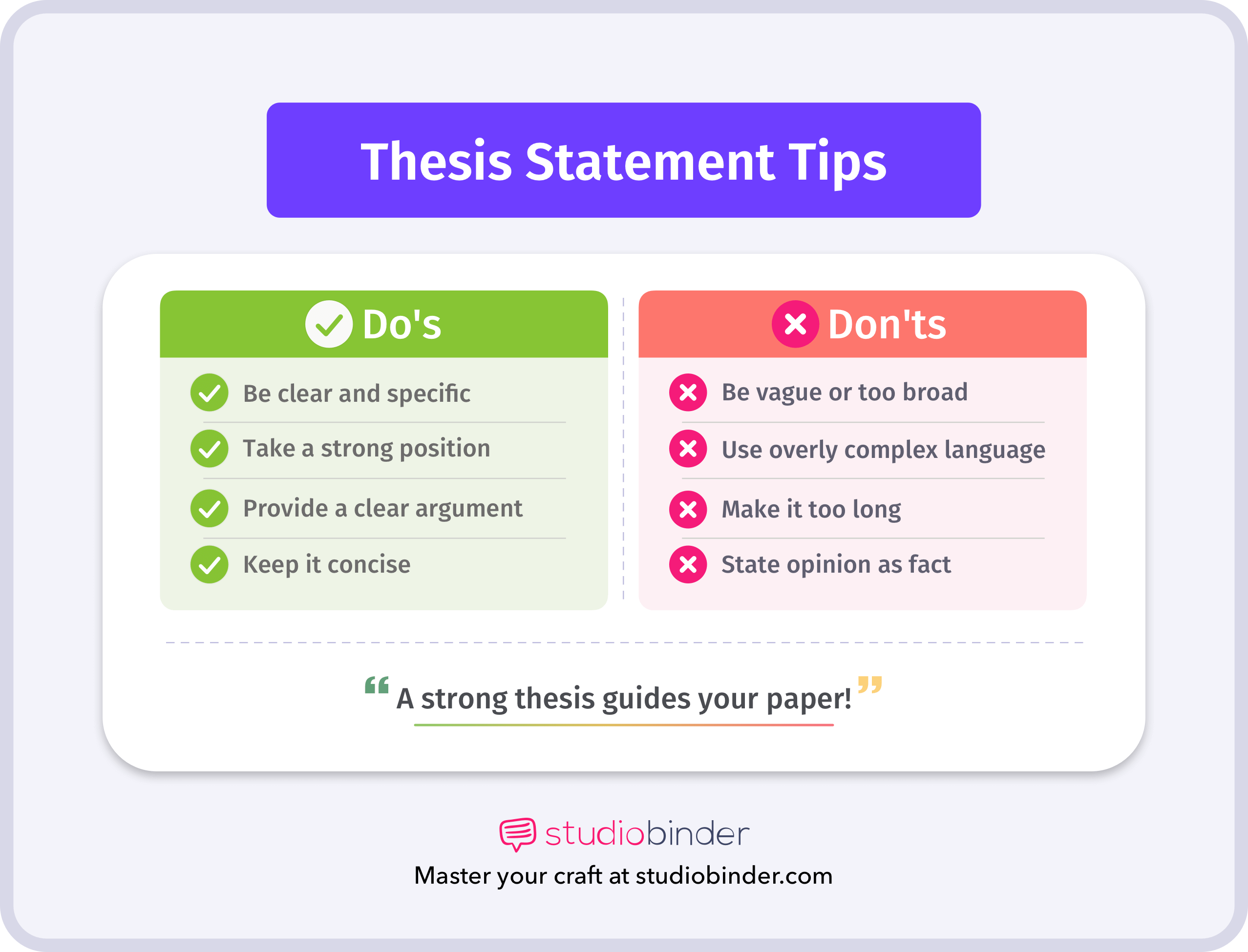
Be sure to avoid these mistakes when writing a thesis statement:
1. Being too broad
“Technology affects society.” This is too general to support effectively.
2. Stating a fact instead of an argument
“Water boils at 100 degrees Celsius.”
A thesis should invite discussion, not state an uncontested fact.
3. Including too many ideas
A thesis should focus on one clear, unified claim rather than several unrelated or loosely connected arguments at once.
4. Using announcement language
“In this paper, I will discuss…”
Instead of announcing your topic, state your argument directly.
Related Posts
5. Being too vague
Avoid vague phrases like “many reasons” or “a lot of problems.” Be precise and specific in your wording.
If you can avoid all of these issues, it will make your thesis statement clearer, more precise and persuasive.
Thesis Statement Do's and Don'ts · How to write a thesis statement
Frequently Asked Questions
Questions about how to write thesis statements
A clear and focused argument that can be debated and explored with sources, facts, and evidence.
Yes, a thesis statement very often goes through changes as you conduct more research into your topic/argument.
A strong thesis statement is never a question; rather, it is an argument that invites questions that will be answered and explored in the body of your essay.
First, choose a topic that you can explore and find a core idea within that topic to defend as an argument. Next, develop your argument by analyzing its strengths and faults, including what makes it important as a topic to discuss. Finally, clarify your argument with specifics to make sure it is neither vague nor general, allowing you to really dig into the details of the topic.
A thesis statement should be between 20 and 40 words.
A thesis statement includes a controlling idea that comes from the main topic; some thesis statements also include reasons for why you have chosen your stance/topic/argument.
A thesis statement goes in the beginning of your essay; where at the beginning will depend on the type of essay and its length, meaning it could be in the first paragraph or at the end of your introduction.
A thesis statement is usually no longer than one or two sentences.
Up Next
How to write a narrative essay
Now that you know how to write a thesis statement, look into how to write a narrative essay. Our guide provides background on the style, things to look out for, and the best way to write one.
Up Next: How to Write a Narrative Essay →