Perhaps you’ve come across the hundreds of thousands of permanent markers moving at hyper-speed to trending audio on TikTok, or you’ve picked up a blackout poetry book at the bookstore. Or maybe you literally blacked out and have no idea how you ended up on a poetry article, but stay with us! #BlackoutPoetry isn’t just for those who consider themselves poets. Today, we’ll dive into what is blackout poetry, historic roots, its connection to Dadaism, and why it might be the cure for your writer’s block.
Definition of Blackout poetry
First, let’s define Blackout Poetry
Blackout poetry exists at the intersection of visual art and literature. Also known as erasure or redacted poetry, blackout poems are created in the tradition of found art (or form of found poetry). Found (or readymade) art takes existing materials and transforms them into a new artistic work.
DEFINITION OF BLACKOUT POETRY
What is blackout poetry?
Blackout poetry is a type of erasure poetry where the writer takes an existing text, often a page from a book, newspaper, or article, and blacks out (or otherwise obscures) most of the words. The remaining words form a poem, giving new meaning to old text.
Six styles of erasure poetry:
- Blackout: crossing out words to create a new poem.
- Computer: using computer software to add or remove lines.
- Cut out: using a knife to cut words out of paper.
- Cover up: covering up the original text with another material.
- Retyped: retyping the original text to make it look like a conventional, traditional poem, leaving space where the original text used to be.
- Visual: Incorporating additional visual elements such as collage, drawing, painting, etc.
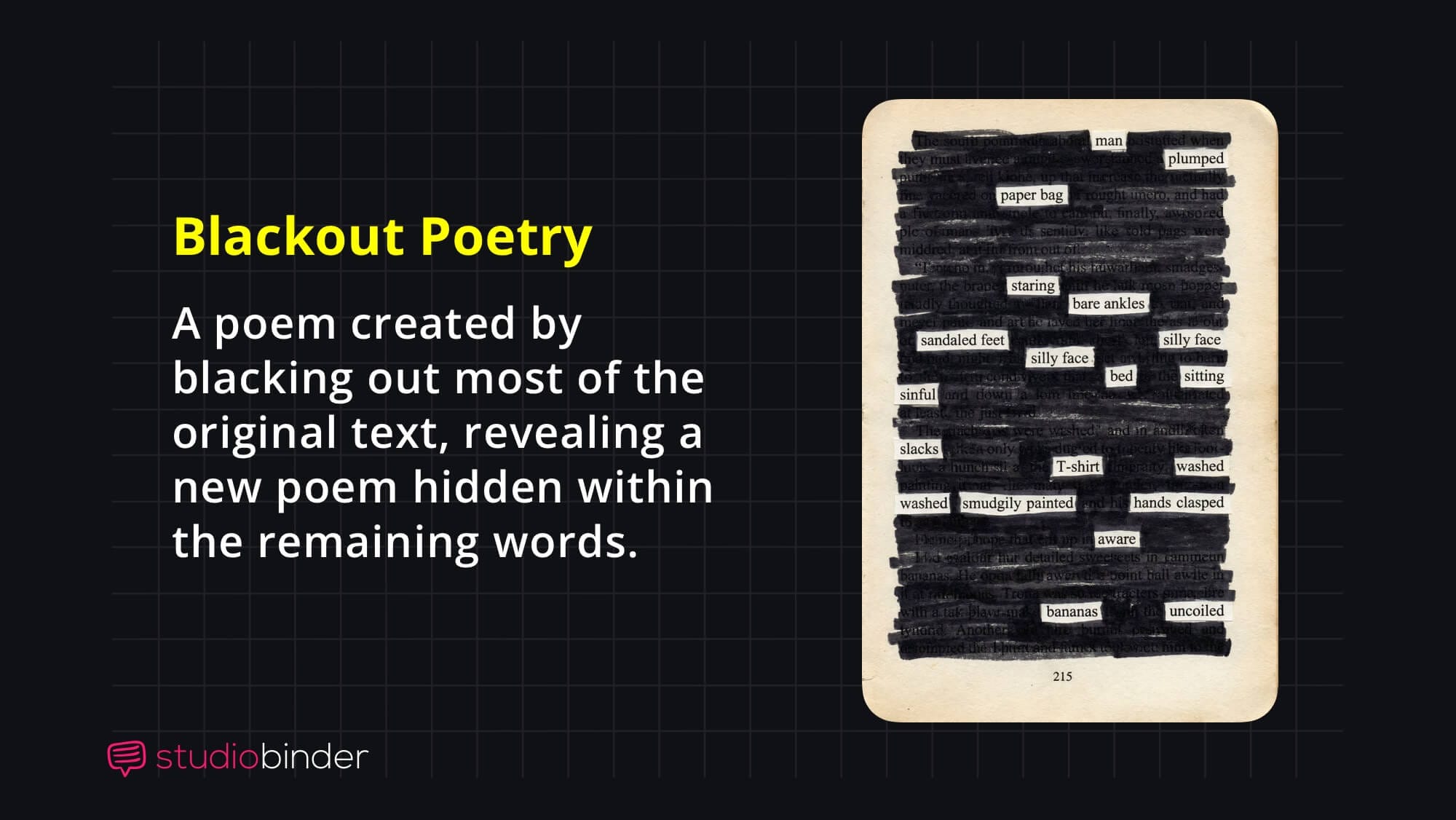
Blackout Poetry Definition and Example
Blackout Poetry History
The birth of the blackout poem
You may think blackout poetry is a more modern art, but the idea of creating new meaning from existing text isn’t new. At least no more new than the idea of combining words and phrases. In fact, as long as print newspapers have existed, people have used redaction to create new bodies of work.
Poet Austin Kleon traced this back to the days of Benjamin Franklin. In one of the earliest known examples of blackout poetry art, Franklin’s neighbor Caleb Whiteford published a broadsheet created from the very first print newspapers. Perhaps started as comedy, his edited versions replaced serious news with jokes and puns. In another early blackout poetry example, “The daily advertiser, in metre," published in 1781, made fun of advertisements in a London newspaper by rearranging them into verse.
The modern resurgence of blackout poetry is often credited to writer Austin Kleon, whose 2010 book Newspaper Blackout helped popularize the form for a contemporary audience. Kleon’s work demonstrated how everyday materials like newspapers could be transformed into striking, minimalist poems through redaction.
Around the same time, the broader literary movement of erasure poetry was gaining recognition, with poets like Tom Phillips (A Humument) and Ronald Johnson (Radi Os) using existing texts as raw material for entirely new works.
Presently, blackout poetry continues to evolve across both print and digital platforms, embraced by artists and social media creators as an accessible form of creative expression.
The below video is a Ted Talk that covers the history of blackout poetry. Check out the compelling journey below.

Austin Kleon on the history of blackout poetry | What is blackout poetry
Related Posts
Blackout Poetry and Dadaism
Dada poets bring back the blackout
The early 20th century saw the return of blackout poems with the dada movement. Hugo Ball’s “Dada Manifesto” named Dadaism “a new tendency in art” that rejected logic and reason in favor of chance. For Dada artists, “nonsense was the ultimate political tool to smash existing power structures and artistic norms,” which might explain the popularity of absurd memes, video collage, and the rise of black out poetry art today. That #aesthetic Tiktok video you love of seemingly random videos mixed with cartoons from the 1940’s, set to a trap song? Dada.
Tristan Tzara, one of Dada’s founders, created poems by cutting out words on the page of a newspaper, putting them in a hat, and pulling them out at random to form verse. His “How to Make a Dadaist Poem," subverted the traditional confines of art and poetry, emphasizing spontaneity and chance.
Check out the compelling way Tzara would perform his art in the video below.

Beginners guide to flash photography | What is blackout poetry
Trusted by Over 1M Creatives
Screenwriting from draft to set
Write, format, and share your script. Ready for production when you are.

Blackout Poetry
Examples of black out poetry
While many black out poems use black markers, blackout poems can be created by covering words with anything. For example, Erin Dorney’s use of foliage.
The Poetry Foundation offers these excellent examples of erasure poetry: “Freeland: An Erasure” by Leigh Sugar; and M. NourbeSe Philip’s Zong!, “which uses court documents about the 18th-century slave ship that threw more than 120 enslaved Africans overboard in order to collect insurance money.”
Below are more examples that showcase the range of blackout and erasure poetry styles:
Newspaper Blackout Poems
As we've covered, the most common form of blackout poetry comes from newspapers. Writers isolate phrases from headlines and articles to create poems that often comment on current events. Because the source material is already rooted in reality, these poems can feel immediate, ironic, or even satirical depending on the word choices.
Book Page Erasure Poetry
Using pages from novels or nonfiction books allows poets to work with richer, more descriptive language. These blackout poems are often more lyrical or narrative-driven, as the original text provides more texture and emotional depth. Many artists also incorporate illustration into the blacked-out space, turning the page into a visual composition.
Political and Historical Erasure
Works like Zong! demonstrate how blackout poetry can engage directly with history and politics. By erasing and reshaping archival documents, poets can critique power structures, highlight marginalized voices, and reframe historical narratives. This form is often more abstract but deeply impactful.
Digital Blackout Poetry
With the rise of digital tools, blackout poetry has expanded beyond paper. Creators now use apps, PDFs, and design software to redact text and share their work online. This format makes it easier to experiment, edit, and distribute poems across social platforms, helping the form reach a wider audience.
As you can see, blackout poetry can take many surprising new shapes. Contemplate which form of blackout poetry works for you and get to creating! Maybe you'll even discover a brand new form.
Related Posts
Blackout poetry ideas
Create your own blackout poem
From newspaper articles and magazines to the dusty one dollar book pile at the thrift store, part of the appeal of blackout poetry art is its accessibility. With just an old book (or screenplay!) and a marker, you too can be a blackout poet.
- Source: Your source can be anything with preexisting text. The most common sources are newspapers, books, and magazines, but if the back of a cereal box is what you feel called to, go for it!
- Inspiration: Scanning the source material, you’ll want to choose a block of text to pull from. For our example, we’ll use the front page of a newspaper. Use a pencil to underline the words that catch your eye, regardless of if they feel connected.
- Create: After marking the potential words, you’ll want to read over them to see what story is emerging. Here you can add or remove words for flow and find connecting words if needed.
- Commit: Once you finalize your word selection, highlight the words more boldly by drawing a box, circle, or underline with a pen to make sure they stand out.
- Blackout: Cover all unwanted text so that only your circled words remain. Staying true to the name “black out poem,” our example below uses a black permanent marker, but you can cover the redacted words with anything you’d like.
- Share your work: Whether you’re a first time or long time poet, hashtags like #blackoutpoetry and #newspaperpoems are filled with erasure poems.
Once you’ve completed your first blackout poem, don’t stop there. Like any creative practice, blackout poetry becomes more rewarding the more you experiment. So turn that poetry month into a poetry year and try working with different types of source material. This can include dense novels, poetic prose, news articles, or even scripts.
Another helpful approach is to create multiple versions from the same page. By selecting different words or arranging them in new ways, you’ll start to see how many possible poems are hidden within a single block of text. This not only sharpens your eye for language but also helps you think more flexibly about structure and meaning.
Above all, blackout poetry is about discovery. There’s no single “correct” way to do it, just a subjective process of uncovering something unexpected from what’s already there. After all, that's what making art is all about, right?
Related Posts
Frequently Asked Questions
Common questions about blackout poetry
A type of poetry that takes an existing text and blacks out (or obscures) most of the words. The remaining words form a poem.
Five easy steps! Find a source, get inspired, choose your words, finalize with a pen, black out the rest.
No one single person is credited with the invention of this form, but key figures include Doris Cross, Tom Phillips, and Austin Kleon amongst others.
There are no strict rules, though it has been suggested to black out at least half of what is on the page for your work to be considered original.
Some scholars consider Tom Phillips’ A Humument the most famous erasure poetry work in literary history, while Austin Kleon’s work is the most famous modern blackout poetry example.
UP NEXT
Cure your writer’s block
Writer’s block often happens because the blank page feels intimidating. Black out poetry removes the pressure to start from nothing and forces the brain into a creative space. Too often we meet the page while with the stress of writing something that can be produced on a specific budget, but with poetry one can write for play. If you’re looking for other ways to reignite your creativity, check out our list of 23 ways to overcome writer’s block. We promise it'll be just as fascinating as exploring blackout poetry art.
Up Next: Curing writer's block →