Done right, video is one of the most powerful tools a healthcare organization has. It simplifies complex procedures, trains new staff faster, and lets real patient stories do more than any marketing tagline. This article covers the main types of healthcare video production, what makes them different from standard corporate work, and how to plan a shoot that clears every compliance hurdle.
HEALTHCARE VIDEO PRODUCTION
What is healthcare video production?
Healthcare video production is the process of planning, filming, and editing video content for healthcare organizations, including hospitals, clinics, medical device companies, health insurers, and more. It is not a standard medical video production job with a sterile backdrop and a talking head. Compliance requirements, clinical accuracy standards, and patient privacy rules set it apart. Getting any one of those wrong is not just a production problem. It can be a legal one.
HEALTHCARE VIDEO TYPES
5 Types of Healthcare Videos
Healthcare organizations produce several types of video, and each one serves a different audience and purpose. Knowing which type you are making before you pick up a camera is step one. The format, tone, and compliance requirements shift depending on who is watching and why.
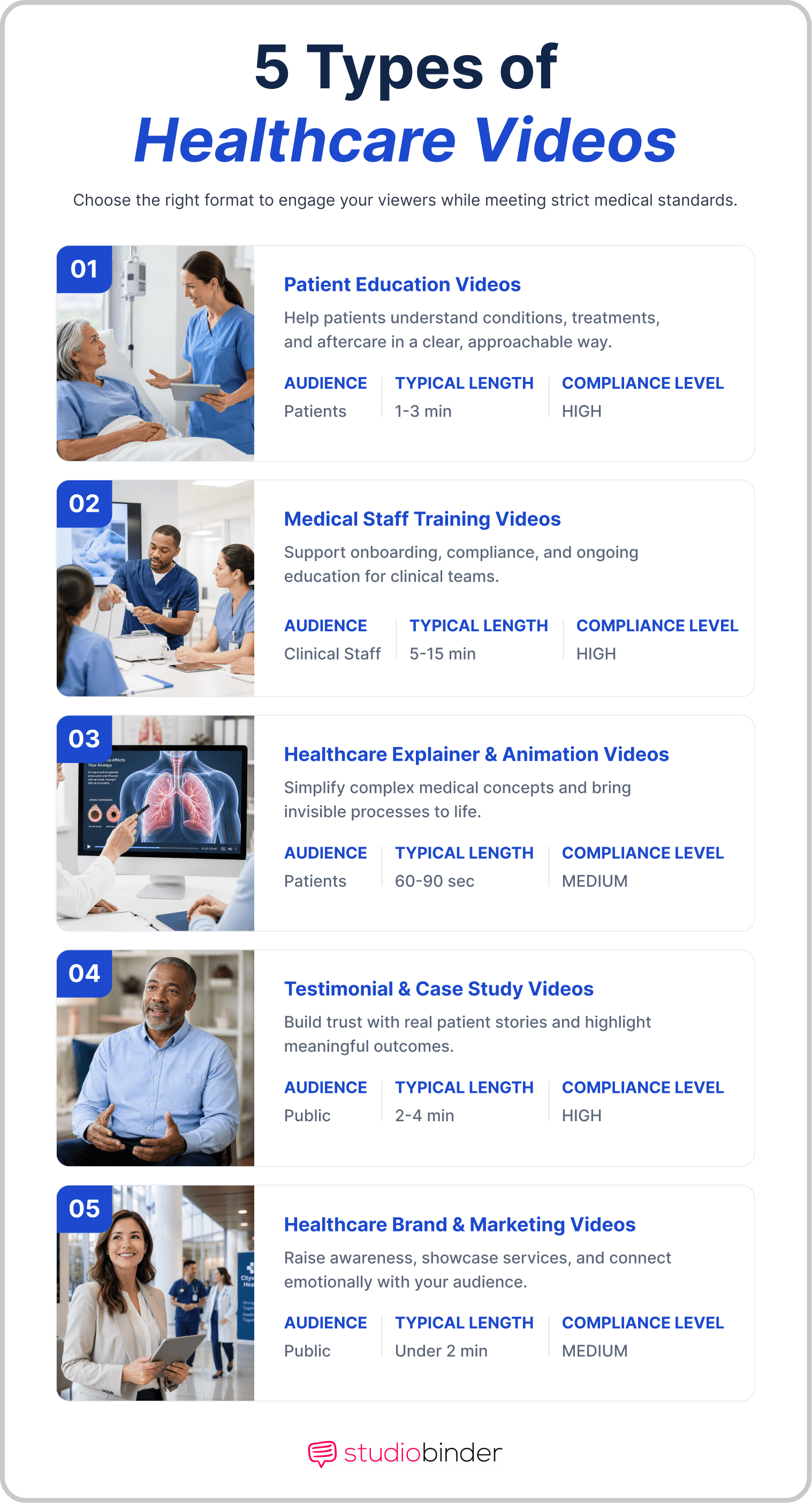
5 Types of Healthcare Videos • Healthcare Video Production
1. Patient education videos
These explain diagnoses, procedures, medications, or post-care instructions. They are hosted on hospital websites, played on loop in waiting rooms, and appear in patient portals. The most important rule: use plain language, not medical jargon. A patient who cannot understand their post-surgery instructions is more likely to end up back in the hospital. Clarity is not just a production value here. It is a health communication strategy.2. Medical staff training videos
Onboarding, compliance training, continuing education, procedure demos. This is where medical training videos earn their budget. The best versions are modular: short, self-contained segments built for busy schedules and LMS platforms. Done well, training video production becomes a resource teams use for years.
Piedmont Health Care - Customer Care Training Video • Healthcare Video Production
3. Healthcare explainer and animation videos
Some things cannot be filmed. That is where medical animation comes in. Internal anatomy, microscopic biology, how drugs work, how diseases progress — none of it can be captured on a standard camera. A healthcare explainer video takes those concepts and makes them visual. These are common in medical device marketing and patient education, where abstract science needs to become something a viewer can follow in 90 seconds.

A Journey Inside Your Body • Healthcare Video Production
4. Testimonial and case study videos
Patient stories, physician spotlights, and outcome case studies. These build trust and humanize organizations. They also call for the most legal groundwork before production even begins. Done well, real patient stories are some of the most effective content in healthcare marketing video.

5 Keys to Creating a Killer Testimonial Video • Healthcare Video Production
5. Healthcare brand and marketing videos
Awareness campaigns, facility tours, recruitment videos, service-line marketing. These follow standard corporate video production conventions, but a healthcare marketing video still has to align with brand and compliance guidelines. Video marketing in healthcare at the brand level can reach audiences no paid ad can. Cleveland Clinic's "Empathy: The Human Connection to Patient Care" has nearly 9 million views. It is widely considered the gold standard in healthcare brand video.
Empathy: The Human Connection to Patient Care • Healthcare Video Production
Related Posts
MEDICAL VIDEO PRODUCTION
What makes healthcare videos different
Healthcare video production is not just corporate video with a stethoscope in the frame. Three factors make it different from standard production. Each one affects your timeline, your budget, and the way you write your script before a single crew member shows up on set.
HIPAA compliance and patient privacy
Any video involving patient information, identifiable images, or medical records falls under HIPAA. That means written consent before filming, strict limits on distribution, and a clear paper trail from consent form to final cut. Healthcare content creation without a documented consent workflow is a liability. Treat it as part of pre-production, not an afterthought you handle on the day.
Medical accuracy and review requirements
Scripts and visuals need clinical review before production. Work with subject matter experts or outside clinical consultants. Build a review round into your pre-production timeline. A medication dosage shown incorrectly is not just an ethical problem. It is a legal one. Fixing errors in post costs money. Fixing them after distribution costs more.
Tone, sensitivity, and trust
Healthcare audiences, especially patients, are often in a vulnerable state. That affects everything: the warmth of your narrator's voice, how you phrase instructions, whether you lead with data or compassion. Keep technical language out of patient-facing content. Save it for staff training, where it belongs. The tone that builds trust in health communication is one that respects what the viewer is going through.
VIDEO PRODUCTION PLANNING
How to plan a healthcare video
Pre-production is where most healthcare video projects succeed or fail. In a standard video production, an incomplete brief can be patched in post. In healthcare, an incomplete brief becomes a costly reshoot, a compliance violation, or a video that cannot be legally released. Every decision you make before the camera rolls either tightens or loosens your risk exposure.
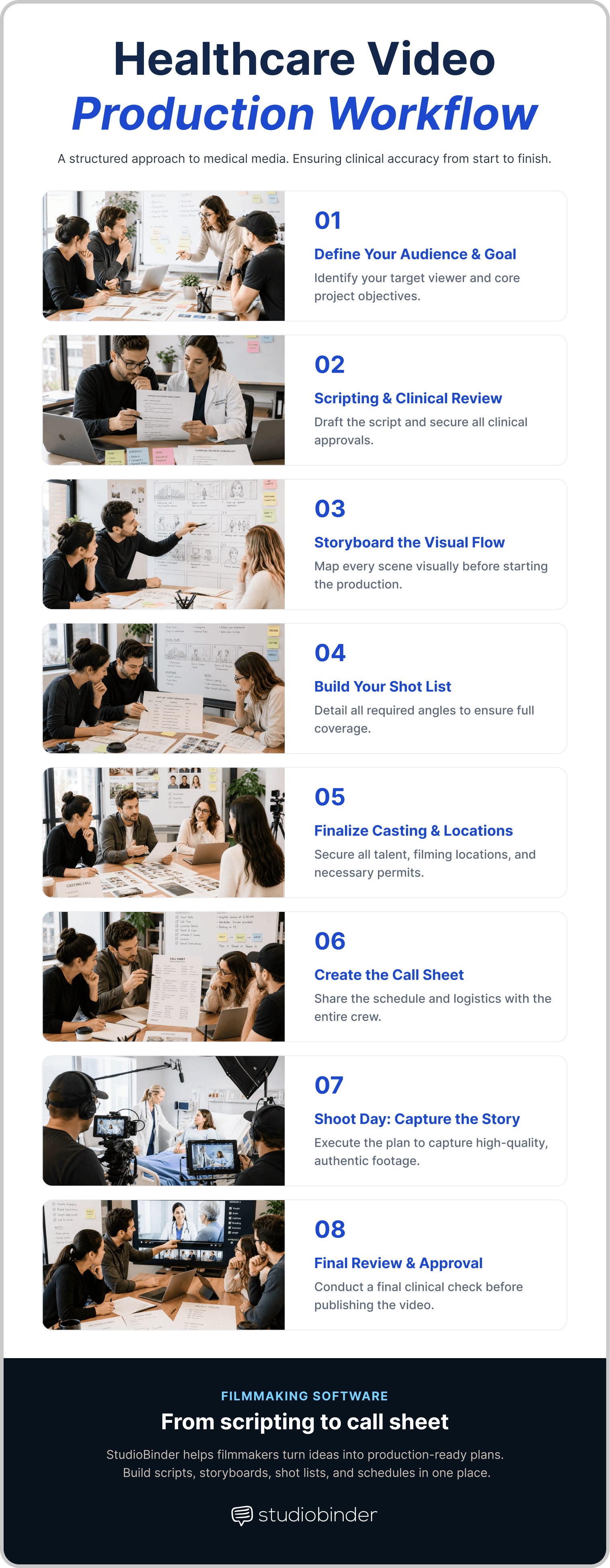
Healthcare Video Production Workflow • Healthcare Video Production
1. Define your audience and goal
Who is the video for? Patients, staff, the general public, payers? What specific action or understanding should it produce? A patient education video and a staff training video can cover the same procedure but look completely different. One uses plain language with reassuring visuals. The other can go deep on clinical detail. Get that locked in writing before anything else moves.
2. Write the script with clinical review built in
Draft the script with clearly flagged sections for clinical review. Do not finalize production until the script is approved. Get sign-off from your clinical or compliance stakeholder first. Factor in at least one full review round in your timeline.
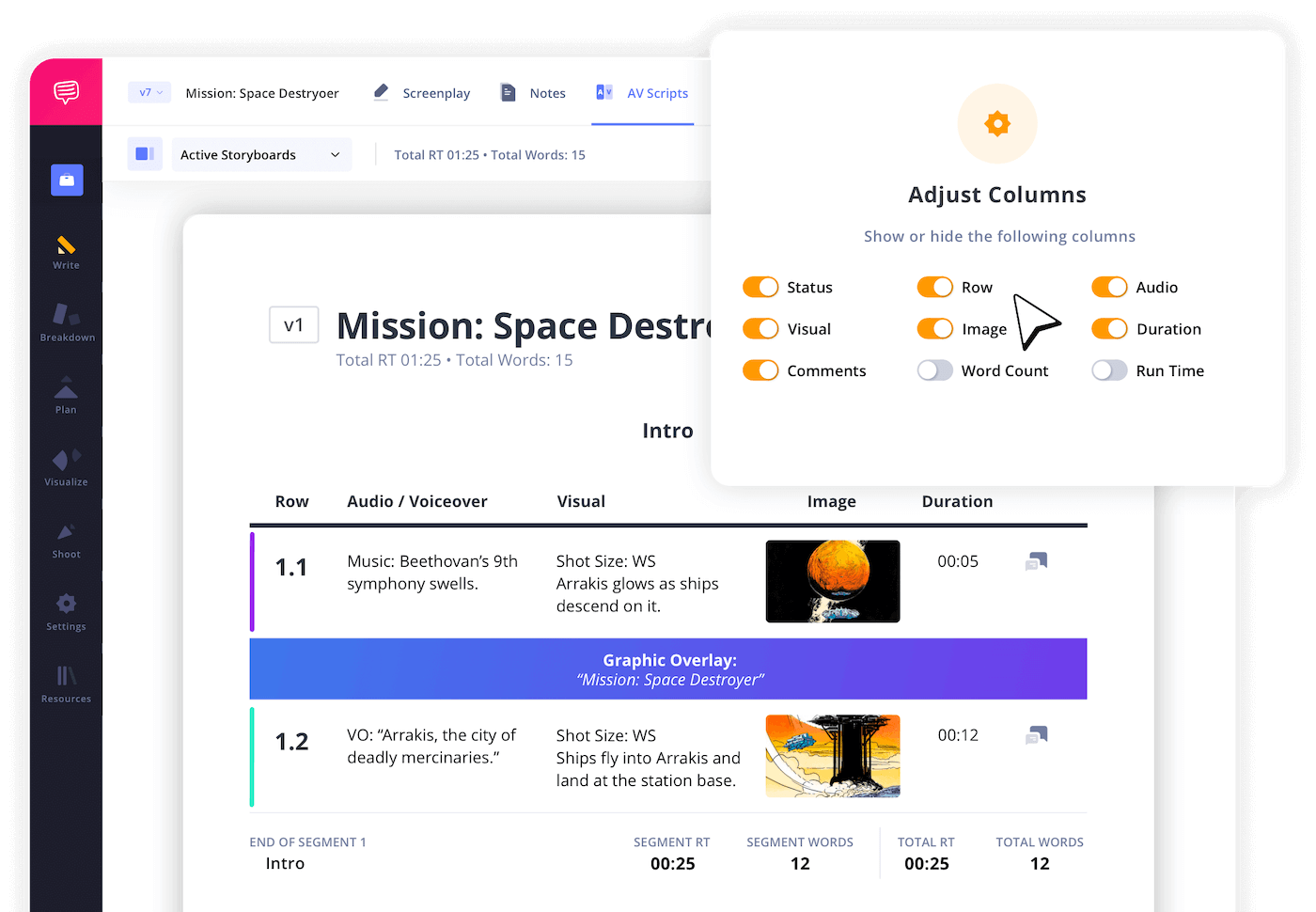
An AV script format works well here. Side-by-side visual and audio columns make it easier for reviewers to flag specific moments without getting lost in a wall of prose.
Create a free AV script in StudioBinder • Healthcare video production
3. Storyboard your sequences
A storyboard visualizes your shots before you take a single step on location. In healthcare production, this matters more than on a standard shoot. Clinical procedures, patient interviews, equipment placement — all of it needs to look accurate on screen.
A storyboard catches problems before they become expensive reshoots. In a hospital setting, a reshoot can be logistically impossible.
Storyboard your medical video production in StudioBinder • Healthcare video production
4. Shot list your video
A shot list documents every planned shot: angle, framing, duration, notes. In a hospital setting, reshoots can be logistically impossible. Patient care schedules and facilities access do not accommodate "can we come back and do that again."
A thorough shot list keeps your crew aligned before a single light is hung.
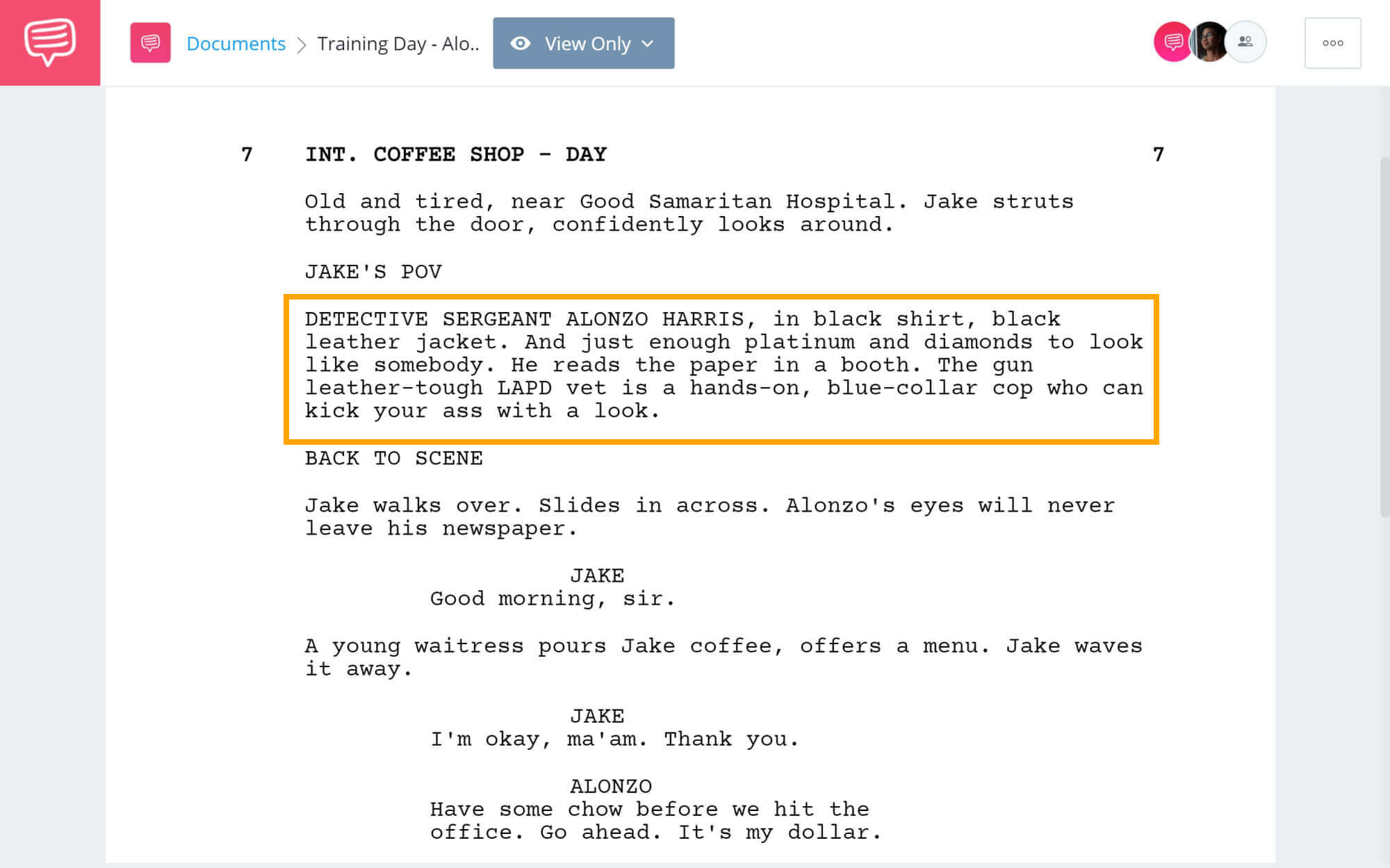
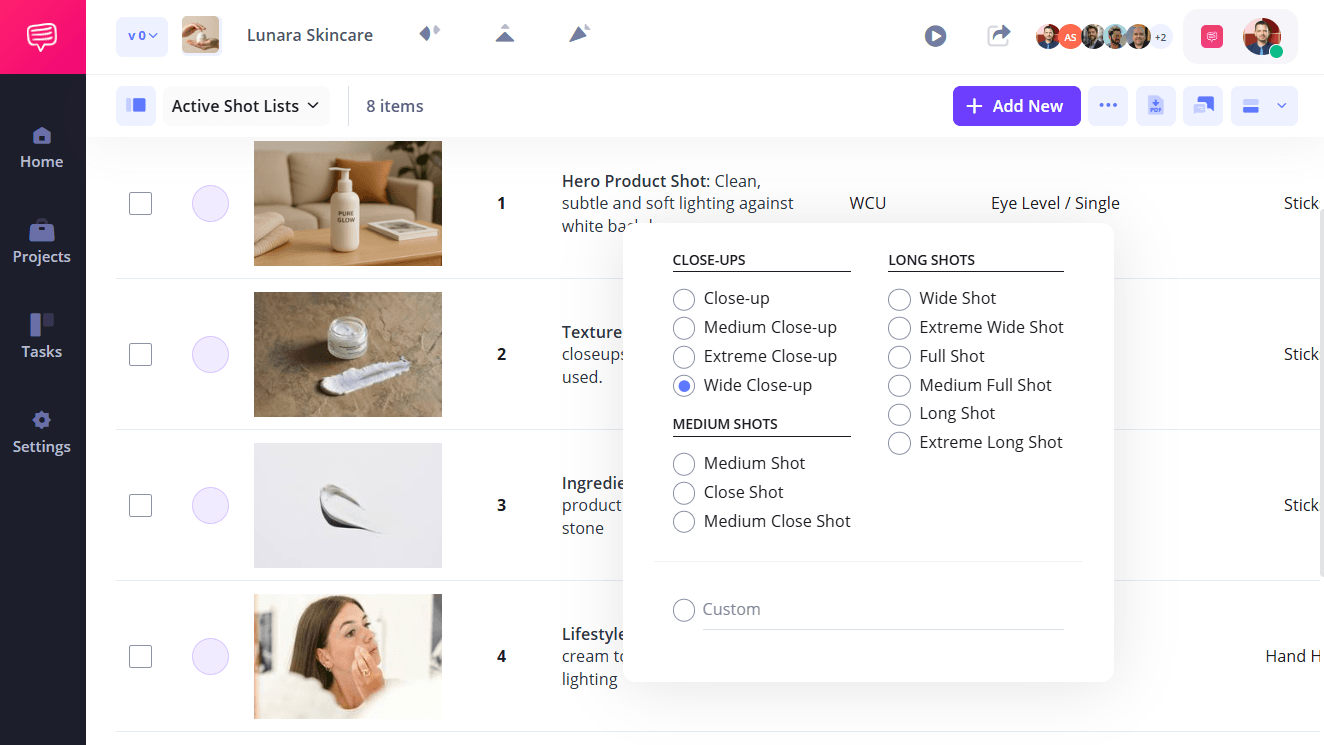
Shot listing inside StudioBInder • Healthcare video production
5. Casting, locations, and talent considerations
Real patients need written consent and a careful briefing before shooting. Actors playing patients need to look credible: think age range, appearance, and relatability. Props and costumes matter too.
One wrong detail and the whole thing loses credibility. Location permits in hospitals and clinical settings take longer than standard commercial permits. Apply early. If healthcare video production companies are on your shortlist, ask specifically about their experience securing access to clinical locations before hiring.
Related Posts
6. Send out call sheets
Send your call sheet before Day One. A call sheet tells everyone where to be, when to be there, and what to bring. In a clinical setting, this matters more than on a standard corporate shoot.
You are working around patient care, facility schedules, and staff. Send it 24 hours out minimum.
Sending a call sheet inside StudioBinder • Healthcare video production
HEALTHCARE VIDEO PRODUCTION TIPS
7 Healthcare Video Production Tips
Good healthcare video production comes down to a handful of habits. They are not complicated, but skipping any one of them is how projects go sideways. Here is what makes the real difference on set and in post.
1. Work with Subject Matter Experts on Set
Having a clinical expert on set prevents costly errors. Wrong equipment in frame, an incorrect procedure, a patient interaction that does not look real — all of it is avoidable with the right person in the room. Their time on set is far cheaper than a reshoot. Make their role clear before the shoot: they are there to flag anything that looks wrong before it is captured, not after. For medical video production, this is a non-negotiable line item in your budget.
2. Keep It Accessible
Unless you are making a video for clinical staff, cut the jargon. Plain language is not dumbing it down. It is respecting your audience's time. Use clear graphics, on-screen text, and easy-to-follow narration. A patient watching a post-procedure video might be tired, stressed, or medicated. Design for that viewer, not the ideal one.
3. Build Compliance Review Into the Timeline
Identify your reviewers before pre-production begins. Share the script early. Get legal sign-off before you shoot. A compliance issue caught in pre-production is a conversation. The same issue caught after launch is a crisis.
4. Use Animation When Live Footage Is Not Possible
Some medical processes cannot be filmed. Internal anatomy, microscopic biology, future surgical scenarios: medical animation fills those gaps. It is often clearer than live footage for complex procedures. Budget for it early. Animation takes longer to produce than a standard shoot day and has its own round of medical accuracy review.
Anatomy & physiology of Human heart: 3D medical animation • Healthcare video production
5. Match the Format to the Distribution Channel
A 12-minute staff training module works on an LMS. It does not work on a hospital's Instagram page. A 60-second animated explainer works for social and waiting room screens. It does not work as a standalone compliance training module. Define where your video will live before you define how long it will be. Format and length should follow distribution, not the other way around.
6. Add Closed Captions to Every Video
Closed captions are required under ADA guidelines for many healthcare organizations. They also improve watch time for viewers in noisy environments and for those for whom English is a second language. For healthcare content creation, captions are not optional. Add them in post and check them for medical terminology accuracy before publishing.
7. Archive Final Assets and Consent Forms Together
When a video is complete, the final export, the signed consent forms, the clinical review approvals, and the distribution rights documentation should all live in the same folder. Not split between a production drive and a legal file cabinet. Healthcare content has a long shelf life. Patient footage may be used years after the original shoot. Knowing exactly what you consented for and where the footage is stored is risk management, not just good organization.
HEALTHCARE VIDEO PRODUCTION COST
How much does healthcare video production cost?
Healthcare video production costs vary more than most people expect. The gap between a simple animated explainer and a multi-location patient education series can be an order of magnitude. The main cost drivers are animation versus live action, number of locations, clinical review rounds, and talent fees.
Video Type | Estimated Cost Range | Key Cost Drivers |
|---|---|---|
Simple healthcare explainer video (animated) | $3,000 – $10,000 | Animation complexity, voiceover talent, medical accuracy review |
Medical staff training video (live-action, single location) | $5,000 – $20,000 | Number of modules, SME on-set time, LMS formatting |
Healthcare brand / marketing video | $8,000 – $30,000 | Location access, cast, compliance review, post-production |
Patient testimonial video | $3,000 – $15,000 | Legal groundwork, consent documentation, on-site coordination |
Full patient education series | $15,000 – $100,000+ | Episode count, clinical review per episode, multilingual versions |
When getting quotes, ask specifically about compliance experience and clinical location access. Those two factors separate specialist healthcare video production companies from generalist ones. That expertise almost always saves more than it costs.
A film budget template can help you benchmark pre-production costs before you start collecting bids. For a broader look at the full video production process, that guide covers every phase from development to delivery.
Related Posts
FREQUENTLY ASKED QUESTIONS
Frequently Asked Questions
The main categories are patient education, staff training, explainer and animation, patient testimonials, and brand and marketing videos. Each serves a distinct audience and requires a different approach to production. A patient education video calls for plain language and reassuring visuals. A staff training module is built for LMS delivery and clinical precision. Brand videos follow corporate video production conventions, with added compliance requirements layered in.
Any video involving identifiable patient information or images must comply with HIPAA. That means written consent, distribution limited to authorized channels, and following your organization's privacy policies. When in doubt, get legal involved before production starts, not after it wraps.
It depends on the type. Patient education videos typically run 1–3 minutes. Staff training modules: 5–15 minutes per topic. Explainer animation: 60–90 seconds. Brand and marketing videos: under 2 minutes. Shorter is almost always better. A viewer who stops watching before the key message lands is a production failure, not a viewer failure.
Yes, with written informed consent. The consent form should clearly explain how footage will be used, where it will be distributed, and for how long. When in doubt, use actors. It removes the ambiguity entirely. You can see how one hospital handled the balance well in this patient experience video, where hospital staff volunteered to portray real patient scenarios.
Look for HIPAA experience first. A production company that has never worked in clinical settings will underestimate consent timelines, location access, and compliance review rounds. Ask to see their pre-production documentation — specifically how they handle patient consent and clinical review. The right company treats those steps as standard workflow, not as extra requests. That discipline is what separates a specialist from a generalist in this space.
UP NEXT
Mastering healthcare shot lists
Planning a healthcare video without a shot list is a risk. You might get through it. But a missed shot in a clinical setting can mean a reshoot that is logistically impossible to schedule. Pre-production planning and storyboarding are the documents that turn a solid script into a smooth shoot day.
Start Your AV Script
Start planning your next video with a structured AV script. Whether for commercials, corporate videos, or social media, our templates provide the perfect framework.