
The Bildungsroman (BIL-dungs-roh-mahn), a German term translated as “novel of education,” centers on the narrative formation of a young protagonist’s journey from innocent childhood to becoming an experienced adult who has grown in every way: morally, intellectually, psychologically, spiritually, and emotionally. It’s not always an exciting journey, often mundane, and the ending isn’t guaranteed to be happy, clear, or satisfying. The Bildungsroman is life.
bildungsroman Meaning
First, let’s define bildungsroman
While you may have a general idea of what bildungsroman encapsulates, it's best to start with a basic definition. Then we'll jump into an expansion on the idea with some examples.
Bildungsroman DefinitionWhat is a bildungsroman?The Bildungsroman is a novel of a protagonist's journey from childhood innocence to mature wisdom. The story typically follows the protagonist as they face challenges, gain experience, and discover their identity. Through these experiences, the character matures emotionally, morally, or intellectually. |
Features of Bildungsroman:
- Coming-of-age journey
- Personal growth
- Identity discovery
- Life challenges
- Moral maturation
Now let's let the OSU School of Writing, Literature and Film break down the basics of what a bildungsroman is:

OSU School of Writing, Literature and Film · What is a bildungsroman
Where the Term Comes From
Philologist Johann Karl Simon Morgenstern is credited with coining the term in 1819. The novel that set the Bildungsroman standard is the 1795 Wilhelm Meister’s Apprenticeship by Johann Wolfgang von Goethe. The novel tracks the journey of Wilhelm, the son of a merchant, who finds his secure life banal, and he prefers to join the world of theater, art, and poetry.
In the end, after a journey fraught with heartbreak and brutal realizations, he matures and returns to a stable life in society.
Other popular Bildungsroman novels are Charles Dickens’ David Copperfield and Great Expectations, Charlotte Brontë’s Jane Eyre, J.D. Salinger’s Catcher in the Rye, Harper Lee’s To Kill a Mockingbird, and Stephen Chbosky’s The Perks of Being a Wallflower.
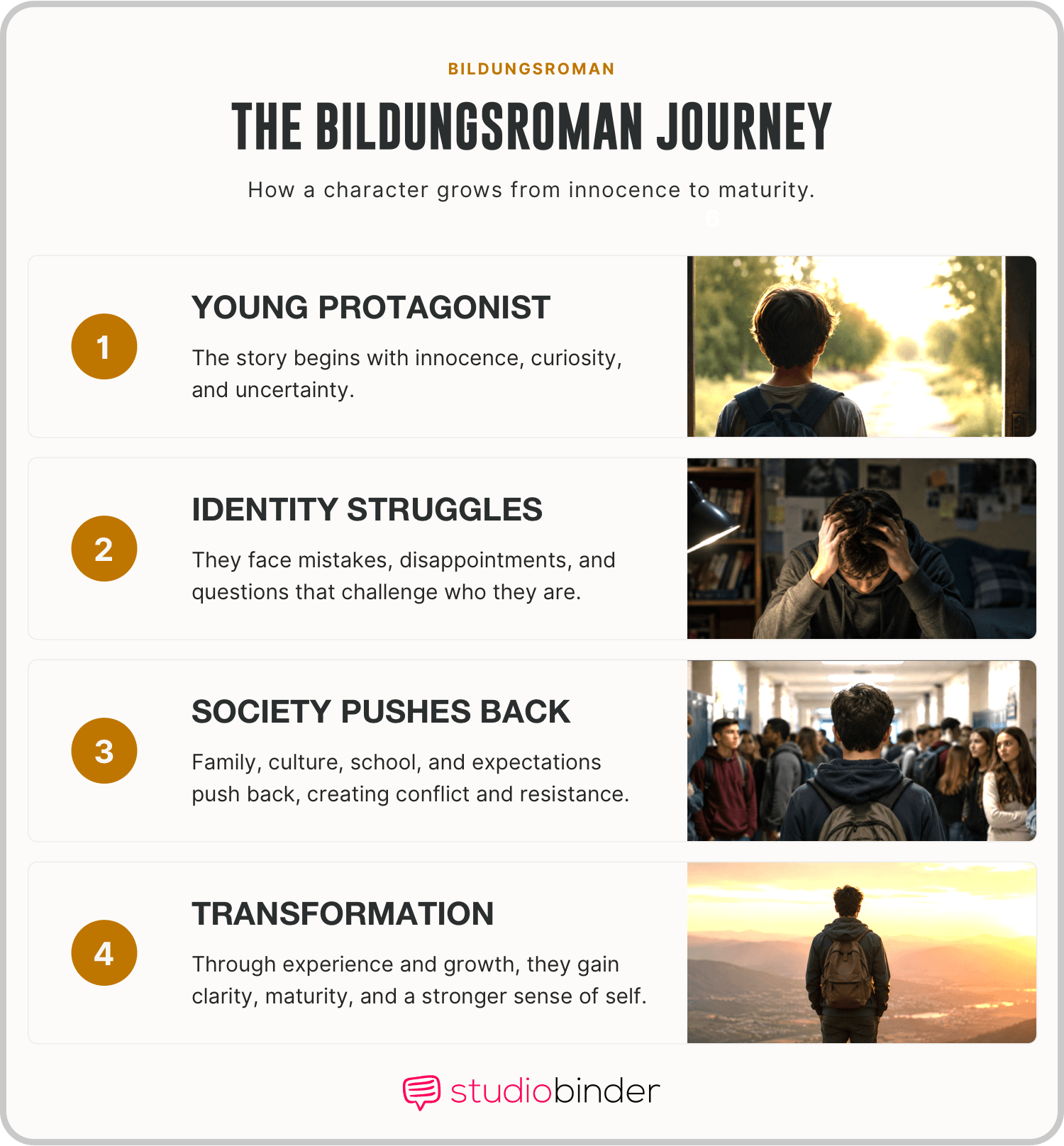
The Bildungsroman has also found its way into film. The most popular Bildungsroman films include Lady Bird, Boyhood, Stand by Me, The Graduate, and Almost Famous. We distilled the core building blocks of the bildungsroman journey into 4 essential stages below.Bildungsroman Characteristics
Key characteristics of a bildungsroman
As a literary device, the Bildungsroman functions through a specific narrative structure and character arc.
A Young Protagonist at the Start of a Journey
The protagonist is usually an adolescent or a young adult in a state of innocence, ignorance, and confusion of who they are and their place in society. Mason in Boyhood begins as a child with no agency.
What does the character journey look like visually in a protagonist? Take a look at the example below to give you a good idea.
The Journey from Innocence to Maturity • Bildungsroman
He bounces around because his life is controlled by the turbulent adults around him. This is the opening wound, the ache the Bildungsroman protagonist must heal, and it is the world that will be the teacher.
In the end, the protagonist is transformed with a new understanding of the world and their place in it. In , teen writer William Miller has been stripped of his illusions and naive adoration of the rock music world after betrayal. He can see the world in its dirty truth and live in that world. His war with society is over, and the has found balance between the self and the world.Psychological Growth and Inner Conflict
In the Bildungsroman, the transformation is internal, not just external. It isn’t about the plot events in the protagonist’s life. It is about how those experiences fuel significant character development and change the character’s understanding of self.
The protagonist’s journey is not peaceful but riddled with numerous challenges, failures, humiliations, and revelations that are often unpleasant. For Lady Bird, she bucks her mother, her stuffy hometown, and her strict Catholic school. Her senior year is rife with turmoil, and these vignettes reshape Lady Bird’s character as they offer life lessons.
Society as the Antagonist
What is key is that the protagonist is at war with society, with family, or with the community. The protagonist is misunderstood, maligned, and is fighting for identity in a world that does not accept or understand them.
Young Gordie in Stand by Me is shunned by his family, and he and his friends travel the landscape assaulted by bullies, their communities, and their pasts. Society isn’t a villain to be defeated, however. Society is the teacher.
A Transformed Hero by the End
Want both a quicker and highly entertaining explanation of a bildungsroman? Johnathan Apuzen has you covered:

Johnathan Apuzen · What is a bildungsroman
Bildungsroman vs Coming-of-Age
Bildungsroman vs. Coming-of-Age Story
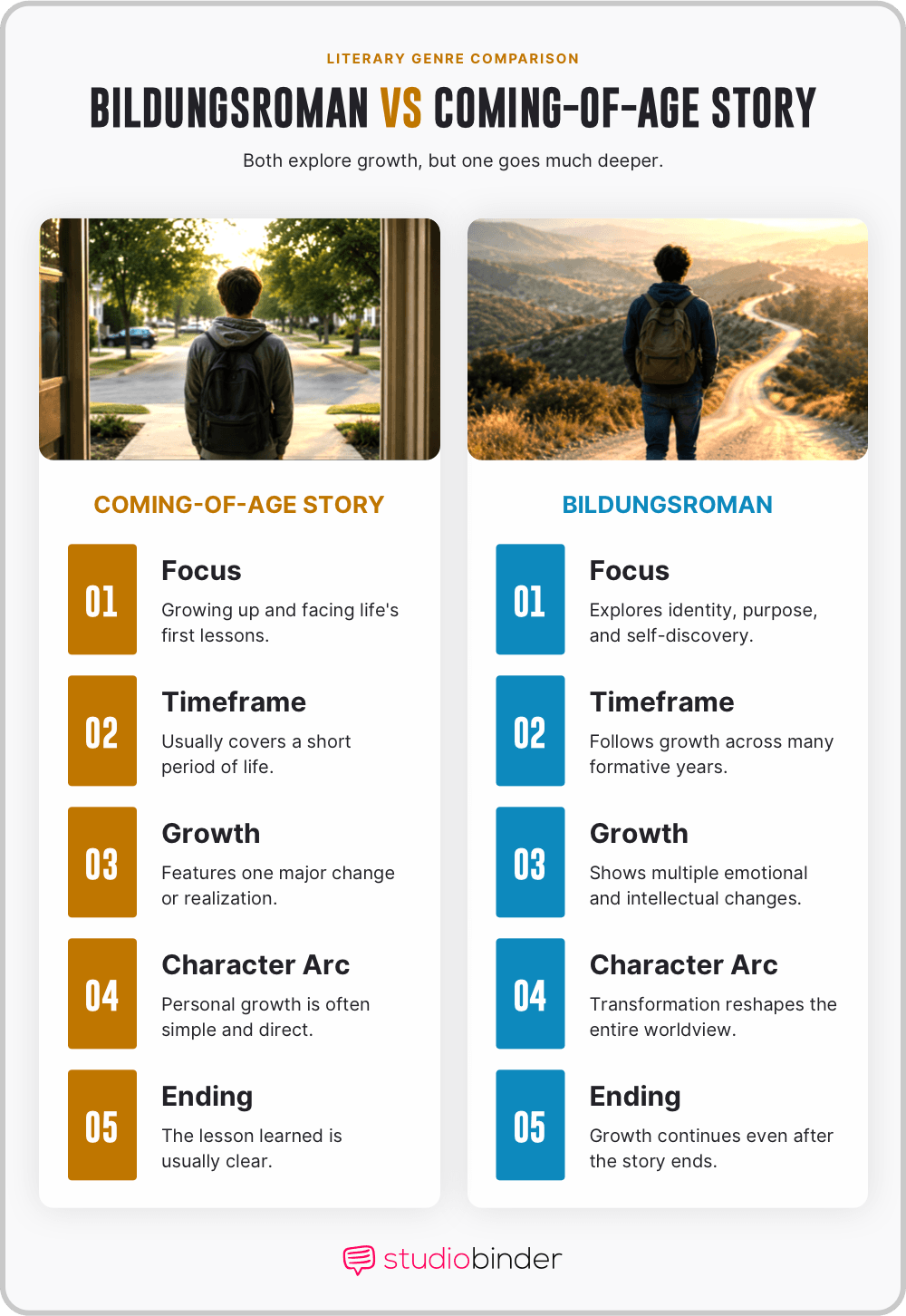
The Bildungsroman can be considered a sub-genre of the coming-of-age story. All Bildungsromans are coming-of-age stories, but not all coming-of-age stories are Bildungsromans.
The coming-of-age tale is simpler. This story of growing up has a far less textured landscape, and such a tale may feature a heartbreak or a lesson hard learned.
Comparing Literary Genre Differences with Coming of Age Stories • Bildungsroman
The story may only be a snapshot of a day, weekend, or a month. In contrast, the Bildungsroman protagonist doesn’t merely get older and wiser. Usually, the story follows the protagonist over an extended formative period.
The protagonist experiences deep philosophical, intellectual, moral, psychological, and spiritual shifts as a result.
Bildungsroman Films
Classic bildungsroman examples in literature
From David Copperfield to The Catcher in the Rye, these influential novels define the bildungsroman genre through journeys of self-discovery, personal growth, and the search for identity. Let's jump into six literary examples of bildungsroman below.
1. David Copperfield (1850) by Charles Dickens
This Bildungsroman is David Copperfield’s narration of his own life story. His wound is the loss of his father and subsequent abuse at the hands of his stepfather. He is unsettled and seeks to find an identity of his own.
His story is overflowing with an odd cast of characters, many of whom are treacherous and deceitful and serve as moral trials or warnings of deceit.
They aren’t there for color but to serve as teachers. David experiences heartbreak, financial loss, and grief that tame his wild heart. In the end, he finds balance in a relationship and career.
2. Great Expectations (1861) by Charles Dickens
This Bildungsroman begins with an eight-year-old orphan Pip who lives with his sister and her blacksmith husband. His humble and impoverished origins are a shame to Pip and he longs to become a gentleman in a society that only sees him as coarse and unworthy.
Pip yearns for external validation of his worth. He travels to London thanks to the generosity of a benefactor, and he does find a life of status. Yet, life can be a brutal teacher, and he realizes that wealth does not equal value. In the end, he finds humility and balance.
3. Jane Eyre (1847) by Charlotte Brontë
This Bildungsroman follows the life of an orphan from childhood to adulthood. Jane is lost in the world after her parents die, and she is left to the abuse of her aunt and cousins. Her deep wound is feeling isolated and unloved which builds a rage inside her, and she presses to be treated with dignity.
She is determined to find a place in a society that rejects her. At every turn, Jane is faced with restrictions on her freedom and forces that try to break her spirit. Yet, humiliation tempers her, and in the end, she learns of an inheritance and a family, and she finds love with a man who treats her as an equal.
4. The Catcher in the Rye (1951) by J.D. Salinger
This Bildungsroman is written as a flashback from 16-year-old Holden Caulfield. His wound is profound alienation and cynicism from a society that he believes is “phony.”
He is expelled from an elite private school, and before returning to his parents, he spends a few days in New York City where he is confronted by his own hypocrisies. In the end, he is in a psychiatric facility, and it is unclear if he is wiser or still unwilling to grow up.
5. To Kill a Mockingbird (1960) by Harper Lee
This Bildungsroman is the story of Scout Finch. She is the daughter of Atticus Finch, an attorney living in rural Alabama. Atticus takes on a case to defend Tom Robinson, a black man, against a bogus rape charge.
In the beginning, Scout is a naive little girl, yet during the course of the Robinson trial, she is exposed to the realities of hatred and racism, marking the profound loss of innocence and an awakening to the cruel injustices of the world. Thanks to her father, she learns the art of balancing this new awareness with empathy.
6. The Perks of Being a Wallflower (1999) by Stephen Chbosky
This Bildungsroman follows Charlie through his freshman year in high school. His wound, initially buried under survivor’s guilt and grief, is that he is traumatized by repressed sexual abuse and the suicide of a friend.
As he navigates his school year as a shy “wallflower,” he looks to older students to understand how to behave, and he learns to forgive his abuser. By the time he enters his sophomore year, he considers that he is “infinite,” and becomes optimistic that there is life after trauma.
Related Posts
Writing a Bildungsroman Guide
Bildungsroman examples in film
From Lady Bird to Boyhood, these films capture the emotional, psychological, and personal transformations that define the bildungsroman journey.
Lady Bird (2017)
High school senior Christine McPherson is trapped. This is her wound. She feels imprisoned by her mother’s conservative protection and her family’s tight financial situation. In reality, her mother is the personification of society, a society that demands conformity while she seeks identity. But in classic Bildungsroman style, her mother isn’t the enemy. She is the friction Christine needs to grow.
Lady Bird trailer · bildungsroman
Christine experiments with new identities, and she specifically changes her name to Lady Bird. She yearns for more than what she perceives as her provincial hometown of Sacramento. So, she bucks these restrictions. She applies to colleges in New York City and Los Angeles against her mother’s will. She insists on the name Lady Bird rather than her given name of Christine. She disrupts an anti-abortion speaker at school and vandalizes a nun’s vehicle.
Every conflict is an experiment in the exploration of her identity. Director Greta Gerwig has acknowledged the influence of her own childhood hometown of Sacramento in Lady Bird, and she has said it is often only when one leaves home that one truly understands and appreciates it.
“There’s all this stuff built in at that age where you feel like you’re wrong, the place is wrong, and the certainty that life is happening someplace else, and that you’ve just got to get to the life that’s happening another place … and once you get there, you realize that life was going on all the time,” Gerwig said in an interview.
In the end, this is Lady Bird’s final balance. She embraces her given name, and realizes her gratitude for her childhood and her mother.
Boyhood (2014)
Boyhood is singular in cinematic history, embodying the Bildungsroman in both content and form. By filming Ellar Coltrane annually from age six to 18 between 2002 and 2013, Richard Linklater captures maturation as a lived reality rather than a cinematic illusion. Consequently, the film’s structure is a historical fact, transcending simple film genre labels.

Boyhood trailer · bildungsroman
Mason is raised largely by his single mother, yet he enjoys visits with his father. There are no astounding or shattering moments in Boyhood. Rather, the film follows Mason over 12 years as daily life experiences coalesce and cause him to shift his perspectives on his turbulent childhood.
The events are mundane and relatable and capture the true experience of growing up. Mason’s journey is quiet, and his shifts are gradual as they would be over extended time. In the end, he has left for college as a young man who has come to terms with a more independent world view and the realization that life is a series of constant moments.
Linklater has noted, at the start of film production, that there was a script for the first year but a broad outline for the remaining years. This way, he allowed the script writing to evolve with the filming. Director Richard Linklater described this process as a rare luxury and said, “It’s such a unique process because as a writer you’re not really given that chance because you just write a script. But in this case I got to write a part of a script, shoot it, edit it, and have that inform the continual writing process. That was an incredible gift and opportunity that the time allowed.”
Stand By Me (1986)
Stand by Me is based on Stephen King’s novella “The Body.” Four boys set out to find a dead body and return after burying their own childhoods. The framing of this Bildungsroman is key in that Gordie’s arc is the most explicit. The narrative begins as a flashback where Gordie, now a father and a writer, is recalling an overnight journey where he and his friends walk the railroad tracks to locate the body of a missing local boy. It is their hope that they will return as local heroes for discovering the body.

Stand By Me trailer · bildungsroman
This search is even more poignant for Gordie because his family has not stopped grieving the death of his older brother, leaving Gordie alone and neglected. In this quest for the body, Gordie faces death head on.
All four of the boys are harboring familial wounds, and the journey’s tribulations offer new insights and perspectives on their lives. For director Rob Reiner, focusing on Gordie’s story arc was important because “through the experience of going to find the dead body and his friendship with these boys, he began to feel empowered and went on to become a very successful writer. He basically became Stephen King.” This made the Bildungsroman literal.
It is fitting that their quest is a walk along the railroad tracks, symbolizing the linear journey they are taking from their child selves to adulthood, from innocence to experience. It’s even more notable that they seek a dead body which is a stark contrast to the living bodies they inhabit.
Adult Gordie’s final observation crystalizes the theme of the Bildungsroman. Gordie says, “I never had any friends later on like the ones I had when I was twelve. Jesus, does anyone?”
It is here that Gordie realizes that the body and the journey were insignificant in comparison to the bonds he shared with three other boys, the boys who shared their struggles on the tracks toward inevitable adulthood.
The Graduate (1967)
Benjamin Braddock returns to his family’s California home after his college graduation and is paralyzed and overwhelmed with what could be next. He is disgusted with his family’s bourgeois lifestyle and their vapid friends, yet Benjamin has no idea what to do with himself.
What’s notable is that The Graduate offers a perfect inversion of the Bildungsroman form. Instead of Benjamin engaging with society, doing battle with his demons, Benjamin retreats into his awkward and sexually insecure self. He spends the summer floating in the family pool and having an affair with the older Mrs. Robinson, a friend of his parents.

The Graduate trailer · bildungsroman
There is no growth in this Bildungsroman because Benjamin refuses to participate. He is separated from the world as Nichols repeatedly filmed Benjamin underwater, through glass windows, and behind a SCUBA mask. He refuses to participate because he can’t. And this makes the world a tough place.
The book Mike Nichols: A Life (2021) describes how director Mike Nichols saw The Graduate as a story of a young man suffocating in materialism. “He comes home and is almost catatonic from the bombardment of things,” Nichols said.
The Graduate was released when the United States was culturally in flux. The America of the Greatest Generation was clashing with a radicalized culture of youth. The Benjamin Braddocks are caught in the crossfire of this cultural tension. Nowhere is this more clear than in the famous final shot.
Benjamin has just disrupted the wedding of Elaine, the daughter of Mrs. Robinson, and runs off with the bride. The two escape the church and jump onto a bus, Elaine still in her wedding gown.
Slowly their adrenaline-fueled smiles fade, and their expressions return to the ambiguous stare of “now what?” In the end, Benjamin, and now Elaine, are stalled, even though the bus keeps moving.
Almost Famous (2000)
In Cameron Crowe’s autobiographical film, William Miller, age 15, joins a band’s tour on assignment for Rolling Stone magazine. William’s wounds are rooted in the complex relationship with his mother Elaine. He is brilliant but invisible.
He is suffocating from a mother who loves him by smothering him. William is seduced by the rock-and-roll music that is strictly forbidden by his overprotective mother, and he writes articles about music for underground magazines.
Rolling Stone takes notice of young William’s talent and sends him on tour with a band called Stillwater. It is William’s idealism of the rock world that makes him vulnerable to the harsh truths of the road.
![Almost Famous (2000) Original Trailer [FHD]](https://i.ytimg.com/vi/PmojczkkQdU/hqdefault.jpg)
Almost Famous trailer · bildungsroman
Almost Famous mirrors Cameron Crowe’s own development as a music journalist. At age 16, he published his first cover story in Rolling Stone. Like William, he was a victim of his own desire to be cool, yet he called his own memoir The Uncool (2025). Crowe said he grew to wear that label like a badge of honor.
In the film, Lester Bangs, William’s rock journalism mentor, told him that a true journalist must be honest and unmerciful, and he warned that the band may try to use him so he will write a flattering story. William is reluctant to receive this advice, so society, in the form of the music industry, must provide the pressure to crack William’s rose-colored glasses.
Almost Famous is a classic Bildungsroman journey story where the bus tour is the route of William’s transformation. He leaves his sheltered home full of idealism for the rock-and-roll scene of the 1970s. He is seeking validation from the “cool” people he has idolized for most of his young life. Unfortunately, he learns the music scene is full of deception, anxiety, and all the selfishness and insecurity that comes with fame.
The moment that delivers the harshest lesson is when William submits a truthful article to Rolling Stone about the tour, but the band claims William’s writing is false. Thus, Rolling Stone kills the piece. This is when William’s idealism shatters, and he enters the adult world of reality. Perhaps that is where the true “cool” lies.
WRITING A BILDUNGSROMAN
How to Write a Bildungsroman
Learn how to build a compelling character arc through identity, conflict, growth, and transformation. Follow these four steps and you'll be on your way.
1. Start with Defining the Wound
Begin with your protagonist. The Bildungsroman lead must have a wound. What broke this person before the story begins?
Christine McPherson grew up in a poor family. Mason was bounced around by the erratic adults surrounding him. Gordie’s brother died, leaving his parents distant and inaccessible. Benjamin Braddock just graduated college and was lost and directionless. William Miller craved an in to the cool people because he has skipped grades and lives as a child in an older world.
2. Build the Society Your Character Must Reckon With
Your Bildungsroman protagonist needs to live in a fully developed world with values, priorities, and point-of-view that provide friction for your character. When your character encounters these forces, they must absorb, reject, or renegotiate. Be specific.
Your society can be Sacramento, Texas in the early 2000s, rural Oregon on Labor Day weekend in 1959, Pasadena in 1967, or a rock-and-roll tour bus in the mid-1970s.
Think about these settings and all they imply. Consider your cast of characters, your scenery, the media, and music of the time. Think about the style of dress and the vernacular speech. Allow the characters to peek out of the story and see what’s going on in the world around them.
3. Let the Journey Change Them — Show, Don't Tell
What exactly is the journey? Is it the senior year of high school? Is it 12 years of childhood daily activities? Is it a walk along the railroad tracks to find a dead body? Is it the summer after graduating college? Is it a rock tour on a bus?
As your protagonist undertakes this heroic journey, there are a series of events, scenarios, vignettes that poke at the wound, expose it, and challenge it. How does your protagonist respond to each moment?
What is key is that the transformation for your Bildungsroman protagonist must be revealed through their behavior. Your character does not announce to your viewer, “Hey, I changed and here is why and how.” The transformation is presented through what they do and the new choices they make. Trust your audience to notice.
4. Don't Resolve Everything
Your protagonist has changed, but the future is open. Lady Bird, newly grateful for her family and childhood, arrives in New York City. Mason sits with his new friends in nature, pondering the possibilities on his terms. Gordie embraces a loving family and career as well as appreciation for his old friends.
Benjamin Braddock finally took some action, yet the results of that action are unclear. William has stepped away from his illusions and accepted himself for all his uncoolness. The best Bildungsromans end ambiguously, like life.
Frequently Asked Questions
Bildungsroman FAQs
Yes, Harry Potter is a Bildungsroman. It is actually a combination of Bildungsroman and fantasy which is quite common. Harry’s psychological arc and all the resistance he receives from Voldemort, the Hogwarts class system, and the wizarding world’s bureaucracy provides the resistance to usher in his transformation across all seven novels. Seven novels can certainly capture the extended formative period of the genre.
The Bildungsroman can be considered a sub-genre of the coming-of-age story. All Bildungsromans are coming-of-age stories, but not all coming-of-age stories are Bildungsromans. The coming-of-age tale is simpler. The coming-of-age story may only be a snapshot of a day, weekend, or a month. In contrast, the Bildungsroman protagonist doesn’t merely get older and wiser. Usually, the story follows the protagonist over an extended formative period, and the protagonist experiences deep philosophical, intellectual, moral, psychological, and spiritual shifts as a result.
Some of the most beloved Bildungsroman films are Lady Bird (2017), Boyhood (2014), Stand by Me (1986), The Graduate (1967), and Almost Famous (2000). Also check out Moonlight (2016), Clueless (1995), The 400 Blows (1959), Spirited Away (2001), and The Goonies (1985).
No, a Bildungsroman does not have to end happily. The ending can be painful, incomplete, or bittersweet. All that is required in the Bildungsroman is change. As everyone knows, the road to change can be a bumpy road. In fact, many Bildungsroman protagonists often trade their innocence for harsh and brutal truths.
Traditionally, a Bildungsroman does not feature an adult protagonist. The form is usually defined by an adolescent or young adult on a quest for identity formation. Some “adult Bildungsroman" books and films exist such as Eat, Pray, Love, but such texts usually don’t fully satisfy the genre’s structural requirements. Such a text could be called a “Re-Bildungsroman” or a “late-life coming-of-age.”
UP NEXT
What is a Narrative
Now that you understand what a bildungsroman narrative is, explore how narratives are structured. Learn how characters, conflict, plot, and theme work together to create compelling stories across film, television, literature, and other forms of storytelling.

From script to production. Write, collaborate, and produce all in one place.
Write scripts online for free. Track versions. Share for feedback and approval. When you're done transition seamlessly to script sides, shot lists, storyboards, schedules, breakdowns, call sheets and more.