
Every iconic movie, script, or novel relies on a hidden structural blueprint. When a narrative feels stuck or falls flat, it’s almost always because one of these foundational building blocks is missing. Here are the 7 essential parts of a story you need to master to hook your audience from start to finish.
Story Elements
What are the parts of a story?
Every story feels different. Different characters. Different worlds. Different stakes. But beneath those differences, the parts of a story are often the same.
Writers, screenwriters, and filmmakers all rely on a shared foundation. Every narrative is built from the structure of a story that shapes how events unfold, and from story elements that give those events meaning. When these components of a story work together, the story feels clear, engaging, and complete.
For a simple understanding of all the parts of a story, let's check out a visual breakdown below by Khan Academy.

The Elements of a Story by Khan Academy • Parts of a Story
The problem is that these ideas are often taught separately. You learn about plot in one place. Character somewhere else. Theme later. That makes it harder to see how the parts of a story actually connect.
This guide brings those pieces together.
First, we break down the five structural parts of a story — the core of story structure. Then, we explore the seven essential elements of a story, from character and conflict to theme and tone.
Whether you are analyzing a narrative or building your own, understanding the parts of a story gives you control.
Plot Structure
The structural parts of a story
Most narratives follow a recognizable arc, often described as Freytag's pyramid.
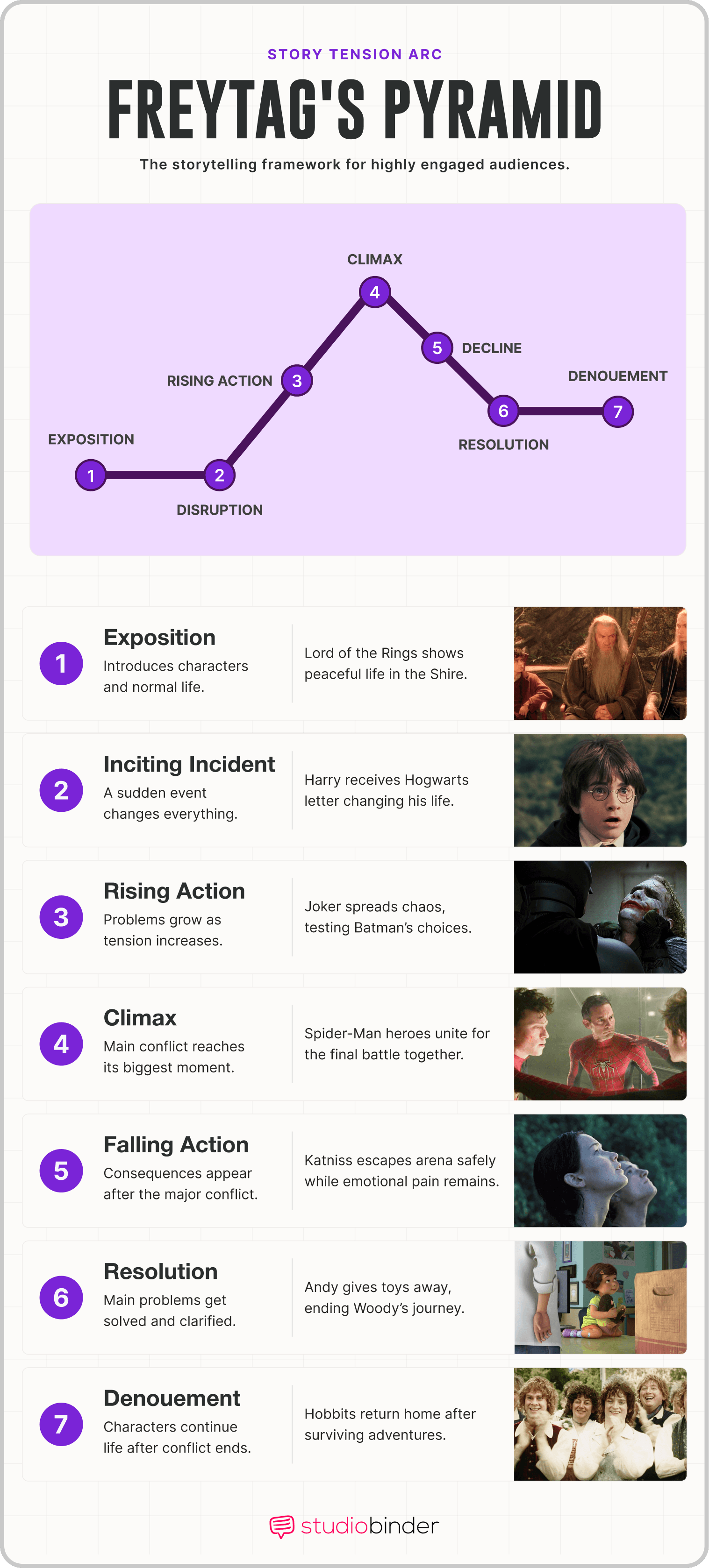
Freytag's Pyramid Narrative Tension Structure Framework • Parts of a Story
Now Freytag's pyramid started out as five parts of a story; modern storytelling uses an expanded 7-stage version to track how tension builds, peaks, and resolves. They are not rigid rules, but they are reliable patterns. When a story feels off, the problem usually sits in one of these stages.
The goal is not to label each part. The goal is to understand what each part must do.
1. Exposition
Exposition parts of a story establish the world before anything changes.
It introduces:
- Characters
- Setting
- Tone
- Baseline relationships
This is the "normal" state of the story. The audience needs this to understand what is at stake once disruption occurs.
Good exposition is active. It reveals information through behavior, not explanation. It avoids front-loading unnecessary detail.
A common mistake is over-explaining. Another is under-explaining. If the audience does not understand the world, they cannot engage with the conflict.
In The Godfather, the wedding sequence introduces power dynamics, family structure, and tone in one continuous flow. Nothing is stated directly, but everything is clear.
Diagnostic question: Do we understand what "normal" looks like before it changes?
To learn about the fundamentals of exposition in writing, take a look at StudioBinder's video essay below:

What is Exposition? • Subscribe to StudioBinder's YouTube Channel
2. Rising action
Rising action begins when the story is disrupted.
This is where the central conflict develops. Obstacles appear. Stakes increase. The protagonist is forced to respond.
Rising action is not just "more events." It is escalation. Each event should make the situation harder, more complex, or more dangerous.
There is usually an inciting incident at the start of this phase. This is the moment that breaks the normal world established in the exposition.
A common mistake is repetition. If the same type of obstacle repeats without escalation, the story stalls.
In The Godfather, the attempted assassination of Vito Corleone destabilizes the system. Michael is drawn in. Each step pulls him deeper into conflict.
Diagnostic questions: Is the situation getting harder? Are the stakes increasing? Is each event pushing the story forward?
3. Climax
The climax of a story is the point of maximum tension.
This is where the central conflict is confronted directly. The protagonist must act. Delay is no longer possible.
The climax of a story is not just the biggest event. It is the most decisive one.
It is also where character is revealed. The choice made here shows who the character has become.
A weak climax often comes from weak build-up. If the rising action does not escalate properly, the climax of a story will feel unearned.
In The Godfather, Michael's decision to execute the heads of the Five Families resolves the external conflict and confirms his internal transformation.
Diagnostic questions: Does this moment resolve the central conflict? Does it force a decisive action? Does it reveal character?
Learn the fundamentals of building climax in a story by watching StudioBinder's video essay below:

How to Build Conflict in a Story • Subscribe to StudioBinder's YouTube Channel
4. Falling action
Falling action shows the consequences of the climax.
This is where tension begins to release. The audience processes what has happened. The world adjusts to the outcome.
This stage is often misunderstood. It is not filler. It is essential.
Without falling action, the climax has no weight. The audience needs space to understand the impact of the decision.
A common mistake is rushing from climax to resolution. This creates emotional disconnect.
In The Godfather, Michael consolidates power. The cost of his actions becomes visible in his relationships.
Diagnostic questions: Do we see the consequences clearly? Does the story allow the impact to land?
5. Resolution
The resolution in a story is the final stage of the structure of a story.
It establishes the new normal. It answers the central question, either directly or indirectly.
The resolution in a story shows change. The protagonist is not the same as they were in the beginning. Even if they fail to change, that failure is meaningful.
Resolutions do not have to be neat. They can be ambiguous or unresolved. What matters is that they feel intentional.
In The Godfather, Kay watching the door close on Michael confirms his transformation. The resolution in a story can be quiet — but it must be definitive.
Diagnostic questions: What has changed? What has stayed the same? Does the ending feel earned?
How to use the 5 parts in practice
Understanding the five structural parts of a story is not just theoretical. It is a practical tool.
When analyzing a film, you can map these stages to understand how it works. When writing, you can use them to diagnose problems:
Stage | Function | Diagnostic Question |
|---|---|---|
Exposition | Establish the world | Do we understand what "normal" looks like? |
Rising Action | Build conflict, escalate stakes | Is the situation getting harder? |
Climax | Force a decisive action | Does this moment resolve the central conflict? |
Falling Action | Show consequences | Do we see the impact clearly? |
Resolution | Establish new normal | Does the ending feel earned? |
Knowing the Freytag's pyramid is one thing, but tying it to a 3-act structure still becomes important to give it a clear beginning, middle and end.
What is the 3-Act Structure • Subscribe to StudioBinder's YouTube Channel
In StudioBinder, you can map every scene to its act, track story beats across your script, and watch the whole story take shape in one visual Task Board.
Building a 3-Act Story Structure • Try StudioBinder's Free Task Board for Writing
After that, simply write your story in StudioBinder's Screenplay Software with the five parts of a story in place.
Industry-standard auto-formatted screenwriting • Try StudioBinder's Free Screenwriting Software
Once it's written, invite your Assistant Director to begin breaking down the script for your production.
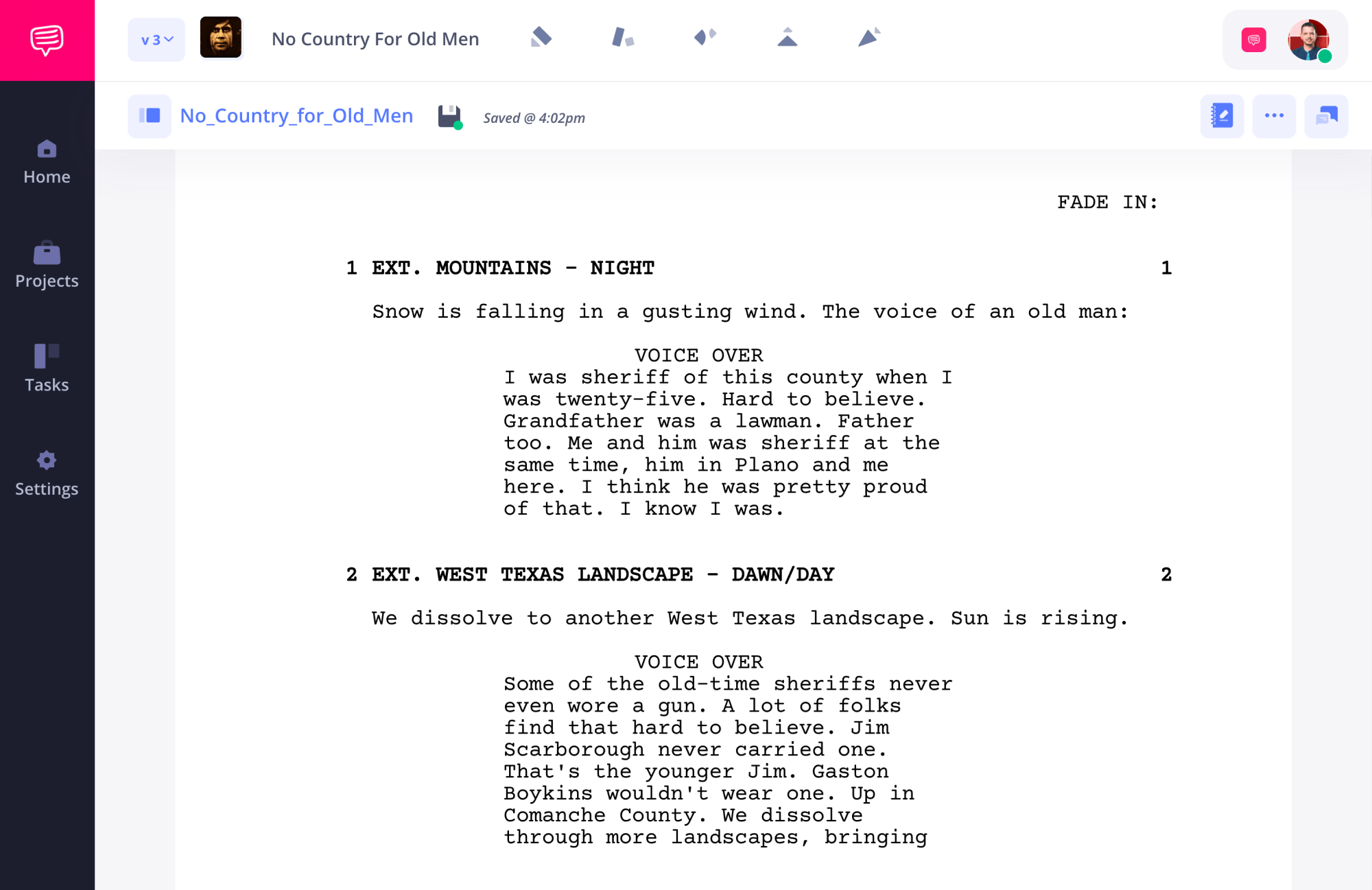
Screenplay • Try StudioBinder's Screenplay Software
Narrative Components
The 7 essential story elements
If the five structural parts are the shape of a story, the elements of a story are what fill that shape. These are the components that create meaning. They determine how the audience connects to the narrative. Without them, the structure is empty.
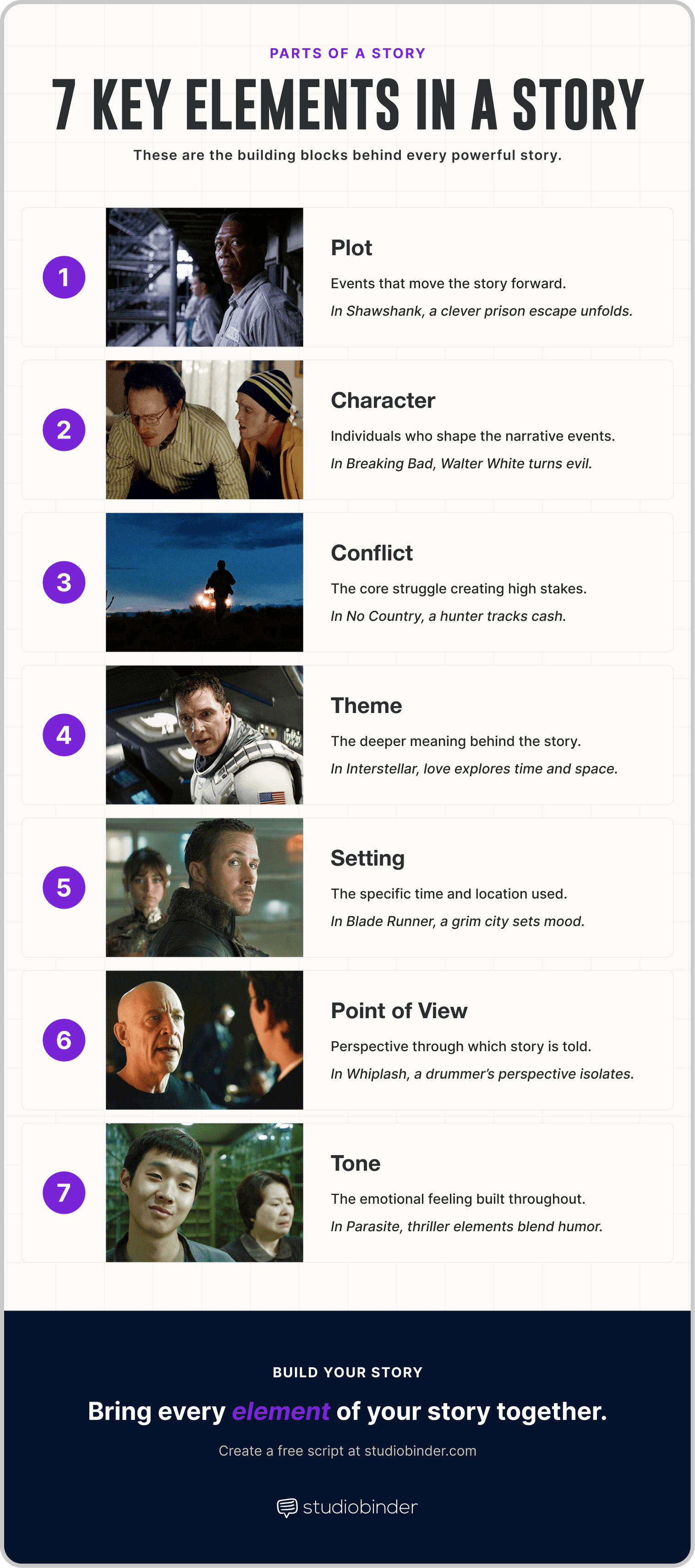
Key Elements In A Story • Parts of a Story
Each element serves a different function. Strong storytelling comes from how they work together.
1. Plot
Plot is the sequence of events in a story. It is what happens, in what order, and why.
But the plot is not the same as the story. Story includes everything that exists in the narrative world. Plot is what the writer chooses to show.
The plot is shaped. It is selective. It is built around cause and effect.
A strong plot moves forward because each event creates the next. One decision leads to another. One consequence triggers the next problem.
A weak plot feels random. Events happen, but they do not connect.
When analyzing plot, ask: What causes each major event? What changes as a result? Does each moment push the story forward?
The plot is the engine of the story. It carries the audience through the structure.
2. Character
Character is the center of the story. Characters make decisions. They experience consequences.
The audience does not follow events. They follow people.
A strong character has:
Clear character motivation
Defined behavior
The capacity to act
Character is also where emotional investment comes from. If the audience does not care about the character, the plot has no impact.
There are three main roles:
Protagonist: drives the story
Antagonist: creates opposition
Supporting characters: shape the world and relationships
But the most important aspect is character development — how a character changes across the arc of the narrative.
How characters actually change in a story
Across most narratives, three elements shift:
Situation — The character's circumstances change. This is often the reason the story exists. In Parasite, access to the Park household transforms the family's circumstances.
Actions — The character's actions are what they do in response. These can change without deeper transformation. A character may act differently because the situation demands it.
Attitude — Attitude is internal. It reflects belief and worldview. This is where real character development happens. In Pride and Prejudice, Elizabeth must reassess her own perspective before the story can resolve. That shift in attitude is the most meaningful kind of change.
Related Posts
3. Setting
Setting is the world of the story.
It includes:
- Location
- Time period
- Cultural context
Setting shapes behavior. It influences what characters can do and how they act.
In film, the setting is visual. It is expressed through mise-en-scène, design, and environment.
In Parasite, the house is not just a location. It represents class structure. It controls movement and power. Let's take a deep dive into the story to understand how this connects to the Save the Cat beat sheet.
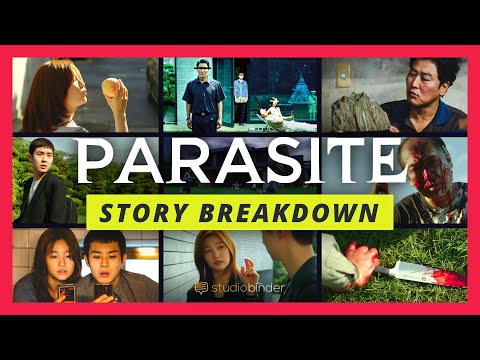
How Parasite uses Save the Cat beat sheet • Subscribe to StudioBinder's YouTube Channel
A strong setting is active. It contributes to conflict and meaning.
When analyzing setting, ask: How does the environment affect the characters? What does it reveal about the world?
4. Conflict
Conflict in a story is the central problem.
Without conflict in a story, there is no tension. Without tension, there is no narrative.
Conflict creates stakes. It forces characters to act.
There are different types, but what matters most is pressure:
External conflict: between characters or forces
Internal conflict: within the character
The strongest stories combine both.
In The Godfather, the external conflict is the family war. The internal conflict is Michael's transformation.
When analyzing conflict, ask: What is at stake? What is resisting change? Who is affected most?
Conflict in a story drives the structure forward.
5. Theme
Theme in a story is what the narrative explores beneath the surface.
It is not a message. It is not a moral. It is a tension or idea.
Common themes in a story include:
Power
Identity
Love
Control
But theme in a story must be specific to the narrative — not generic. Theme is built through repetition. It emerges from patterns across the narrative.
Take a look at the various ways to layer theme into a screenplay:

What is theme in a story? • Subscribe to StudioBinder's YouTube Channel
For example, in The Godfather, the theme is not just power. It is the cost of power and the erosion of identity. A common mistake is stating the theme directly. Strong stories show it through action.
Let's take a look at this scene as Michael transforms into the family leader, and ultimately The Godfather through film blocking.

Film blocking in The Godfather • Subscribe to StudioBinder's YouTube Channel
When analyzing theme, ask: What ideas repeat? What patterns appear? What tension is being explored?
Theme gives the story meaning.
6. Point of view
Point of view is the perspective through which all parts of a story are told.
In writing, this includes:
In film, point of view is visual. It is controlled through camera placement, camera framing, and access to information.
Whose experience does the audience share? What do they know, and when do they know it?
Point of view shapes interpretation. It controls how the story is understood.
When analyzing, ask: Who is the audience aligned with? What is hidden?
7. Tone
Tone is the attitude of the story.
It reflects how the creator approaches the material. It shapes how the audience experiences it. Tone is consistent. It is built through repeated choices. Tone is not the same as mood. Tone is the intent. Mood is the effect.
Take a look at how the tone of a story can change, depending on the director.

Film tone • Subscribe to StudioBinder's YouTube Channel
In No Country for Old Men, the tone is controlled and fatalistic. Every choice reinforces it.
Tone creates coherence. It ensures the story feels unified.
Parts of a story
How the parts and elements work together
Understanding the elements of a story is not about memorizing definitions.
It is about recognizing how they interact within the parts of a narrative.
- Plot moves the story
- Character gives it emotional weight
- Conflict creates tension
- Theme gives it meaning
- Setting and tone shape how all of it lands
Every component of a story supports these core functions. Remove one, and the whole structure weakens.
When writing, start with conflict, character, and theme. When analyzing, track how these elements repeat and interact across the structural parts of the story.
This is where the parts of a story become useful — not as labels, but as a diagnostic framework.
Character Integration
How the parts and elements work together
These examples show how the parts of a story and the elements of a story work in practice. Each one maps structure, then applies character, conflict, and theme.
Let's take a look at some examples to give you a better sense of how the parts of a story and story elements work together:
1. The Godfather
The structure is clear and controlled. Exposition establishes the family. Rising action escalates conflict. The climax transforms Michael. Falling action reveals consequences. Resolution confirms his new identity.
Now apply the character model:
- Situation: Michael is pulled into the family
- Actions: He commits to violence
- Attitude: He becomes what he once rejected
The internal arc mirrors the structure exactly.
Baptism sequence (climax)
This scene represents the climax of a story told across three hours. The sequence cross-cuts between a baptism and multiple assassinations. Editing creates meaning through contrast. Sound design reinforces it. Sacred vows play over acts of violence. This is not just the resolution of the plot — it is the full expression of the theme.

The Godfather Baptism Sequence (Climax) • Parts of a Story
2. The Great Gatsby (novel)
The structure of The Great Gatsby builds toward the Plaza Hotel confrontation. Exposition introduces Gatsby through Nick. Rising action builds through obsession. The climax exposes illusion. Falling action collapses into tragedy. Resolution reflects on loss.
Point of view shapes all the parts of a story.
- Situation: Gatsby constructs a new identity
- Actions: He pursues Daisy
- Attitude: He does not change
This lack of internal change is the tragedy. It is what makes Gatsby a cautionary story rather than a triumph.
Plaza Hotel confrontation (film adaptation)
This scene represents the climax of Gatsby's pursuit. The illusion is exposed directly. Framing isolates characters. Heat builds pressure. Dialogue strips away illusion. The structure peaks here, but the emotional fallout continues — which is why the falling action carries so much weight.
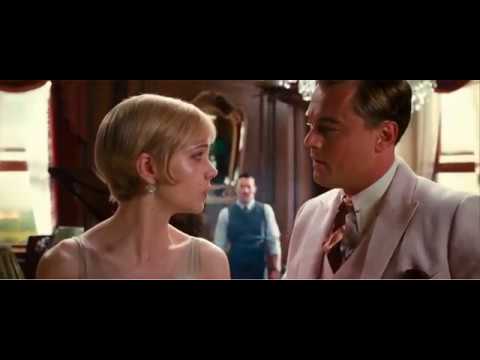
The Great Gatsby Plaza Hotel Confrontation (2013) • Parts of a Story
3. The Gift of the Magi (short story)
This example shows how the parts of a story function in compressed form.
Exposition is immediate. Rising action builds quickly. Climax and falling action merge. Resolution delivers the thematic impact.
- Situation: The couple has no money
- Actions: Each sacrifices something valuable
- Attitude: Their love remains unchanged
This is key. The story does not rely on transformation. It relies on alignment with theme. The resolution in a story does not always require change — sometimes it confirms what was already true.

The Gift of the Magi Short Film Adaptation • Parts of a Story
Writing Frameworks
How to plan your story's structure
Understanding all the parts of a story is only useful if you can apply them.
Start with conflict. Then theme. Then map your narrative structure — identify where each structural part sits, and what each scene must accomplish.
For visual thinkers, this is where tools matter.
Using StudioBinder, you can:
Write your script
Break scenes into beats
Build shot lists
Create storyboards
Instead of thinking abstractly about structure, you can see it. You can track where your rising action stalls. You can identify where the climax of a story should land.
This is the difference between knowing the parts of a story and actually using them.
Trusted by Over 1M Creatives
Screenwriting from draft to set
Write, format, and share your script. Ready for production when you are.

Frequently Asked Questions
Questions about parts of a story
The five parts of a story are exposition, rising action, climax, falling action, and resolution. These stages form the basic narrative structure, describing how tension builds, reaches a peak, and then resolves. Exposition introduces the world. Rising action builds conflict. The climax of a story is the turning point. Falling action shows consequences. The resolution in a story establishes the new normal.
The seven essential story elements are plot, character, setting, conflict, theme, point of view, and tone. These are the components that give a story meaning. While the structural parts describe how a story moves, the elements of a story explain what the story is made of. Together, they form the full parts of a narrative.
The three-part version breaks a story into beginning, middle, and end. This model maps onto the three-act structure. The beginning sets up the story. The middle develops conflict. The end resolves it. This is useful for a broad overview, but the five-part structure offers more precision for writers doing actual story analysis or script development.
Conflict. Without conflict in a story, there is no tension — and without tension, there is no narrative. Conflict creates stakes and forces characters to act. It drives the structure of a story forward. A close second is character. The audience connects to people, not plot alone. Strong conflict in a story combined with strong character development creates compelling storytelling at every level.
Structure refers to the shape of the story — how events unfold over time. Elements of a story refer to what the story is made of: character, conflict, theme, and the rest. A simple way to hold them: structure tells you how the story moves; elements tell you what gives the story meaning. Both are necessary. A story with structure but no depth feels empty. A story with strong elements but no structure feels unfocused.
The Godfather is a clear example. The exposition introduces the Corleone family at the wedding. Rising action begins when Vito is shot and Michael is drawn into the conflict. The climax of a story arrives when Michael orders the execution of rival family heads. Falling action shows the cost of that decision. The resolution in a story confirms his transformation as Kay watches the door close on who he used to be.
The five structural parts of a story are essential tools for screenwriters. Exposition establishes the world in the first act. Rising action drives escalating scenes through the second act. The climax of a story typically lands near the end of act two. Falling action and the resolution in a story close out act three. Mapping your script's scenes to these stages helps you spot where your narrative structure breaks down before it shows up on screen.
UP NEXT
What is story structure?
Understanding the parts of a story gives you the foundation. You can identify structure, track conflict, and analyze how meaning is built.
The next step is learning how to shape those parts into specific frameworks. Story structure becomes practical when you apply models like the three-act structure or the Hero's Journey — both show you how to organize scenes, pace tension, and control narrative flow.
Start Your AV Script
Start planning your next video with a structured AV script. Whether for commercials, corporate videos, or social media, our templates provide the perfect framework.