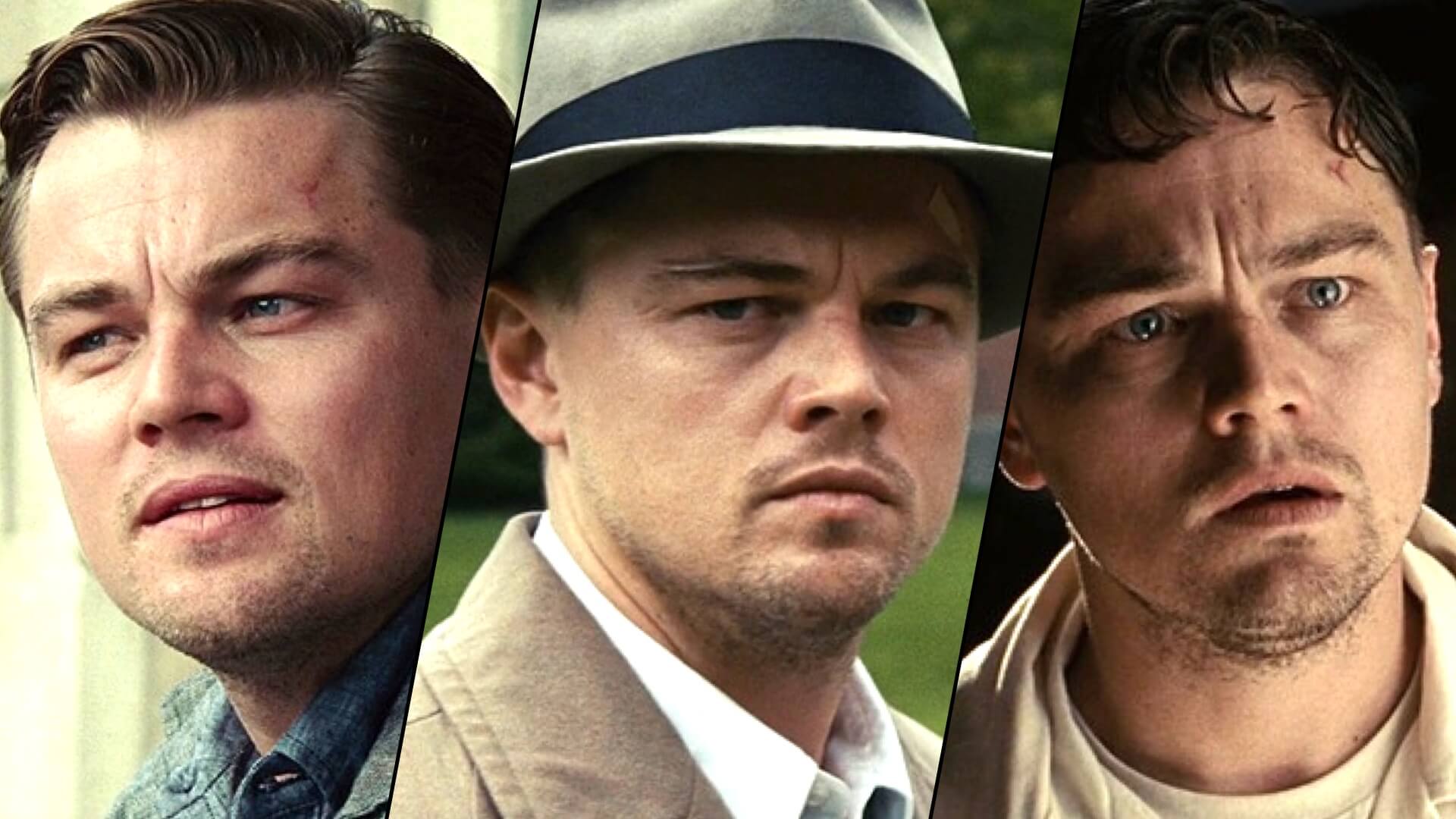
Martin Scorsese’s Shutter Island features one of cinema’s most debated endings: did Andrew Laeddis choose lobotomy over living with the truth? When it comes to having the Shutter Island ending explained, there’s more than meets the eye.
Laeddis’ psychiatrists took a massive gamble in 1954, a time when two ideological fields of psychiatry were at war. On one side stood Dr. Cawley, a physician who believed that all patients, regardless of their actions, could be healed through listening, care, and a respect for their basic humanity.
His ideological foes, represented by Dr. Naehring and the Warden, championed the authoritarian approach. They preferred the quick compliance of lobotomies, ankle chains, and stupor-inducing medications.
Spoilers ahead!
shutter island ending explained
What really happened at the end of Shutter Island
To full have the Shutter Island ending explained, we'll need to review exactly happened in that ending. Teddy Daniels/Andrew Laeddis, played by Leonardo DiCaprio, is not a U.S. Marshal, at least not anymore. He is actually Andrew Laeddis, a patient committed to Ashecliffe Hospital on Shutter Island after murdering his manic-depressive wife, Dolores, who had just drowned their three children in the lake behind their home.
Unable to cope with the crushing weight of his trauma and guilt, Laeddis retreated into the alternate identity of "Teddy Daniels." In this defensive delusion, he never killed Dolores; instead, she died in a tragic fire set by a phantom arsonist named Andrew Laeddis.
But Andrew has been far from a docile patient. For two years, he has violently raged against the hospital staff, leaving his doctors, Dr. Cawley and Dr. Sheehan, grappling with his cyclical delusions. Now, the hospital's board of directors is insisting that immediate action be taken to subdue his threat, warning that if this final breakthrough fails, he must be lobotomized.
As a radical last resort, the doctors stage an elaborate, hospital-wide role-play experiment. They allow Andrew to live out his delusion as "Teddy," hoping that by letting the fantasy run its course, the real-world contradictions will finally shatter his denial.
To pull it off, they feed into his fiction, "employing" him to investigate the disappearance of a missing patient, Rachel Solando, a woman institutionalized for murdering her three children, mirroring Andrew’s own suppressed reality.
His partner, "Chuck Aule" (a name that sounds like "chuckle" if you say it fast), is actually his primary psychiatrist, Dr. Sheehan, operating undercover to keep him safe.
By the end of the film, Andrew is led away toward his lobotomy, seemingly because the experiment failed. Or did it?
What Happened to Laeddis's Wife and Children
Dolores Chanal, Andrew’s wife, suffered from severe, untreated mental illness. In a psychotic break, she drowned their three children in the lake behind their remote cabin.
After discovering the horror, a devastated Laeddis pulled his children’s bodies from the water, only for Dolores to beg him to "set her free." Andrew shot her in the stomach, an act that remains deeply ambiguous, balancing on the knife-edge between blind rage and a tragic mercy killing.
Unable to process the crushing guilt of his own complicity, Andrew’s mind entirely rewrote the tragedy. In his defensive delusion, the children never existed, and Dolores died in a city apartment fire set by a sinister arsonist named Andrew Laeddis. By splitting his identity, "Teddy" cast himself as the righteous hero hunting down the monster who destroyed his life.
However, Andrew was far from stable even before the day at the lake. As a U.S. soldier, he participated in the liberation of the Dachau concentration camp, where he witnessed piles of murdered prisoners and may or may not have participated in the execution of surrendered Nazi guards.
Haunted by these wartime atrocities, Andrew returned home and buried his trauma in severe alcoholism and long stretches of work, ignoring his wife's escalating psychological cries for help until it was far too late.

Teddy Daniels real identity reveal • Shutter island ending explained
shutter island ending explained
The final scene: did Laeddis relapse or choose death?
Shutter Island leaves Andrew Laeddis' fate deliberately ambiguous. One reading suggests he relapsed into his delusion, while the other argues he knowingly accepted lobotomy to escape unbearable guilt. Let's get into both to have the Shutter Island ending explained top to bottom.
The "Which Would Be Worse?" Line Explained
After appearing to accept the truth, Andrew sits outside with Dr. Sheehan and refers to him as “Chuck,” his name in the delusion. This suggests that he has once again regressed into psychosis.
He then asks this question: “Which would be worse, to live as a monster or to die as a good man?”
The first interpretation is that Andrew has truly relapsed and no longer remembers who he is. Therefore, the lobotomy will proceed. The second interpretation is that Andrew knows exactly who he is. He is choosing to perform the delusion so his doctors will lobotomize him.
This would be Andrew choosing a psychological death over living with his profound guilt and trauma. He would be “set free,” just like Dolores.
What Dr. Cawley Believes
Dr. Cawley's reaction heavily supports the second interpretation. When Dr. Sheehan shakes his head to signal a relapse, Cawley looks utterly devastated, not victorious, as Laeddis is led away.
Whether Laeddis chose regression or genuinely relapsed, Cawley treats it as a total failure of his experimental, radical therapy. In that single, heartbreaking moment, he realizes he has lost the ideological war for the future of psychiatric care.
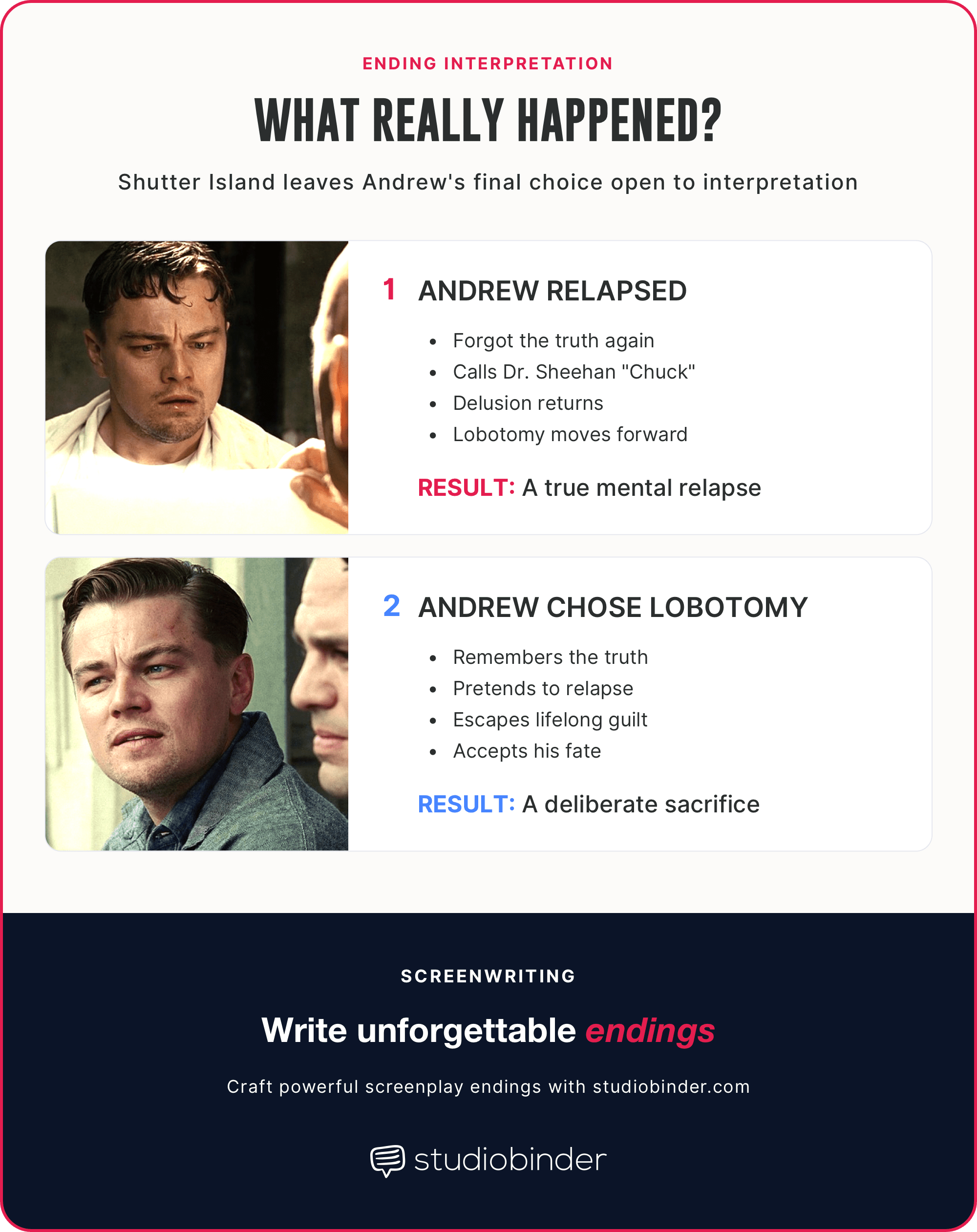
Andrew Laeddis final fate interpretation • Shutter island ending explained
shutter island ending explained
The role-play experiment and how it was set up
The role-play experiment is a significant key to having the Shutter Island ending explained. Dr. Cawley proposed the role-play as a humane alternative to lobotomy. The entire island was in on the plan including the staff, guards, and patients. Dr. Sheehan played his partner “Chuck Aule” for the duration of the role-play.
The goal was to have Andrew fully inhabit the delusion and then confront him with enough contradictions and evidence that the truth would break through.
The experiment worked briefly. In the final act, Andrew heads to the lighthouse, the exact location he believed housed a sinister government brainwashing facility. Instead of mad scientists, he finds Cawley and Sheehan waiting to force him to look at the brutal photographs of his deceased children.
Confronted by reality, Andrew’s psyche breaks, and that night, his dreams finally reveal the brutal truth of what happened to his family two years prior.
![Shutter Island - The Truth And The Lighthouse [4/4]](https://i.ytimg.com/vi/w_3C5MYNgw8/hqdefault.jpg)
Andrew Laeddis confession scene • Shutter island ending explained
Clues You Missed on First Watch. The Anagram (Teddy Daniels / Andrew Laeddis)
The names at the center of the mystery are precise linguistic mirrors of one another, a classic literary device planted by Dennis Lehane and preserved perfectly by Scorsese:
Edward Daniel = Andrew Laeddis
Rachel Solando = Dolores Chanal
While Andrew spends the entire film tracking "the law of 4,” a cryptic note found in Rachel’s room, the full, devastating meaning of that clue isn't unraveled until the lighthouse confrontation.
There, Dr. Cawley reveals that these four names are exact anagrams, forcing Andrew to realize that the phantom missing patient and the elusive arsonist are merely projections of his own family.
The Dream Sequences as Memory
Every dream and hallucination in the film is a fragment of repressed memory:
In Andrew's dreams, Dolores is frequently engulfed in fire and turns to ash. Because his mind cannot accept that he shot her at a lakefront cabin, his unconscious borrows the imagery of the apartment fire to maintain the delusion, literally burning away the truth.
The children at the lake, his own children, appear as themselves in his unconscious. His unconscious cannot fully erase his children, forcing him to look at the reality of the family he failed to protect.
The repetition of fire and water is evocative. Fire is constant in his delusions and represents his safety in his madness. Meanwhile, water represents the horrific truth.
The heavy rainstorms, the leaking ceilings, the dripping wet clothes of his dead daughter, and the ocean surrounding the island are constant, physical reminders of the lake where his children drowned.
Did you notice these clues?
Subtle clues were basically giving you the Shutter Island ending explained the whole time. As the film opens, the ship emerges from the mist establishing the entire narrative of unreality. The background of the shots on the boat are eerily artificial. Things are not what they seem.
“Teddy’s” clothes are absurdly oversized, as if they belonged to another person, merely pulled out of someone else’s closet.
When Laeddis and Sheehan land on the island, they are surrounded by armed guards, and they are on full alert, weapons poised. This is not how guards would ordinarily greet U.S. Marshals. They are terrified of a volatile patient.
Dr. Sheehan, “Chuck,” has no experience with firearms and has difficulty unholstering his weapon.
“Teddy” never has matches because a patient is not allowed to have access to fire.
When Laeddis and Sheehan enter what is supposed to be Rachel Solando’s quarters, the shoes in the closet are men’s shoes.
When Laeddis and Sheehan join the search for Rachel, the guards aren’t searching at all, merely reclining on the rocks waiting for the experiment to conclude.
Whenever Dr. Sheehan is mentioned, the camera cuts immediately to him.
Upon a second viewing, every conversation is imbued with new meaning: Dr. Naehring’s observations on “Teddy’s” defense mechanisms, the nurse demanding that “Teddy” define “unusual” and the other staff members laughing, and Laeddis’ own unforgiving comments about mentally ill patients.
As the film progresses and Laeddis’ medication begins to wear off, his propensity for violence is revealed, first by smashing the glass in the doctor’s dining room, and second when he brutally attacks a Ward C patient. Understanding that violence helps to have the Shutter Island ending explained.

Live as a Monster or Die as a Good Man • Shutter island ending explained
Related Posts
shutter island ending explained
The Shutter Island movie vs. the novel
Having the shutter island ending explained is one thing, but what happens when we bring the novel it was adapted from into the mix? Overall the film is loyal to Dennis Lehane’s novel except for omitted flashbacks, name changes, and cut conversations Teddy and Chuck have with hospital staff.
There are, however, two notable differences.
The first difference worth unpacking is Teddy’s conversation with the Warden. Earlier in the story, Teddy notices the Warden’s Nazi-esque demeanor, and he isn’t far off the mark. The casting of Ted Levine – “it rubs the lotion on its skin or else it gets the hose again” – was a masterful choice.
In the film, after Teddy spends the night in a cave with his latest delusion, the Warden picks up Teddy in a militarized jeep. The Warden asks if Teddy enjoyed “God’s gift,” referring to the violence of the storm, the very storm that crashed a tree into his living room and reached out like a “divine hand.”
The Warden then recites his own ode to violence, that “God loves violence” and that violence is “what we are.” Why? “Because God gave us violence to wage in his honor.”
Teddy disagrees and says that God gave people “moral order.” For the Warden, the world runs on a basic principle: Can my violence conquer yours?
In the novel, the exchange continues, tapping into the real war present on the island. The Warden exemplifies the authoritarian belief that some people matter and others don’t. He continues on a racist diatribe where some people “are no more use than two-legged dogs.”
This is an interesting comment given that at the beginning of this interaction with Teddy, the Warden expressed his admiration for rats, creatures he found “strangely regal” and “utile.”
The Warden is the dark side of humanity Dr. Cawley is fighting against. Dr. Cawley believes that even the worst people, the mentally ill killers, deserve compassion, patience, and time. The Warden says they need chains, their “friends.”
The second difference is lethal, and that is the film’s final enigmatic line: “Which would be worse—to live as a monster, or to die as a good man?” This line, the line that throws the film’s ending into mystery, is not uttered in the novel.
Instead, Lehane makes it clear that Edward has certainly regressed into madness. So, the novel can't help us have the Shutter Island ending explained. At least not in terms of that final enigmatic line. Let's investigate:
This is the novel’s exchange after Teddy accepts a cigarette from Dr. Sheehan:
“So what’s our next move?” he said.
“You tell me, boss.”
He smiled at Chuck. The two of them sitting in the morning sunlight, taking their ease, acting as if all was fine with the world.
“Gotta find a way off this rock,” Teddy said. “Get our asses home.”
Chuck nodded. “I figured you’d say something like that.”
“Any ideas?”
Chuck said, “Give me a minute.”
Teddy nodded and leaned back against the stairs. He had a minute. Maybe even a few minutes. He watched Chuck raise his hand and shake his head at the same time and he saw Cawley nod in acknowledgment and then Cawley said something to the warden and they crossed the lawn toward Teddy with four orderlies falling into step behind them, one of the orderlies holding a white bundle, some sort of fabric, Ted thinking he might have spied some metal on it as the orderly unrolled it and it caught the sun.
Teddy said, “I don’t know, Chuck. You think they’re onto us?”
“Nah.” Chuck tilted his head back, squinting a bit in the sun, and he smiled at Teddy. “We’re too smart for that.”
“Yeah,” Teddy said. “We are, aren’t we?”
The film’s ending is far more nuanced. Teddy states that “We gotta get off this rock, Chuck. ‘Cause whatever’s going on here, it’s bad,” indicating his delusions have once again taken over. Sheehan turns to Cawley, who is standing with Dr. Naehring and the Warden.
Cawley is distraught, visibly disappointed in his professional failure, and turns his back. Naehring nods and the Warden points for assistance. A closeup on the package in an orderly’s arms, clinking metal wrapped in white fabric, is the sign that Teddy is going to be lobotomized.
Did Teddy choose this fate, the life of a lobotomized man who can no longer live in guilt and trauma? In the film, this interpretation holds. Teddy appears to walk to the orderlies of his own free will with resignation. Dr. Sheehan calls out the name “Teddy,” but he doesn’t turn to him.
Is he actually the non-regressed Andrew Laeddis choosing the painfree life of lobotomy? If so, Andrew is no longer a passive victim of tragedy but an active participant in his fate.
Watch the video below to have the Shutter Island ending explained with even more depth in terms of its comparison to the book.

Shutter Island Ending Explained • Shutter island ending explained
shutter island ending explained
Martin Scorsese on the ending
During an interview on Good Morning America, director Martin Scorsese acknowledged his enduring cinematic fascination with "men of violence" and the psychological wreckage left in their wake. While he noted that he didn't want to agree with the Warden's dark philosophy that violence is humanity's natural state, he used the film to pose a deeper question: “Can violence ultimately be evolved out of our species?”
When it comes to solving the film’s central narrative riddle, whether Andrew genuinely relapsed or chose his fate, Scorsese intentionally leaves the final judgment to the viewer. Regarding the meaning behind the film’s final question, his response remains beautifully open-ended: “The answer to that is up to the individual.”
And if that's not the best way to have the Shutter Island ending explained, we don't know what is.
Related Posts
Frequently Asked Questions
Shutter Island ending FAQs
No. Teddy Daniels is a delusion constructed by Andrew Laeddis, a patient at Ashecliffe Hospital. Laeddis invented the identity of a U.S. Marshal to escape the memory of murdering his wife after she drowned their three children. The entire investigation was a role-play experiment arranged by his doctors.
"Which would be worse, to live as a monster or to die as a good man?" The line has two readings: Laeddis has genuinely relapsed into his delusion, or he is consciously choosing lobotomy over living with the truth of what he did. Scorsese has said that the answer to that question is up to the individual.
It's deliberately unclear. The most supported reading, based on Dr. Cawley's reaction and the deliberateness of Laeddis's final words, is that Laeddis consciously chose to regress. By calling Dr. Sheehan "Chuck" again, he triggers the lobotomy procedure, choosing death over the burden of his guilt.
"Teddy Daniels" is an exact anagram of "Andrew Laeddis." Similarly, "Rachel Solando" (the missing patient) is an anagram of "Dolores Chanal" (Laeddis's wife). Both anagrams were in Dennis Lehane's original novel and are planted early in the film as hidden clues to the twist.
No. Shutter Island is based on Dennis Lehane's 2003 novel of the same name. The island setting draws on the real history of Boston Harbor Islands, and Ashecliffe's treatments reflect actual 1950s psychiatric practices, but the characters and plot are entirely fictional.
UP NEXT
Unreliable Narrator
With the Shutter Island ending explained, let's dig even deeper into our protagonist's perspective type. Understanding how Scorsese built this twist raises the natural question: how do filmmakers construct unreliable narrators from the script stage? That article is the natural next read.