Over the last decade, streaming has made the limited series the dominant prestige TV format, but most viewers cannot define what it actually is. A limited series is a self-contained, finite story told over a series of episodes that is designed to end within that single season.
In this post, we’ll go more in depth on what is a limited series and how it differs from typical episodic TV shows. Using examples from acclaimed limited series, we’ll also touch on the fundamentals of writing for the limited series format.
what is a limited series
Limited series definition
Before we get deeper into what is a limited series and all the nuances around that question, let's first establish a basic limited series definition. Read on below:
TV SERIES
What is a limited series?
A limited series is a scripted television program with a predetermined number of episodes that tells a self-contained story. This type of series, usually told over the course of 4-10 episodes, has a definitive beginning, middle, and end planned from the start. Unlike ongoing, traditional episodic series, there is no open-ended renewal in a limited series. The story concludes within its original run.
Key characteristics of a limited series:
- Tells one complete story with a planned ending.
- Usually runs for 4–10 episodes.
- Designed as a single-season production.
- Every episode moves the main story forward.
- Characters complete their arcs by the finale.
- Not intended for ongoing renewal.
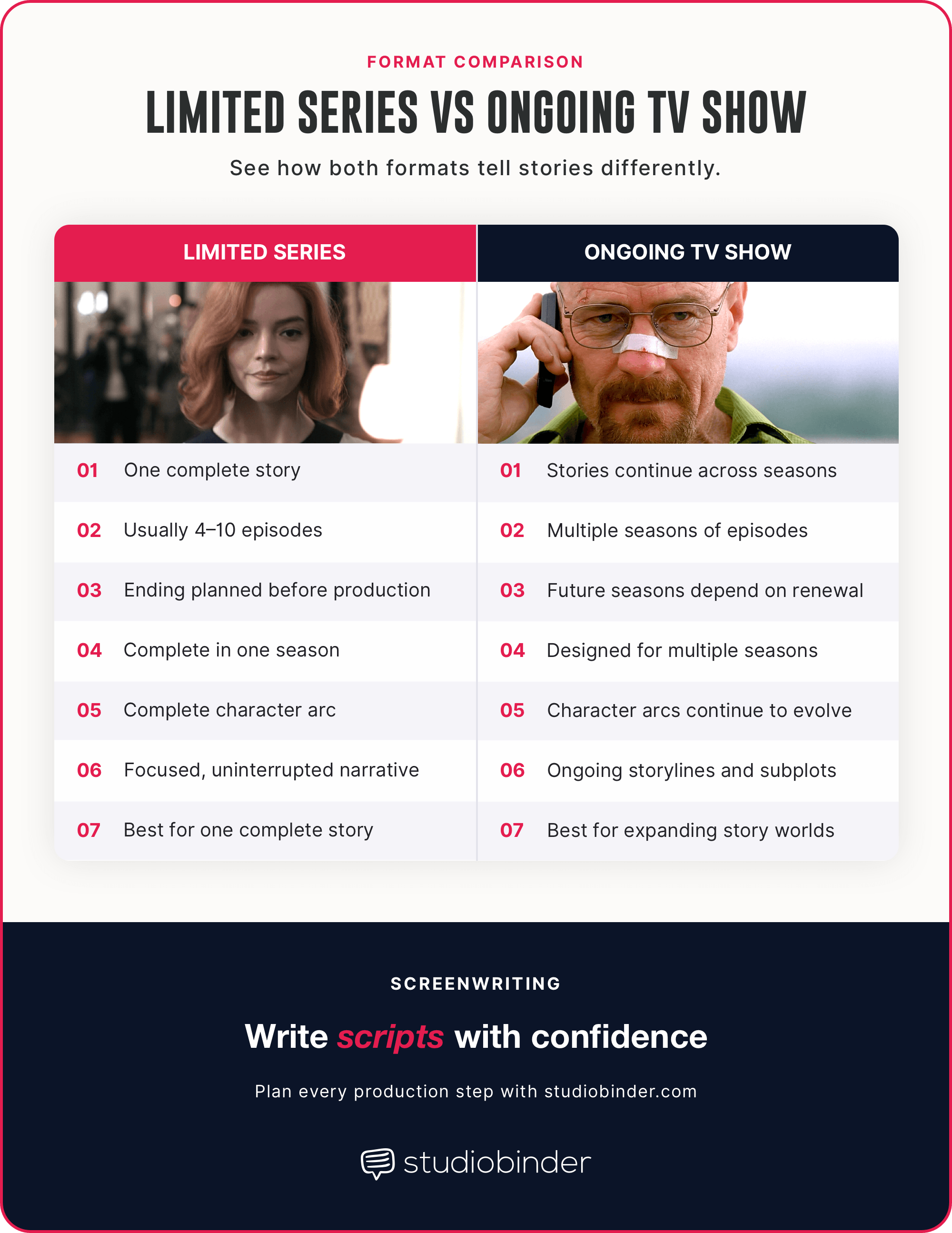
Format comparison versus ongoing television • What is a limited series
what is a limited series
Limited series vs. miniseries
Although nowadays the terms “limited series” and “miniseries” are nearly interchangeable, distinguishing between the two is a matter of practical difference and an evolving TV landscape.
A miniseries is an older term that stems from broadcast television. Back when linear television and cable TV were more popular, a miniseries was a series that consisted of anywhere from 2 to 6 episodes over consecutive nights.
Two early examples of successful miniseries are Roots (1977) and The Thorn Birds (1983), both of which were adapted from novels, and whose consecutive broadcasts were made to feel like television events.
The term limited series is now used most commonly when referring to shows on both broadcast TV and streaming. Now, a limited series tends to be 5 to 10 episodes. Instead of releasing over consecutive nights, limited series will be released all-at-once on a streaming platform to encourage binge-watching, or will be staggered over a weekly release schedule, like Chernobyl and The Queen’s Gambit.
While your friends and industry alike will know what you mean whether you refer to it as a limited series or miniseries, the Television Academy officially uses “Limited or Anthology Series” as a single combined category for the Emmy Awards.
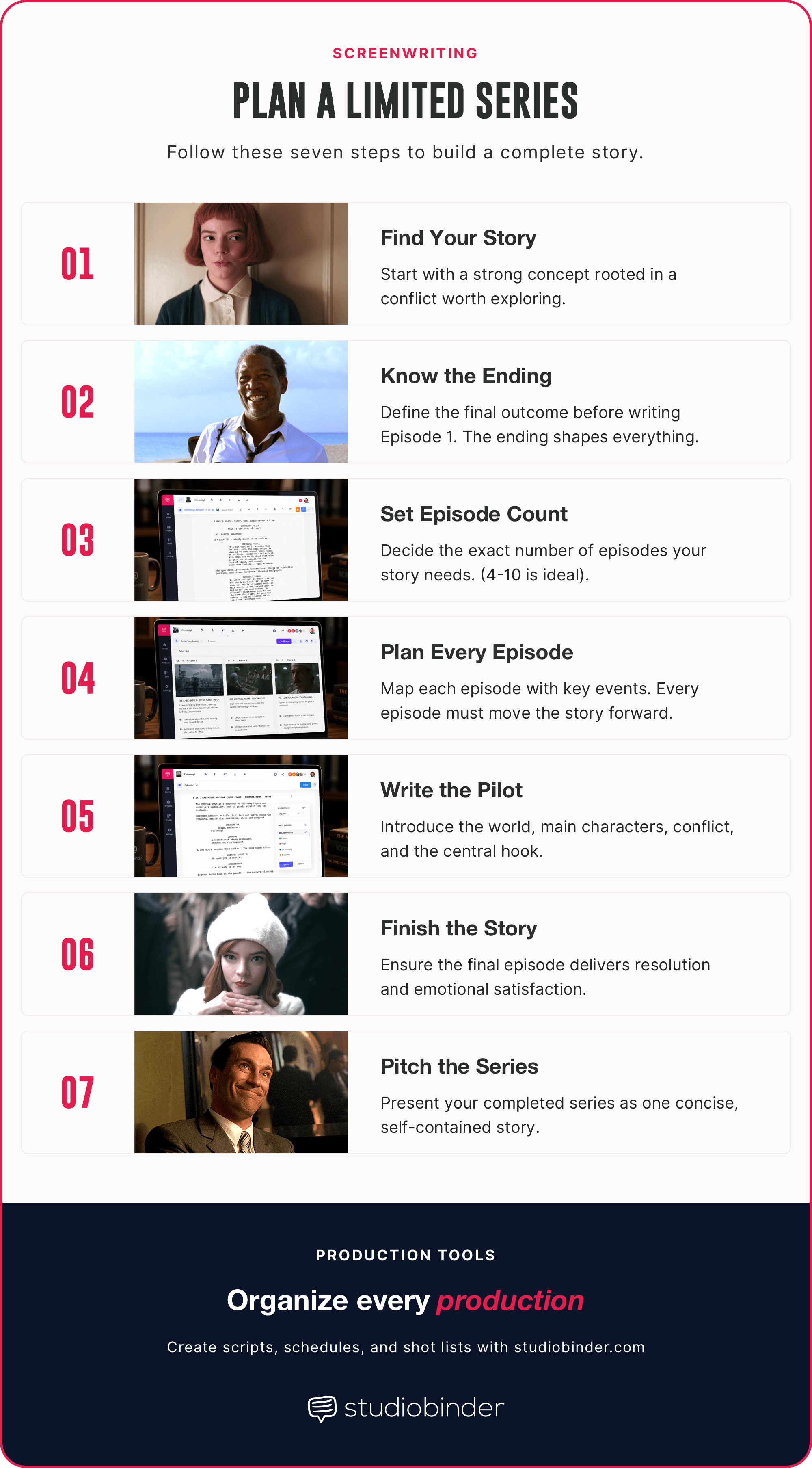
Screenwriting steps to plan a story • What is a limited series
What is a limited series
Limited series vs. regular TV shows
Let’s say you have an idea for a TV pilot but aren’t sure if it should be a limited or regular episodic series. How do you decide? A good place to start is by learning the differences between limited series and regular TV and what makes each format unique.
Episode count and scope
A traditional TV series is designed to run as long as audiences will watch it. In the traditional network model, a season of episodic television was 22 episodes. That’s a lot of airtime, therefore it was common for a few episodes of a network season to have “filler episodes” – episodes that don’t directly relate to the overall season arc.
On the contrary, a limited series is conceived with a fixed number of episodes in mind. There are no filler episodes, no extra padding. The story is structured to fit its container – nothing more, nothing less.
Self-contained story arc
Before streaming, the litmus test of a good idea for a series would be if it could sustain 100 episodes, or roughly five seasons in the traditional network model. Even though seasons of television tend to be much shorter now in the streaming era, there’s still the expectation that a series should have a story engine to sustain multiple seasons.
However, in a limited series, every episode moves toward a known ending. The show’s creator, also known as the showrunner, is expected to know how the series ends before they begin episode one. And the finale episode of the limited series should provide a satisfying ending to the show, rather than a cliffhanger or open-ended question to be answered in another season.
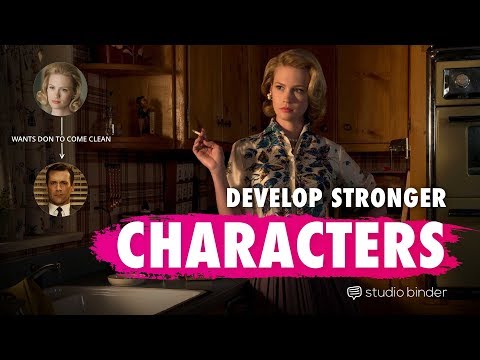
Learn more about developing a TV character’s arc in the video below:
Subscribe to StudioBinder • What is a limited series
Renewal model and production structure
Another key difference between regular episodic TV and limited series is how they’re renewed and structured. For a regular series, ratings decide whether the show returns for another season, and a series may not receive a full order upfront.
A limited series, by contrast, receives a full series order from the start. Both creators and network know going in that the story concludes within its run. However, if a limited series is wildly successful and is renewed for another season, it will likely return as an anthology.
Each new season brings a different cast and story built around a central premise, location, or genre from the first season. Consider how each season of The White Lotus is set at a different resort with a new cast, or how True Detective spans different time periods and settings, all while maintaining a slow-burn detective narrative over its four seasons.
Related Posts
what is a limited series
Types of limited series
Now that we have 'what is a limited series' established, and what makes it different from regular TV, let’s dive deeper. In theory, one could write a limited series about anything as long as there’s enough material to sustain several episodes. However, the format tends to best suit the following subgenres:
1. True crime limited series
In a true crime limited series, the show often dives into a single case or event. While it may present the crime from a variety of perspectives or different characters involved, the limited series specifically goes narrow and deep on the one case. Examples include American Crime Story: The People vs. O.J. Simpson (FX, 2016), Making a Murderer (Netflix, 2015), The Staircase (HBO, 2022).

True Crime Limited Series • What is a limited series
2. Historical drama limited series
Sometimes, the length of a feature film isn’t enough to delve into the context needed to dramatize a single event, era, or biography. That’s why historical drama limited series are common, as they allow the creators to go narrow and deep on their subject. Popular examples of this type of prestige TV are Show Me a Hero (HBO, 2015), When They See Us (Netflix, 2019), and John Adams (HBO, 2008).

Historical Drama • What is a limited series
3. Anthology limited series
In an anthology limited series, each season tells a completely different story, usually with a new cast. Though the stories and characters may differ, a setting or larger theme typically connects all the seasons of the anthology. A few acclaimed examples of this type of limited series are True Detective (HBO), Fargo (FX), and The White Lotus (HBO).

Anthology series • What is a limited series
what is a limited series
Popular limited series examples
To get a better sense of what is a limited series in practice, let's look at three critically acclaimed examples that show why the format works so well for its subject matter.
Chernobyl (HBO, 2019)
Chernobyl explores and unpacks the 1986 Soviet nuclear disaster over the course of five episodes from the explosion through the cleanup, and ultimately the trial following it. The series is an intense, intimate examination of a single event in history, so its defined beginning, middle, and end leaves no room for an ongoing series about the disaster.

Exploring a single event in Chernobyl • What is a limited series
The Queen's Gambit (Netflix, 2020)
The Queen's Gambit follows fictional orphan Beth Harmon's rise to become a world chess champion while battling an addiction in the 1960s. The limited series is a stylish, complex character study. Once Beth's arc concludes, so does the series. That structural completeness is exactly what defines it as a limited series.

A self-contained arc in The Queen’s Gambit • What is a limited series
Band of Brothers (HBO, 2001)
A landmark limited series, Band of Brothers follows the Easy Company’s journey in World War II from D-Day through V-E Day. Although World War II is a massive world event, the focus on one company at a specific point in the conflict defines Band of Brothers as a limited series rather than a TV show designed to run indefinitely.

Focus in Band of Brothers • What is a limited series
what is a limited series
How a limited series is written
Writing a limited series combines aspects of both feature film and episodic television writing. Structurally, you need to know your ending first, much like writing a feature film, rather than focusing on developing a compelling, long-running story engine as traditional television writers do.
Similarly, decide how many episodes are needed to tell the story as meaningfully and efficiently as possible. There are no filler episodes in a limited series, nor are you meeting an episode count determined by a network or streamer.
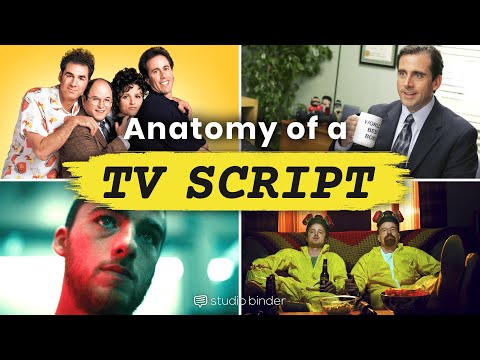
For more details and guidance on how to write a TV script, check out StudioBinder’s “Anatomy of a Screenplay” series:
Subscribe to StudioBinder • What is a limited series
A limited series may resemble a film in its overall arc, but like a television series, every episode of the series must tell a coherent story in itself and end on a cliffhanger that compels the viewer to keep watching.
Furthermore, it’s important to adhere to standard TV formatting when writing your limited series, such as including act breaks, scene headings, and slug lines.
Once you’ve written the pilot for the series, you must explicitly pitch the show as a limited series so buyers know the project is finite. That means having a predetermined episode count and clearly defined series arc in addition to any scripts.
StudioBinder's TV Screenwriting Software formats your script to industry standards automatically, so you can stay focused on the story while we handle the formatting.
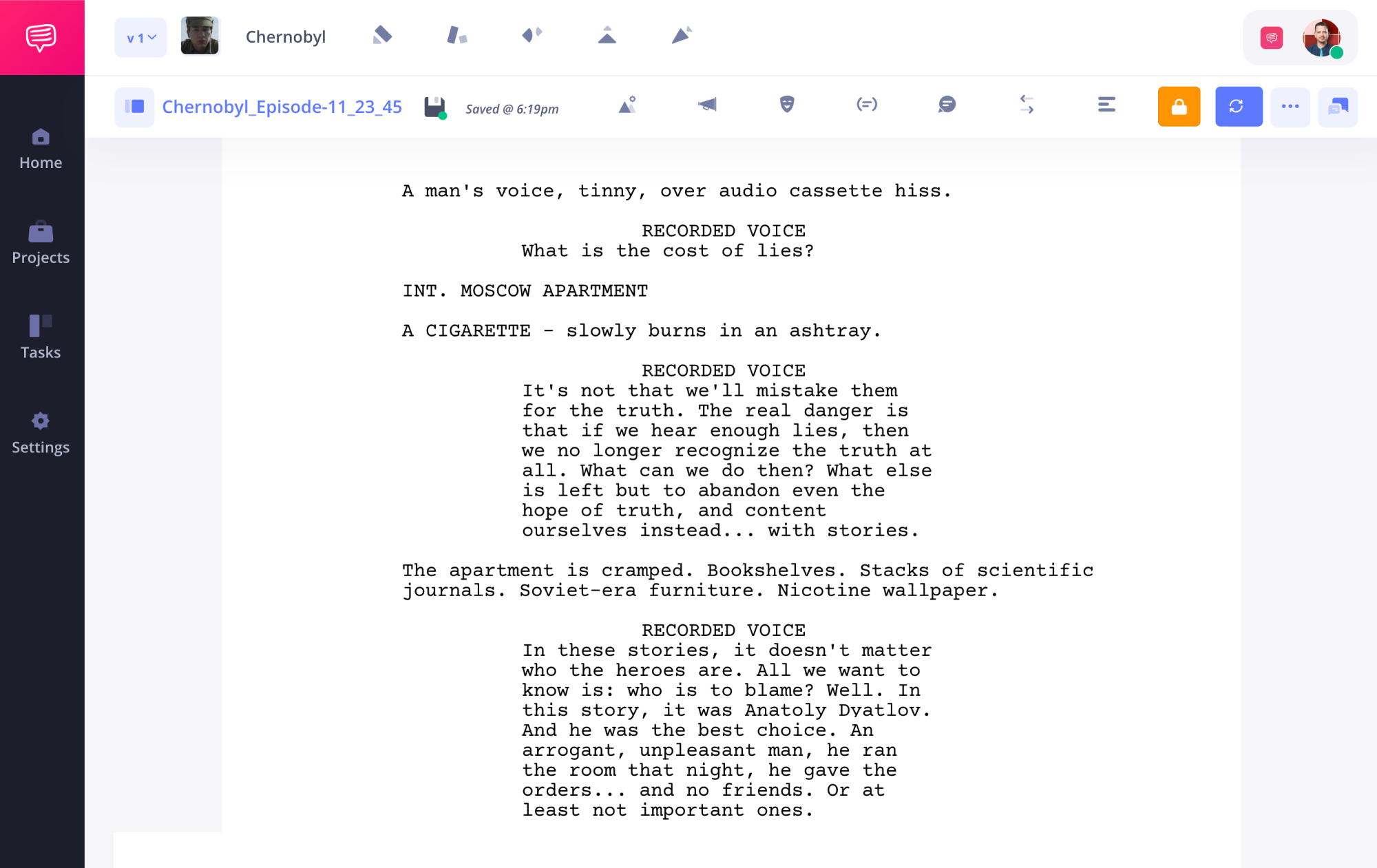
StudioBinder's Free TV Screenwriting Software • What is a limited series
The best part is that you can easily share your TV script version with your co-writers, get feedback and make new versions all in one place. That way, you don't have to worry about have outdated versions spread across inboxes.
Related Posts
Frequently Asked Questions
Limited series FAQs
A limited series is a scripted or documentary television show that tells a self-contained story with a fixed number of episodes and a definitive end. Unlike a traditional ongoing series, a limited series is meant to be a single season of television and conclude within its original run.
There is no fixed rule regarding how many episodes a limited series should be. Having a clear, finite, self-contained subject and scope matters more. Typically, a limited series can be anywhere between 2 to 10 episodes, with the majority falling between 4 and 10.
The two terms are nearly interchangeable. Miniseries is an older broadcast-era term that typically referred to when a series would air over consecutive nights. A limited series is a more contemporary streaming term. The Emmy Awards combine them into one category: "Limited or Anthology Series."
Technically, yes. However, these series are typically anthology series, where subsequent seasons return with a new cast, setting, and story that thematically relate to the first season. Two good examples of anthology series are True Detective and Fargo.
A limited series returning with the same characters is unusual and undermines the self-contained premise. However, a modern example is Big Little Lies (HBO, 2017), which was originally perceived as a limited series but got a second season order due to its critical and commercial success.
An anthology series is a type of limited series where each season tells a completely new story with a new cast and setting. A standard limited series tells one self-contained story with the same cast throughout its run. Shows like True Detective and Fargo are anthology limited series, while The Queen's Gambit is a standard limited series with one story, one cast, and one definitive end.
UP NEXT
Best Limited Series to Watch
Now that you know the limited series definition, it’s time to dive deeper. We’ve put together a list of the best limited series to watch to get you inspired when writing your own. We're no longer asking 'what is a limited series,' now we're breaking down the best ones in order.

From script to production. Write, collaborate, and produce all in one place.
Write scripts online for free. Track versions. Share for feedback and approval. When you're done transition seamlessly to script sides, shot lists, storyboards, schedules, breakdowns, call sheets and more.