
Every story you’ve ever loved started as writing. The documentary that changed how you see the world, the commercial that stopped your scroll, the short film that stayed with you long after it ended — they all began with someone at a keyboard working through the fundamentals of narrative writing.
Narrative writing is the foundation of nearly every kind of storytelling, and its principles translate directly into film and video production. Understanding what it is, how it works, and how to apply it makes you a better writer, a better director, and a stronger creative collaborator.
This guide covers the definition of narrative writing, the major types, core techniques, key narrative elements, and real examples drawn from film and branded content.
Define Narrative Writing
First, let’s define narrative writing
Before we jump straight into the article, let's go over precisely what narrative writing actually is.
Storytelling DefinitionWhat is narrative writing?Narrative writing is the structured presentation of events, characters, and conflict to create a meaningful story. It is writing designed to move a reader or viewer through a sequence of experiences — not just inform them, but make them feel something. The narrative writing definition is broad by design. It covers novels, screenplays, brand films, documentary scripts, and short films. Wherever events unfold in sequence and a character faces a meaningful challenge, narrative writing is at work. In film and video, the narrative doesn't live in prose — it lives in visual storytelling. But the writing behind the camera shapes every decision about pacing, tone, character, and meaning. A strong narrative film starts with writing that knows what it's trying to say before a single scene is shot. |
Narrative writing forms include:
- Screenplay
- Short film script
- Documentary script
- Brand film
- Video essay
- Novel
- Short story
- Memoir
- Personal narrative
Storytelling Definition
Key elements of narrative writing
Before exploring the types and techniques, it helps to understand the structural components that nearly all narrative writing shares. These narrative elements appear across every format — from literary fiction to a 30-second brand video script.
Narrator
Every narrative has a point of view. The narrator controls what the audience knows, when they know it, and how they interpret what they experience. The choice of narrator — first person, third person, documentary guide — shapes the entire emotional register of the story. In film and video work, voiceover is one of the primary tools for establishing a narrator's presence and the story's interpretive frame.
Plot
Plot is the sequence of events that carry a story forward with cause and effect. A strong plot structure isn't just "things happen" — it's events that build on each other toward a meaningful outcome. In film, plot includes scene order, act beats, and how individual moments connect to the larger story.
Character
Characters give the audience someone to follow. In narrative writing, characters need goals, obstacles, and change. Character development in film works through behavior and action — what a character does reveals who they are more than anything they say about themselves.
Conflict
Conflict is the engine of narrative. Without tension between desire and obstacle, there's no story. The types of conflict available to a narrative writer range from internal (a character vs. their own fear or doubt) to external (a character vs. society, nature, or another person).
Narrative structure
How a story is organized determines how it lands. Whether it follows a three-act structure, a circular arc, or a fragmented timeline, structure shapes audience expectations and emotional payoff. Knowing your structure before you write saves enormous revision time.
Theme
Theme is what a story is actually about beneath the surface events. A narrative about a director finishing her first film might carry a theme about creative courage. Theme is the layer that makes stories feel meaningful rather than merely interesting — and it's the dimension that stays with an audience after the story ends.
Setting and tone
Where and when a story takes place shapes everything else. Setting influences character behavior, visual choices, and emotional texture. Tone in film runs through every narrative decision — whether the writing is intimate, epic, comedic, or elegiac — and it's established through the writing before it's established through the camera.
Story arc
A story arc traces the trajectory a character or narrative follows over time. Understanding how arcs work helps writers design scenes that build toward a payoff rather than simply accumulating events without direction. Without an arc, narrative writing is a sequence of scenes. With one, it's a story.
These eight elements don't operate independently. Together they form the architecture every type of narrative writing draws from, whether the end product is a feature screenplay or a 30-second brand spot.
Element | What It Does | In Film and Video |
|---|---|---|
Narrator | Controls POV and information flow | Voiceover, camera perspective, character narration |
Plot | Sequences events with cause and effect | Scene order, act beats, story structure |
Character | Gives the audience someone to follow | Protagonist arc, casting, performance notes |
Conflict | Creates tension and stakes | Inciting incident, antagonist, internal struggle |
Narrative structure | Organizes the emotional arc | Three-act structure, circular narrative, in medias res |
Theme | Adds meaning beneath the surface | Subtext, visual symbolism, emotional throughline |
Setting and tone | Shapes world and emotional register | Location, cinematography, color palette, music |
Story arc | Maps the trajectory of change | Character transformation, rising action, resolution |
With the foundation in place, the next question is which type of narrative writing fits the story you're trying to tell.
Related Posts
Narrative Formats
What are the 5 types of narrative writing?
Narrative writing isn't one thing. It takes different forms depending on the medium, the audience, and the purpose. The major types of narrative writing each make distinct choices about narrator, structure, and the relationship between writer and audience.
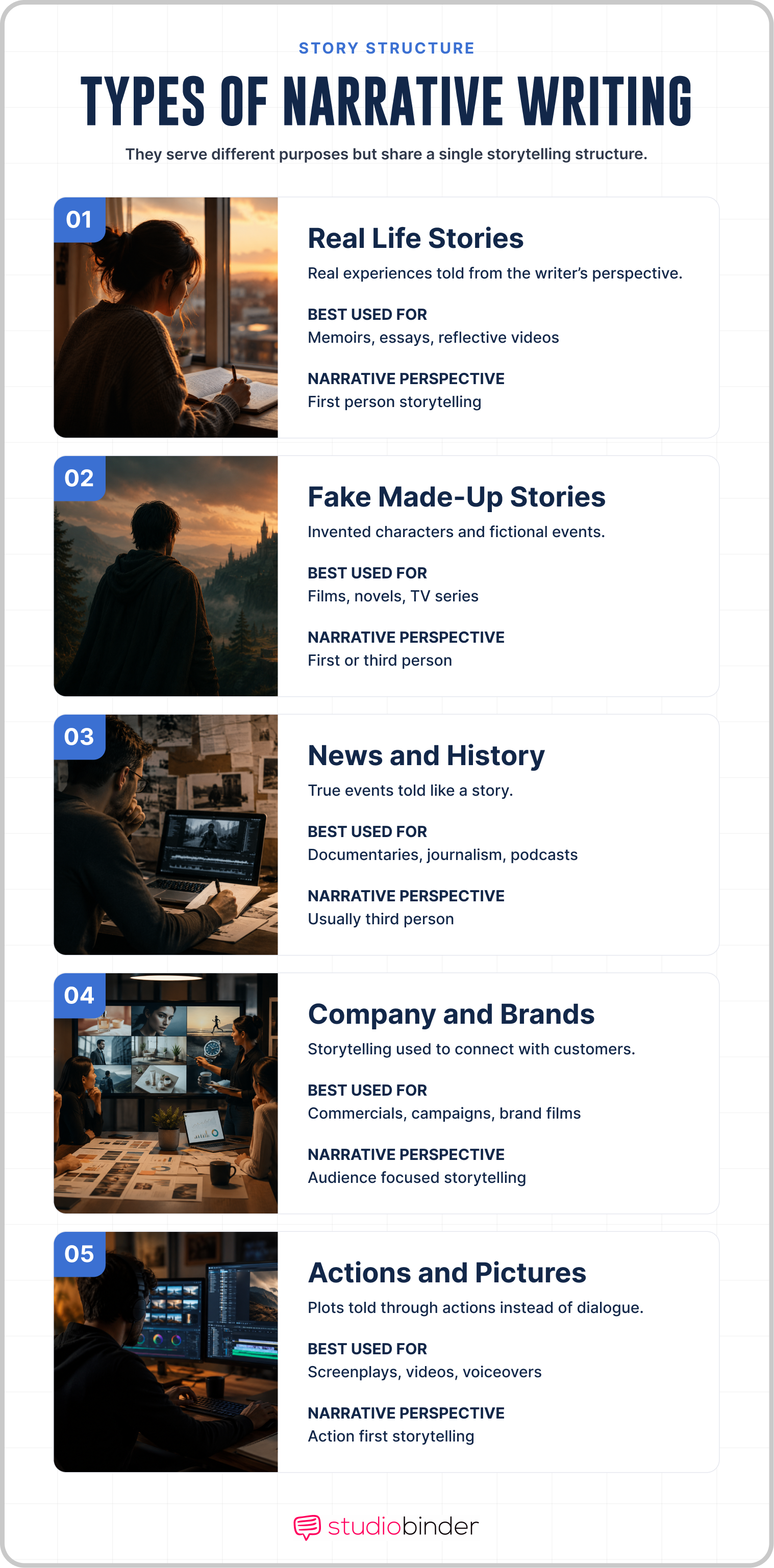
Types of Narrative Writing • Narrative Writing
Personal narrative
Personal narrative draws directly from lived experience. The writer is the narrator, telling a true story from their own point of view. Memoirs, personal essays, and first-person documentary narration are all forms of personal narrative.
In film, personal narrative shows up most clearly in documentary work. A subject recounting their own story on camera performs personal narrative even when the words are unscripted. When that narration is written, the writer must capture the authentic voice of the speaker while giving the story the clarity and structure it needs to function on screen. This is harder than it sounds — making a documentary requires navigating the gap between how a person actually speaks and how a narrative needs to move.
Fictional narrative
Fictional narrative invents its characters, events, and world. Feature films, short films, and scripted series all draw on fictional narrative writing. The writer constructs reality from scratch — what the characters want, what stands in their way, what the world looks and feels like.
Good fictional narrative requires a solid understanding of story elements and narrative structure. Audiences suspend disbelief as long as the internal logic holds and characters behave consistently with who they've been established to be. Violation of either breaks the spell.
Narrative nonfiction
Narrative nonfiction applies storytelling techniques to true events. The goal is the same emotional pull as fiction while remaining factually accurate. Literary journalism, narrative documentary scripts, and certain forms of branded content fall into this category.
The challenge of narrative nonfiction is that the writer cannot invent conflict, characters, or outcomes. They must find the story already present in the facts and shape it — which requires strong scene building skills, clear narrative structure, and a commitment to accuracy that fiction writers don't face.
Brand and commercial narrative
Brand and commercial narrative writing serves a persuasive function while using the emotional mechanics of story. This is the type of narrative writing used in brand films, product launch videos, television commercials, and branded content campaigns.
Unlike editorial storytelling, commercial narrative operates under extreme time pressure. A 30-second spot has to establish a character, create conflict, and resolve it before the viewer looks away. This demands structural discipline — the inciting incident must land in the first few seconds, and every image must earn its place in the narrative.
In longer brand work, brand storytelling uses many of the same techniques as documentary: real subjects, real stakes, and a narrative arc that builds trust rather than just attention. AV scripts are one of the most practical writing tools for this kind of work — they let writers map narration and visuals side by side so both tracks reinforce each other throughout the piece.
In StudioBinder, we provide a 2-column scripting layout so you can easily build out your script with image references and duration details.
AV Scripting • Try StudioBinder's Free AV Script Software
The persuasive dimension of commercial narrative doesn't require shallow content; the best brand films work because they tell a story worth watching even before the product appears.
Learning is the baseline for most screen narrative writing. Understanding — a blueprint that describes only what the camera sees and what characters say — clarifies where the narrative writer's responsibilities begin and end. The conventions of the format exist to keep the writing production-ready, not to constrain the writer's creative choices.
Video and script narrative
Video and script narrative covers the full range of professional screen-based storytelling: screenplays, video scripts, how-to videos, YouTube series, and narrative-driven social content.
Trusted by over 1M creatives
AV scripts with built-in timing
Write in two-column format, track runtime, and share with version control

Creative Writing Techniques
Narrative writing techniques
Strong narrative writing uses a specific set of techniques that create momentum, depth, and emotional connection. These aren't rules so much as tools — skilled writers apply them deliberately based on what each story needs.
Point of view
The narrator's relationship to the story defines everything else. In documentary and nonfiction narrative writing, the narrator typically speaks in first or third person, providing context and meaning from outside or inside the events. Third person narration is the most common register in nonfiction because it creates authority and distance. But intimate stories often benefit from first person — the choice fundamentally changes how close the audience feels to the experience.
Tension and conflict
Every narrative writing technique ultimately connects back to tension. Tension doesn't mean constant action — it means unresolved stakes. The reader or viewer keeps going because they don't know how the conflict ends. The range of available conflict types includes internal conflict (a character vs. their own doubt), interpersonal (character vs. character), and external conflict (a character vs. a broken system or a hostile environment).
Foreshadowing and dramatic irony
Foreshadowing hints at future events to create anticipation. Dramatic irony gives the audience knowledge that the characters don't have, producing dread or comedy depending on tone. Both techniques are most common in fictional narrative, but they appear in documentary and commercial work too — a documentary might cut early to an image that won't fully register until the final act. That's structural foreshadowing built into the edit.
Subtext and dialogue
Good dialogue in film reveals character through subtext rather than direct statement. A character who is frightened doesn't say "I'm frightened" — their behavior changes, their rhythm shifts, or they say something that means the opposite of what it appears to say. Strong narrative writing trusts the audience to interpret what's happening without explanation.
In screen narrative, "show don't tell" is literal. The audience experiences what characters experience through action, environment, and behavior. A strong scene does not explain itself — it presents and trusts.
Three Act Structure Explained • Narrative Writing
Writing Process
How to write a narrative
The process of narrative writing is iterative. Most professional writers don't work in a straight line — they develop ideas, draft, revise, and revise again. But the five steps below cover the core sequence in order.
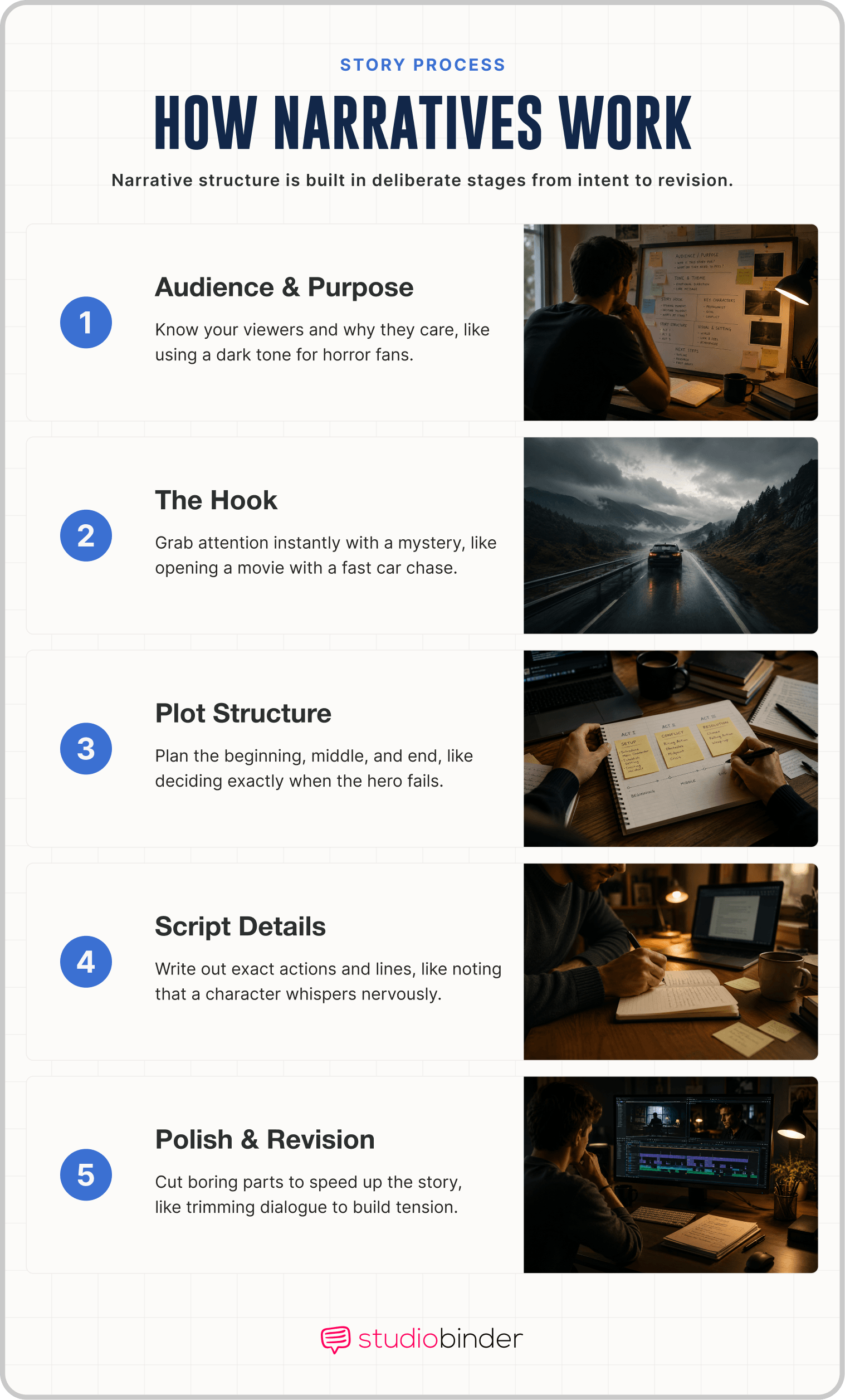
Developmental Screenplay Writing Process Guide • Narrative Writing
Step 1: Identify the core conflict
Every narrative starts with one question: what does someone want, and what stands in the way? That conflict is the engine. Without it, the writing is description rather than story. In film and video work, the conflict doesn't have to be dramatic — a person trying to capture something true about the world before the moment passes is enough of a premise to build from.
Step 2: Build your narrative structure
Plot your story before you write it. Even a rough map of beginning, middle, and end gives the writing a direction. Most screen narratives follow some version of a three-act structure: setup, confrontation, and resolution. Understanding story structure at this stage prevents the most common writing problem — a strong opening that doesn't know where it's going.
Step 3: Develop your characters
Characters who change are more compelling than characters who don't. Before writing, know what your central character wants, what they're afraid of, and what they'll discover. In a short film, this might be a single core truth about a person. The clearer the character is before the draft begins, the more honest the scenes will be during execution.
Step 4: Write the first draft
Write to finish. The first draft doesn't need to be good — it needs to exist. Most of what makes narrative writing work reveals itself in the process of writing, not before it. Write every scene through to the end, including the ones that feel wrong. A screenplay or video script that exists can be fixed. A blank page can't.
In StudioBinder's free screenwriting software, we handle all of the formatting automatically so you can focus on the narrative storytelling:
Script Formatting • Try StudioBinder's Free Screenwriting Software
Step 5: Revise for clarity, rhythm, and truth
Revision is where narrative writing actually happens. Read everything aloud — dialogue especially. Cut any scene or line that doesn't serve the story. Check whether the story arc resolves with honesty: does the ending feel earned, or was it imposed? The best narrative writing has an inevitability to it — the ending feels like the only possible conclusion given everything that came before. That quality is almost never in the first draft. It comes from revision.
Related Posts
Literature Examples
Narrative writing examples
Looking at how different productions use narrative to achieve specific effects shows the range of what narrative writing can do. Each format below makes different structural choices, and the writing behind each reflects those choices in every scene.
Brand video narrative example
Nike's "Find Your Greatness" campaign doesn't sell shoes. The brand writing identifies a universal narrative — the struggle of an ordinary person trying to do something hard. The voiceover script redefines "greatness" as something available to everyone, not just elite athletes.
The brand film works because the narrative is structurally complete: there's a conflict (mediocrity vs. effort), a character (anyone watching), and a resolution (greatness is already there). The writing is minimal, but every line serves a structural function.
Effective branded content almost always works this way — brand storytelling that only describes a product without constructing a story rarely builds lasting connection. On the production side, work like this involves everything from a film lookbook that establishes visual tone to a shot list that translates the narrative intent into specific frames.
Documentary narrative example
In documentary filmmaking, narrative writing works differently than in fiction. The writer cannot invent what happened — but they control how the material is shaped, sequenced, and interpreted. Strong documentary narration positions the viewer inside events that have already occurred. In Errol Morris's films, the voiceover doesn't just explain — it asks questions, delays resolution, and creates tension between what the images show and what the narrator says.
That gap between image and language is where meaning lives. The writing behind a documentary also determines the edit. The structure of a documentary script — where interviews appear, how archival footage is cued, when the narration steps back and lets cinematography and shot selection carry the weight — is itself a form of narrative writing.
Understanding documentary filmmaking means recognizing that narrative writing continues through post-production, not just during the research and scripting phase. Documentary narration at its best uses the same tools as fiction: foreshadowing, conflict, character arc, and earned resolution. The constraint is that every element must remain true.
Scripted narrative example
In Moonlight (2016), written by Barry Jenkins, the script structure divides the narrative into three chapters, each following the same character at a different point in his life. The narrative writing doesn't explain the character's internal experience — it shows behavior, silences, and relationships, and lets the accumulation of scenes carry the meaning.
What makes this a useful narrative writing example is how little the script over-explains. Dialogue is spare. Mise-en-scène notes are precise but not overwrought. The writing trusts the audience to do interpretive work — which is what the best narrative writing always does, regardless of format.
For productions working from scripts of this kind, the path from page to screen involves tools like a script breakdown sheet to organize production elements and a storyboard to translate the narrative's visual intentions into production-ready frames.
In StudioBinder, you can go from script breakdown to building out a fully shareable storyboard with just a few clicks as seen below:Creating a storyboard • Try StudioBinder's Free Storyboard Software
Frequently Asked Questions
Narrative writing FAQs
Narrative writing is writing designed to tell a story through characters, events, conflict, and structure. The goal is to move readers or viewers through a sequence of experiences — not just inform them, but make them feel something. The narrative writing definition covers everything from personal memoirs to screenplays to brand films: any writing where events unfold meaningfully over time, and where character and conflict give those events significance.
The key narrative elements are narrator, plot, character, conflict, narrative structure, theme, setting and tone, and story arc. These work together to create emotional resonance and forward momentum. Strong narrative writing applies all of them deliberately, with each choice serving the story's central conflict. Missing even one — a story without a real conflict, or a narrative without a meaningful arc — weakens the whole structure.
The main types of narrative writing are personal narrative, fictional narrative, narrative nonfiction, brand and commercial narrative, and video and script narrative. Each type applies core narrative writing techniques differently based on medium, audience, and purpose. In film and video production, most professional writing falls into fictional or commercial narrative forms, though documentary work draws heavily on narrative nonfiction.
Key narrative writing techniques include establishing a clear point of view, building tension through unresolved conflict, using foreshadowing and dramatic irony, and applying "show don't tell" principles. These narrative techniques appear across all types of narrative writing and are especially important in screenwriting and video scripting, where the writer can only describe what the camera sees and what characters say aloud.
In prose, the narrator has direct access to a character's thoughts and can describe them explicitly. In film narrative writing, the writer can only describe what the camera sees and what characters say. This constraint makes visual behavior the primary storytelling tool — environment, action, and performance communicate what prose can state directly. Strong screen narrative writing shows inner experience through outer behavior, trusting the audience to close the gap.
Effective brand narrative writing follows the same structural rules as any story — clear conflict, recognizable character, earned resolution. The persuasive goal doesn't change those requirements. Brand films that work use real stakes and a narrative arc that resolves with something true. Brand storytelling that skips the story in favor of product description rarely builds the kind of emotional connection that translates into lasting audience trust.
UP NEXT
What is visual storytelling?
Narrative writing is the foundation of every story. It shapes structure, controls information, and determines how an audience experiences events. The next step is understanding how that writing translates to the screen. Visual storytelling is where narrative elements become images, movement, and composition.

From script to production. Write, collaborate, and produce all in one place.
Write scripts online for free. Track versions. Share for feedback and approval. When you're done transition seamlessly to script sides, shot lists, storyboards, schedules, breakdowns, call sheets and more.