Astage play is one of the oldest forms of storytelling. It is also one of the most demanding. There are no close-ups. No editing tricks. No camera movement to guide the audience. Everything happens live in front of the crowd. That changes how a writer builds character, conflict, and dialogue.
Learning how to write a stage play means learning how to write for actors, space, rhythm, and silence. It also means understanding stage play script format, dramatic structure, and the mechanics of live performance. In this guide, we will break down how to write a play from the ground up. We will cover structure, spoken dialogue, formatting, revision, and what makes theater different from screenwriting.
Follow this five-step framework as you read. It maps directly to the sections ahead.
Define stage play
First, let’s define a stage play
While we all may have a general image in our head of stage actors on a stage, what does stage play mean, exactly? Nailing down a precise definition will be essential to understanding how to write a stage play.
Playwriting DefinitionWhat is a stage play?A stage play is a scripted dramatic work written to be performed live before an audience. Actors perform the story in a shared physical space using dialogue, movement, lighting, sound, and staging. |
Famous stage plays include:
- Hamlet (William Shakespeare)
- Death of a Salesman (Arthur Miller)
- A Streetcar Named Desire (Tennessee Williams)
- Waiting for Godot (Samuel Beckett)
- A Raisin in the Sun (Lorraine Hansberry)
- Hamilton (Lin-Manuel Miranda)
Unlike film or writing for television, theater unfolds in real time. The audience watches events happen without cuts or edits. That changes how scenes are written and how tension builds.
Now let's breakdown the key differences between stage plays and screenplays. The difference will really help with learning how to write a stage play script.
Stage Plays vs. Screenplays
A screenplay is written for camera framing. A stage play is written for live performance.
Film relies heavily on editing and visual language. Theater relies more heavily on actors, blocking, and dialogue. A playwright cannot cut from one image to another. The writer must create momentum inside a physical space.

Stage Play Versus Screenplay Narrative Rules Comparison • How to Write a Stage Play Script
That also changes the role of stage directions. In film, writers may describe visual details that the camera captures. In theater, stage directions guide movement, pacing, and performance within a shared environment.
Dialogue also carries more weight on stage. It must reveal character, conflict, tone, and subtext without the help of reaction shots or montage.
The Elements Every Play Shares
Every stage play script has a few core dramatic elements.
First, there are characters with clear objectives. Every scene should contain someone pursuing something specific.
Second, there is conflict. The audience watches characters struggle against obstacles, each other, or themselves.
Third, there is story structure. Plays are divided into acts and scenes that shape the dramatic rhythm.
Finally, there is dialogue. Theater lives through speech. Even highly visual productions still depend on language to move the story forward.
Good playwriting balances all of these elements.
Understanding dramatic elements is only the beginning. Next, explore how different parts of a play work together to create momentum, tension, and emotional payoff.
Related Posts
Theater Play Structure
How to structure a stage play
Structure can make new writers nervous. Some fear there are secret rules they do not know. Others reject structure because it sounds too mechanical.
But dramatic structure is not the enemy of creativity. It is one of the most useful tools in playwriting.
At its simplest, structure is the relationship between story, time, and place. What happens? When does it happen? Where does it happen?
Those choices shape the whole play. A tense family argument might work best as a pressure-cooker play in one room. A political epic may need to move across years, locations, and public events.
A strong narrative arc creates movement. Pressure builds scene by scene until the play reaches its structural climax.
When learning how to write a play script, structure matters as much as dialogue. Even naturalistic plays depend on carefully placed plot points, reversals, and limits.
Structure can also save time. Many struggling drafts do not need better lines. They need the right shape.
When learning how to write a stage play, it helps to think about the audience experience first. Theater is immediate. Every pause, silence, entrance, and line reading happens live.
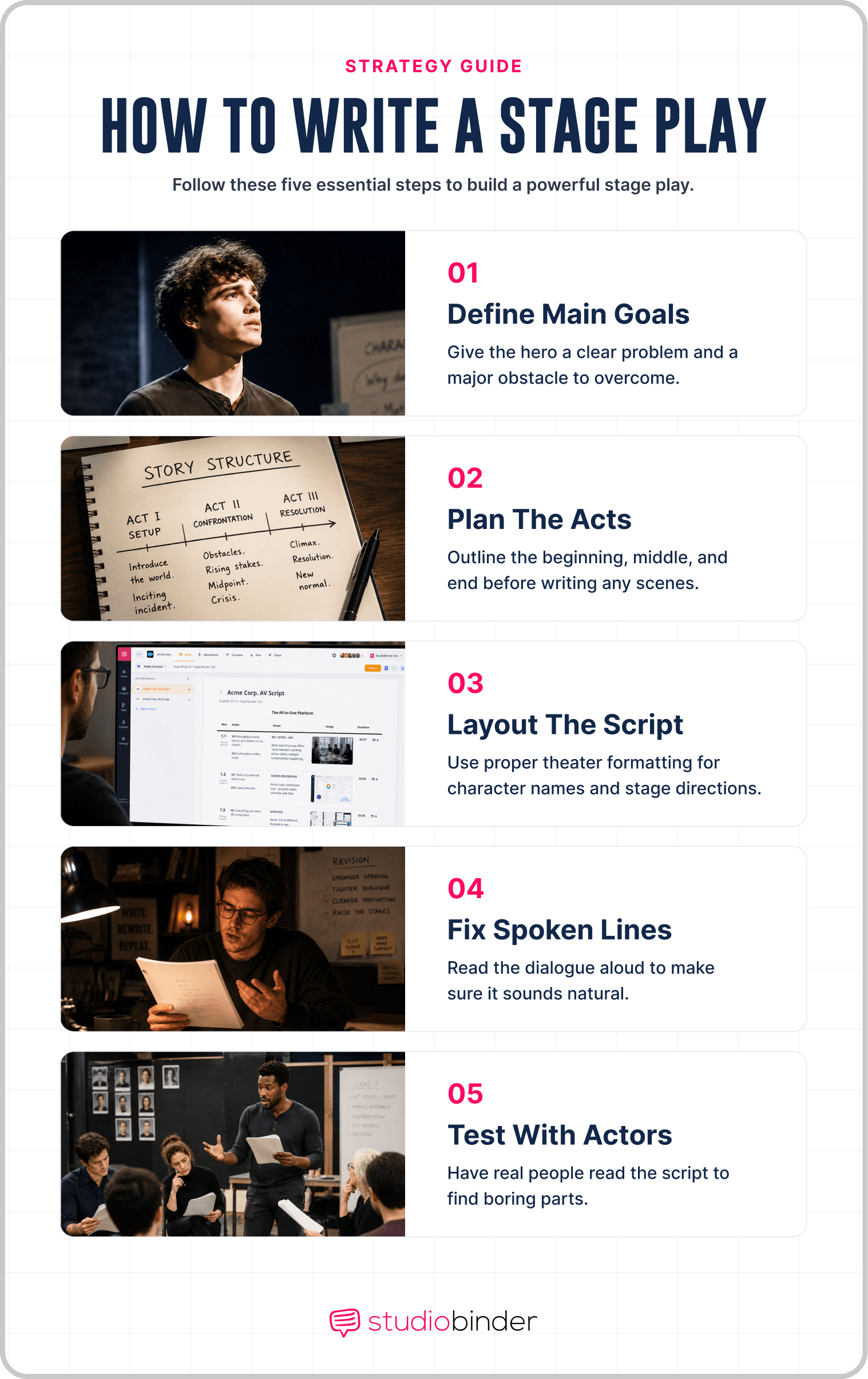
Essential Steps to Draft Live Theater Scripts • How to Write a Stage Play Fromat
Acts, Scenes, and How They Work
Act structure is intrinsic to understanding how to write a stage play format. An act is a major division within a play. Different formats create different rhythms.
A one-act play moves continuously without intermission. A two-act play often builds toward a major midpoint break. Three-act structures create a broader rise and fall across the evening.
Scenes are smaller divisions inside each act. A new scene usually begins when there is a major shift in location, time, or character arrangement.
In stage play script format, scene headings are simpler than screenplay slug lines. They usually identify the setting in plain language.
For example:
DRAWING ROOM. EVENING.
Or:
A STREET OUTSIDE THE THEATER.
The goal is clarity, not cinematic precision.
The Three-Act Structure for the Stage
Many playwrights use a version of the three-act structure.
Act One establishes the world, introduces the main character, and presents the inciting incident.
Act Two escalates conflict. Obstacles grow larger. Relationships fracture. Stakes increase.
Act Three resolves the central conflict and delivers the climax.
The tension arc below shows how pressure builds across each act — and why most playwrights find Act Two the hardest section to sustain.
This model is useful because it makes a large task feel writable. A full-length play can feel impossible at first. Breaking it into sections gives the writer a path through the draft.
The model is also flexible. Sections do not need to be equal in length. The middle can sprawl, tighten, or fracture depending on the play.
Theater structure often feels more compressed than film structure because scenes play out in real time. Long stretches of exposition can quickly stall momentum.
Example: Death of a Salesman
Arthur Miller’s play begins by establishing Willy Loman’s exhaustion and disappointment. The audience quickly understands the emotional tension inside the family.
As the play progresses, the pressure builds scene by scene. Willy’s fractured memories and growing instability create the rising action that drives the play toward tragedy.

Death of a Salesman • How to Write a Stage Play
This production trailer highlights how stage performance carries emotional tension without cinematic editing. The actors, lighting, and blocking create the dramatic rhythm in real time.
Example: A Raisin in the Sun
Lorraine Hansberry’s play uses domestic space to intensify conflict. Much of the story unfolds inside a small apartment.
That contained environment increases pressure between the characters. Every decision feels immediate because the audience shares the same physical space.

A Raisin in the Sun • How to Write a Stage Play
Notice how the blocking and staging reinforce emotional dynamics. Character movement inside the room becomes part of the storytelling.
Rising Action, Climax, and Resolution
Rising action is the sequence of events that increases tension across the play.
Every scene should increase pressure in some way. New information appears. Relationships shift. Obstacles grow larger. Each of these moments functions as a plot point that moves the story forward and makes the climax feel earned.
A story also needs reversal. If the action only moves in one emotional direction, the audience can predict the shape too early.
Conflict keeps a play alive. Reversal keeps it surprising.
There is one more structural question to ask.
When does the story stop?
A play cannot include every event in a character’s life. The writer must choose the limits of the story. Those limits give the piece focus.
On stage, the climax feels especially immediate because the audience experiences it live. There is no distance created by editing.
Resolution also lands differently in theater. A final stage image can linger in silence after the lights fade.
That physical stillness is one reason theater remains so powerful.
Now that you understand dramatic structure, the next step is learning how plot mechanics shape tension, pacing, and payoff.
Related Posts
Play Dialogue Techniques
Writing stage play characters and dialogue
Character and dialogue are the foundation of understanding how to write a stage play script.
A stage audience spends long periods watching actors speak in real time. Weak dialogue becomes obvious immediately.
That is why many playwrights focus less on spectacle and more on objective, conflict, and subtext.
Character Objectives and Obstacles
Every character should want something specific. That's how to write a stage play format 101.
Vague objectives create vague scenes. Clear objectives create dramatic movement.
A character may want:
Forgiveness
- Power
- Love
- Escape
- Money
Something must also stand in the way.
That obstacle creates conflict. Without conflict, scenes become static.
David Mamet often argues that drama works best when characters pursue objectives directly. The audience should understand what each person wants from the scene.
That does not mean characters speak honestly. Many strong scenes work because characters avoid saying what they mean.
Subtext creates tension.
Example: Who’s Afraid of Virginia Woolf?
Edward Albee’s dialogue constantly shifts between attack, performance, and vulnerability. The characters rarely speak plainly.
Instead, they weaponize language against each other. That emotional pressure drives the scene forward.

"Who's Afraid of Virginia Woolf?" at Arena Stage • How to Write a Stage Play Format
Watch how pauses and interruptions shape the rhythm. The tension comes from what remains unsaid.
Dialogue That Only Works on Stage
Stage dialogue behaves differently from screen dialogue.
In film, actors can communicate emotion through close-up shots and editing. Theater cannot rely on those tools.
That means spoken language must carry more dramatic weight.
Silence also matters. A pause on stage feels physical because the audience shares the same room as the actors.
Playwrights also use theatrical conventions that rarely appear in film.
A soliloquy allows a character to speak their thoughts directly to the audience. An aside briefly breaks the illusion of privacy.
These devices may seem artificial on screen. On stage, they can feel intimate and immediate. Considering how it'll feel to watch the play in a room is an essential step to how to write a stage play script.
Example: Hamlet’s “To Be or Not To Be” Soliloquy
Shakespeare’s famous speech in Hamlet works because the audience becomes part of Hamlet’s internal struggle.
The character is not simply speaking. He is thinking out loud in front of the crowd.
To be or not to be Kenneth Branagh • How to Write a Stage Play
Different performances change the rhythm and meaning of the speech. That flexibility is central to theater.
One practical rule for how to write a stage play helps almost every playwright.
Read dialogue out loud.
If it sounds unnatural when spoken, it will usually feel unnatural on stage.
Dialogue changes across mediums. Next, explore how screen dialogue differs from theatrical dialogue and how film writers create subtext visually.
Related Posts
Play Script Format
Stage play script format
Formatting matters because it affects readability.
Directors, actors, and producers all need to navigate the script quickly. Clear formatting makes rehearsal easier.
If you are learning how to write a stage play script, understanding stage play format is essential.
Title Page, Dramatis Personae, and Scene Headings
A stage play script format usually begins with a title page.
The title appears centered in all caps. The playwright’s name appears underneath. Contact or representation information may appear near the bottom.
Many plays also include a dramatis personae section.
This is a cast list that introduces the characters in order of appearance.
For example:
JOHN, a tired schoolteacher in his forties.
EMMA, his younger sister.
Scene headings in play script format remain simple and readable.
Unlike screenplay formatting, stage plays avoid complex sluglines.
The emphasis stays on staging and performance rather than cinematic coverage. Formatting is crucial for knowing how to write a stage play.
Stage Directions
Stage directions describe movement, action, or technical changes.
They are usually written in present tense using concise language.
For example:
(JOHN crosses to the window.)
(Lights fade slowly.)
Strong stage directions remain functional. They guide the production without overwhelming the page.
Overwritten directions can become restrictive. Theater is collaborative. Directors and actors need space to interpret the material.
That balance matters in playwriting.
Many contemporary plays use sparse stage directions. It's all part of the process of learning how to write a stage play.
This lets productions adapt the material to different stages, budgets, and design choices.
How to Format Dialogue on the Page
Dialogue formatting in a stage play script is straightforward.
Character names appear in ALL CAPS above each speech. Dialogue appears underneath.
Brief parentheticals may appear within the dialogue when necessary.
For example:
JOHN
(quietly)
I did not think you would come back.
Margins also differ slightly from screenplay formatting. Theater scripts are built for rehearsal rather than shooting schedules.
StudioBinder handles stage play script format automatically. Everything from character names capitalize, stage directions indent, and dialogue blocks position correctly without manual adjustment.
How to Properly Format Scripts • Try StudioBinder's Free Playwriting Software
StudioBinder's playwriting software allows writers to focus on what actually matters: character objectives, subtext, and the shape of the scene.
Formatting and how to write a stage play overall becomes easier once you see it on the page. Next, explore full play script examples and formatting breakdowns.
Trusted by Over 1M Creatives
Screenwriting from draft to set
Write, format, and share your script. Ready for production when you are.

One Act Play
How to write a one-act play
Many new playwrights learn how to write a stage play with one-act plays.
That shorter form teaches discipline. Writers learn how to establish story conflict quickly and maintain momentum.
A one-act is also easier to stage and workshop.
Length and Structure for One-Acts
A one-act play tells a complete story in a single act.
Most run between ten and forty-five minutes.
Ten-minute plays usually focus on one conflict and one setting. Longer one-acts allow more room for secondary relationships or thematic development.
The inciting incident should arrive quickly.
There is little room for extended exposition in shorter formats.
What Works (and What Doesn't) in the Shorter Form
The best one-acts stay focused.
Contained locations work well. Smaller casts also help maintain clarity.
This is where structure becomes practical. A one-act does not give the writer much room to wander. The form rewards clear conflict, swift reversal, and a strong ending point.
Strong one-acts often include:
- Focused conflict
- Small cast
- Clear objective
- Limited setting
Some ideas work less effectively in shorter formats.
Large ensemble stories can feel rushed. Multiple subplots may distract from the central tension.
A strong one-act feels inevitable. Every scene pushes directly toward the ending.
Example: Trifles
Susan Glaspell’s Trifles demonstrates how contained environments can intensify dramatic tension.
The play remains focused on a single investigation and a tightly controlled setting.

Trifles by Susan Glaspell, a Concrete Timbre & d'moiselles production in NYC • How to Write a Stage Play Format
Notice how small details gradually reshape the audience’s understanding of the story. Short-form storytelling exists across mediums. Next, explore how short film structure compares to theatrical structure as you continue learning how to write a stage play.
Related Posts
Play Script Revision
Revising and table reading your play
First drafts are rarely finished drafts.
Revision is where many plays truly take shape.
One of the most valuable tools in playwriting is the table read.
A table read is a session where actors read the script aloud before staging begins. Hearing dialogue spoken by real performers immediately reveals weak moments.
Listen carefully during the reading.
You may notice:
- Flat dialogue
- Slow pacing
- Blurred voices
- Repetitive scenes
Some lines that seemed effective on the page may suddenly feel unnatural out loud.
That is normal.
After the table read, take notes. Then step away from the script for a few days before revising.
Distance helps writers spot structural problems more clearly.
Table reads help writers hear structure, pacing, and dialogue in real time. Yes, this is important knowledge for how to write a stage play. Next, learn how to organize and run one effectively.
Frequently Asked Questions
How to write a stage play FAQs
Begin with a single clear conflict, one character wanting something specific and facing an obstacle. Before outlining, write one scene. Hearing dialogue on the page early helps writers discover the play's voice. Many experienced playwrights suggest starting with character rather than plot because story grows naturally from what people want.
Most full-length plays run between 90 and 120 minutes, including a brief intermission. The script typically runs between 80 and 110 pages, depending on dialogue density and stage direction length. One-act plays range from ten minutes to roughly forty-five, depending on format and production context.
There is no rule on character count, but practical considerations matter. More characters mean larger casts and higher production costs. Many successful plays focus on two to six characters. Smaller casts let writers develop each character more fully and create tighter dramatic tension within scenes.
A table read is the most effective tool available to playwrights. Hearing trained actors read the script aloud reveals pacing problems, weak dialogue, and structural gaps that are easy to miss on the page. Local theater companies and university drama departments often host informal readings for developing work.
Stage play scripts follow a different formatting convention than screenplays. Character names appear in all caps above each speech block rather than centered on the page, and stage directions use a different indentation style. Tools built specifically for playwriting handle these formatting differences automatically.
Dialogue is what characters say. Subtext is what they actually mean but do not say directly. Strong stage writing relies on subtext because audiences experience plays in real time, noticing the gap between what characters say and what their behavior reveals. Playwrights like Harold Pinter and David Mamet built entire dramatic styles around withheld meaning.
UP NEXT
Understand parts of a play
Now that you understand the key components of how to write a stage play, you'll need a refresher on the key parts of a play, which we break down in the next article.
Start Your AV Script
Start planning your next video with a structured AV script. Whether for commercials, corporate videos, or social media, our templates provide the perfect framework.