NNo character in dramatic literature has provoked more debate than Hamlet. He hesitates. He questions. He delays. But the real problem is not simply that he cannot act. It is that, in this world, action itself becomes difficult to trust. Hamlet, Shakespeare’s longest play, was written around 1600. It begins as a revenge tragedy. A son must avenge his father’s murder. But the play quickly complicates that premise. The more Hamlet investigates, the less stable the truth becomes. Appearances shift. Evidence depends on interpretation. Even identity feels uncertain.
This guide covers a Hamlet summary, key Hamlet characters, themes, Hamlet quotes, and what continues to make the play feel unresolved.
SHAKESPEARE'S LONGEST TRAGEDY
What is Hamlet?
Let's begin this Hamlet summary with a basic breakdown of what it is. Hamlet, Shakespeare's longest tragedy, follows Prince Hamlet, who seeks revenge after learning that his uncle Claudius murdered his father.
Written around 1600 and first performed at the Globe Theatre, it belongs to the revenge tragedy tradition. But it resists the clarity that genre usually provides.
Revenge tragedies depend on certainty. A crime is committed. The avenger responds.
Its cultural reach reflects that complexity. Dozens of film adaptations exist, from early silent versions to modern reinterpretations. That makes it one of the most adapted plays in history.
In Hamlet, certainty is always unstable.
The ghost might be truthful. Or deceptive. Claudius might be guilty. Or simply fearful. Even Hamlet's madness is unclear. Is it performed, or becoming real?
What is Hamlet about?
On the surface, it is a revenge story. Underneath, it is about the difficulty of acting in a world where truth cannot be fixed.

Hamlet (Edison Theatre) - ghost's first appearance • Hamlet Summary
FIVE-ACT STRUCTURE
Hamlet plot summary
This Hamlet summary follows the play's five-act structure, but the movement is not straightforward. Each act builds pressure and makes certainty harder to secure. What starts as a clear revenge story grows unstable. Action gets delayed, redirected, and complicated by interpretation. Now let's jump into the always intriguing Hamlet summary.
Act I: The ghost and the revelation
The play opens at Elsinore Castle, where guards encounter the ghost of the dead king. When Hamlet meets it, the ghost claims that his brother, now King Claudius, murdered him.
The demand is immediate: Hamlet must take revenge.
But instead of acting, Hamlet questions what he has seen. He cannot be certain the ghost is truthful. This uncertainty shapes everything that follows. He decides to feign madness. That creates distance between his inner thoughts and outward behavior.
Act II: Hamlet's plan and feigned madness
Hamlet begins performing madness. His speech becomes erratic, and his behavior unpredictable.
Claudius and Polonius respond by watching him closely. Even Ophelia is used to test his condition. The court becomes a space of observation, where everyone is both watching and being watched.
Hamlet develops a plan. A group of traveling actors arrives, and he decides to use a play to test Claudius's guilt.
Act III: The play within the play
The play within the play, "The Mousetrap," mirrors the murder described by the ghost. Claudius reacts strongly, confirming his guilt.
The scene is a masterclass in dramatic irony. The audience knows what the staged murder mirrors, while most of the court does not.
Hamlet now has evidence, but it remains indirect. He still does not act immediately.
He confronts his mother, Queen Gertrude. In the confusion, he kills Polonius, who is hiding behind a curtain. This is the play's turning point. Action finally happens, but it is misdirected, and the consequences start to escalate.
Check out the mousetrap scene from the 2000 adaptation:
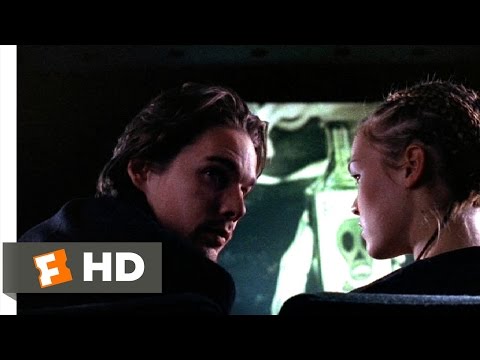
The Mousetrap - Claudius reveals his guilt • Hamlet Summary
Act IV: Exile, Ophelia's breakdown, and Laertes
Claudius sends Hamlet to England with orders for his execution. Hamlet escapes, but the damage spreads through the court.
Ophelia, Hamlet's former love, descends into madness and later dies, unable to recover from her grief. Her brother Laertes returns, furious and seeking revenge for their father's death.
Claudius uses Laertes' anger to form a plan against Hamlet. The external conflict now spreads. More characters get pulled into the cycle of revenge.
Act V: The duel and the ending
Hamlet returns to Denmark, changed by his experiences.
In the graveyard, he confronts death directly, holding the skull of Yorick. The moment lands as dramatic irony, since the audience knows the jester he once knew is reduced to the bones he holds.
Laertes challenges him to a duel. Claudius arranges for the sword to be poisoned and prepares a poisoned drink as a backup plan.
The final scene unfolds rapidly. Gertrude drinks the poison by mistake. Laertes and Hamlet wound each other. Laertes reveals the plot before dying. Hamlet finally kills Claudius.
Hamlet dies soon after. The play ends without restoration, as nearly all the central characters are gone.
This Hamlet summary tracks how a single act of murder unravels into total collapse.
The Act V duel involves a poisoned sword, a poisoned cup, and four deaths in one scene. A script breakdown lets you tag every prop, track who touches what, and flag continuity issues before you're on set.
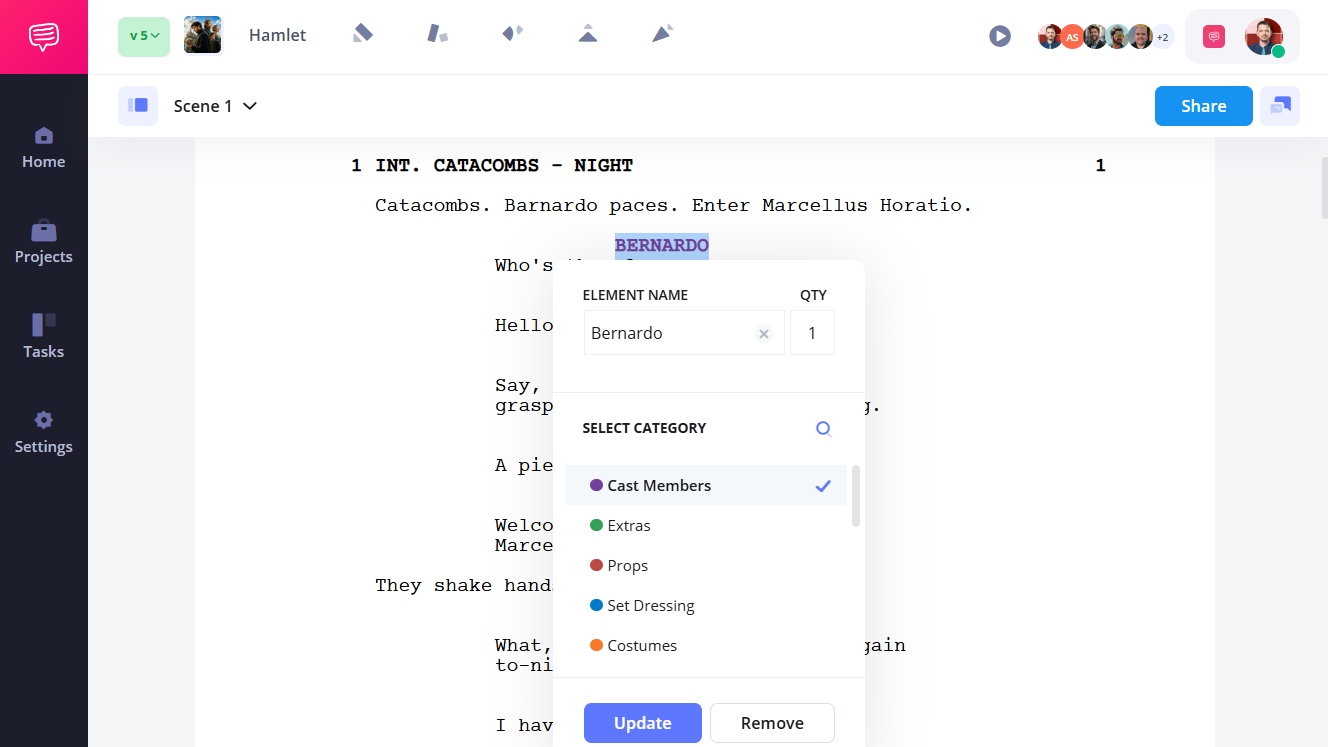
Hamlet Script Breakdown • Hamlet Plot Summary
CAST OF ELSINORE
Hamlet characters
The Hamlet characters reflect different responses to uncertainty, power, and performance.
Each one shows a distinct way of moving through a world where truth is unstable and appearances can be manipulated. Understanding these characters is key to understanding the play. Meaning comes through their contrasts, not through Hamlet alone.
Let's dive into the key characters in Hamlet:
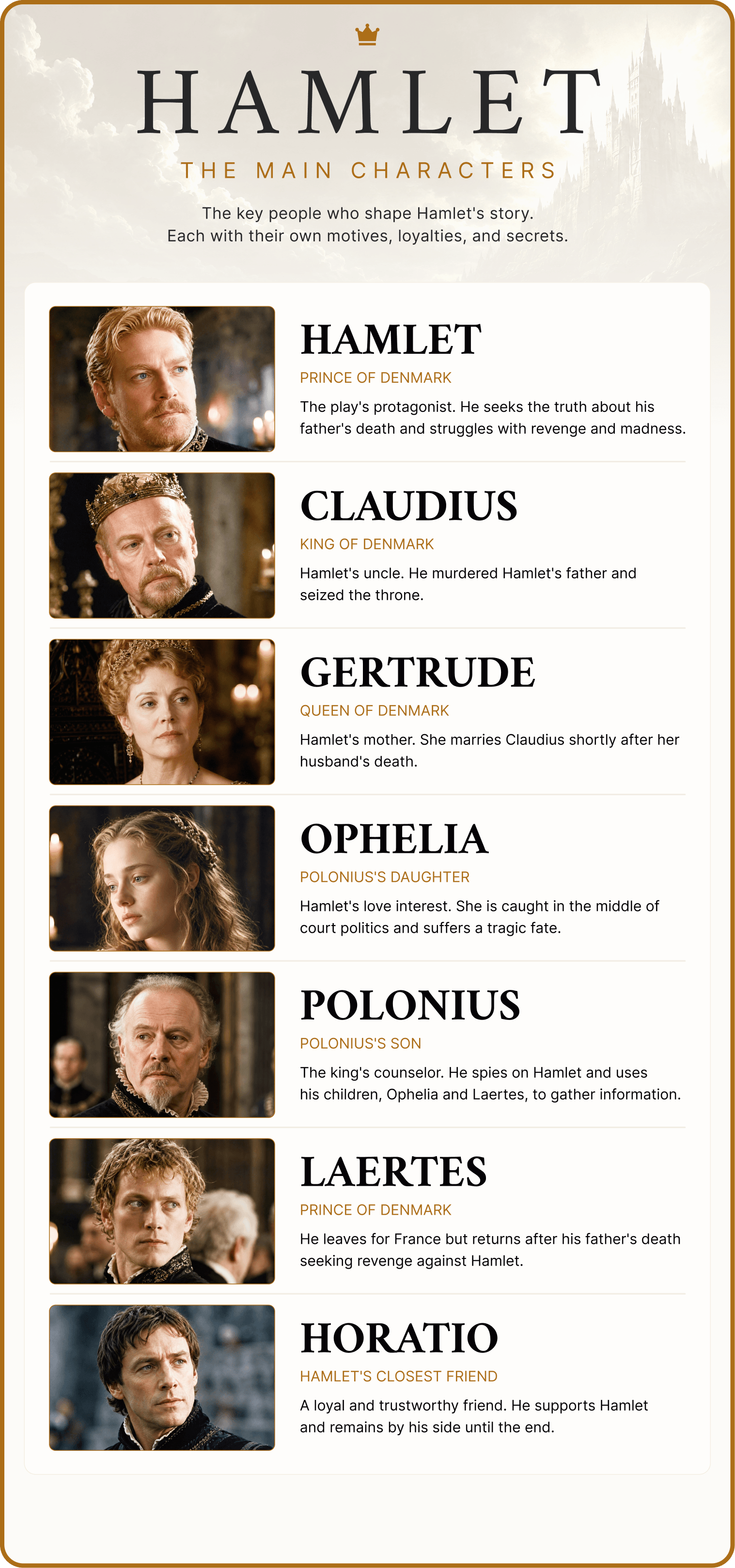
Hamlet Main Characters • Hamlet Summary
Prince Hamlet
The protagonist. Prince of Denmark and son of the murdered king.
Hamlet is defined by thought. He is not simply indecisive. He will not act without first knowing the consequences. His tragic character flaw lies in the need for certainty in a world that cannot provide it. This creates the central tension of the play. He knows what he must do, but cannot reconcile that duty with his moral and intellectual doubts. His hesitation shapes the entire structure of the tragedy.
King Claudius
The antagonist. Brother of the dead king and current ruler of Denmark. Claudius is both a murderer and an effective king. He keeps political stability while hiding his crime. This duality makes him dangerous. He proves that power does not depend on truth, but on control and perception. His private guilt, especially in the prayer scene, contrasts with his public authority. He is aware of his wrongdoing, but unable to undo it.
Queen Gertrude
Hamlet's mother and queen of Denmark.
Gertrude's role is deliberately ambiguous. The play never confirms whether she knew of the murder before marrying Claudius. This uncertainty is crucial. It prevents the audience from fully judging her.
She seems adaptable rather than manipulative. Her loyalty shifts toward stability instead of truth, which puts her at the centre of Hamlet's emotional conflict.
Ophelia
Ophelia, Hamlet's love and ultimately his loss, is the daughter of Polonius and the prince's intended.
Ophelia represents obedience within a rigid social structure. She follows the instructions of her father and the court, leaving little space for independent action.
Her descent into madness contrasts sharply with Hamlet's behavior. Where he controls and uses performance, she gets overwhelmed by grief and loss. Her death shows the cost of a system that denies her agency.
Horatio
Hamlet's closest friend and confidant.
Horatio is defined by stability. He does not seek power or manipulate events. He observes and supports.
His survival at the end of the play is significant. He remains to tell Hamlet's story, providing a final point of continuity in a world that has otherwise collapsed.
Polonius
Chief counsellor to the king and father of Ophelia and Laertes.
Polonius is verbose and controlling. He believes in careful observation and management of others, often treating people as tools.
Although he is not malicious, his actions contribute to the atmosphere of surveillance in the court. His accidental death at Hamlet's hands triggers the final cycle of revenge, pushing the play toward its conclusion.
REVENGE, MORTALITY, MADNESS
Hamlet themes
The themes of Hamlet are what give the play its depth and longevity. While the plot follows a revenge structure, the themes go far beyond it. They shape how the audience reads each action, hesitation, and consequence.
Instead of giving clear answers, Hamlet explores ideas that stay unresolved. Each theme is introduced through specific moments in the play, then complicated as the action develops.
What follows are the four central Hamlet themes, grounded in key scenes and decisions.
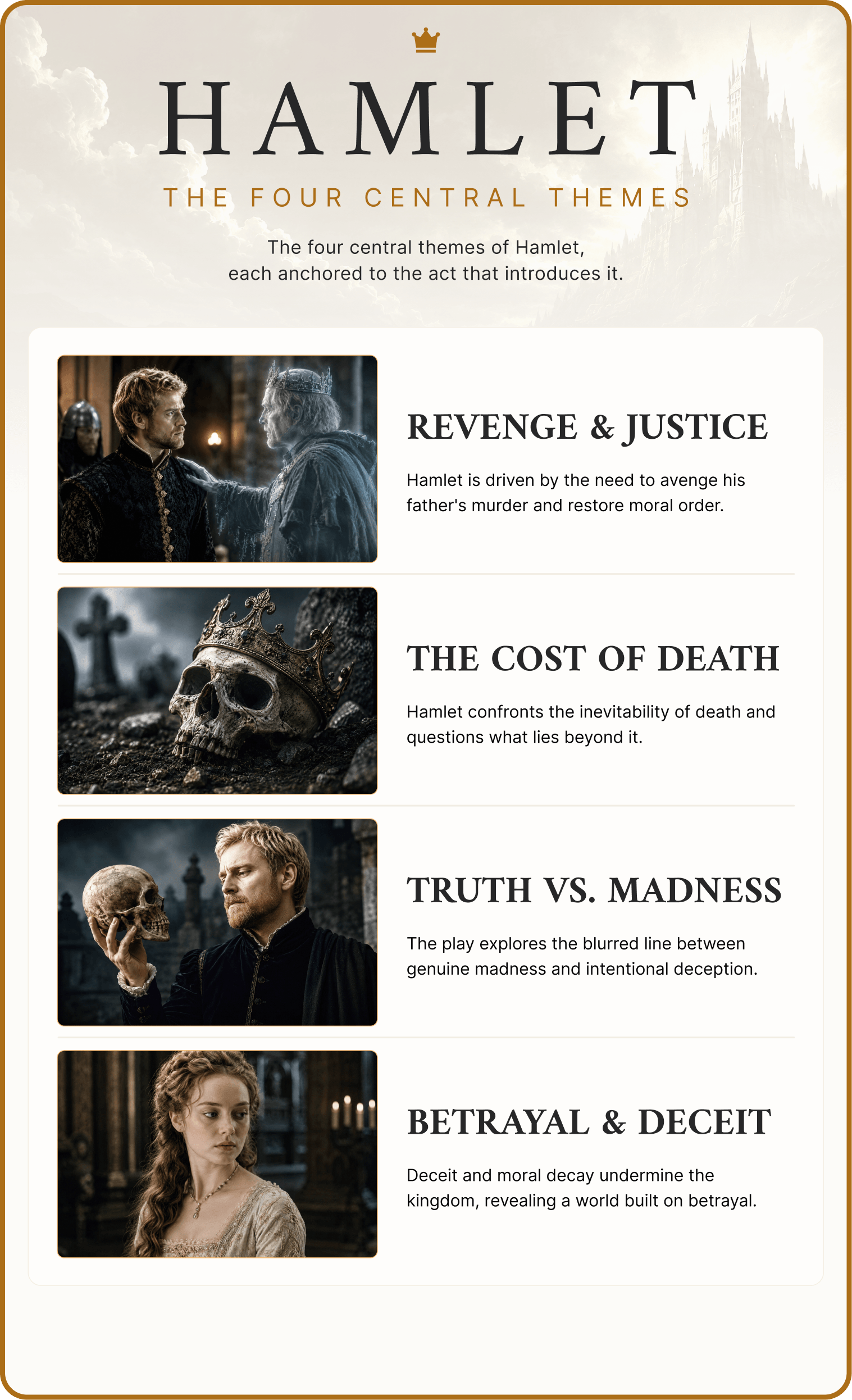
Hamlet Four Central Themes • Hamlet Summary
Revenge and justice
Hamlet belongs to the revenge tragedy tradition, but it constantly disrupts it.
In a typical revenge tragedy, the structure is clear. A crime is committed. The avenger confirms it. Action follows. Justice is carried out.
In Hamlet, that clarity never holds.
The ghost provides the accusation, but it cannot be verified. Its authority is uncertain. Hamlet's response is shaped by that uncertainty. He delays not because he lacks motivation, but because he lacks reliable proof.
Even when Claudius's guilt shows during the play within the play, the evidence stays indirect. It depends on interpretation. A reaction to performance becomes the basis for action.
The prayer scene complicates this further. Hamlet has the opportunity to kill Claudius, but reframes the moment through moral logic. Killing him in prayer would not match the crime. It would twist justice instead of fulfilling it.
Revenge, in this context, becomes unstable. It is no longer a simple corrective act. It requires interpretation, timing, and justification.
By the end of the play, revenge does occur. Claudius is killed. But it happens within chaos, not control. Justice is achieved, but not cleanly.
Mortality and the meaning of death
Death is not a distant concept in Hamlet. It is immediate and constant.
"To be or not to be" frames existence as a decision. Continue living, or escape suffering through death. But the decision cannot be made because of what stays unknown. It is not death itself that creates hesitation, but the uncertainty that follows it. This uncertainty shapes Hamlet's thinking. He cannot resolve the question, so he stays stuck between options.
The graveyard scene removes that suspension.
When Hamlet holds Yorick's skull, death is no longer theoretical. It is physical. The remains of a person reduced to bone. Identity, status, and memory collapse into the same endpoint.
This moment shifts Hamlet's perspective. He no longer seeks to fully understand death. He accepts its inevitability.
That acceptance lets him act later in the play. Not because he has found certainty, but because he no longer needs it.
Madness: real vs. performed
Madness in Hamlet operates on two levels.
Hamlet's madness is performed. He adopts it as a strategy. It allows him to disrupt expectations and speak without being held accountable. Within this performance, he can observe others more freely.
But performance has consequences. The longer Hamlet keeps it up, the more unstable his position gets. Others respond to the madness as if it were real. The distinction begins to blur. Ophelia provides a contrast.
Her madness is not strategic. It is the result of pressure, grief, and loss of control. Where Hamlet uses fragmentation deliberately, Ophelia is overtaken by it. Her songs and speech break apart meaning rather than manipulate it.
The play does not clearly separate these two forms. Instead, it places them side by side, forcing the audience to question whether control over identity can be maintained indefinitely.
Betrayal and corruption
"Something is rotten in the state of Denmark."
This line captures the broader structure of the play. Corruption is not limited to Claudius. It extends throughout the court. Surveillance becomes normal. Rosencrantz and Guildenstern monitor Hamlet. Polonius uses Ophelia to gather information. Private relationships are turned into tools.
This creates a system where trust cannot work. Without trust, action gets hard. Decisions rely on information, but information is unreliable. Every interaction may conceal another character motive.
The corruption is not just moral. It is structural. It shapes how characters think, act, and interpret the world around them. By the end of the play, this system collapses. But it does not resolve. It simply ends.Related Posts
LINES THAT ENDURE
Famous Hamlet quotes
The most famous quotes from Hamlet endure because they do not offer clear answers. Instead, they capture the play's central tensions: uncertainty, performance, and the difficulty of action.
These Hamlet quotes often get cited on their own, but within the play they come from specific moments of conflict and reflection. Each one reveals something about Hamlet's state of mind or the wider structure of the world around him.
1. "To be or not to be, that is the question"
Spoken by Hamlet in Act III, Scene 1.
This is the most famous soliloquy in Hamlet and one of the most famous quotes of all time. It frames existence as a choice between continuing to endure suffering or ending it. The speech does not resolve the question. Instead, it shows how uncertainty, especially about what happens after death, blocks action.
2. "Something is rotten in the state of Denmark"
Spoken by Marcellus, on the moral decay surrounding them.
This line captures the atmosphere of the play. The corruption from Claudius's crime spreads beyond one person and into the state itself. It signals that the problem is systemic, not isolated.
3. "The lady doth protest too much"
Spoken by Queen Gertrude in Act III, Scene 2.
Often used to suggest insincerity, this line refers to the Player Queen's exaggerated declarations of loyalty. It reflects the play's concern with performance and the gap between what is said and what is true.
4. Neither a borrower nor a lender be"
Spoken by Polonius in Act I, Scene 3.
This line is part of Polonius's advice to Laertes. While often taken as practical wisdom, it also reflects Polonius's tendency to rely on conventional sayings rather than genuine insight.
5. "To thine own self be true"
Spoken by Polonius in Act I, Scene 3.
One of the most quoted lines from the play. Its meaning becomes unstable in context, as Polonius himself frequently acts in ways that contradict this advice. The line highlights the gap between stated values and actual behaviour.
6. "What a piece of work is a man"
Spoken by Hamlet in Act II, Scene 2.
Hamlet begins by praising humanity's capabilities, then undercuts the speech with disillusionment. The shift reflects his growing inability to find meaning or satisfaction in the world around him.
THOUGHT AS ACTION
The soliloquies
The Hamlet soliloquy is one of Shakespeare's most important dramatic tools. A soliloquy is a speech delivered by a character alone on stage, allowing the audience direct access to their thoughts.
Hamlet has more soliloquies than any other Shakespeare protagonist. Through them, the audience sees not just what he does, but how he thinks. Action gets delayed again and again because it is first examined, questioned, and reframed in language.
These speeches are where the play truly unfolds. They turn internal conflict into the play's dramatic structure, where thought drives the action forward.
To be or not to be
Act III, Scene 1.
This is the most famous Hamlet soliloquy, and one of the most recognised speeches in English literature.
Hamlet frames existence as a choice: to continue living and endure suffering, or to end that suffering through death. But the decision cannot be made. The uncertainty of what comes after death interrupts the logic of the argument.
The speech does not move toward an answer. It circles the problem instead. Thought replaces action. This moment reflects the wider structure of the play. Hamlet cannot act because he cannot resolve the conditions that would justify action.
O, what a rogue and peasant slave am I
Act II, Scene 2.
This soliloquy follows Hamlet's encounter with the travelling actors.
He compares himself to a performer who can produce genuine emotion for a fictional story, while he cannot act on a real injustice. This contrast creates self-disgust. Hamlet sees his own inaction as a failure.
But the speech does more than express frustration. It produces a plan.
From this moment, Hamlet decides to stage "The Mousetrap" to test Claudius's guilt. Action emerges, but it is mediated through performance. Even here, Hamlet does not move directly. He creates a layer between himself and the act.
Why the soliloquies matter
The soliloquies are not interruptions to the action. They are the action.
Each speech slows the plot down, but deepens it. Instead of moving quickly from event to event, the play expands each moment through reflection.
This is why Hamlet feels different from other revenge tragedies. The conflict is not just external. It is internal, and the audience is made to experience it in real time.
Through the soliloquies, thought becomes visible. And once thought takes priority, action can never be simple again.
ADAPTATIONS ACROSS ERAS
Hamlet on film
Hamlet has been adapted for the screen more than almost any other play. That longevity comes from its flexibility. Because the play resists a single reading, each adaptation can stress a different angle: psychological, political, or structural.
Some versions focus on Hamlet's internal conflict. Others reshape the setting entirely. What remains constant is the central tension between thought and action.
Hamlet (1948)
Directed by and starring Laurence Olivier.
This version presents Hamlet as a psychological tragedy. The focus is on the protagonist's inner life, emphasising introspection and emotional conflict over political context.

Hamlet - 1948 - Laurence Olivier - Trailer • Hamlet Summary
The famous opening description frames the play as the story of "a man who could not make up his mind," reinforcing a widely recognised interpretation.
The Lion King (1994)
While not a direct adaptation, The Lion King follows the core structure of Hamlet. A young prince loses his father, is displaced by an uncle who takes power, and eventually returns to confront him. The narrative simplifies the philosophical complexity but retains the central arc.

The Lion King (1994) Trailer • Hamlet Summary
Hamlet (1996)
Directed by and starring Kenneth Branagh.
This adaptation presents the full, uncut text of the play. Its scale is expansive, situating the story within a grand 19th-century setting. By keeping every line, it lets the original language shape the film instead of simplifying it.

Hamlet (1996) trailer • Hamlet Summary
Hamlet (2000)
Directed by Michael Almereyda and starring Ethan Hawke.
This version relocates the story to modern-day New York. Denmark becomes a corporate environment, and surveillance is expressed through cameras and media technology. It highlights how the play's themes of observation, performance, and control translate into contemporary settings.

Hamlet (2000) Official Trailer • Hamlet Summary
Hamlet (2015)
Justin Kurzel’s visceral adaptation of Macbeth strips away the theatricality to deliver a gritty, mud-and-blood war drama. Michael Fassbender captures the immediate, reckless velocity of a tragic hero consumed by a singular, irreversible decision.

Michael Fassbender in Hamlet • Hamlet Summary
Hamlet (2025)
Performed by Eddie Izzard.
This one-person adaptation strips the play down to language and performance. With a single actor playing all roles, the focus shifts to how identity is constructed through speech.

EDDIE IZZARD - HAMLET • Hamlet Summary
It foregrounds one of the play's central concerns: that character itself can function as performance.
Related Posts
Frequently Asked Questions
Common questions about the Hamlet summary
At its core, Hamlet is about the difficulty of acting when truth is uncertain. The protagonist is given a clear task, but the conditions required to carry it out never fully stabilise. The play explores what happens when action depends on knowledge that cannot be fully secured.
Hamlet's tragic flaw is often described as indecision or procrastination. A more precise reading is that he requires certainty before he acts. This becomes a flaw because the world of the play does not provide that certainty. His hesitation is therefore not simple delay, but a response to unresolved conditions.
Yes. Hamlet is a tragedy in both the classical and Elizabethan sense. It ends in the death of the protagonist and the collapse of the central characters. It also fits within the revenge tragedy tradition, while complicating that structure by questioning how and when action should take place.
The ghost of Hamlet's father is the engine of the play. He delivers the accusation that sets the revenge plot in motion — but Hamlet can never fully verify whether the ghost is truthful or a deceptive spirit. That uncertainty is precisely why Hamlet delays. The ghost's credibility is never settled, which makes the entire revenge plot structurally ambiguous from the start.
Hamlet adopts the performance of madness as a tactical shield. It lets him speak dangerous truths, observe others' reactions, and avoid accountability — all without revealing his true state of mind. The strategy works in the short term, but the longer he sustains it, the more it destabilises his actual position in the court.
"The Mousetrap" is a play Hamlet stages in Act III to test Claudius's guilt. He directs the players to perform a scene that mirrors the circumstances of his father's murder. Claudius's visible distress during the performance gives Hamlet the confirmation he was looking for — but the evidence is still indirect, based on interpretation rather than direct proof.
Hamlet dies in the final duel scene of Act V. During a fencing match arranged by Claudius, Hamlet is wounded by a poisoned sword wielded by Laertes. Before dying, he kills Claudius. Gertrude has already died after drinking from a poisoned cup Claudius had prepared for Hamlet. Laertes also dies from the poisoned sword. Hamlet is the last to go, dying after completing the act of revenge.
UP NEXT
Mastering the Dramatic Arc
Hamlet is a tragedy built on hesitation. Action is delayed, questioned, and reshaped by uncertainty until it finally arrives too late. This is the very essence of the Hamlet summary post we just covered.
Macbeth moves in the opposite direction. It is driven by immediate action — decisions are made fast, consequences unfold faster. Where Hamlet searches for certainty, Macbeth acts without it.
Taken together, the two plays reveal how differently tragedy can operate depending on how a character responds to power, knowledge, and time.
Up Next: Macbeth: Plot Summary, Characters, Themes & Analysis→

From script to production. Write, collaborate, and produce all in one place.
Write scripts online for free. Track versions. Share for feedback and approval. When you're done transition seamlessly to script sides, shot lists, storyboards, schedules, breakdowns, call sheets and more.