Narrative elements are the building blocks of every story — whether you’re writing a screenplay, directing a documentary, or producing a brand video. Every story that resonates does so because its narrative elements work together: a protagonist with a goal, a conflict that tests them, a theme that gives the whole thing meaning.
This guide breaks down each of the seven core narrative elements, shows how they function in film and video, and gives you practical tools for strengthening your own work.
Narrative elements definition
First, let's define narrative elements
The narrative elements definition, broadly stated: the individual components that give a story its structure, meaning, and emotional impact. The term covers both surface-level elements like plot and setting and deeper elements like theme and tone.
Together, they form the framework every storyteller works within, whether they're conscious of it or not.
Narrative ElementsWhat are narrative elements?Narrative elements are the fundamental components that make up any story. They include plot, character, conflict, theme, setting, point of view, and tone. When these elements are well-developed and work in concert, stories feel whole. When any one of them is underdeveloped, audiences sense it — even if they can't articulate why. What are narrative elements, exactly? Think of them as the grammar of storytelling. Just as sentences need subjects and verbs to function, stories need these components to generate meaning and emotional response. |
Narrative elements in film:
- Plot: Pulp Fiction's nonlinear structure
- Character: Michael Corleone's arc in The Godfather
- Conflict: man vs. nature in Jaws
- Theme: class hierarchy in Parasite
- Setting: dystopian Los Angeles in Blade Runner
- Point of view: first-person narration in Forrest Gump
- Tone: cold fatalism in No Country for Old Men
Storytelling Components
7 key narrative elements of storytelling
Every story uses the same seven narrative elements. What separates a weak story from a strong one is not whether these parts are present, but how deliberately they are developed.
A story can have an interesting concept and still fail if the character is flat, the conflict is weak, or the tone feels inconsistent.
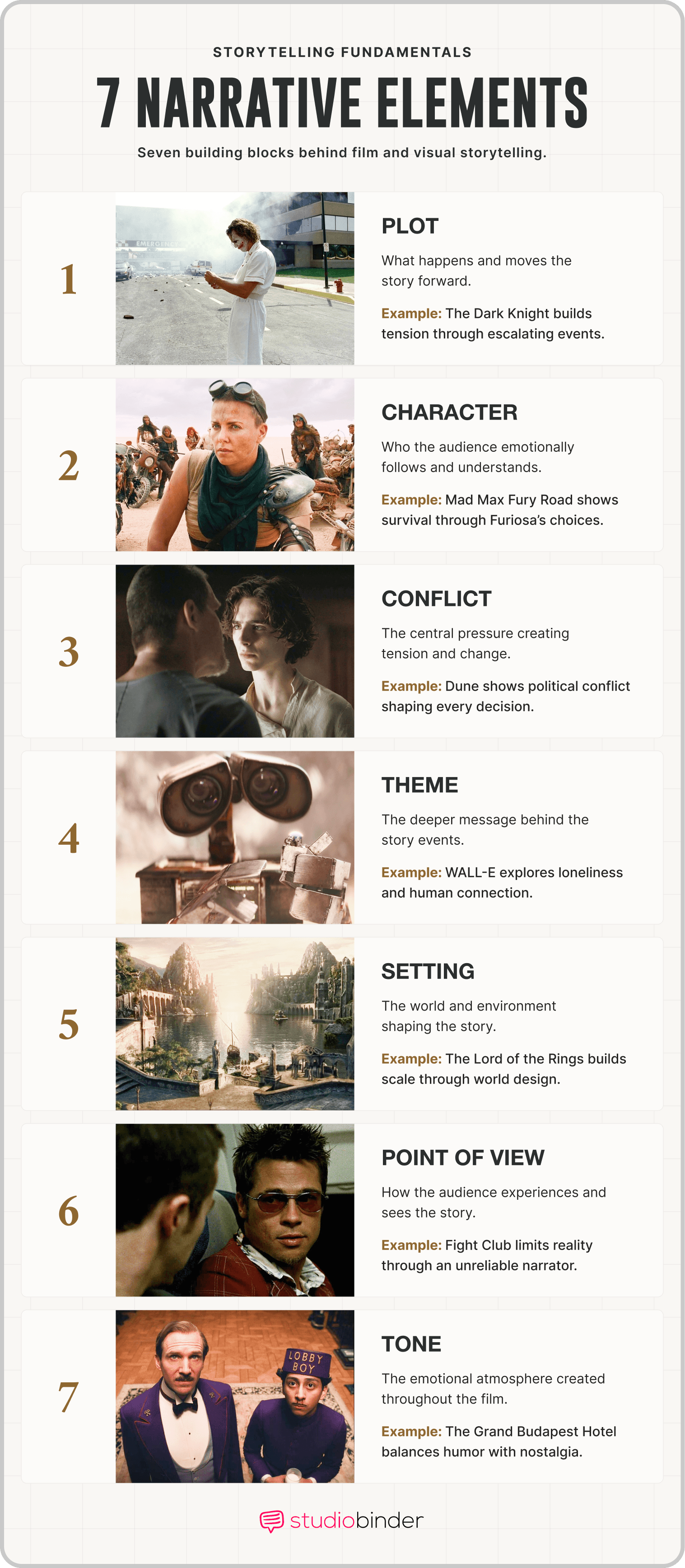
Core Storytelling Fundamentals and Film Examples • Narrative Elements
1. Plot
Plot is the sequence of events that drives a story forward. It answers the fundamental question: what happens? A well-constructed plot moves through a cause-and-effect chain — each event follows from the one before it because of character choices, not coincidence.
Most stories follow some version of a three act structure: setup, confrontation, resolution. The setup introduces the world and the protagonist. The confrontation escalates the central conflict. The resolution delivers a conclusion that feels earned.
If you're looking to organize and plan your plot structure in the most efficient way, then StudioBinder's task management software is just the tool for you.
Plan out your 3-act structure • Try StudioBinder's Task Board for Plot Planning
Narrative structure varies by genre and format, but the underlying logic remains consistent: events happen because of who these characters are and what they want. Plot structure frameworks like the hero's journey or the five-act structure are maps of that logic, not formulas to follow mechanically.
2. Character
Character is the element that makes an audience care. Character development is the process of showing how a person changes — or refuses to change — across the arc of a story.
A well-drawn protagonist has a goal (what they want), a need (what they actually need), and a flaw (what gets in their way internally). The gap between what a character wants and what they need is where the most interesting stories live.
The antagonist doesn't have to be a villain. They're the force — person, institution, nature, or the character's own psychology — that opposes the protagonist's goal and forces them to grow.
3. Conflict
Conflict is the engine of narrative. Without something standing between your protagonist and their goal, there's no story — just a sequence of events. Types of conflict range from person vs. person to person vs. self to person vs. society or nature.
The strongest stories layer multiple conflict types. A character might face external opposition — an antagonist, a deadline, a collapsing institution — while wrestling with an internal conflict that makes every choice genuinely costly.
Conflict shapes the story arc — the trajectory of rising stakes that carries an audience from setup to resolution.
4. Theme
Film theme is the central idea a story explores. It's not the subject (loss, ambition, war) but the claim the story makes about that subject: that loyalty demands sacrifice, that ambition corrupts, that loss can be transformative.
Theme is what separates a story that stays with you from one that fades. It gives the elements of a narrative coherence — when plot, character, and conflict all orbit the same thematic question, every decision the storyteller makes feels purposeful rather than arbitrary.
5. Setting
Setting is more than location. It includes time period, cultural context, and the physical environment — and each of those choices shapes what kind of story is possible. A story set in occupied Paris in 1943 inherits a set of pressures and stakes that a contemporary setting simply can't replicate.
In film, mise-en-scène — the arrangement of everything visible within the frame — is how setting is translated into image. Set design, costume, lighting, and location work together to make a world feel inhabited.
Strong settings don't just provide backdrop. They create atmosphere, amplify conflict, and can function as a character in their own right.
Tone is established through every creative decision — pacing, score and performance. Consistency matters. When tone shifts without intention — a joke dropped into a tense dramatic scene, or sudden violence in a light comedy — the audience loses their footing.
Lookbooks • Try StudioBinder's Free Lookbook Software
6. Point of View
Point of view in film determines whose perspective shapes the story — and how camera placement, narration, and editing reinforce that perspective.
- First-person: A narrator inside the story (voiceover, direct address)
- Third-person limited: The camera follows one character closely; their experience is the lens
- Third-person omniscient: The camera moves freely between characters and locations
Point of view is a production decision as much as a writing one. A close-up shot creates intimacy that pulls the audience into a character's experience. A wide shot creates scope or emotional distance. The full range of types of camera shots is the visual vocabulary for rendering point of view on screen.
7. Tone
Film tone is the emotional register of a story — how it feels to inhabit it. Tone in literature and film both refer to the attitude a story takes toward its subject and audience: earnest or ironic, solemn or playful, intimate or epic.
Related Posts
Cinematic Narrative
Narrative elements in film and video
Story elements that originate in written fiction translate directly into visual media — but film adds a layer of translation. A screenwriter working with narrative elements isn't just describing what happens; they're describing what the camera can capture and what editing can shape into meaning.
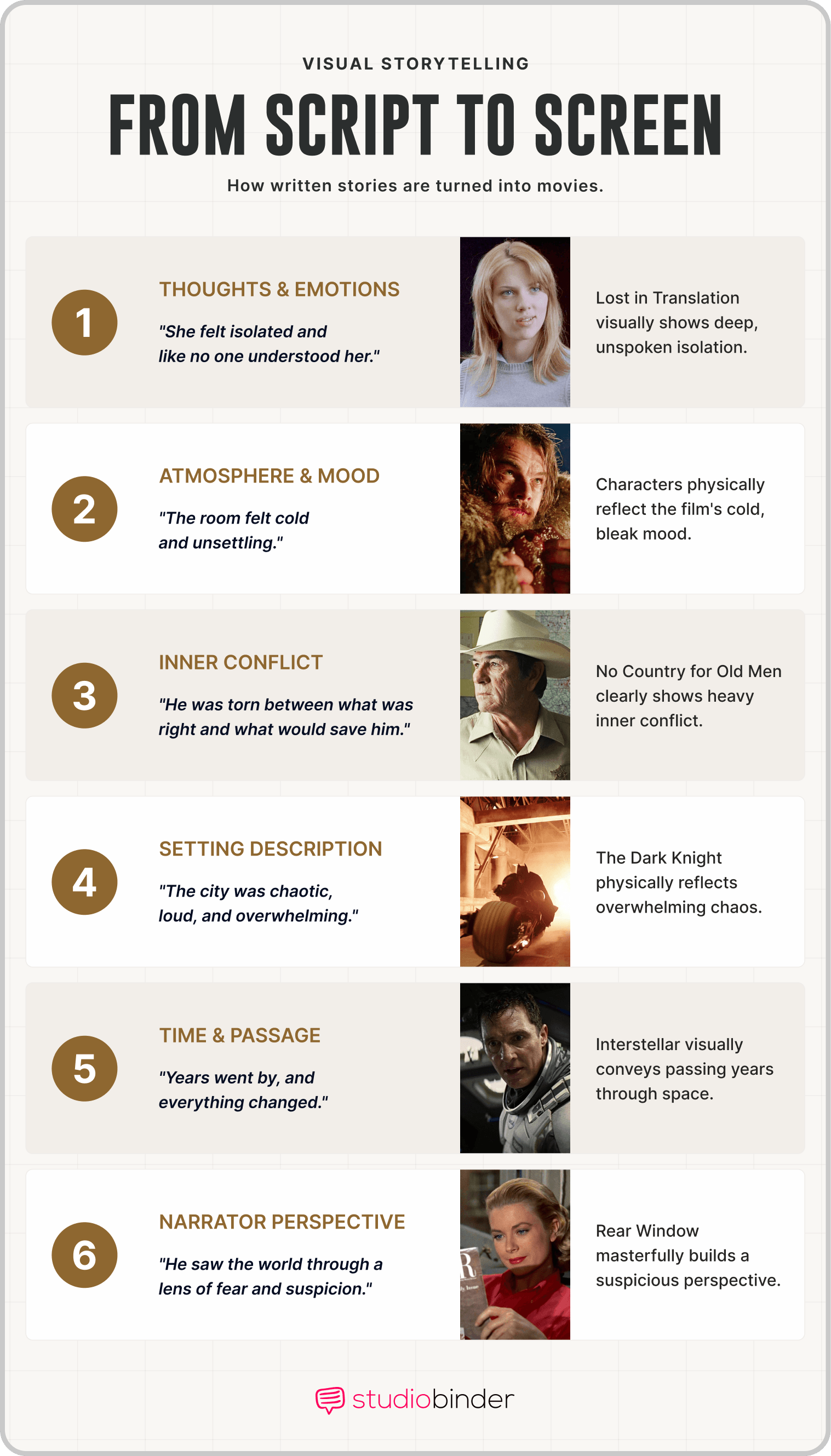
From Script to Screen • Narrative Elements
Film narrative structure
Story structure in film is built from scenes — each scene a unit of action that changes something. The best scenes do multiple things simultaneously: advance the plot, reveal character, and deepen theme.
Film genres carry their own structural conventions that audiences internalize. A thriller builds tension in predictable rhythms because audiences have learned to expect escalating stakes. Working within those conventions — or deliberately subverting them — is how skilled filmmakers control what an audience feels.
Narrative arc in film is shaped not just by the script but by editing. The sequence, pace, and rhythm of cuts determines when and how audiences feel the weight of each story beat.
filmmakers face this challenge constantly: finding the narrative elements latent in real events, then shaping them into something that reads as story rather than report.
8 Types of Narrative Structures • Narrative Elements
Digital and online video narrative
Online video has compressed the rules of narrative writing. Where a feature film might spend ten minutes in setup, a YouTube essay, documentary short, or brand video often has thirty seconds before an audience leaves.
But the narrative elements don't change — only the timeline. An effective 90-second brand video still needs a protagonist (even implied), a conflict or tension (even subtle), and a resolution that pays it off. Visual storytelling is what compresses narrative elements into their most efficient form.
Related Posts
Script Elements
Narrative elements in the screenplay
The screenplay is where narrative elements get their first formal shape. Screenplay format gives each element a dedicated space: action lines for setting and physical story, dialogue for character voice and subtext, scene headings that anchor each beat in time and place.
A script breakdown takes the narrative elements defined in a screenplay and translates them into production requirements — what locations, props, costumes, and cast are needed to bring each scene to life.
Strong screenwriting keeps narrative elements tightly integrated. A setting detail that doesn't serve character or conflict is just description. A line of dialogue that doesn't advance the plot or reveal character is padding. Economy is a feature, not a limitation.
Oftentimes, a top-notch script tool can help unlock those narrative elements you're trying to find.
That's where StudioBinder's free scriptwriting software comes in.
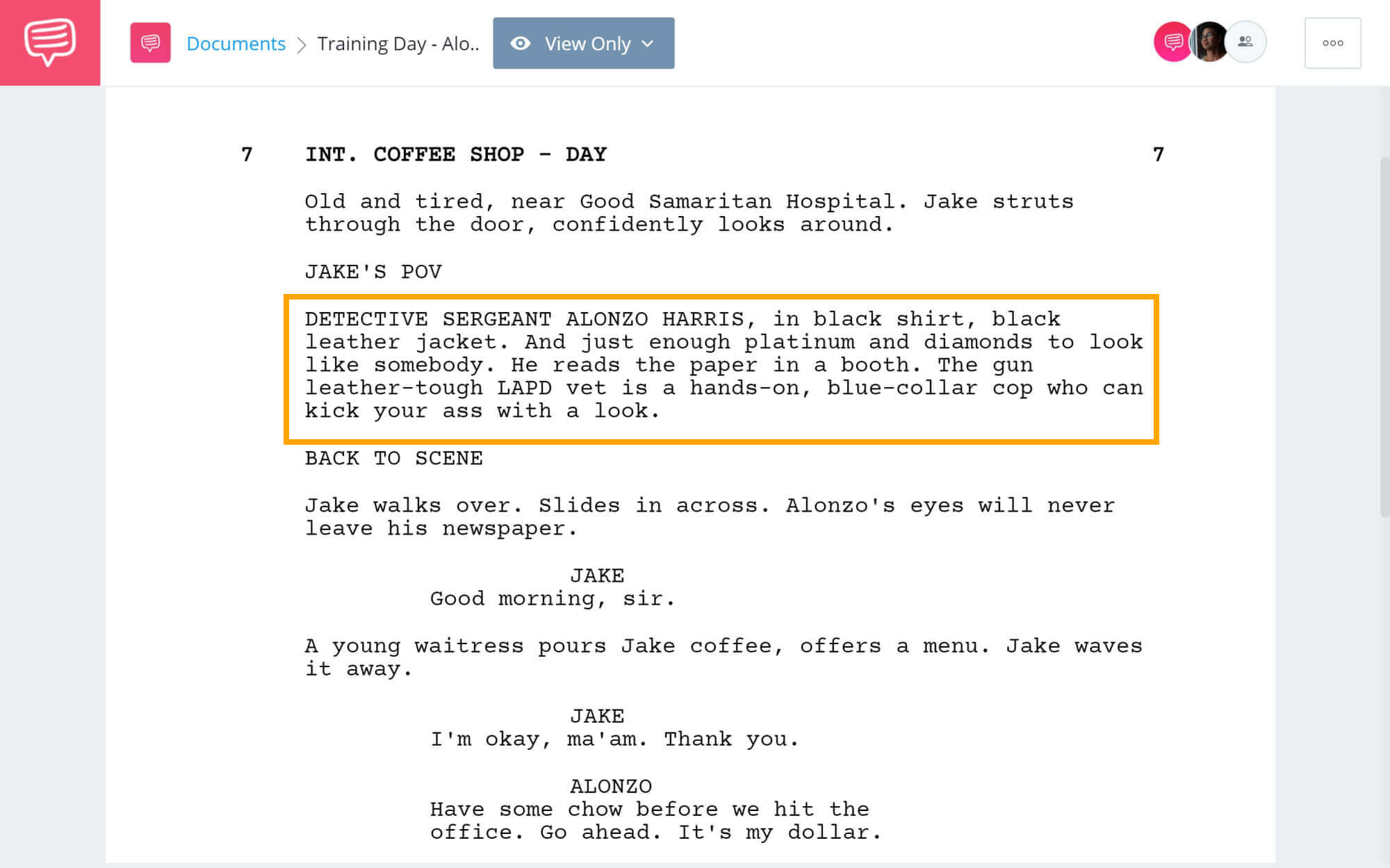
Training Day Script • Try StudioBinder's Free Screenwriting Software
Related Posts
Literary Devices
Narrative elements vs. narrative techniques
Narrative elements are the components of a story. Narrative techniques are the methods used to deliver them. The distinction matters because it clarifies where a story problem actually lives.
What they are | The building blocks | The tools |
|---|---|---|
Examples | Plot, Character, Conflict, Theme | Flashback, Foreshadowing, Dramatic irony |
Role | Give story its structure and meaning | Shape how the story is told |
Present in every story? | Yes | No — techniques are choices |
Narrative Development
How to develop stronger narrative elements
Knowing the seven narrative elements is step one. Strengthening each one in your own work is where the craft lives.
Start with conflict
Every weak story has conflict that isn't sharp enough. Before writing — or before the next draft — define the core conflict in one sentence. What does the protagonist want? What's standing in their way? If the answer to either question is vague, the story will reflect it.
Short film makers know this well: with limited time, the conflict has to be undeniable in the first minute. That discipline is useful at any length.
Build characters around theme
The most cohesive stories are built so the protagonist's flaw connects directly to the theme. If your theme is that ambition corrupts, your protagonist should be defined in part by unchecked ambition. Their arc — whether they change or double down — is how the theme gets dramatized rather than stated.
That alignment carries through film production stages from development through post. When every collaborator — from the cinematography team to the editor — can answer "what is this story about?" in the same terms, every decision serves the same end.
Use setting as a character
The best settings press on characters, create or complicate conflicts, and embody theme. A location that only provides backdrop is a missed opportunity.
Translating narrative elements into visual decisions starts in pre-production with storyboards. A storyboard isn't just shot planning — it's a translation of story elements into images. The setting choices you make at the storyboard stage will determine how much emotional weight a location carries on screen.
Try out StudioBinder's free storyboarding software for yourself to see just how effective the storyboarding process can be.
Create storyboard panels • Try StudioBinder's Free Storyboarding Software
Trusted by over 1M creatives
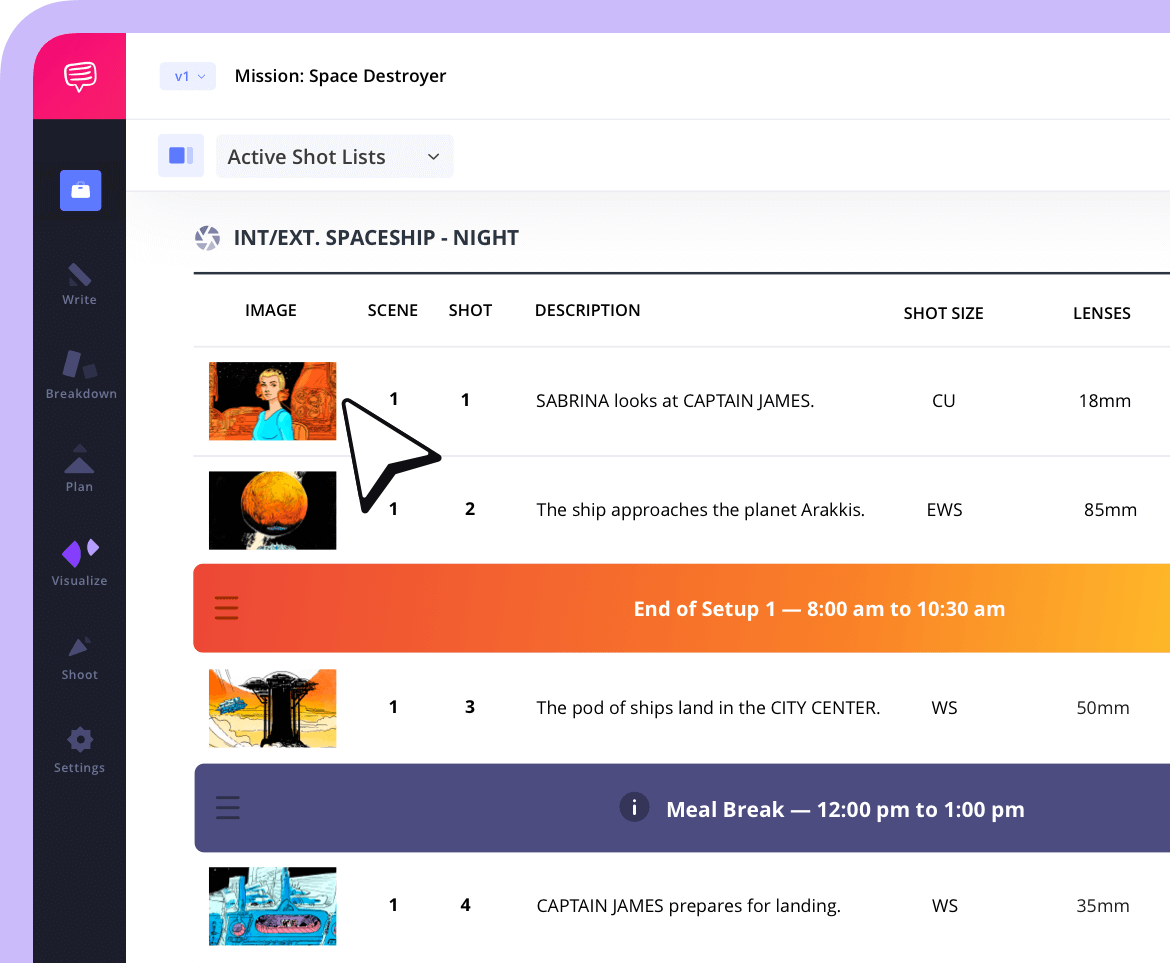
Shot lists that turn vision into action
From first draft to final take, plan, organize, and execute every shot with confidence.
Frequently Asked Questions
Narrative elements FAQs
The seven narrative elements are plot, character, conflict, theme, setting, point of view, and tone. These are the core components present in every story, from a feature film to a two-minute brand video. Understanding each element helps writers and filmmakers make intentional decisions rather than relying on instinct alone.
"Narrative elements" and "story elements" refer to the same set of components — plot, character, conflict, theme, setting, point of view, and tone. The terms are used interchangeably in most writing and film education contexts. "Story elements" is more common in academic settings, while "narrative elements" appears more often in screenwriting and film analysis.
Documentary films use the same narrative elements as fiction — character, conflict, theme, and setting — but they're drawn from real events rather than invented ones. A documentary filmmaker's job is to find the narrative elements latent in reality and shape them into a story with a clear structure and emotional arc.
Narrative elements examples work best in film when each element reinforces the others. A strong conflict reveals character. A well-chosen setting amplifies theme. When the narrative elements are integrated rather than functioning independently, the story feels cohesive and the audience responds to it as a whole.
Yes. Even a 60-second commercial can have an implied protagonist, a clear conflict, a resolution, and a discernible tone. Short-form content compresses the narrative elements but doesn't eliminate them. The most effective brand videos and short films work because their narrative elements, however compressed, are clearly defined.
A personal narrative is a first-person account of real experience. The elements of a personal narrative follow the same framework as other story forms — a narrator as character, a challenge or turning point as conflict, a time and place as setting, and a reflection on meaning as theme. The main difference is fixed point of view: the narrator is always "I."
UP NEXT
What is story structure?
Narrative elements are the raw materials of story. They explain what a story is made of. Narrative structure is the next step — the framework that organizes those materials into a coherent shape.

From script to production. Write, collaborate, and produce all in one place.
Write scripts online for free. Track versions. Share for feedback and approval. When you're done transition seamlessly to script sides, shot lists, storyboards, schedules, breakdowns, call sheets and more.