The best villains are not terrifying because they are evil. They are terrifying because they believe they are right. Hannibal Lecter sees himself as intellectually superior. Thanos believes genocide is mercy. Walter White convinces himself every monstrous act is for his family long after that stops being true. Their conviction is what makes them dangerous.
This guide breaks down what makes a good villain work, the different types of villains in screenwriting, and how to write a villain from the inside out — covering motivation, backstory, moral conviction, and the craft decisions that separate a memorable antagonist from a plot device.
How to write a villain
First, let's define a villain
There are many writing ingredients to share when it comes to how to write a villain with real impact. But first, let's set the stage with defining what a villain is so we're all on the same page.
VILLAIN BASICS
What is a villain?
A villain is a character whose goals, methods, or values place them in direct opposition to the protagonist and drive the central conflict of the story. Unlike a general antagonist, a villain uses destructive, malicious, or morally corrupt methods while believing their actions are justified within their own worldview.
The distinction between antagonist vs villain matters here. An antagonist is any force opposing the protagonist. A villain is an antagonist whose methods create genuine harm through violence, manipulation, corruption, or destruction.
The most memorable villains feel psychologically complete from the moment they enter the story. The American Film Institute ranked Hannibal Lecter the greatest screen villain of all time despite the character appearing in only 24 minutes of The Silence of the Lambs. His impact comes from psychological presence rather than screen time.
A believable villain operates according to recognizable emotional logic. They pursue goals. They rationalize behaviour. They protect identity. The audience may reject their actions, but they understand the internal reasoning behind them.
That emotional coherence matters because audiences instinctively recognize inconsistency. A villain who exists only to create a plot twist or obstacle feels mechanical. A villain whose behaviour emerges from personality, ideology, insecurity, or emotional wounds feels human.
Key Traits of a Villain:
- Opposes the protagonist and drives the story's central conflict
- Pursues clear goals through harmful or destructive actions
- Believes their choices are morally justified
- Follows a consistent worldview and personal logic
- Uses fear, manipulation, violence, or corruption to achieve goals
- Feels believable because their motives remain emotionally consistent
How to write a villain
Why writing great villains is important
It's not enough to know how to write a villain, you also want to know how to make them endearing and memorable. A weak villain creates a weak story. The antagonist sets the ceiling for the hero's journey. If the villain feels shallow, the conflict collapses with them. That is why memorable films and television shows almost always contain equally memorable antagonists.
Cinema understands this instinctively. Hannibal Lecter dominates The Silence of the Lambs with less than half an hour of screen time. Hans Gruber turns a contained action movie into a battle of intelligence and ego in Die Hard. Anton Chigurh transforms philosophical fatalism into horror in No Country for Old Men. These characters endure because their psychology shapes every scene they enter.
Learning how to write a villain means learning how people justify harm, rationalize obsession, and transform emotional wounds into ideology. The strongest villains are not random obstacles. They are psychologically coherent characters with desires, fears, contradictions, and moral logic.
Before we get deeper, let's watch and listen to EmpLemon tell us his theory on what makes a memorable villain in the first place.

Sympathy for the villain • How to write a villain
How to write a villain
What makes a villain work?
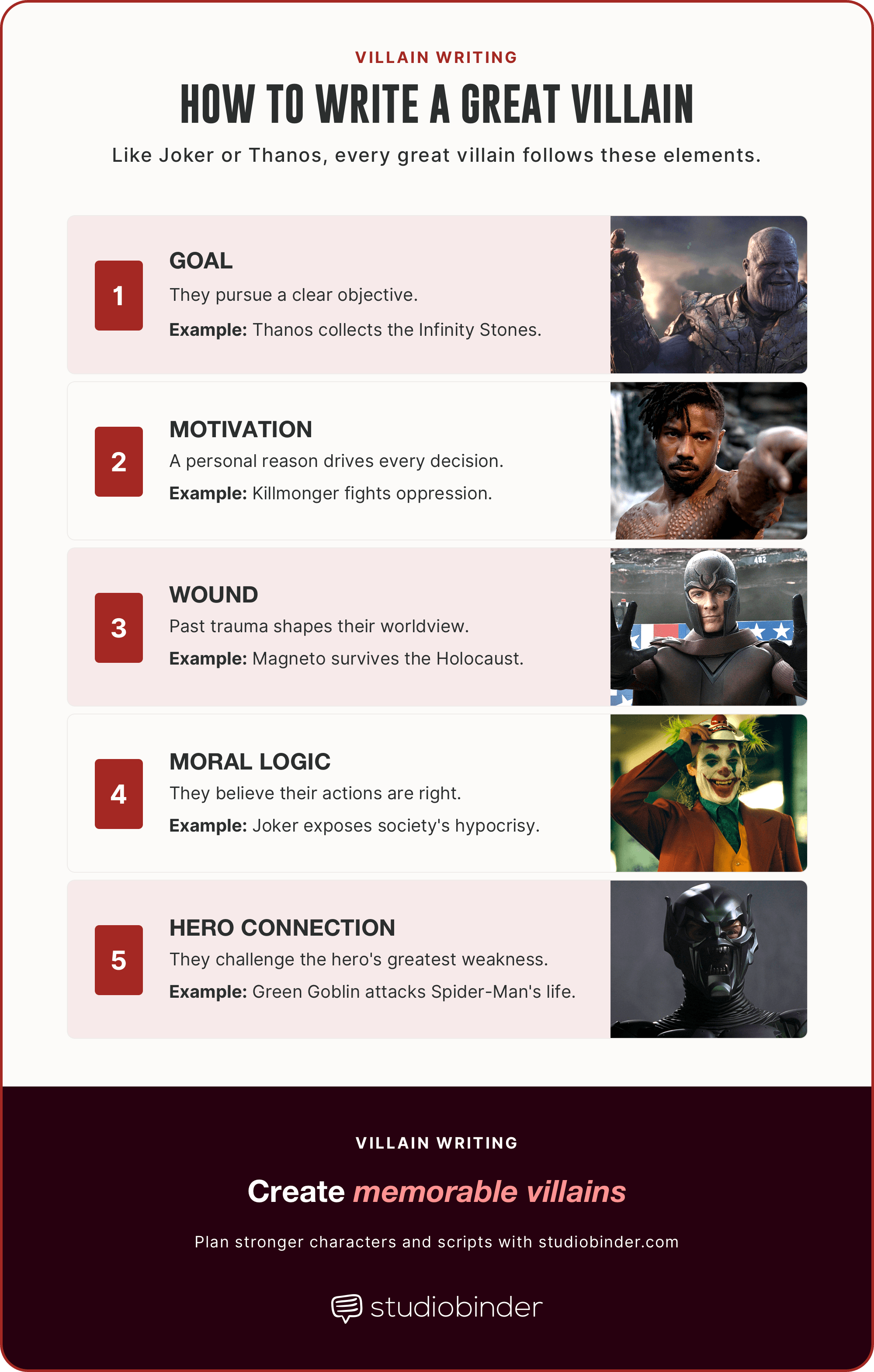
How to write a villain stats with knowing that a good villain is not built from cruelty alone. What makes a good villain memorable is psychological coherence.
Their behavior, dialogue, methods, and worldview all emerge from the same internal logic.
Building a great antagonist • How to write a villain
The strongest screen villains tend to share four qualities:
- a specific goal
- a deeper motivation
- a meaningful relationship to the hero
- a moral framework they believe in
Goal and motivation — what they want and why
The single most important element in learning how to write a villain is understanding the difference between goal and motivation.
Goal is external.
Motivation is internal.
A goal is what the villain wants to achieve in the world.
A motivation is the emotional reason they need that goal.
Hans Gruber's goal in Die Hard is straightforward: steal bearer bonds from Nakatomi Plaza. His motivation, however, is greed disguised as political performance. He hides mercenary ambition beneath the image of ideological extremism.
Thanos works differently. His goal is to eliminate half of all life in the universe. His motivation is rooted in utilitarian philosophy and trauma. He watched his home world collapse from overpopulation and concluded that mass extermination is mercy. From inside his worldview, he is not a monster. He is a saviour.
A villain with a goal but no motivation becomes a plot device. A villain with both becomes a character.
This distinction is essential because character motivation examples reveal character traits more clearly than exposition ever can. Writers often over-explain villain plans while under-developing the emotional need driving them.
Screenwriting teacher Robert McKee argues that character is revealed through choices made under pressure. Villains become memorable when pressure exposes the emotional logic underneath their actions. The save the cat beat sheet approach puts it another way: character is tested most clearly at the moment of maximum resistance.
Their motivation determines the choices they make when fear, humiliation, desperation, or power force them into action.
The wound or origin
How to write a villain backstory? Make sure it explains behavior without excusing it.
A wound is a formative emotional experience that shapes the villain's worldview. It may involve:
- abandonment
- humiliation
- grief
- betrayal
- systemic injustice
- powerlessness
- neglect
The wound creates psychological logic and that's key for how to write a villain.
Psychologist Philip Zimbardo argued in The Lucifer Effect that harmful behaviour often emerges from situational pressures rather than inherent evil. Strong villains work similarly. Their worldview develops through environment, humiliation, fear, ideology, or emotional conditioning rather than random cruelty.
Magneto survives the Holocaust and concludes that power is the only protection against extermination. Killmonger grows up abandoned while Wakanda isolates itself from Black suffering across the world. Walter White spends decades feeling intellectually overlooked and economically diminished.
These are not sympathy tricks. They are emotional engines. A sympathetic villain earns audience understanding through the wound — the emotional backstory that makes their logic feel internally coherent even when the actions are wrong.
The villain origin story should feel inevitable rather than arbitrary. How to write a villain means making them believable people. When the backstory is specific enough, the character's later choices stop seeming random. They become the only logical outcome of that particular life under those particular pressures. That inevitability is what separates a credible villain origin story from a convenient excuse.
Negative character traits — cruelty, manipulation, narcissism, rigidity — become convincing when they can be traced back to a formative emotional experience. Writers who understand where those traits came from write villains audiences recognize rather than simply fear.
Psychology framework becomes useful here because it treats personality as behavioural pattern rather than static archetype. Villains become more convincing when writers understand:
- how humiliation shapes identity
- how resentment alters moral reasoning
- how hubris distorts self-perception
- how emotional wounds distort relationships
However, writers should be careful not to confuse explanation with absolution. A tragic backstory does not erase responsibility. Once the audience feels manipulated into forgiving every action, the villain loses dramatic tension. The balance of these ideas is where you really learn how to write a villain with some serious punch.
Relationship to the hero
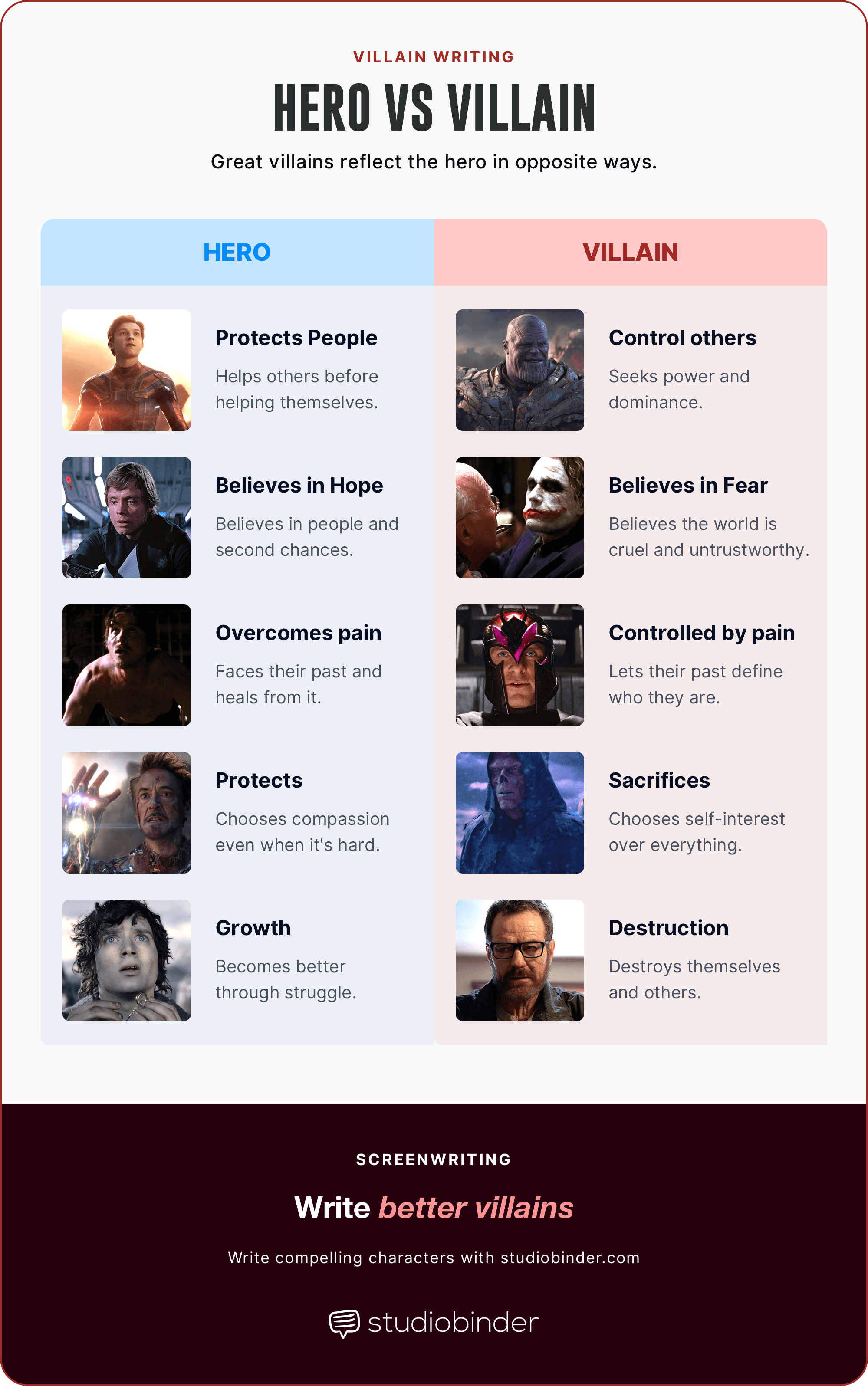
The best villains reflect the protagonist.
Sometimes they mirror the hero.
Sometimes they invert them.
Sometimes they embody what the hero could become.
A villain who has no meaningful relationship to the protagonist often feels interchangeable. That's how to write a villain 101.
Hannibal Lecter and Clarice Starling work because Hannibal sees Clarice clearly. He recognizes her ambition, emotional isolation, and desire for recognition before anyone else does. Their scenes operate like psychological duels.
Walter White represents an even more extreme version of this principle because the villain and hero gradually collapse into the same person. Vince Gilligan famously pitched Breaking Bad as the story of turning "Mr. Chips into Scarface." The entire series functions as a villain origin story unfolding inside a protagonist arc.
The hero-villain relationship also defines each character's character arc. Because the villain often represents who the hero could have become under different circumstances, the foil dynamic forces the protagonist into sharper self-definition. Removing the villain from a strong story does not just eliminate the threat — it removes the pressure that shapes the hero's transformation.
Psychologically believable villains are built through relational behaviour rather than static characterization.
Personality reveals itself through how a character speaks, listens, interrupts, avoids, and responds under pressure. Villains expose themselves through the way they interact with protagonists.
The way method acting approaches characterization is instructive here: performances are built through emotional patterns, conversational rhythms, contradictions, and behavioural habits rather than abstract labels. Writers can use the same logic — villains should not simply "sound evil." Their dialogue reflects deeper patterns of need, fear, and control.
A manipulative villain may:
- ask strategic questions
- mirror language patterns
- withhold emotional information
- weaponize silence
- interrupt selectively
- perform warmth insincerely
An ideologically rigid villain may speak in absolutes.
A narcissistic villain may redirect every conversation toward status.
A psychopathic villain may display emotional flatness under pressure.
How to write a villain means knowing what kind of villain you're writing. Personality shapes conflict style. Some villains manipulate quietly. Others dominate scenes through confrontation.
Narcissistic villains redirect conversations toward recognition and superiority. Psychologically coherent villains do not simply "sound evil." Their dialogue reflects deeper patterns of need, fear, and control.
Just keep in mind when it comes down to how to write a villain, the relationship between protagonist vs antagonist becomes psychologically richer when dialogue reflects personality rather than exposition.
Hero versus villain comparison • How to write a villain
Moral conviction — they believe they're right
This is what separates a compelling villain from a cartoon.
The villain must possess coherent moral logic.
Anton Chigurh in No Country for Old Men operates according to a philosophy of fate and inevitability. He does not see himself as chaotic. He sees himself as honest. Violence, in his worldview, is simply the natural order stripped of illusion.
Amy Dunne in Gone Girl believes she is reclaiming control inside a culture built around performance and manipulation. Her methods are monstrous, but her observations about gendered expectations and emotional performance contain uncomfortable truths. The truths are gold when it comes to how to write a villain.
The audience does not need to agree with the villain.
They need to understand them.
In The Writer's Journey, Christopher Vogler describes the Shadow archetype as the dark side of the ego expressed externally through villain figures. Many memorable villains embody impulses the protagonist represses, fears, or could become under different circumstances. This is where villain symbolism becomes most powerful — the villain is not just an obstacle, but a mirror showing what the hero refuses to become.
Many memorable villains draw from three dark personality patterns: Machiavellianism, narcissism, and psychopathy. These character archetypes create conflict through manipulation, superiority, and emotional detachment rather than simple cruelty.
A Machiavellian villain manipulates social systems strategically.
A narcissistic villain requires superiority and admiration.
A psychopathic villain lacks empathy and pursues stimulation or dominance.
But psychologically believable villains usually contain contradictory traits as well. They may display tenderness selectively. They may love genuinely in one area of life while causing destruction in another. That juxtaposition creates depth. Writing a morally complex character this way takes longer, but the result is a villain the audience will actually think about after the credits.
That complexity creates three-dimensional villain writing.
The test is simple:
Could your villain write a one-page argument explaining why they are right?
If the answer is no, the character probably is not fully developed.
Let's dive deeper into how to write a villain with unforgettable villain motivation in the StudioBinder video essay below.

Subscribe for more video essays • How to write a villain
How to write a villain
Types of villains in screenwriting
Not every villain operates the same way. Different stories require different forms of antagonistic pressure.
Understanding villain structure helps writers avoid repeating the same emotional dynamic in every screenplay.
The classic antagonist
The classic antagonist creates direct external opposition. That opposition is key in how to write a villain.
Their goals are clear.
Their methods are visible.
Their relationship to the hero drives escalating conflict.
Hans Gruber in Die Hard is the perfect example. He wants money and will kill anyone necessary to obtain it. His intelligence and composure make him dangerous because he consistently feels capable.
Hannibal Lecter functions differently but still fits classic antagonist structure. His threat is immediate even when his motives remain partially opaque.
Examples include:
- Hans Gruber (Die Hard)
- Hannibal Lecter (The Silence of the Lambs)
- The Joker (The Dark Knight)
The Joker is especially effective because he combines classic antagonism with ideological conflict. He wants to expose social hypocrisy and prove morality collapses under pressure.
The ideological villain
The ideological villain believes their worldview justifies extreme actions.
These villains are often the most disturbing because parts of their logic feel coherent. They function almost like dystopian ideologues — convinced that extreme means are justified by a perceived larger truth.
Thanos believes overpopulation will destroy civilization.
Anton Chigurh believes violence reveals truth.
Tyler Durden believes consumer capitalism has spiritually destroyed masculinity.
Their danger comes from conviction.
Examples include:
- Thanos (Avengers: Infinity War)
- Anton Chigurh (No Country for Old Men)
- Amy Dunne (Gone Girl)
These villains work because the audience partially understands the worldview before rejecting the methods. That's the key nuance of how to write a villain.
The tragic villain
The tragic villain begins somewhere emotionally recognizable.
The audience watches them cross moral lines step by step.
Example: Walter White and the villain protagonist
Vince Gilligan famously pitched Breaking Bad as "Mr. Chips turned into Scarface." That framing works because Walter White's transformation is gradual and psychologically coherent. Every compromise feels emotionally justified to him in the moment, which makes the audience complicit in his evolution.
Walter White transforms insecurity into domination.
Magneto transforms trauma into extremism.
Anakin Skywalker transforms love into possessiveness and fear.
Examples include:
- Walter White (Breaking Bad)
- Magneto (X-Men)
- Anakin Skywalker (Star Wars)
Tragic villains require careful writing because the audience must continue recognizing their humanity without losing sight of responsibility.
The wound explains behaviour.
It does not erase consequences.
Let's let B-WHERE tell us about what he sees as the seven essential types of villains in storytelling.

7 Types of Villains · How to write a villain
How to write a villain
How to write a villain in 5 steps
Learning how to write a villain becomes easier when the process is treated practically rather than abstractly. Each step below builds on the previous one — by the end, the villain has a goal, a wound, a relationship to the hero, a moral logic, and a lived interior life that shapes every scene.
1. Define their goal
Write one sentence describing exactly what your villain wants.
Avoid vague goals like:
- wants power
- wants revenge
- wants control
Instead, define a concrete objective.
For example:
- "She will expose the government by releasing classified footage."
- "He will seize control of the company by destroying the board financially."
- "They will force the city into martial law."
Specific goals create actionable scenes and drive the plot forward in a way vague ambitions never will.
2. Build the wound and backstory
Write a one-page villain backstory that never appears directly in the script.
Answer:
- What shaped their worldview?
- When did they begin rationalizing harmful behaviour?
- What humiliation, fear, or grief still controls them?
- What are they trying to recover emotionally?
This is the villain origin story — it stays off the page, but it controls everything that appears on it. Writers who spend time on this document find that their villain's dialogue, body language, and reactions under pressure become instinctively consistent rather than requiring constant conscious invention.
Believable characterization emerges through long-term personality patterns rather than isolated moments. That means the villain backstory should shape:
- body language
- dialogue rhythms
- emotional defensiveness
- coping mechanisms
- reactions under stress
The audience does not need exposition.
They need behavioural consistency.
3. Establish the hero connection
Ask how the villain reflects the protagonist.
Do they share:
- the same wound?
- the same ambition?
- the same fear?
- the same desire?
Often the difference between hero and villain is not circumstance but response.
This connection strengthens the character arc because the conflict becomes emotionally personal rather than mechanically external. The hero's arc and the villain's arc are frequently mirror images — one chooses growth, the other chooses dominance. That parallel gives each character's journey weight. This is especially important when you learn how to write a villain.
4. Give them a moral logic
Open a blank document.
Write 200 words from the villain's perspective explaining why they are right.
Do not write it sarcastically.
Write it sincerely.
The goal is not agreement.
The goal is coherence.
The most effective villain motivation always feels internally logical from inside the character's worldview. If the villain's argument collapses immediately under scrutiny, they do not yet have a worldview — they have a plot function.
A strong villain worldview often contains foreshadowing built into their early scenes. They reveal their logic before the audience fully understands its implications.
5. Write a scene from their POV
Write one scene entirely from the villain's point of view.
Not a scene from the script.
A private moment.
What do they fear?
What do they resent?
How do they justify themselves internally?
What emotional need are they protecting?
Personality reveals itself through behaviour and speech.
This exercise helps writers discover:
- conversational style
- emotional vocabulary
- defensive patterns
- social performance
- psychological contradictions
Even if the scene never appears in the screenplay, it deepens characterization. Think of it as the villain equivalent of the inciting incident exercise — you are discovering the emotional logic that drives every subsequent choice.
Dig deeper into how to write a villain with some memorable punch to them with the below video from StudioBinder's video essay channel.

Writing Great Villains · How to write a villain
Related Posts
How to write a villain
Villain motivation examples
Strong villain motivation examples clarify the difference between external action and internal psychology. These are essential to understand when pondering how to write a villain in your story.
Goal vs. motivation — the distinction
Goal is external.
Motivation is emotional.
The goal exists in the plot.
The motivation exists beneath the plot.
A villain may want to steal technology.
But why?
Because their company is collapsing.
Why does that matter?
Because their identity depends on success.
Because humiliation terrifies them.
Because failure confirms every insecurity they have spent years avoiding.
That final emotional layer is motivation.
A villain with only a goal functions mechanically.
A villain with motivation feels psychologically believable.
Villain character motivation examples from film and TV
Each of these villain motivation examples shows how the emotional layer transforms a character from obstacle into antagonist.
Hannibal Lecter (The Silence of the Lambs)
- Goal: manipulate and consume
- Motivation: intellectual superiority and contempt for mediocrity
Thanos (Avengers: Infinity War)
- Goal: eliminate half of all life
- Motivation: utilitarian philosophy shaped by witnessing societal collapse
Walter White (Breaking Bad)
- Goal: build a drug empire
- Motivation: wounded pride and the need to feel exceptional
Killmonger (Black Panther)
- Goal: arm oppressed communities globally
- Motivation: abandonment, grief, and rage at systemic betrayal
Amy Dunne (Gone Girl)
- Goal: destroy Nick emotionally and socially
- Motivation: fury at performance, manipulation, and loss of control
Amy Dunne is also one of cinema's most effective femme fatale constructions precisely because her motivation is specific rather than generic — her rage has a target, a logic, and a method that feel psychologically real.
What unites these characters is that none of them see themselves as the villain. Each is the protagonist of their own story. That alter ego quality — the gap between how the villain sees themselves and how the audience sees them — is where dramatic tension lives.
How to write a villain
5 common mistakes when writing villains
Even well-designed villains can fall flat if they lack believable psychology or consistent motivation. Avoiding these common mistakes will help you with how to write a villain that feels authentic, memorable, and essential to your story.
1. Evil for evil's sake
The villain performs cruelty without emotional logic.
Result:
The character feels shallow and forgettable.
Fix:
Give them coherent goals and recognizable emotional reasoning. A villain character trait is convincing only when it can be traced to a psychological source.
2. The exposition monologue
The villain pauses the story to explain everything.
Result:
Tension disappears. A lengthy villain monologue that explains the plan is almost always the wrong choice.
Fix:
Reveal psychology through action, relationships, and behaviour rather than speeches.
3. The redemption shortcut
The villain suddenly sacrifices themselves in the third act.
Result:
The redemption feels emotionally unearned.
Fix:
Real change requires sustained behavioural transformation, not a single moment.
4. The incompetent mastermind
The villain becomes irrational simply so the protagonist can win.
Result:
The hero's victory feels weak.
Fix:
Make the antagonist genuinely capable. The more competent the villain, the more the hero's success means.
5. Backstory as excuse
The screenplay treats trauma as moral absolution.
Result:
The story loses accountability.
Fix:
Remember the difference between explanation and justification. A sympathetic villain is not a pardoned one. The wound explains the behaviour. It does not authorize it. These are essential tools in how to write a villain.
Related Posts
Frequently Asked Questions
FAQs when writing villains
Every villain is an antagonist, but not every antagonist is a villain. An antagonist is any character, force, or system opposing the protagonist. A villain specifically causes destructive harm through morally corrupt or malicious actions. In Kramer vs. Kramer, the opposing force is not villainous. In The Dark Knight, the Joker clearly is. The antagonist vs villain distinction matters because it clarifies what kind of dramatic pressure the story is applying — institutional, relational, or moral.
What makes a good villain is coherent motivation. A compelling villain has believable emotional logic, a meaningful relationship to the protagonist, a wound that explains their worldview, and the genuine ability to win. They are frightening not because they are evil, but because their behaviour feels psychologically possible.
A morally complex character becomes convincing when the audience partially understands their logic without fully agreeing with their actions. Give the villain emotional wounds, coherent beliefs, contradictory behaviour, and meaningful choices. Complexity comes from internal consistency and psychological realism, not from making the villain secretly harmless.
No. Many effective villains do not think of themselves as evil at all. They may see themselves as protectors, survivors, revolutionaries, or realists. What matters is whether their actions create genuine harm and opposition within the story. Motivation, conviction, and consequence matter more than labels.
Yes. Villain protagonists are one of the most powerful story structures available to a writer. Walter White, Amy Dunne, and Tom Ripley are all protagonists the audience follows closely while watching them do genuinely harmful things. The challenge is maintaining enough psychological access that the audience stays engaged even as they lose sympathy. Villain protagonists work when the internal experience remains vivid — the reader or viewer understands every choice even while condemning it.
A believable villain origin story is specific, emotionally grounded, and proportionate. The wound should feel real, not convenient. The leap from trauma to ideology should have internal logic — the audience should be able to trace how a specific emotional experience led to a specific worldview. What makes a villain origin story feel false is when the backstory feels engineered to generate sympathy rather than to explain behaviour. The difference is whether the writer built the origin from the character outward, or worked backward from a desired emotional effect.
The key is separating explanation from justification. A sympathetic villain earns understanding through a specific, emotionally coherent backstory. The audience sees how the character arrived at their worldview. But the story must hold the line on consequences — other characters suffer, the protagonist is tested, and the world does not simply absorb the villain's actions without cost. A sympathetic villain stops working the moment the narrative starts treating their trauma as a reason why their actions do not fully count.
UP NEXT
What Is an Antagonist?
Understanding how to write a villain raises the next storytelling question: how does the villain fit into the larger architecture of the story?