Watching a film is easy. Understanding how it works is not. Most viewers follow the story. They track characters. They react to emotion. But film analysis asks a different question. It asks how those reactions are created in the first place.
Every film is built from choices. Where the camera sits. How a scene is lit. When a cut happens. What sound is heard, and what is left out. These choices shape meaning. They guide attention. They control how the audience feels, often without the audience noticing.
This is where film analysis becomes useful. It turns instinct into method. Instead of saying a scene feels tense, you can explain why. Instead of saying a film is powerful, you can point to the exact techniques that create that effect.
It also connects films to a wider context. Genre, structure, and conflict all shape how a story is understood. A thriller movie builds tension in a specific way. A drama explores interruption and consequence. Recognising these patterns makes analysis clearer and more precise.
In this guide, you will learn how to analyse a film step by step. First, we break down the core elements that create meaning. Then, we move into the writing process itself. How to gather evidence. How to build an argument. How to turn observation into a strong, well-reasoned argument.
Film analysisWhat is film analysis?Film analysis is the process of examining how a film creates meaning through its formal and narrative elements. Movie analysis is another name for the same practice. Both ask how and why choices are made. It is not a review. It is not film criticism. Both evaluate quality rather than meaning. It is not a summary. A summary recounts the plot. Film analysis explains how the film communicates and what those choices achieve. Film theory provides the vocabulary. This guide puts it into practice. |
Film analysis in practice:
- Citizen Kane: deep focus and shot composition
- Parasite: class hierarchy through mise-en-scène
- Memento: non-linear narrative structure Jaws, sound design and suspense
- The Godfather: lighting and symbolism
- Mad Max: Fury Road: color and visual storytelling
Cinematic Elements
The key elements of film analysis
Film analysis is built from a set of core elements. These are the tools filmmakers use to shape meaning.
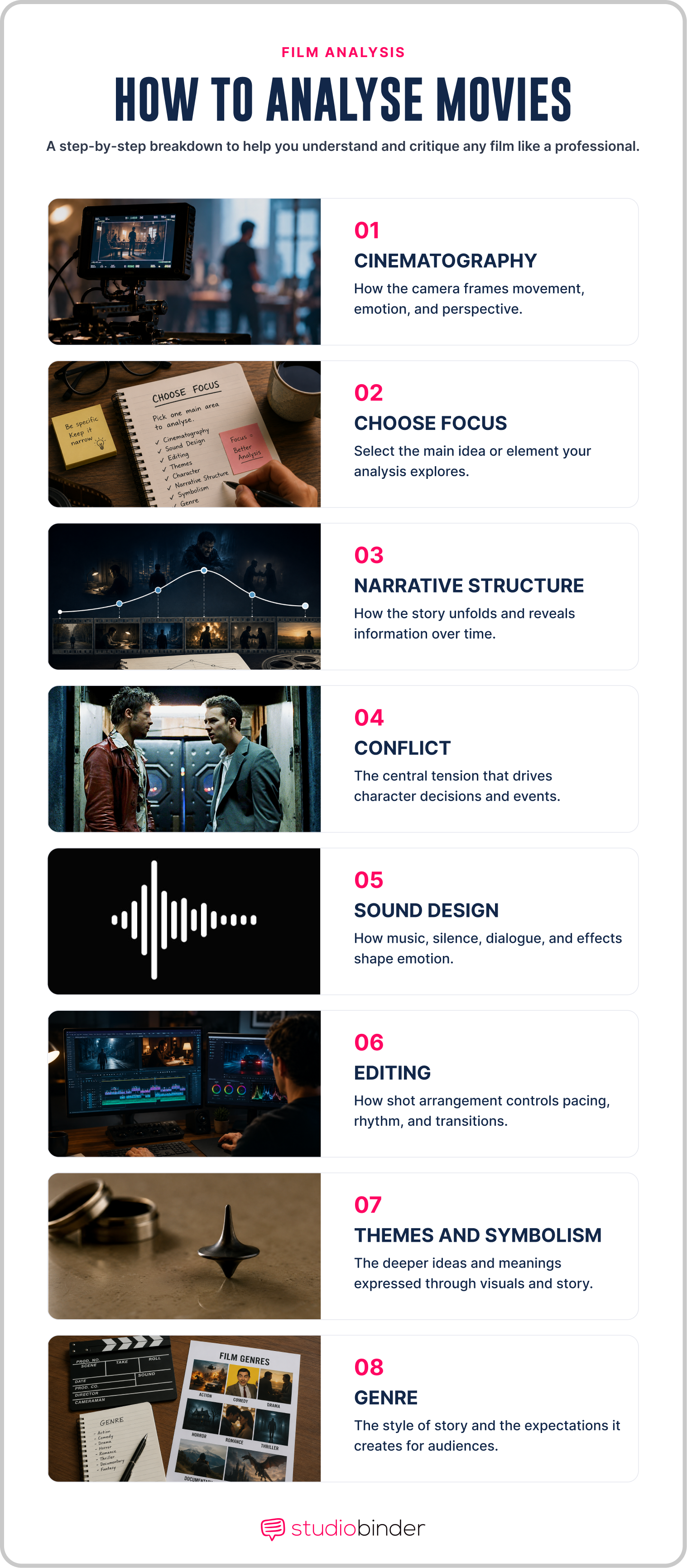
Core Elements to Study and Critique Cinema • Film Analysis
These elements do not work in isolation. Image, sound, and structure are always interacting. A scene’s impact comes from how these elements combine.
Before looking at each one, start with a simple question. What is the film doing, and how is it doing it?
1. Genre
Genre is the category of the story. It signals the kind of experience the audience can expect.
Common genres include:
Genre is not just a label. It is a framework. It tells you what patterns to look for.
Each genre has conventions. A horror movie builds fear through tension and release. A romantic comedy builds story conflict through relationships and misunderstanding. A drama often centres on interruption. Something disrupts ordinary life, and the story explores the consequences.
When analyzing genre, ask:
What expectations are set?
How does the film follow them?
Where does it challenge them?
Genre helps you connect the film to audience response. It explains why certain choices feel effective or surprising. It's good to start your film analysis with genre investigation.
2. Cinematography
Cinematography is how the film is photographed. It shapes what we see and how we see it.
This includes camera angles, shot composition, framing, and movement. Each choice directs attention.
A close-up shot isolates a face. It forces the viewer to read emotion. A wide shot places a character in space. It can emphasize isolation or scale. Camera angles also matter. A low angle shot can make a character appear powerful. A high angle shot can reduce them.
Movement adds another layer. A slow tracking shot builds tension over time. A handheld shot creates instability. These are not decorative choices. They guide interpretation.
When analysing cinematography, focus on:
Camera placement
What is included in the frame
How the camera moves
Then ask what that choice makes you feel, and why. If you are studying cinematography to apply it to your own films, planning these decisions before you shoot is where it begins.
StudioBinder's Shot List Software provides you with an organized shot list structure so you can professionally prepare each shot before shooting day. Check out the shot list example below.
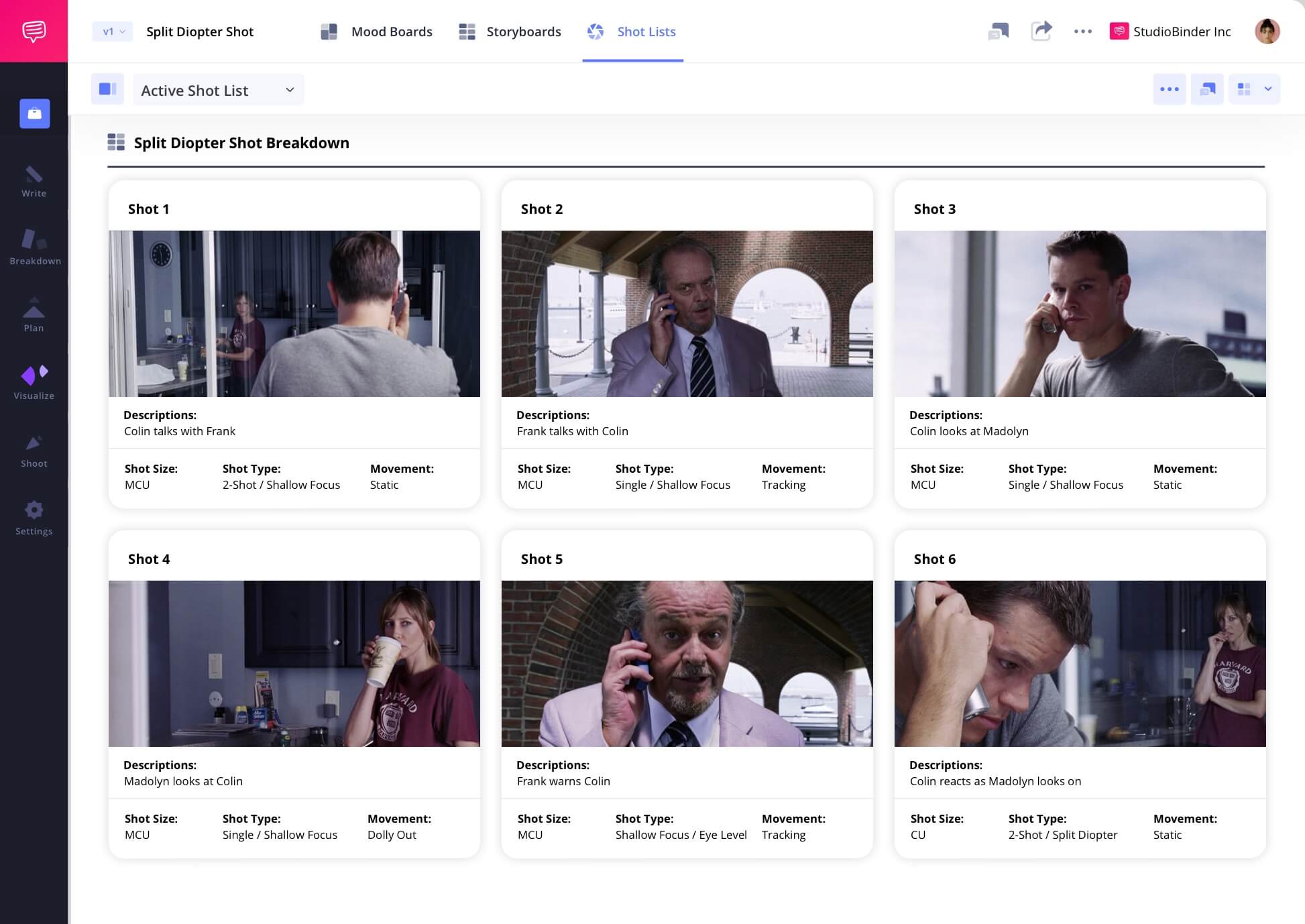
Shot list • Film Analysis
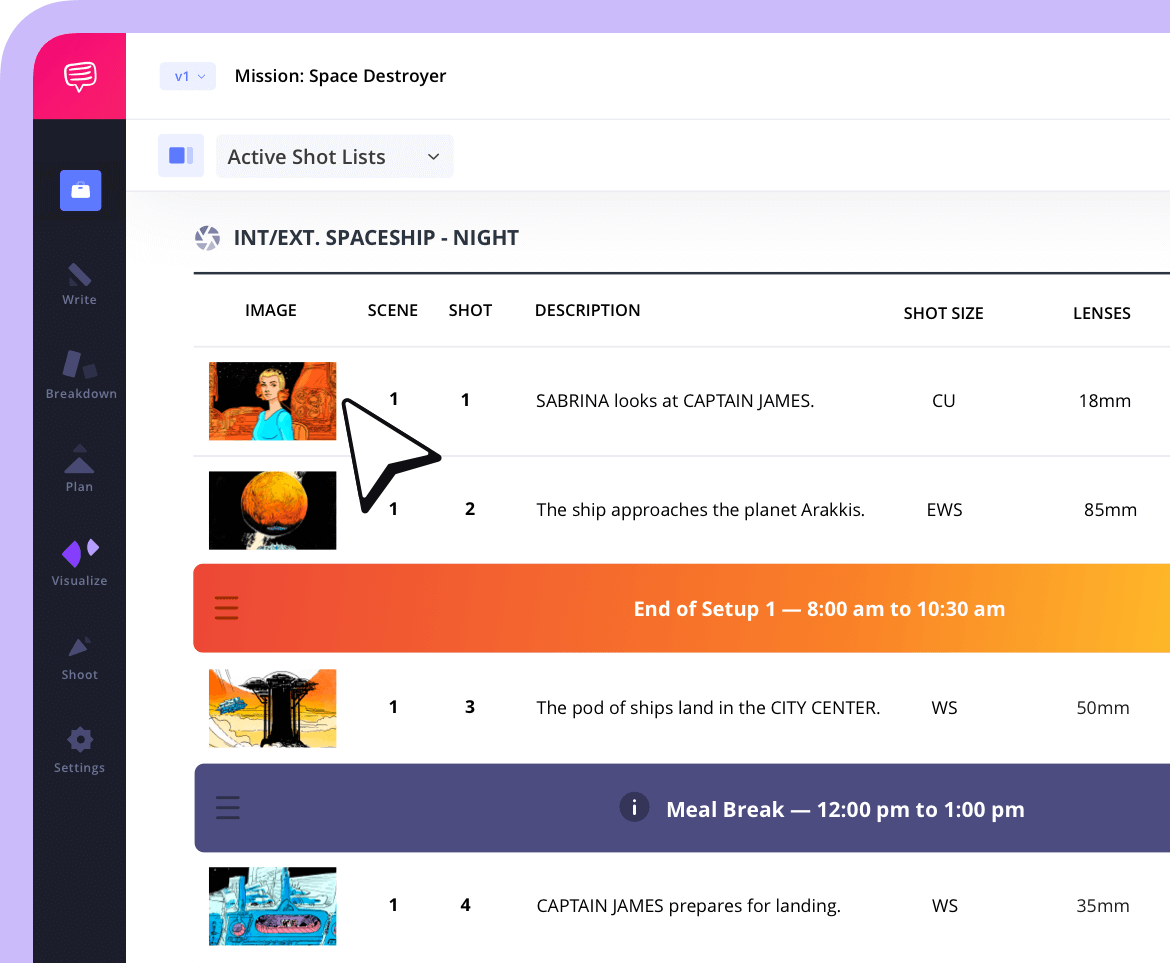
Trusted by over 1M creatives
Shot lists that turn vision into action
From first draft to final take, plan, organize, and execute every shot with confidence.
3. Mise-en-Scène
Mise-en-scène refers to everything visible within the frame. It is the design of the film’s world.
This includes:
These elements work together to create visual meaning. Color scheme can signal emotion. Lighting can reveal or conceal. Positioning can show power relationships between characters.
Mise-en-scène often communicates indirectly. A character’s environment can reveal their status. A controlled space can suggest order. A cluttered space can suggest pressure or instability.
When analysing mise-en-scène, do not list details. Select specific ones. Focus on what stands out and why it matters.
For example, take a look at StudioBinder's film analysis of mise-en-scene which shows how Stanley Kubrick uses this technique in his movies.
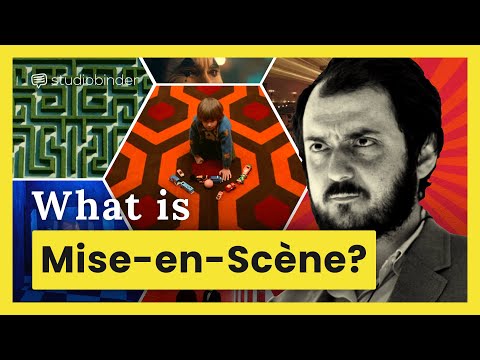
What is Mise-en-Scène • Subscribe to StudioBinder's YouTube Channel
4. Narrative Structure
Narrative structure is how the story is organised. It controls how information is delivered.
A film can follow a linear narrative structure, where events unfold in order. It can also use non-linear plot techniques such as flashbacks or parallel timelines. These choices affect how the audience understands the story.
Structure is closely tied to interruption. In many films, especially drama, the story begins when something disrupts normal life. The narrative then explores the impact of that disruption.
The way information is revealed shapes the dramatic question. What is the audience waiting to find out?
When analysing structure, ask:
When does the main conflict appear?
How is information revealed?
What is the audience encouraged to anticipate?
Structure is not just about sequence. It is about control.
Related Posts
5. Conflict
Conflict is the central problem that drives the story. Without it, there is no movement.
In strong films, there is one clear conflict that holds everything together. This conflict may evolve, but it should remain coherent.
Conflict can come from:
An external conflict situation
A personal relationship
An internal conflict struggle
In drama, conflict often comes from the situation itself. An event disrupts life, and the characters must respond. Different characters react in different ways, which creates further tension.
When analyzing conflict, focus on:
Who is most affected
What is at stake
The conflict remaining consistent
Weak or shifting conflict often leads to a weak analysis. Clear conflict gives your argument focus.
6. Sound Design
Sound design includes everything we hear. Dialogue, music, effects, and silence all contribute.
Sound shapes how a scene is experienced. Music can guide emotion. Silence can increase tension. A sudden absence of sound can be as powerful as a loud cue.
There are two main types of sound. Diegetic sound exists within the world of the film. Non-diegetic sound exists outside it, such as a musical score.
Sound can support the image. It can also contradict it. This creates complexity.
When analysing sound, listen closely. Ask what is being emphasised, and what is being withheld.
7. Editing
Film editing is how shots are arranged. It controls the rhythm of the film.
Fast cuts can create urgency. Long take shots can create immersion. Transitions between shots create meaning. A cut can connect two ideas. A delay can build tension.
Editing also controls time. It decides what is shown and what is skipped.
When analysing editing, focus on:
Then consider how these choices shape the audience’s understanding.
Related Posts
8. Themes and Symbolism
Themes are the ideas the film explores. Symbolism is how those ideas are expressed visually or narratively.
Themes are not stated directly. They emerge through repetition. Patterns build meaning over time.
Symbols can be objects, colors, or spaces. A repeated image gains significance. A location can become symbolic.
Strong analysis avoids vague claims. Do not say a film is about “life” or “society.” Be precise.
Instead:
Identify a recurring element
Track where it appears
Explain what it represents
Themes are built across the film. They are not found in a single moment.
Why These Elements Matter Together
Each element offers a different perspective. But film analysis is not about isolating them.
It is about connection.
Cinematography shapes how we see. Mise-en-scène shapes what we see. Structure shapes when we see it. Sound shapes how we feel it. Editing shapes how it flows.
Strong analysis brings these together. It shows how multiple elements work toward a single effect.
Critical Essay
How to write a film analysis
Understanding the elements of film analysis is the first step. Building a strong argument is the second. For a short guide on the process, take a look at the infographic below:
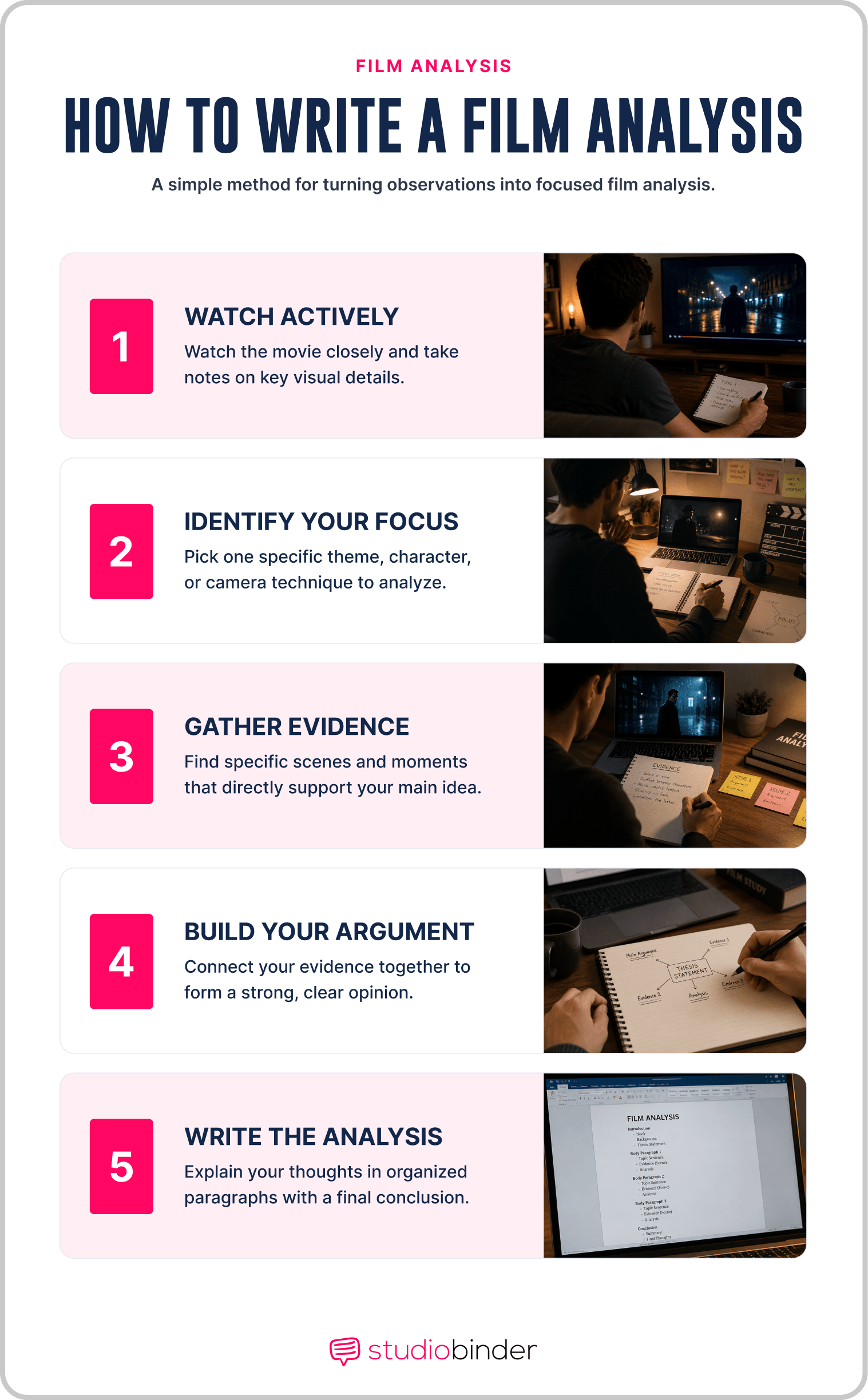
Step Guide for Writing Focused Movie Essays • Film Analysis
This step-by-step film analysis process breaks it into clear steps.
1. Watch the Film Actively
Start by changing how you watch.
The first viewing is for story. Follow the plot. Understand the characters. Do not analyze yet.
The second viewing is for detail. This is where film analysis begins.
Pause when needed. Take notes. Record specific moments. Use timestamps so you can return to them.
Focus on:
- Key scenes
- Visual choices
- Sound cues
Avoid general impressions. Saying “the film feels tense” is not enough. You need to identify where that tension is created and how.
Active viewing turns reaction into evidence.
2. Identify Your Focus
A strong film analysis essay needs a clear focus. Without it, the writing becomes scattered.
Do not try to analyse everything. That leads to surface-level observations.
Instead, choose one or two elements and build around them. This gives your analysis direction.
Weak focus: The film uses cinematography well.
Stronger focus: The film uses framing to isolate the protagonist in Act 2, reinforcing their emotional detachment.
Notice the difference. The second example is specific. It gives you something to prove.
Ask yourself:
- What stands out?
- What repeats?
- What feels deliberate?
Your focus should come from the film, not from a preset idea. Scene analysis works the same way. Start with what you observe, not what you expect.
Related Posts
3. Gather Evidence From the Film
Once you have a focus, collect evidence to support it.
Choose three to five scenes. That is enough to build a strong argument.
For each scene, note:
- What happens
- How it is presented
- What it suggests
Be precise. Do not refer to the film as a whole. Instead, point to specific moments.
Weak evidence: Throughout the film, the character is isolated.
Strong evidence: In the dinner scene, the character is framed at the edge of the shot, separated from the group.
This is the core of scene analysis. You move from description to interpretation.
Good evidence is concrete. It can be seen and verified.
4. Build Your Argument
Your film analysis needs a thesis statement.
This is your central claim. Everything supports it.
Each paragraph should:
- Introduce evidence
- Describe briefly
- Interpret clearly
Avoid plot summary. Focus on meaning.
5. Write the Analysis
Use a clear structure.
Introduction sets up the argument. Body paragraphs develop it. Conclusion reinforces it.
Write in present tense. Use clear language. Avoid overcomplicating.
A strong film analysis essay is precise and focused. The same applies to any movie analysis paper: evidence, argument, and clarity carry it.
Scene Breakdown
Parasite film analysis example
This film analysis example focuses on mise-en-scène and structure in Parasite.
The film explores class through space. The Kim family lives low. The Park family lives high. This is not stated. It is shown.
The story elements also built on interruption. The Kim family enters the Park household. That entry disrupts both worlds.
Basement Flood Scene
In Parasite, the Kim family returns home during a flood. The camera follows them descending. Streets slope downward. Water rises around them.
Studying mise-en-scène in film analysis means reading what the environment tells you about the characters. Parasite makes this legible: the lower you live, the more exposed you are. The mise-en-scène reinforces class position. Their environment collapses. Space becomes unstable. Light becomes harsh.
This is also a structural turning point. The interruption becomes irreversible.
The film does not explain class. It shows how it operates through space, movement, and environment.
Watch our film analysis on the entire Parasite story below:
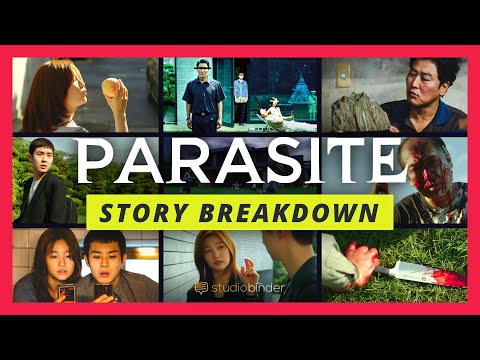
Parasite Story Breakdown • Subscribe to StudioBinder's YouTube Channel
Frequently Asked Questions
Questions about film analysis
Film analysis is the process of examining how a film creates meaning through its formal elements. Rather than reviewing quality, it identifies the techniques behind the audience's response. It explains how the film works, not just what happens.
The main elements are:
Cinematography
Mise-en-scène
Narrative structure
Sound design
Editing
Themes
Each offers a different way to interpret the film.
Length depends on purpose. A short film analysis essay may be 500 words. A full analysis may reach 2,000 words or more. Clarity matters more than length.
A review evaluates quality. It asks if the film is good. Film analysis explains meaning. It asks how the film works. How do you analyse a specific scene in a film? Start by watching the scene multiple times. Note what you see, hear, and feel. Then ask how those choices create that effect. Focus on one or two elements: cinematography, sound, or mise-en-scene. Connect your observations to the film's larger themes. A close scene analysis often produces the strongest film analysis arguments.
UP NEXT
What is film theory?
These film analysis techniques show you how films create meaning. It reveals structure, image, and intention.
Now let's broaden our understanding of film analysis by exploring film theory. This concept introduces us to the more academic and technical approaches to analyzing films. Hit the link below to get started.
Start Your AV Script
Start planning your next video with a structured AV script. Whether for commercials, corporate videos, or social media, our templates provide the perfect framework.