Many readers first encounter Cormac McCarthy through film. Often it’s No Country for Old Men or The Road. The films are precise. They are controlled. But they only show part of what McCarthy does.No Country for Old Men. The novels ask something different. They do not guide you through a clear argument. They do not explain what events mean. Instead, they present action, dialogue, and imagery. Meaning has to be built by the reader.
This is what separates McCarthy from most contemporary writers. He does not prioritise clarity. He prioritises experience. The reader is not given a message. The reader is placed inside a situation and forced to interpret it. This guide covers all twelve books by Cormac McCarthy. It explains what each book does, how it reads in practice, and where it sits within his wider body of work. It also tracks which novels were adapted, and why some resist adaptation entirely.
Across 12 novels and nearly six decades, the best books by Cormac McCarthy return to the same core problem. Human beings look for meaning in a world that does not offer it directly. His fiction does not resolve that tension. It makes you sit inside it.
Cormac McCarthy Bibliography
All Cormac McCarthy Books (1965–2022)
Before diving into the ranked list or reading order for the best Cormac McCarthy books, it helps to see the full range of his work. McCarthy did not write the same book repeatedly.
His prose style evolves, but his concerns remain consistent. Each entry below breaks down what the novel is doing, not just what happens in it.
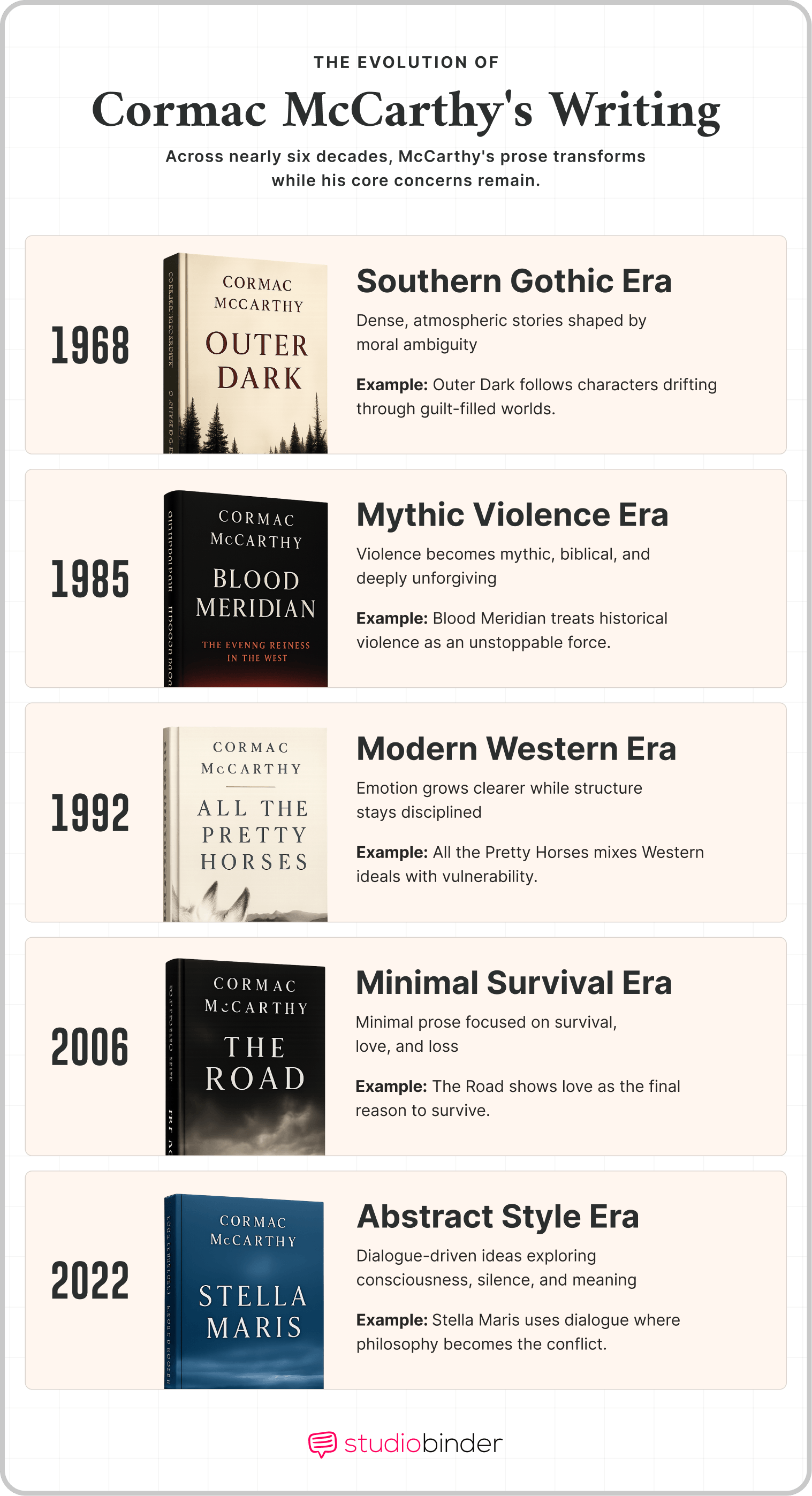
The Evolution of Cormac McCarthy's Writing • All Cormac McCarthy Books
Let's dive into his work now.
1. The Orchard Keeper (1965)
McCarthy's first novel establishes many of his long-term concerns. Set in rural Tennessee, it follows three characters whose lives intersect indirectly: a bootlegger operating outside the law, an old man who guards a hidden body, and a boy connected to both without understanding how.
The novel is less interested in plot than in environment. It captures a disappearing rural world where knowledge is local and often incomplete. Characters don't fully understand their own situations.
The prose is dense and layered, often shifting perspective without warning. Time moves irregularly. Events aren't always explained when they happen. The challenge is orientation — you have to piece together relationships and meaning over time.
No film adaptation. Not an obvious candidate for one.
2. Outer Dark (1968)
Outer Dark strips McCarthy's approach down even further. The premise is simple: a woman searches for her abandoned child, her brother who fathered the child left it to die, and three violent figures move through the same landscape.
But the simplicity is deceptive. The novel removes context — it doesn't explain motivation or provide moral framing. The reader understands what is happening but not how to interpret it. Conflict appears without explanation. Consequences feel arbitrary.
This is where McCarthy's refusal to guide the reader becomes fully visible. He presents events as facts, not arguments. The language is direct. The difficulty comes from the lack of structure around meaning.
No film adaptation.
3. Child of God (1973)
This is one of McCarthy's most confrontational works. Lester Ballard is removed from society. What follows is not a dramatic rise or fall, but a gradual breakdown. The novel tracks his actions without commentary.
The key choice is perspective. McCarthy does not frame Ballard as an exception he presents him as human, a study in character pushed past every limit. That decision shifts the entire reading experience.
The prose is stripped down and the events are clear, but the emotional response is not directed. The reader has to decide how to engage with what they are seeing. The difficulty is not technical — it is psychological.
The 2013 adaptation, directed by James Franco, follows this approach closely. It is committed, but limited by the material's resistance to wider appeal.
4. Suttree (1979)
Suttree expands McCarthy's scope. Instead of focusing on a single descent or journey, it builds an entire social world — closer to a series of vignettes than a conventional novel. The novel follows Cornelius Suttree, who abandons a stable life to live among drifters and labourers.
The structure is deliberately loose. Scenes accumulate like a literary montage rather than build toward a single outcome. Characters come and go. Moments matter more than plot.
This is also McCarthy's most humane work. There is humor and warmth here — rare in his body of work. The characters are not reduced to symbols or functions. The challenge lies in the form: there is no clear narrative drive. You are moving through a world, not toward a resolution.
No film adaptation.
5. Blood Meridian, or The Evening Redness in the West (1985)
This is the novel most often placed at the centre of McCarthy's work. It follows a teenage runaway who joins a historical scalp-hunting gang operating along the US-Mexico border. The events are based on real accounts, but the novel transforms them into something closer to myth.
Judge Holden dominates the narrative. He presents violence as natural, even necessary. His presence pushes the novel past realism into something built on symbolism. The structure is repetitive — violence occurs again and again, with little variation in outcome. This is not accidental. It builds a pattern rather than a traditional rising arc.
The language is archaic. Dialogue is not clearly marked. Meaning is not stated; it emerges through accumulation. Images repeat. Actions echo. The reader has to recognise the pattern.
Screenplay adaptation has repeatedly failed — the difficulty is not the story but the way the story is told. No film adaptation to date.
6. All the Pretty Horses (1992)
This is where McCarthy becomes widely accessible. The novel follows John Grady Cole as he crosses into Mexico after losing his family ranch, combining a coming-of-age narrative with a Western setting.
Unlike earlier work, the structure is clear. Events follow a recognizable three-act structure. Emotional stakes come through clearly. This doesn't mean the novel is simple — it still deals with loss, violence, and identity — but it allows the reader to engage without struggling to orient themselves.
This is the most effective entry point into McCarthy's work.
The 2000 adaptation starring Matt Damon was heavily cut before release, reducing its emotional impact. A lesson in how studio intervention alters narrative structure.
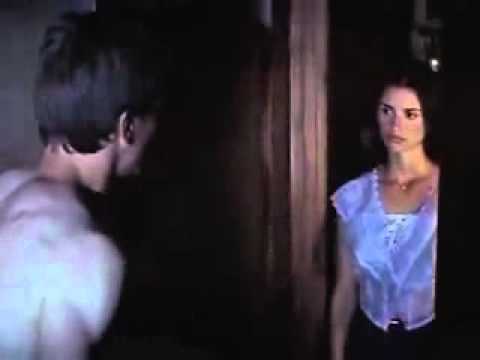
All the Pretty Horses Official Trailer • All Cormac McCarthy Books
7. The Crossing (1994)
The Crossing shifts the focus again. Billy Parham's journey begins with a clear goal: he captures a wolf and attempts to return it to Mexico. But the narrative quickly expands beyond that premise.
The novel pauses for extended stories told by other characters. These stories are not framed as digressions — they are treated as essential. McCarthy presents storytelling as a way of organising experience. Characters pass stories to each other to make sense of events.
The result is a novel that moves outward rather than forward. Progress is not measured by plot, but by accumulation of perspective. The pacing is slow.
No film adaptation.
8. Cities of the Plain (1998)
The final part of the Border Trilogy returns to a more direct structure.
It brings together John Grady Cole and Billy Parham. The narrative centres on a relationship that cannot be sustained.
Compared to the previous two books, this is more straightforward. It moves toward a clear ending. However, its impact depends on familiarity with the earlier novels. It functions as an epilogue to the trilogy rather than a standalone work.
No film adaptation.
9. No Country for Old Men (2005)
This is McCarthy's most structurally controlled novel.
The exposition is stark: a man takes money from a failed drug deal. A killer pursues him. A sheriff reflects on a world that no longer aligns with his values.
The narrative is tight. Events follow a clear chain of cause and effect. Tension builds steadily. This makes it highly accessible — it reads quickly and holds attention without requiring interpretation at every step.
But the underlying method remains the same. Key events aren't shown. Meaning sits in what is missing.
The 2007 adaptation by the Coen Brothers succeeds because it understands this. It removes rather than adds — silences replace exposition, and key events happen off-screen. What is omitted carries meaning.
This trailer shows the film’s story structure and tone.
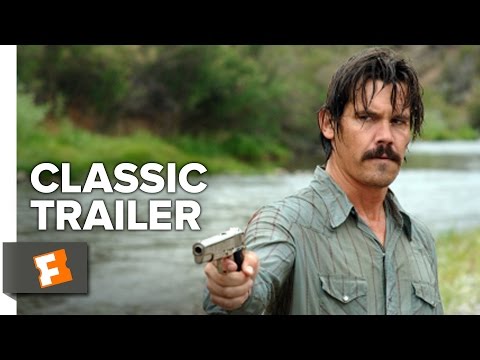
No Country For Old Men • Best Cormac McCarthy Books
10. The Road (2006)
The Road strips everything back.
A father and son move through a devastated landscape. There is no clear explanation of what happened. Only the present matters.
The prose reflects this. Sentences are short. Description is minimal. Dialogue is reduced. This makes the novel easy to read on a technical level, but the emotional weight is constant — pure drama without relief.
The novel asks a simple thematic question: can moral behaviour survive when systems collapse?
The 2009 adaptation captures the visual world but cannot fully replicate the effect of the language. The novel's power comes from its prose — that cannot be fully translated to film.
This trailer highlights the film’s atmosphere, tone and how it relates to the Cormac Mccarthy books.
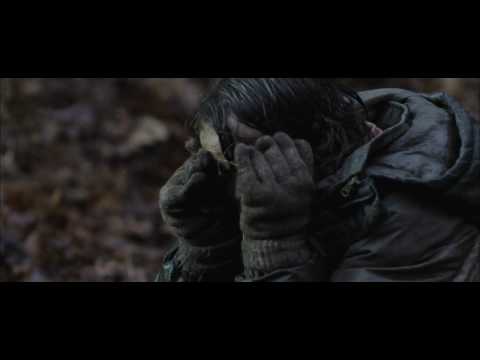
The Road Movie Trailer • Best Cormac McCarthy Books
11. The Passenger (2022)
This marks a shift in focus. Which is why it's regarded as one of the greatest books written by Cormac McCarthy.
Bobby Western moves through memory, grief, and unresolved questions. The narrative does not prioritise plot. Scenes appear disconnected. Time shifts. Meaning is indirect.
This reflects a deeper interest in how thought works. Experience is not linear and does not arrive fully formed. The novel mirrors that process, asking the reader to hold fragments together.
No film adaptation.
12. Stella Maris (2022)
Stella Maris pushes this even further.
The entire novel is dialogue — or closer to monologue. Alicia Western speaks from a psychiatric facility. There is no narration, no description, only conversation.
This removes context. You have to interpret what is being said and what is being avoided. The ideas are abstract expressions — closer to philosophy than fiction. Mathematics, consciousness, and perception dominate.
This is McCarthy's most experimental work. It demands sustained attention and works best read after The Passenger.
No film adaptation.
Related Posts
Cormac McCarthy Chronology
The best Cormac McCarthy books to read in order
Where you start matters. McCarthy’s style changes across his career. Some books are clear and structured. Others demand patience and close reading. If you begin in the wrong place, it can feel impenetrable.
If you begin in the right place, the rest of his work opens up. If you want to read Cormac McCarthy books in order of difficulty, here is the most practical approach. Read through the below to decide which books written by Cormac McCarthy and adapted to film are most worth your time.
No Country for Old Men
The most cinematic and structurally clear entry point to Cormac Mccarthy books. It reads like a thriller but still carries McCarthy's restraint. If you've seen the film, the novel deepens everything. The character of Anton Chigurh is central — he operates according to a system that appears logical, but that logic is never fully explained. The coin toss becomes a way of transferring responsibility. Chance replaces moral choice.
All the Pretty Horses
His most accessible novel. The story is linear, the emotions are direct, and the prose is still distinctive without being difficult. The narrative follows a recognizable coming-of-age structure — John Grady Cole leaves home, crosses into Mexico, and confronts a world that does not match his expectations. But beneath that structure, McCarthy is already removing explanations at key moments.
The Road
Short and direct. Easy to read on a technical level, but emotionally intense. A strong starting point if you're prepared for the weight of it. The tension is driven by responsibility — the father's role is not just to survive but to maintain a moral framework in a world where that framework no longer has support. The stripped language keeps you inside the experience rather than observing it.
Related Posts
Blood Meridian Book
The hardest Cormac McCarthy books to read
When it comes to picking which hard Cormac McCarthy books to read, you have a pretty good selection. For starters, it would be a good idea to begin with the following:
Blood Meridian
The most demanding. Archaic language, no quotation marks, constant violence. It requires sustained attention and often more than one attempt.
Suttree
Long and episodic. The narrative drifts rather than builds. It rewards patience, but it asks for it constantly.
Stella Maris
Entirely dialogue, focused on abstract ideas. It works best if you've already read The Passenger.
Outer Dark
Short, but unforgiving. The lack of explanation makes it difficult to interpret, even when the events are clear.
Cormac McCarthy Adaptations
Which Cormac McCarthy books were made into movies?
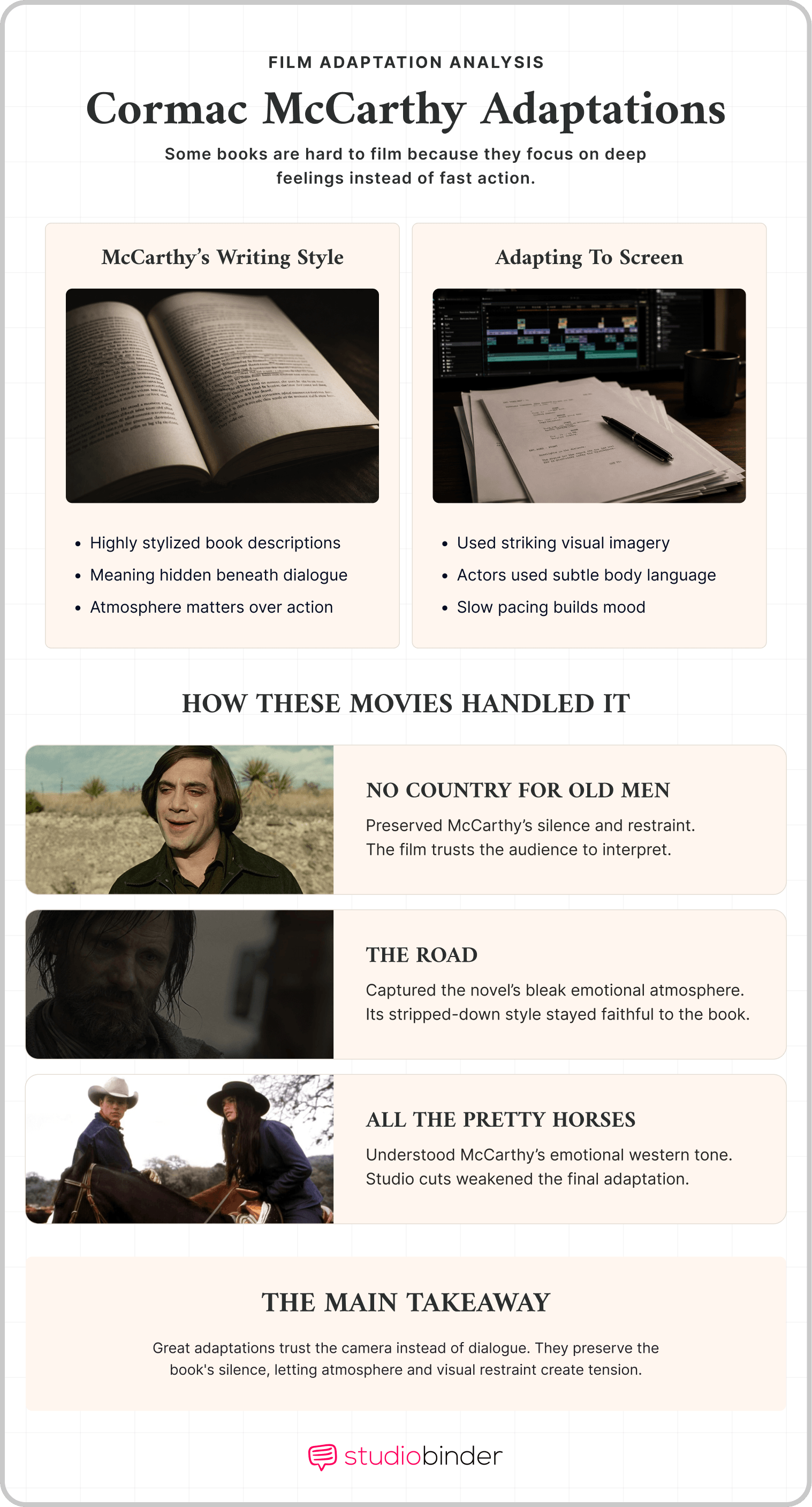
Four Cormac McCarthy movies have been produced from his novels. His work has a strong relationship with cinema, but not all of it translates. The key pattern: McCarthy builds meaning through omission — avoiding exposition — while film often tries to clarify. The best adaptations resist that instinct.
Before diving into all the film adaptations, it's important to understand why it's rather difficult to turn a Cormac McCarthy novel into a film:
Cormac McCarthy Adaptations • All Cormac McCarthy Books
Now let's dive into which film adaptations were made from the books written by Cormac McCarthy.
No Country for Old Men (2007)
Directed by Joel Coen and Ethan Coen.
The screenplay adaptation is unusually faithful. The Coens follow the novel closely, but more importantly, they match its restraint. Key events happen off-screen — a bold filmmaking choice. There is no final confrontation. The film refuses to resolve tension cleanly. For writers and film directors, this is the lesson: trust the material. Do not over-explain what the structure already delivers.
No Country For Old Men • Best Cormac McCarthy Books
The Road (2009)
Directed by John Hillcoat.
The adaptation is faithful in tone and design. The visual world is convincing, and performances carry much of the emotional weight. But the novel's impact comes from language — short, stripped sentences create rhythm and pressure. Film can approximate that, but not fully replace it.
The Road Movie Trailer • Best Cormac McCarthy Books
All the Pretty Horses (2000)
Directed by Billy Bob Thornton.
The production history is key. Thornton shot a much longer version that was cut down significantly before release. The result feels compressed — emotional development is lost. It becomes a case study in how studio intervention alters narrative structure.
All the Pretty Horses Official Trailer • Books written by Cormac McCarthy
Child of God (2013)
Directed by James Franco.
The adaptation is committed and focused. Scott Haze's performance carries the film. It remains a niche work — the material itself limits its accessibility.

Child Of God Official Trailer • Best Cormac McCarthy Books
The adaptation is committed and focused. Scott Haze’s performance carries the film. It remains a niche work. The material itself limits its accessibility. Still, as far as books written by Cormac McCarthy that have been adapted to screen go, it's worth checking out.
Cormac McCarthy Books Ranked
All Cormac McCarthy books ranked
This ranking of books by Cormac McCarthy balances craft, accessibility, and long-term impact.
- Blood Meridian: The ceiling of his ambition. Demanding, but unmatched in literary craft.
- No Country for Old Men: Structurally precise. A model of controlled storytelling.
- The Road: Emotionally definitive. Simple, but devastating.
- Suttree: Expansive and humane. His richest world.
- All the Pretty Horses: The gateway. Where most readers should begin.
- The Crossing: Uneven, but philosophically dense.
- The Passenger: Ambitious and fragmented. 8. Cities of the Plain Effective as a trilogy conclusion.
- Cities of the Plain: effective as a conclusion.:
- Outer Dark: Bleak and foundational.
- Child of God: Difficult but precise.
- Stella Maris: Formally bold, but limited in scope.
- The Orchard Keeper: Important historically, but not a starting point.
And there you have it, our complete ranking of books written by Cormac McCarthy.
Rank | Novel | Year | Difficulty | Film Adaptation |
|---|---|---|---|---|
1 | Blood Meridian | 1985 | 5/5 | No |
2 | No Country for Old Men | 2005 | 2/5 | Yes (2007) |
3 | The Road | 2006 | 2/5 | Yes (2009) |
4 | Suttree | 1979 | 4/5 | No |
5 | All the Pretty Horses | 1992 | 2/5 | Yes (2000) |
6 | The Crossing | 1994 | 3/5 | No |
7 | The Passenger | 2022 | 4/5 | No |
8 | Cities of the Plain | 1998 | 2/5 | No |
9 | Outer Dark | 1968 | 3/5 | No |
10 | Child of God | 1973 | 3/5 | Yes (2013) |
11 | Stella Maris | 2022 | 5/5 | No |
12 | The Orchard Keeper | 1965 | 4/5 | No |
Frequently Asked Questions
More questions about all the Cormac McCarthy books
Blood Meridian is most often cited as his greatest work. It is the most ambitious and formally demanding — its themes resist easy summary. Some readers prefer No Country for Old Men or The Road because they are more accessible, but among Cormac McCarthy's best books, Blood Meridian is usually considered the summit.
Start with No Country for Old Men or All the Pretty Horses. Both offer clear structure while still reflecting his style. If you want something shorter, The Road is also a strong entry point.
Blood Meridian is widely considered the most difficult. The language, structure, and violence all demand sustained effort. Suttree is also challenging due to its length and episodic form.
No Country for Old Men is the most accessible — it reads quickly and clearly. All the Pretty Horses is also approachable, with a more traditional narrative structure.
Cormac McCarthy wrote 12 novels between 1965 and 2022. He also wrote screenplays, including The Counselor, directed by Ridley Scott.
Four Cormac McCarthy books were adapted into films: No Country for Old Men (2007), The Road (2009), All the Pretty Horses (2000), and Child of God (2013). The Coen Brothers' adaptation of No Country for Old Men won the Academy Award for Best Picture. Blood Meridian has been in development multiple times but has never reached production.
You don't need to read Cormac McCarthy books in order of publication. The Border Trilogy (All the Pretty Horses, The Crossing, Cities of the Plain) should be read in sequence, and Stella Maris works best after The Passenger. Beyond that, start with whichever book matches your reading preference. No Country for Old Men and The Road are the most accessible starting points.
UP NEXT
No Country for Old Men ending explained
If you start your Cormac Mccarthy books list with No Country for Old Men, the next step is to understand how the film works beneath the surface. The story withholds key information. That is where its meaning sits. Start with the ending. Then focus on the character who controls the tension. The best Cormac McCarthy books know how to keep you hooked.
Start Your AV Script
Start planning your next video with a structured AV script. Whether for commercials, corporate videos, or social media, our templates provide the perfect framework.