Development hell. It’s a common phrase in Hollywood. A place in which no one wants to find themselves, but almost all filmmakers do. Maybe you’ve heard of it. Development hell describes a phase of pre-production, before the green light, where projects can languish for a very, very… very long time. Few ideas are lucky enough to make it out. That’s why you may hear industry veterans say, “movies are miracles.”
The good, the bad, and the meh. If you’re watching something, even if you hate it, it’s a miracle it exists. Getting films and TV shows to the point where an audience is watching them on screens of any size can be an arduous process — one in which the scripts have a hero’s journey all their own. The ones you’ve never seen, however — the wunderkind director’s passion project, the juicy piece of IP that seemed ripe for box-office billions, or the script born of one writer’s hopes and dreams — can all die a miserable death in development hell.
So, who, then, would deal in this demonic realm of film development and pre-production? What kind of person would make their living ferrying ideas from conception to kick-off over Hollywood’s version of The River Styx, lined with the bones of rejected concept art and redlined drafts of dead projects past?
DEVELOPMENT PRODUCER ROLE
What is a development producer?
A development producer, often referred to as a development executive (more on that distinction later), discovers new voices, new ideas, and prepares them for the world to see.
The process of discovering those ideas can happen in many ways, but mostly in one of two ways:
They help bring a writer's idea to life and work alongside the writer, shopping and pitching the screenplay to studios and networks.
They hire a writer for a specific idea. Whether it be an optioned IP or the seed of an original idea, the development producer will meet with and ultimately hire a writer to help bring that idea to life. Sometimes, multiple writers are cycled through during script development to ensure the script meets the needs of those who give the green light.
Key Responsibilities of a Development Producer
- Discover promising stories, scripts, books, and original concepts
- Work with writers to strengthen scripts and story structure
- Create pitch materials for studios, networks, and streamers
- Guide projects from development through the greenlight process
DISCOVERING NEW PROJECTS
What does a development producer do?
Development producers find, evaluate, and shape ideas into marketable projects.
Identifying and developing new show ideas
What does a development producer do? Read. They read everything. They watch everything. Reading and watching, watching and reading, and if they have captions turned on, they're reading while they're watching. The development producer's antenna is always up. Whether it be a script sent by an agent or manager, an article read over morning coffee, a podcast listened to on the drive to work, a book series causing a fervor among fans, an inspiring life story with potential as a limited series, or a foreign format with potential to be adapted for American audiences. Everything means ev-e-ry-thing.
When the development producer finds something that ignites their interest, they set out to get it made. If it's an existing piece of material — a script, book, podcast, or something already conceived by a creator — they meet with the creator or rights holder to gauge their interest. If the idea is available (yes, other producers may have caught it sooner) and the creator or rights holder is interested, the development producer will make a development deal.
A development deal can take many forms. But most often it involves a set amount of money over a set period of time, granting the producer the right to adapt, pitch, and, hopefully, bring that project into production.
Working with writers and creators
The relationship between the development producer and the writer is vital. Like a director helping an actor shape a performance for a particular film, the development producer helps the writer tailor the script to the project's needs through a process of script development.
Writing can be a lonely world. So when a person comes along who believes in your project, votes on it, and says, "I want to help you get this to the finish line," "I not only want to invest in your dream but make it a reality," it can be an energizing proposition.
In this relationship, the development producer is both a partner and a conduit for the writer. In the writing room, the development producer acts as a sounding board, the first audience member, and a helpful critic, providing necessary feedback to strengthen the script. A good development producer knows story structure inside out. They can identify a weak inciting incident, a thin protagonist, or a conflict that doesn't carry through to the narrative's end. They read with the eye of a script breakdown — looking at what's on the page and what it will cost to bring to life.
In the boardroom, the development producer represents the script. They are passionate advocates for this idea. They listen to the needs of a studio or network and relay them back to the writer. Then, when it comes time to present, the development producer makes the case why this idea is the right choice for that network or studio.
Managing the development pipeline
The slate. It's the development producer's prized possession. It tracks every project they oversee, from a seed idea to a script on the precipice of a green light. And this list is ever-changing. Sometimes, a newly added idea is fast-tracked and rockets up the slate past a title that has been stuck in development hell far too long.
Or a project that a studio nearly bought can drop to the bottom with a swift and simple pass. A development producer tends their slate like a gardener tends their plants, watering and pruning as needed to ensure each one gets the attention it deserves.
That said, the development producer must always keep the rejected projects on the list, or "on the shelf." You never know when a need for that kind of story will come back around.
There may come a day when, over drinks, a studio executive will ask if that development producer has anything similar to that hit movie that just made millions. Just so happens, the development producer does. And in that moment, an idea that was at the bottom of the slate — long considered dead — was just given new life.
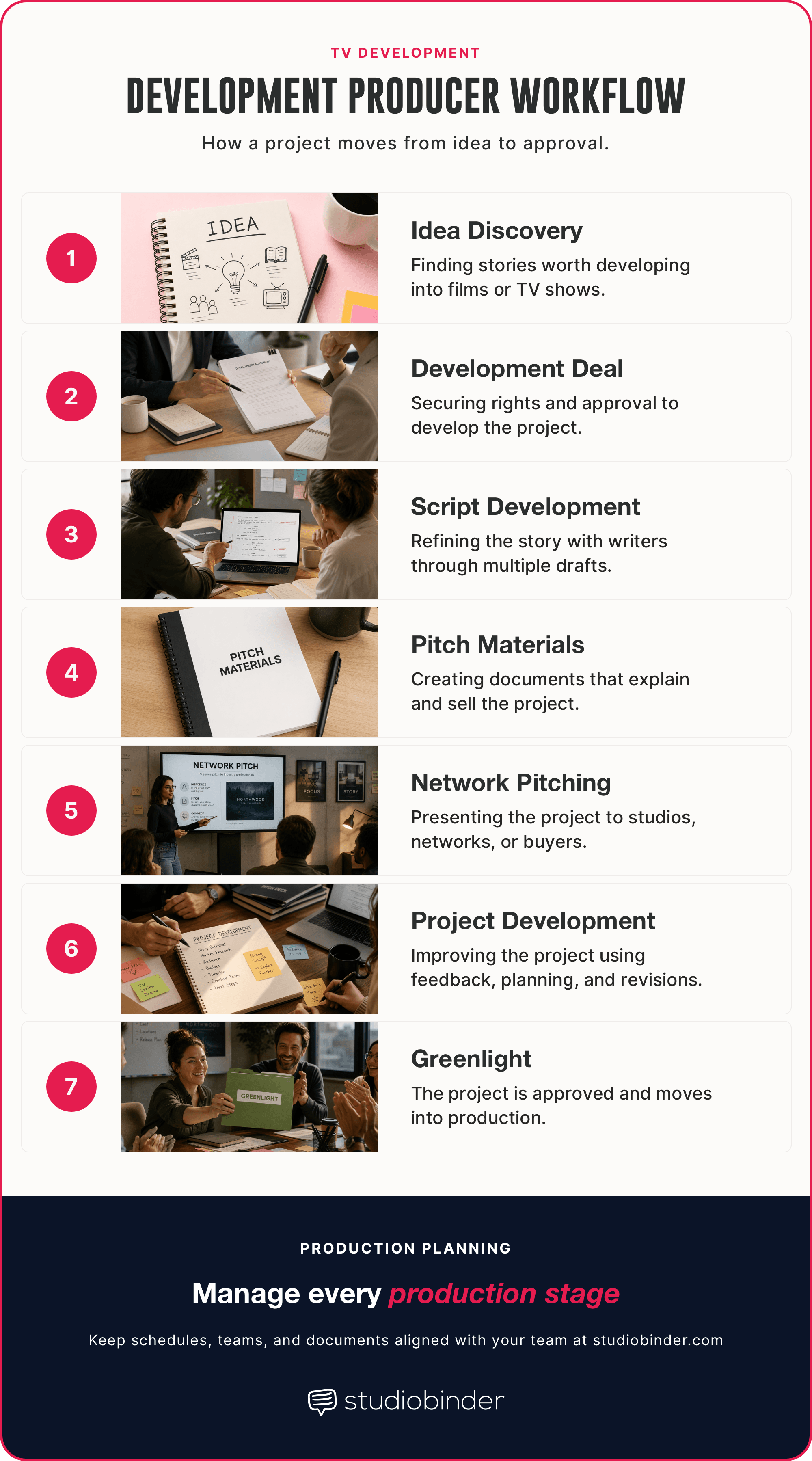
Development Producer Workflow • Development producer
PRODUCER ROLES
Development producer vs. other roles
Understanding where a development producer fits in the production process.
Development producer vs. showrunner
Once a show gets made, who runs it? The answer is fairly simple: the showrunner. In a new series, the showrunner is usually the creator who wrote and developed the pilot with the development producer. Once the show gets greenlit, that writer will most likely become the showrunner.
They'll oversee the hiring and management of the writers' room, hire a director for the pilot episode, and work with budgets and all departments to realize their vision. What a director is to movies, the showrunner is to a television series.
The development producer will bring on the showrunner to pen the pilot and develop future episodes of the series. This writer and showrunner may be someone who was staffed on past TV shows but has never held the role of showrunner before. Or they may already be a seasoned showrunner looking for their next series.
There are also cases where a young writer creates a show and develops the series with the development producer. But because the writer is so junior, the development producer will hire a more experienced showrunner to help decision-making executives feel at ease knowing the series they're spending millions on is in capable, seasoned hands.
Development producer vs. development executive
Now for the difference between the development producer and the development executive.
Often, development producers are development executives. Producer is an amorphous, catch-all title that covers many responsibilities across many projects.
In development, the development producer, typically though not always, works at a production company. Here, the development team may carry executive-rank titles — manager, director, vice president, executive vice president. Whatever the rank within the company, the job of development producer ultimately doesn't change.
The development executives are still producing the project. They're making sure scripts are read, writers are met, and options are dealt with. The scope and scale of the role changes as someone works their way up the film credits hierarchy, but the work remains the same.
However, not every development executive is a development producer. While a development producer is the one who rolls up their sleeves and works on a project with the writer, the development executive may be the person at the network or studio who hears the pitch.
Depending on their title, they may have the power to greenlight — or they may not. If they are a development executive without approval authority, they can present the project to their bosses and campaign for its approval. That's how a good, lucky script in development can have a snowball effect.
Trusted by over 1M creatives
StudioBinder for production teams
Everything you need for a successful shoot: call sheets, shot lists, scripts, and more.
Development producer vs. executive producer
An executive producer credit is unique and can carry multiple meanings and responsibilities. An executive producer can be an executive at a studio, network, or production company who oversees the project for their respective company. At the same time, an executive producer can be the showrunner who makes the key decisions day in and day out.
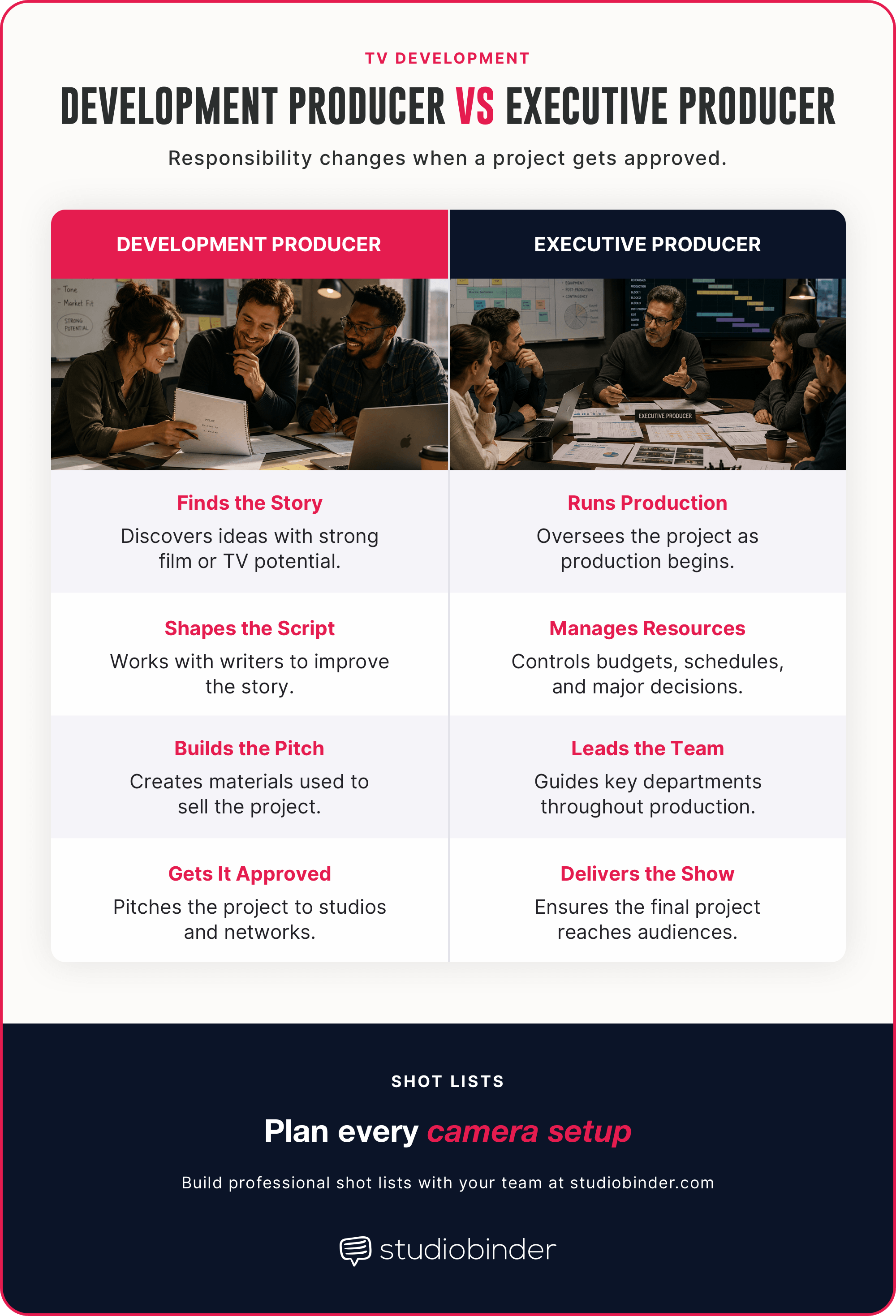
Development Producer vs Executive Producer • Development producer
The title of executive producer can also be given to a director who helmed the pilot episode, setting the tone of the show. It can be an actor whose attachment helps get a movie made, and, as part of their deal, they negotiate an executive producer title despite limited hands-on producing work. Similarly, the title can be held by an A-list filmmaker whose production company is responsible for producing the project — their name lends gravitas, often with limited direct involvement.
But what about the development producer? Are they ever given an executive producer title? Again, the answer is: sometimes. While a development producer can continue their work on a project from development into production — staying on as an executive producer or co-producer — more often their role ends when the green light is given.
That's why getting a green light can be bittersweet. In nearly every way, it's the best thing that can happen. But in one way, it means their involvement in a project — one their passion helped get made — is ultimately complete. They helped ensure the ship could float, but they stayed in the harbor, proudly watching as it sailed away.
Related Posts
CAREER PATH
How to become a development producer
It's been said that there are only three entry-level jobs in the film industry: writer, director, and assistant. While this isn't entirely true — there are many ways in — this sentiment carries real weight: you either create something yourself or you work your way up. The latter is the standard path for the development producer.
Many development producers begin in the lowest-paid positions. Understanding TV show development from the ground floor is how most people learn what the job actually requires day to day. The development producer salary at entry level tends to be modest — coordinator roles typically range from $60,000 to $80,000 — but experience compounds fast.
Learn script coverage and story analysis
Development producers often begin as a "reader" — a mostly freelance, part-time job where a person reads a script and gives their assessment, commonly called script coverage. In this role, the reader rates what was strong or weak about a script, summarizes the story, plot, and characters, and gives an opinion on whether someone higher up should review it.
Script coverage is a foundational skill. Doing it well means knowing your three-act structure, understanding character arcs, recognizing a strong theme, and spotting a weak plot before it gets greenlit. Experienced readers also know frameworks like the Save the Cat beat sheet and the Dan Harmon story circle — the tools writers use to build stories, and therefore the same tools script coverage uses to evaluate them. Learning and refining this skill at the start of a career can pay dividends for the rest of it.
Start in development as an assistant or coordinator
The assistant role is the primary entry-level position for most development producers. Ideally, it involves assisting a development executive or producer directly — a front-row seat to the job they may one day hold.
An assistant's duties oscillate between the critical and the banal. Managing the schedule. Rolling calls. Creating an organizational system for the executive. Preparing pitch materials, including film treatments and loglines. Covering scripts. Ordering lunch. Setting up the conference room.
Precision in every task is key — because success as an assistant builds the trust that leads to a coordinator or manager of development role, where real script development responsibilities begin.
Tools like StudioBinder help development teams manage the organizational side at every stage, especially when reviewing screenplays.
Trusted by Over 1M Creatives
Screenwriting from draft to set
Write, format, and share your script. Ready for production when you are.

Build relationships with writers and agents
As an assistant, building relationships with peers is as important as the desk work. Assistants have their own internal communication network. They work with each other every day — setting meetings, communicating schedules, connecting their bosses.
Something like: "I have my boss for your boss." "Hold for my boss." With their ears on every call, assistants are the most well-informed people in Hollywood. If you need to know the current state of the TV development landscape, ask an assistant.
A proactive assistant is not just handling desk duties during working hours. They are also doing extra legwork after hours and on weekends. That spare time is when they can start developing and sharpening their skills as a development producer — by going for drinks, coffee, or dinner with other assistants who will climb the ranks alongside them.
They can read free movie scripts from young writers and discover new voices in their free time. Even if those writers aren't ready to create their own shows yet, the assistant can build a relationship that will grow as both people advance.
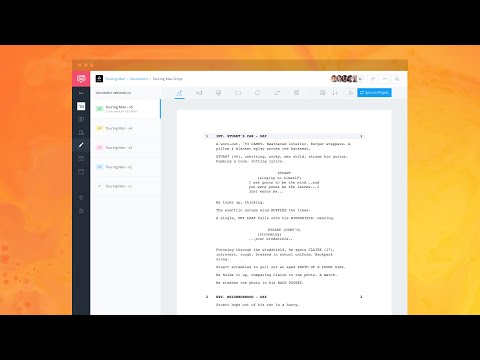
You might receive a .fdx file, .pdf or a link to their screenplay written inside StudioBinder's screenwriting software. This provides a streamlined way to collaborate on script notes.
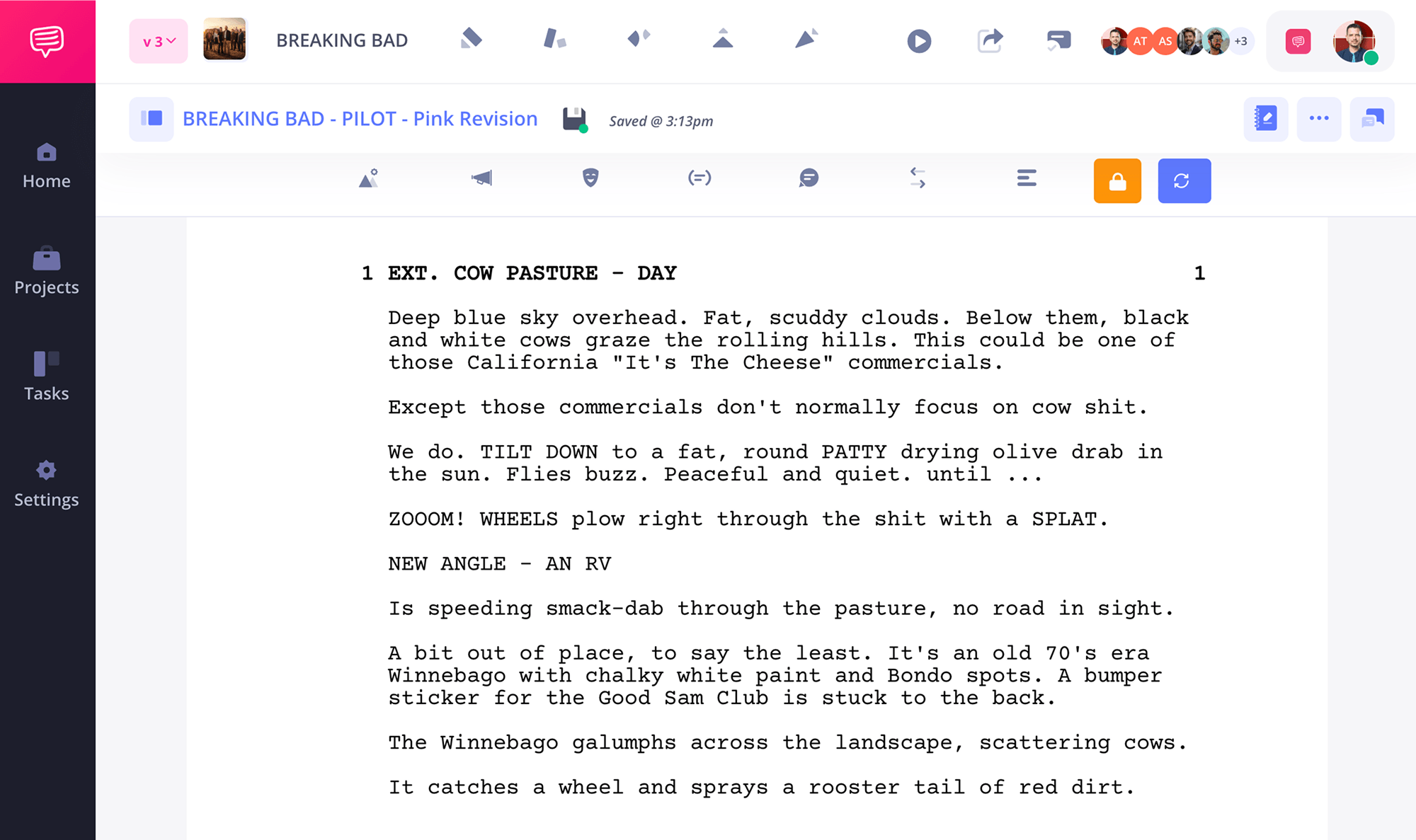
Write your free screenplay in StudioBinder • Development producer
Because someday, the development assistant and the un-repped writer will be the development producer and the showrunner pitching an idea to a studio head who, not so long ago, was asking if their boss's guest wanted a coffee or water. Together, these people will create the next big hit. But they all started at the bottom.
One of the beauties of the film and TV business is that it is one of the last true apprenticeship industries. So it should go without saying: be nice to assistants. Not only is it the right thing to do, but those assistants will one day decide whether your show or movie gets greenlit.
TV DEVELOPMENT PROCESS
How TV development works
When a development producer has an idea, or meets a writer with a great pitch, they'll strike a development deal and get to work. A development deal can be the right to work on that project with the writer, an outright purchase of that writer's script, or a shopping agreement.
A shopping agreement allows the development producer to seek a buyer within a certain period. If the project hasn't found a home by the time that deal ends, the writer and development producer can agree to extend — say, if there has been interest from a buyer but it needs a bit more time — or they go their separate ways and the rights revert to the writer.
Once TV show development begins on a project, the development producer's job is to identify which networks or studios are the right fit. They do this by knowing a studio or network's mandate.
The mandate is the type of content the studio or network wants to make at that time. A studio executive might say, "Right now, we're looking for grounded sci-fi movie projects." Or, "We'll be excited to read family melodramas set in the modern American west, similar to that new hit show." Knowing the genres in demand across every major buyer is part of the development producer's ongoing homework.
Armed with that knowledge, the development producer starts making calls — leveraging relationships and giving a soft pitch.
The soft pitch is where, maybe over the phone, the development producer gives a quick summary of the project and gauges the executive's interest. Sometimes the executive says "no" right there. Sometimes they say, "Yeah, let's set a pitch," or "Send me some materials first."
Pitch materials: From one-sheet to show bible
"Materials" means a one-sheet, a pitch deck, a sizzle reel, a pitch bible, or a script. Any or all of these can help sell a project. Knowing how to pitch a TV show means knowing which material to lead with for each buyer.
The one-sheet is a one-page summary of the project and its characters, with a tease of where the series might go beyond the pilot. It immediately establishes the world, genre, and tone. Busy executives use it to pitch internally to their bosses, take the temperature of colleagues, and make initial decisions. If they're interested, the one-sheet could lead to a full pitch or an agreement to read the pilot.
The pitch deck is a more involved version of the one-sheet. Page by page, it sets the visual tone — pulling images from similar films and shows into a picture book that covers the summary, characters, world, look and feel, tone, and where the series goes in season one, two, and beyond. For a sense of what a great pitch deck looks like, see the Stranger Things pitch deck, originally titled Montauk.
The sizzle reel uses clips from multiple other projects to quickly establish the world, tone, genre, and feel of an idea. More than a one-sheet or deck, the sizzle can create fast excitement for a project and give a buyer a taste of what the final product could look like on screen. Here is an example of a sizzle reel for The Gemini Man, made before Will Smith was attached to the 2019 film, built entirely from old Clint Eastwood movies.
The pitch bible — sometimes called the show bible — is the most detailed of all development materials. Once the network has agreed to develop a project, the writer refines the pilot script and begins building out the pitch bible: a long, in-depth document that covers each episode of the first season, what happens in subsequent seasons, and where the show is headed long-term. Network executives can get more involved at this stage: they'll have notes on the script, the writer will draft updated versions to accommodate those notes, and the studio will begin building budgets and attaching a director or actors. This is the period in TV development where a project can fall into development hell — when a studio is excited but can't get a greenlight, cycling through new directors, new writers, and new actors as the project's creative direction shifts.
How to Write a TV Show Pilot Script That Sells • Development producer
From pitch to greenlight
The development producer goes into the room with the writer and gives the pitch. The writer walks through what happens and who the characters are. The development producer handles why this project is so exciting. Being a fan of the project and sharing genuine enthusiasm is essential. The idea is to create energy around it. If the development producer doesn't seem excited and passionate, why should the buyers be?
After the pitch, the buyers might pass. Or the pitch could lead to more presentations to higher-level executives — because that's how the snowball effect works.
Not every project enters development hell. Some are fast-tracked. All it takes is one pitch and the excitement is clear. A few phone calls later, the project is greenlit. Or, if the right decision-makers are in the room during the pitch, they can greenlight a show on the spot.
From greenlight to production
Once a project is greenlit, it's time to move. Department heads are hired, the team expands, and writers' rooms and production offices are established. The line producer is hired to build the budget. The casting director is brought on immediately to start filling roles.
The director begins working with each department head to establish the look and feel — not just as pitch deck imagery, but for real. Location scouts go out while a team of costume designers starts buying and creating wardrobe. Molds are cast of the actors' heads so the makeup department can begin prosthetics work.
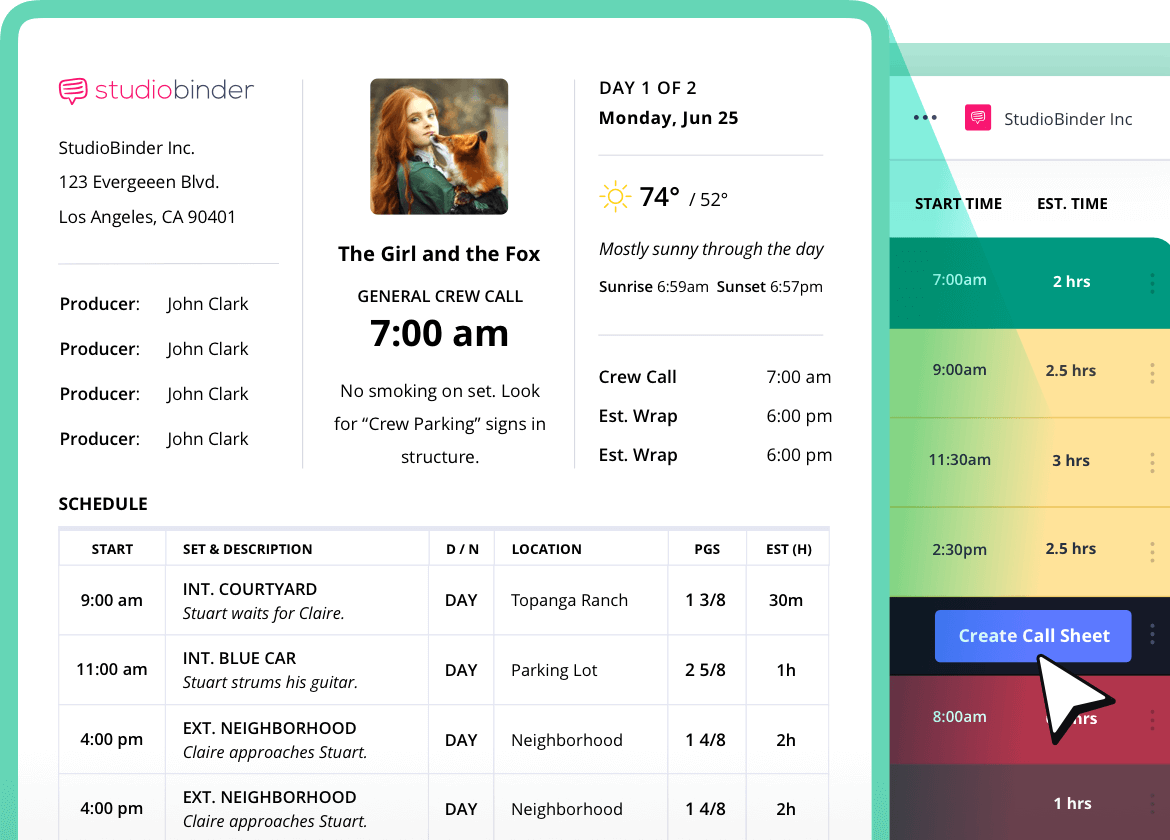
The lead actor is weeks into training with the stunt team for that climactic sword fight. The storyboards come out, the shot lists take shape, and post-production begins its own prep. The call sheets will soon start flying. All the machinations are set in motion.
Take a look at the shot list example below from the academy award winning Moonlight. Shot lists couldn't be more essential at this stage of production. The whole crew needs to be kept in the loop on every planned detail before shooting day. With StudioBinder's shot list software, cloud-based collaboration keeps everyone connected.

Shot List • Development producer
Updates to your shot lists easily sync with your other production documents like script breakdowns, stripboards, and call sheets. This way, you and your whole crew can enter the shoot on the exact same page.
Then, there's the development producer. They may join this adventure as an executive producer or co-producer. Or they may see the project off while staying at the office and diving back into their pile of scripts to find the next sure-fire hit. Like Sisyphus moving boulders up a hill, the development producer heads back to the beginning and starts pushing.
Related Posts
Frequently Asked Questions
Development producer FAQs
A development producer identifies new projects — scripts, IP, books, original concepts — and shepherds them from first read through network pitch and greenlight. They work closely with writers to develop the material, build pitch materials, and advocate for the project to studios and networks. Once a project is greenlit, the development producer may transition to an executive producing role or hand the project off to the production team.
On any given day, a development producer might read three scripts, take calls with agents, give notes to a writer on a pilot draft, pitch a project to a cable network, and update the development slate. The work shifts constantly between creative (story notes, script coverage, pitch meetings) and operational (managing timelines, deal negotiations, tracking multiple projects at once). The development producer's slate is always moving.
A development producer works on a project before it gets made — finding the idea, developing the script, and pitching to networks. An executive producer holds an oversight role once the project is in production, managing budgets, key creative decisions, and deliverables for the studio or network. Sometimes a development producer transitions into an executive producer role on a project they developed. More often, the development producer passes the baton once a project is greenlit.
The titles are often used interchangeably, especially at production companies. A development executive at a network or major studio is typically the buyer — the person hearing the pitch and deciding whether to develop the project. A development producer, even when carrying an executive title, is usually the one doing the hands-on work: developing the material, working directly with writers, and pushing specific projects through the pipeline.
The development producer salary range depends heavily on seniority and the type of company. Development coordinators — the entry-level role — typically earn $60,000 to $80,000 per year. Directors of development at mid-size production companies often range from $100,000 to $150,000. Senior-level development executives at major studios and networks can earn $200,000 to well over $400,000. The highest earners are typically those with strong track records of getting projects greenlit and strong relationships with A-list writers and showrunners.
Most people enter TV development through one of two routes: as an assistant to a development executive (the most common path), or as a development reader doing script coverage on a freelance basis. From there, the progression runs through coordinator, manager, director, and eventually VP or EVP of development. Building strong relationships with writers, agents, and other assistants early in a career is as important as script coverage ability — both determine how fast someone moves up.
Development producers use a combination of script coverage templates, spreadsheet-based slate trackers, and production management platforms. For teams managing multiple projects at once, StudioBinder brings scripts, production documents, and collaboration tools into one platform — useful both for development producers building pitch materials and for the production teams that take over after a greenlight.
UP NEXT
What Does an Executive Producer Do?
Development producers live inside the machine that makes movies and TV happen. Once the greenlight comes, the next job is production — and the best production teams don't wing it. StudioBinder gives every department the tools to stay organized from first draft to final cut.