The series finale of The Sopranos aired June 10, 2007. Millions of viewers sat in front of their TVs with Journey’s “Don’t Stop Believin’” playing, Tony Soprano having dinner with his family at a diner. Meadow finally parks her car and heads for the restaurant. Tony looks up. The screen cuts to black. Silence. Had the TV disconnected? Maybe the cable went out?
No. It was David Chase making one of the most debated television decisions in history, and the endless search for the Sopranos ending explained keeps drawing new audiences back to that diner booth almost two decades later.
What follows is a close look at the final scene, the filmmaking choices that make it work, what it ultimately means, and why the last ten seconds of The Sopranos changed television.
Spoilers ahead.
THE sopranos ending explained
What happens at the end of The Sopranos?
First, let's go back to the scene. What actually happens in the final minutes of "Made in America" (S6E21)? On paper it's mundane — a meal at a family diner. On screen it's something else entirely.
![The Sopranos - Final Scene [Complete] [HD]](https://i.ytimg.com/vi/1x9YACdBUrU/hqdefault.jpg)
The Sopranos final scene • Sopranos ending explained
Setting the scene: Holsten's diner
The final scene opens with Tony Soprano entering Holsten's diner, a real restaurant in Bloomfield, New Jersey, where he meets his family for dinner. He sits in a booth, flips through songs on a mini-jukebox on the table, and selects "Don't Stop Believin'."
A bell above the door rings every time someone walks in. With each ring, Tony looks up. A few strangers enter before Carmela walks in. The camera cuts briefly to other tables — a couple, a family eating quietly.
Tony and Carmela look through their menus. The bell rings again. AJ walks in just behind a man in a Members Only jacket, who moves toward the counter. Outside, Meadow pulls up to a spot on the street and tries to parallel park, needing several attempts.
The man in the Members Only jacket looks around the diner. Tony, Carmela, and AJ chat at their table. The Members Only jacket man rises and heads toward the bathrooms. Meadow finally parks, gets out of the car, and walks toward the entrance. The bell rings. Tony looks up.
Cut to black. Silence.
Now let's do the work of having this brilliant Sopranos ending explained...
Who is in the diner — and why it matters
At first the diner looks ordinary: a couple, a family, an older man adding sugar to his coffee. Then people keep arriving, and the cumulative effect builds a paranoia the audience shares with Tony. Every new face becomes a question.
The man in the Members Only jacket sits at the counter, scanning the room, then walks toward the back just as Michael Corleone walks toward the bathroom in The Godfather before retrieving a planted gun and committing two murders. Two other men enter and look over the pastry display. Each arrival adds pressure.
The cut to black
Meadow parks, crosses the street, and reaches for the diner door. The bell rings as it opens. Tony looks up. Cut to black. The music stops mid-lyric — "Don't stop —" — and the screen holds black for about ten seconds before the credits roll without any sound.
sopranos ending explained
Did Tony Soprano die at the end?
It is the question that has followed the Sopranos ending explained investigation for nearly two decades. The closest answer the evidence supports is yes, Tony dies in the diner. The series finale, though, is built precisely so that certainty is impossible.
The case that Tony died
The final scene runs on a shot-reverse-shot structure: Tony, then his POV looking at the door and the room around him. The audience sees the diner through his eyes. When the image cuts to black from Tony's perspective, black means his perspective has ended.
In the 2024 HBO documentary Wise Guy: David Chase and The Sopranos, David Chase is direct about the black-as-death reading. He recalls a season 3 scene in which Meadow helps AJ analyze a poem for school. Meadow tells AJ that snow represents "cold, endless white, endless nothing. Death." AJ responds, "I thought black meant death." Chase built the finale's visual grammar around that exchange.
During The Sopranos Sessions (2019), a book-length conversation with TV critics Alan Sepinwall and Matt Zoller Seitz, Chase slipped and described the final moment as "the death scene." When the critics noted what he'd said, he cursed and moved on.
The man in the Members Only jacket adds another layer. He enters, looks around, then walks toward the bathroom — a direct visual echo of Michael Corleone in The Godfather. The only reason to make that reference is to tell a viewer what is about to happen.
Then there is Bobby Baccalieri. Thirteen episodes before the series finale, in "Soprano Home Movies" (S6E13), Tony and Bobby are sitting in a boat talking about getting whacked. Bobby says, "You probably don't even hear it when it happens, right?" The sopranos finale explained is inseparable from that line. No gunshot. No warning. Just black.
As far as CineRanter is concerned, it's not a question of if Tony Soprano died, but rather who killed Tony Soprano.
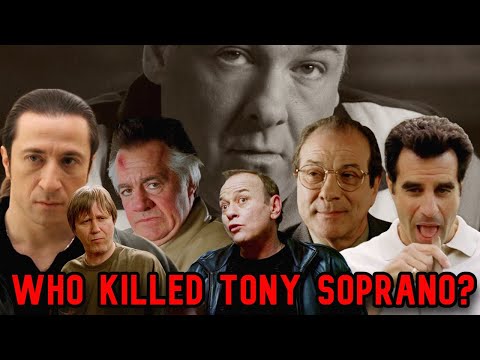
Who killed Tony Soprano? • Sopranos ending explained
The case that Tony survived
The counterargument is thin but has its proponents. Chase never shows Tony getting shot. The cut happens when Meadow walks in, which means the family is finally together.
One reading holds that the scene makes the audience feel Tony's permanent state: he will live inside this paranoia indefinitely, never able to enjoy a meal without scanning every face that walks through a door. The ending gives the audience that feeling directly rather than resolving it.
It is not a strong case for Tony's survival. But it is an honest account of what the scene does not show.
Why David Chase won't give a straight answer
Every writer on the show and every cast member has said the same thing: they did not know how the series would end until they read the final script. They saw the diner scene on the page and could not understand how a dinner would land as a series finale. None of them could anticipate how Chase would edit it.
Chase has never confirmed the ending because the storytelling ambiguity is the mechanism. Even having the Sopranos ending explained in full continues to generate discussion and debate precisely because the show refuses to close the loop.
That refusal changed how television writers thought about endings. Chase is not being coy — he built a machine designed to keep running after the power is cut.
That's why there's even a Sopranos ending explained theory out there that the final episode was just a dream Tony was having:

Was the final episode a dream? • Sopranos ending explained
Sopranos ending explained
The filmmaking behind The Sopranos finale
The cast read the final scene and were mostly baffled. So were the critics who saw the episode early. Meaning they needed the Sopranos ending explained just as much as us! None of them could predict how Chase and cinematographer Alik Sakharov would shoot and cut a family dinner into one of the most analyzed pieces of visual storytelling in television history.
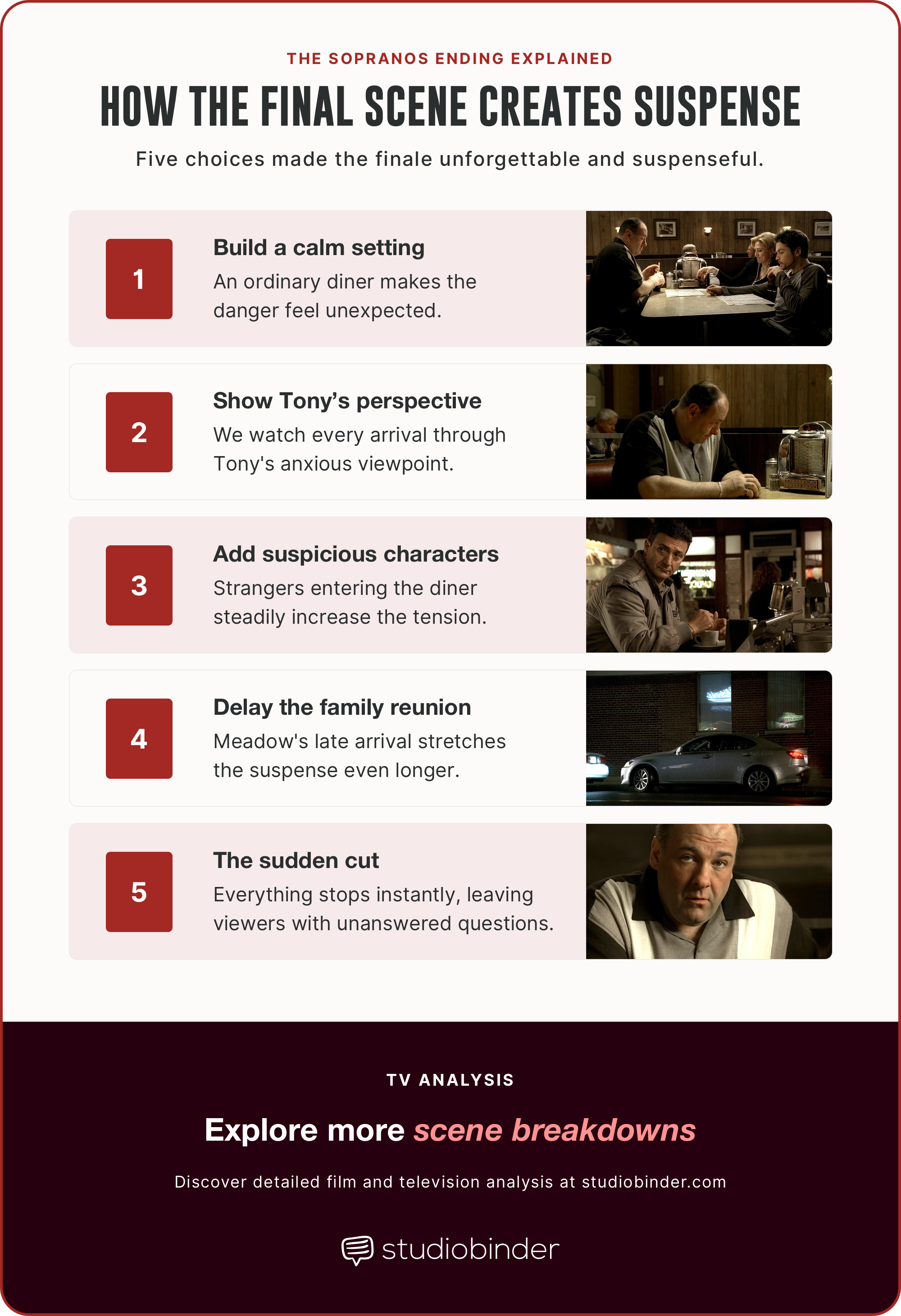
How the Final Scene Creates Suspense • Sopranos ending explained
Having the Sopranos last scene explained requires understanding three specific craft choices.
How David Chase used POV shots to build dread
The scene is a sustained exercise in show-don't-tell filmmaking. To put the audience inside Tony's experience, Chase and Sakharov anchored the entire sequence to Tony's perspective. Wide shots establish the diner as a normal space.
Then the camera begins cutting between Tony's face and what he sees — the Kuleshov effect at work. A neutral shot of Tony's face takes on anxiety, menace, or relief depending entirely on what follows it.
Each bell ring and door opening becomes a beat in a mounting tension structure. Nothing confirming danger ever appears on screen. The feeling comes from the editing rhythm alone.
This is the POV shot used not just as a technique but as the story itself — the audience experiences the paranoia Tony Soprano has lived with for six seasons compressed into three minutes of visual storytelling.
The Bobby Baccalieri foreshadowing
The final moment's setup was written thirteen episodes before it landed, and its subtle foreshadowing really helps with having the Sopranos ending explained. In "Soprano Home Movies" (S6E13), Tony and Bobby Baccalieri are fishing. The conversation turns to getting killed. Bobby says: "You probably don't even hear it when it happens, right?"
Having the Sopranos last scene explained in the most direct sense, it's a visualization of Bobby's line. No gun sound, no visible threat, no goodbye. The lyric stops mid-word. Everything cuts to black, then to silence.
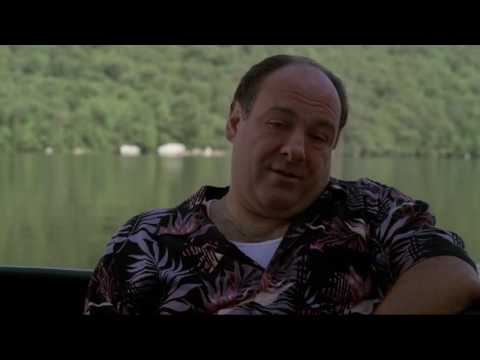
You probably don't even hear it when it happens, right? • Sopranos ending explained
Why 'Don't Stop Believin'' was the right song
You can't have the Sopranos ending explained in full without understanding the 'Don't Stop Believin'' choice behind it. Chase had the song in mind when he wrote the scene, and nearly everyone around him doubted it.
The choice worked on three levels. First, Journey's familiar, optimistic opening disarms the viewer — it is the sound of a normal evening at a diner, not a finale.
Second, the lyrics track against Tony's own compromised belief that things will work out, a belief the series has spent six seasons complicating.
Third, Chase recalled in the Wise Guy documentary that he was thinking about the universe continuing after Tony does not:
"The universe goes on and on. You may not go on and on, but the universe is gonna go on and on. The movie's gonna keep going." Cutting the song mid-word underscores that. The universe keeps going. Tony's experience of it does not.
Related Posts
Sopranos ending explained
What does the Sopranos ending mean?
The Sopranos ending has more than one meaning, and that is the design. Having the Sopranos ending explained in full was never the intent. Its staying power, its rewatch value, and its capacity to generate debate across generations would collapse if David Chase had provided a clear resolution.
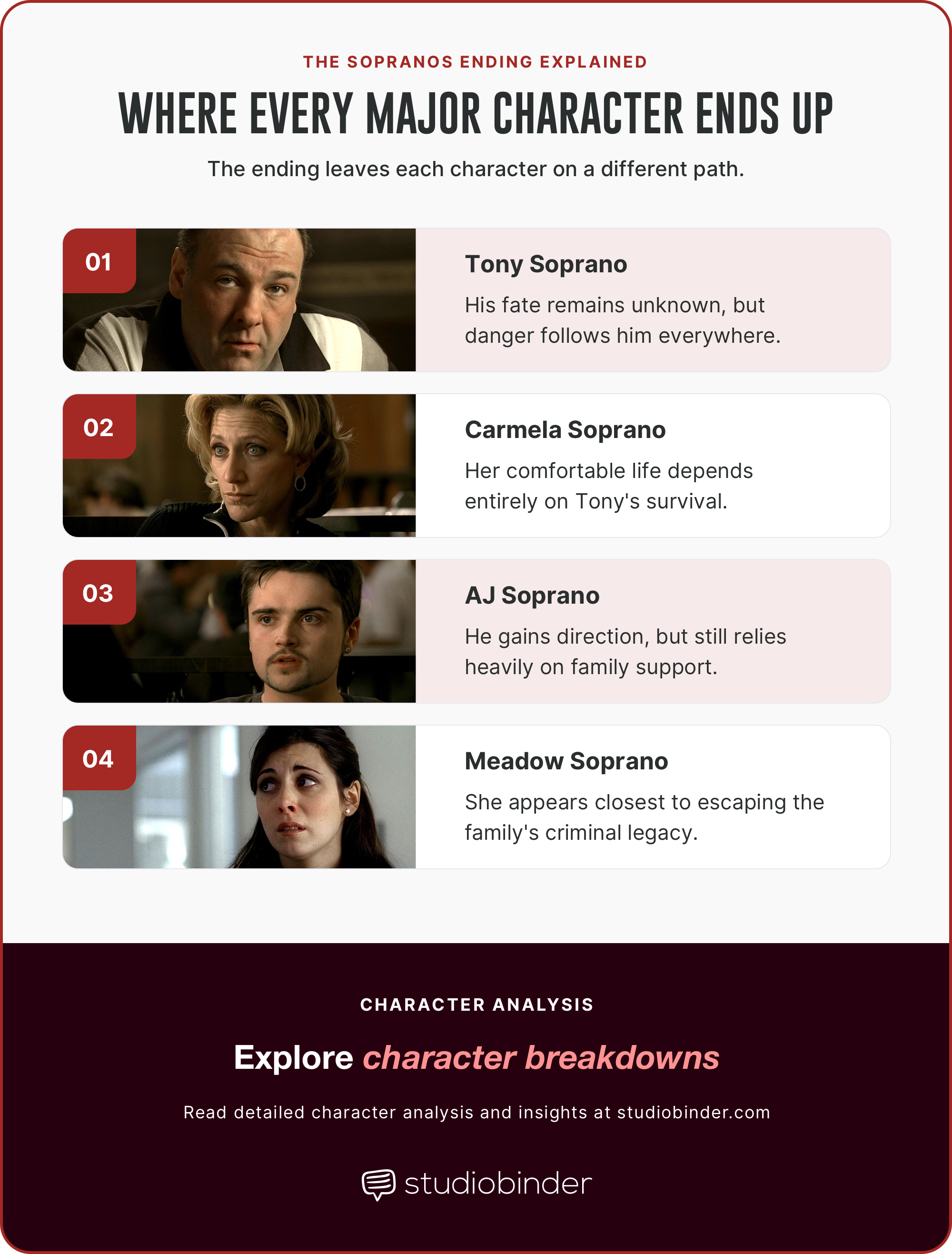
Where Every Major Character Ends Up • Sopranos ending explained
Ambiguity is not the ending's weakness. It is the structure that gives the ending its reach.
The paranoia Tony lives with — made literal
For most of the series, the audience watches Tony from the outside. We see his business, his therapy sessions, his family life.
We understand that he has panic attacks, rage, and paranoia, but we observe these from a remove. The final scene closes that gap. It puts the viewer into a subjective perspective, seeing through Tony's eyes and feeling what he feels.
The editing and sound design in the final sequence are working constantly: "Don't Stop Believin'" underneath the ambient noise of the diner, the bell above the door, the pauses between dialogue, the cuts to strangers.
The whole thing is a portrait of a man trying to eat dinner with his family while his nervous system scans every corner of the room. Even without the cut to black, the final scene would be one of the best-edited sequences in the show's run.
Related Posts
The American Dream and its limits
From the first episode, The Sopranos was about the American Dream and what pursuing it actually costs. In the Wise Guy documentary, Chase put it plainly: "Americans have gotten so materialistic and selfish that it made a mob boss sick." The series finale is even titled "Made in America." So, deconstructing the American dream is vital to having the Sopranos ending explained.
Tony built his life around everything the American Dream promises: wealth, status, family prosperity, power. He pursued those things through a criminal enterprise, but his motivations were not different in kind from any executive's. The trappings never cured his panic attacks. They funded a bigger life and deepened a hole he could not fill.
The diner scene circles back to this: the family, the jukebox, the onion rings. Everything Tony wanted, right in front of him. And he cannot enjoy any of it without scanning the room.
Earlier in the episode, AJ quotes Yeats: "It's always something." The sopranos ending meaning is partly right there. The show refuses to give Tony a clean resolution because the American Dream refuses clean resolutions for most people who chase it.
What separates The Sopranos from every mob film before it is that it refuses to endorse or condemn. It holds up a mirror and asks the audience what they see.
Why ambiguity is the answer
A clear Sopranos ending explained would give Tony closure. His choices would have definitive consequences. His death would carry a legible meaning: crime does not pay, or something like it.
Chase rejected that ending because he was not interested in moral accounting. He was interested in the texture of a life — and lives do not resolve cleanly. We enter the story through Tony, so it only makes sense that we leave through him as well. When his perspective ends, so does the show.
The ambiguity is also why the sopranos ending meaning keeps generating debate more than fifteen years later. Steve Schirripa, who plays Bobby, initially said he believed Tony was alive — he later changed his mind.
Michael Imperioli has been more direct, telling the Boston Globe: "I always interpreted it as it's the last thing Tony sees before he dies."
No one will ever know for certain what happened to Tony Soprano. That uncertainty is not a flaw in the ending. It is the ending. And that's the best way to have the Sopranos ending explained in our book.
Related Posts
Frequently Asked Questions
The Sopranos ending FAQs
The strongest reading of the evidence is yes, Tony was killed in the diner. The cut to black represents his point of view ending mid-moment. David Chase referred to the scene as "the death scene" in a 2019 interview, and the entire sequence was built around Bobby Baccalieri's line from Season 6: "You probably don't even hear it when it happens, right." That said, Chase constructed the scene so certainty is impossible by design.
The man is never identified by name or shown to have any connection to a specific crime family. He is played by actor Paolo Colandrea and credited simply as "Diner Patron." Whether he is a hitman or an ordinary customer is another carefully held ambiguity in the sopranos ending explained: Tony cannot tell, and neither can the viewer. That shared uncertainty is the point.
"Don't Stop Believin'" by Journey, from the 1981 album Escape. Tony selects it from the jukebox himself. David Chase had the song in mind while writing the scene and initially faced skepticism from people around him. The song's familiar optimism disarms the viewer; cutting it mid-lyric at the moment of impact is precise and deliberate.
Meadow spends several minutes parallel parking outside Holsten's diner as the tension inside builds. Her arrival is what Tony and the audience have been waiting for. She parks, crosses the street, and pulls open the diner door. The bell rings. Tony looks up. Cut to black. Her delayed arrival extends every beat of the sequence, which is why David Chase held on her parking attempts instead of cutting away.
The series finale is Season 6, Episode 21: "Made in America," written and directed by David Chase. It originally aired June 10, 2007, on HBO. The episode title is also the name of a Season 3 episode (S3E6), though the finale is the definitive use of the phrase.
UP NEXT
What is the Kuleshov Effect?
Now that we have the Sopranos ending explained, let's go even deeper into the filmmaking intentions of those final moments. The final scene of The Sopranos is one of the most precise applications of the Kuleshov effect in television history. Every cut between Tony's expression and what he sees is doing the same work: making you feel what he feels, not just watch what he watches.
That technique, and the visual storytelling principles behind it, are worth understanding in full.