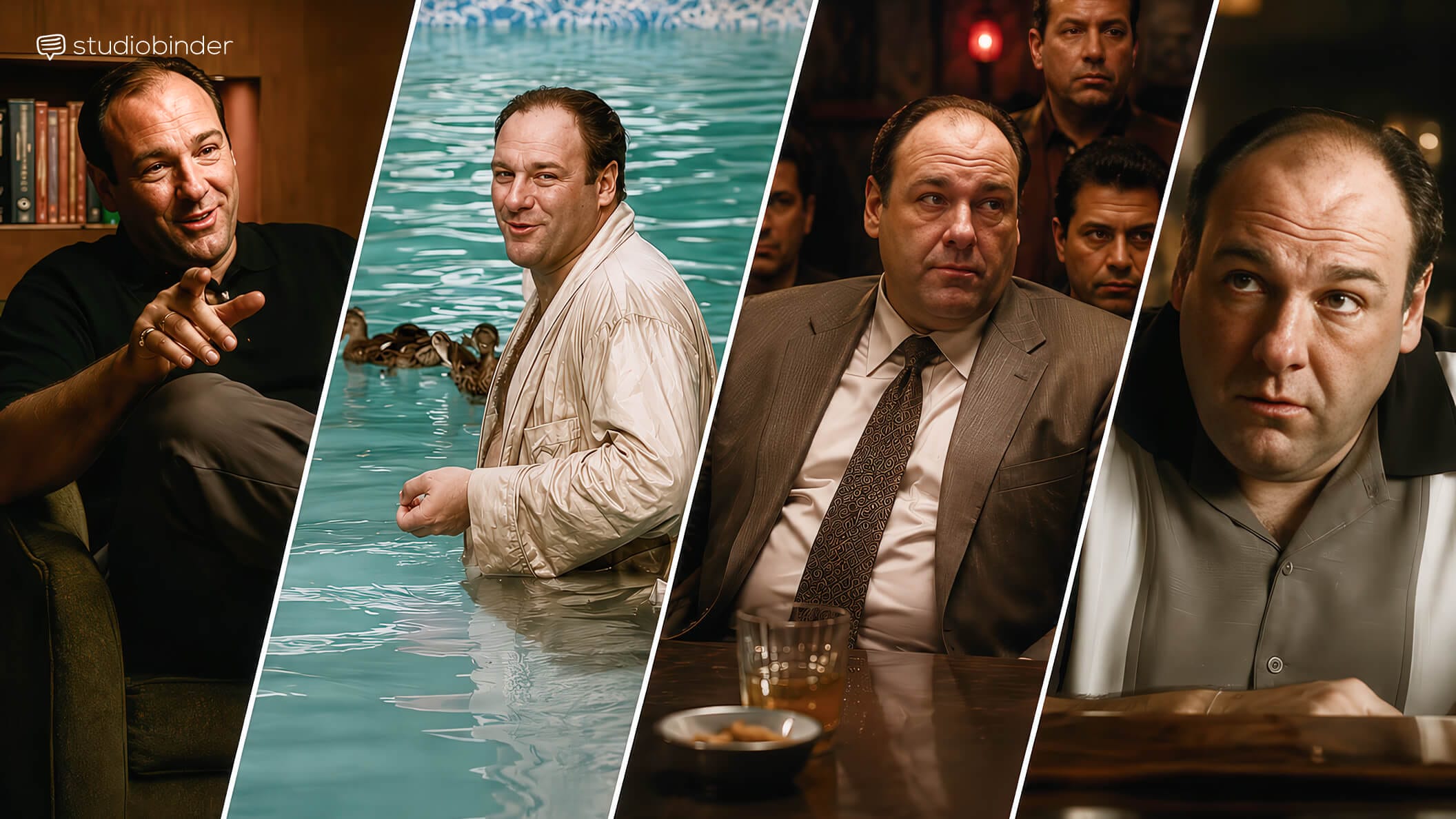
When David Chase pitched the idea of The Sopranos, it would be impossible to predict how a manipulative, murdering, New Jersey mob boss could become one of the most beloved antiheroes in television history. Over the course of six seasons, audiences rooted for his triumphs, no matter how awful the means. So how did David Chase create a modern Italian-American gangster character that broke out of the character archetype? What was it about Tony Soprano that continues to draw so many people into the series for rewatches and first-time watches nearly two decades after the series finale? That question drives this Tony Soprano character analysis. Spoilers ahead.
Tony Soprano Profile
Who is Tony Soprano?
Tony Soprano is the protagonist of the HBO television show The Sopranos (1999-2007), created by David Chase and played by James Gandolfini. We meet him as the right-hand man of the DiMeo crime family, and he soon becomes the boss. He's also a suburban father of two in New Jersey.
The pilot episode's therapy session dives into the event that led to Tony's panic attack — him feeding ducks in his backyard. It becomes a in the series, one that Tony and Dr. Melfi work out to be representative of his fear of losing his family — specifically his fear that his criminal life will eventually destroy them.
The ducks are an example of The Sopranos' approach to: a single image that carries more psychological weight than any line of dialogue could.
Let's dive into the the Tony Soprano character even deeper.
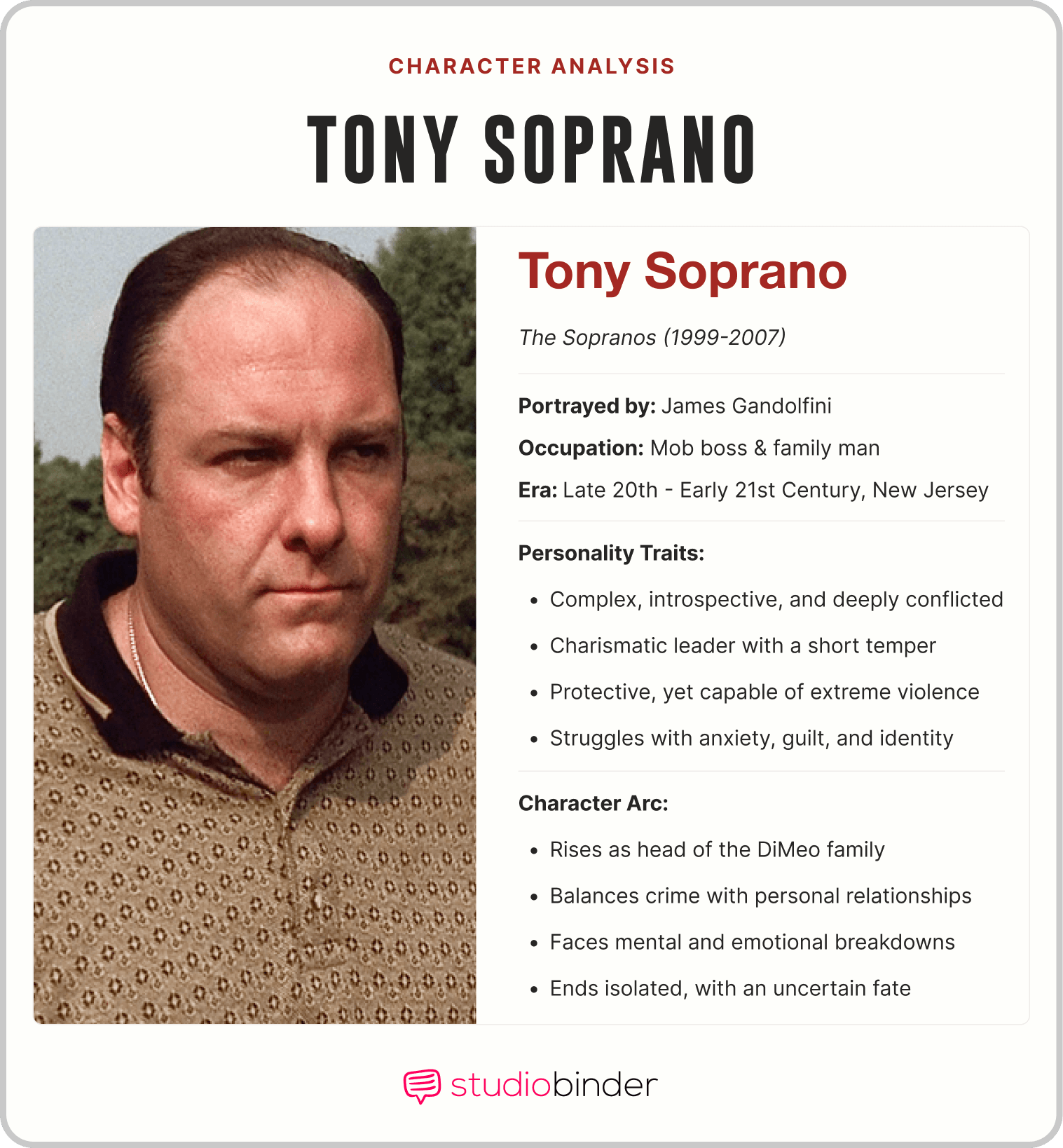
Tony Soprano Character Analysis • Tony Soprano
Tony Soprano's role in the DiMeo crime family
We meet Tony in the Sopranos pilot episode as the right-hand man of Jackie Aprile, the boss of the DiMeo crime family. Tony is technically a capo, but is the acting boss running the day-to-day operations while Jackie is battling stomach cancer.
Corrado "Junior" Soprano, Tony's uncle, is another capo eyeing the role of boss in the event of Jackie's death. The whole first season uses this point of tension between Junior and Tony as the central drama of the DiMeo crime family. Junior becomes the nominal boss, but only as a figurehead. Tony pulls the strings of the operation without taking as much heat from the feds.
The family operates behind the front of a waste management company while their real enterprises include gambling, loan-sharking, construction rackets, and occasional contract work.
Tony the family man — the suburban contradiction
What separates Tony from any other mob character we've seen on TV or in cinema is his domestic life. Tony lives in a large house in the suburbs of New Jersey with his wife Carmela Soprano, daughter Meadow, and son AJ. He has a pool, drives a Chevy, has family BBQs, and worries about his kids' college prospects. This alter ego duality of Tony the family man and the mob boss is central to the dramatic irony of The Sopranos and has influenced later great TV series like Breaking Bad and Mad Men.
The ducks — and what they really mean
Living two lives, one as a mobster and one as a husband and father, is a lot of pressure for Tony. We see the stress of managing DiMeo politics with Uncle Junior, along with battles on the home front with Carmela and his kids, build to a panic attack in the pilot episode. This drives Tony to see a psychiatrist — Dr. Melfi.
Related Posts
Character Complexity
What makes Tony Soprano such a complex character?
Tony Soprano has remained one of the most compelling subjects of character analysis in television history. Audiences felt torn about feeling empathy and even rooting for someone who also murders, cheats, and steals. This complexity is at the core of what makes Tony so incredibly interesting, which drove the success of The Sopranos.
The duality the show was built on
Contradiction was written in the DNA of Tony Soprano. He is the defining TV antihero precisely because that contradiction never resolves. He embodies two American archetypes: the ambitious, self-made patriarch who provides for his family, and the villain driven by greed and ego who will get what he wants by whatever means necessary. The show insists on holding both and never resolving either.
In the Season 1 episode "College", we witness Tony murder a man in broad daylight with nothing but a wire. And in the next scene, we see him pick his daughter up after a college tour, advising her on taking her future seriously. To this day, it's hard for an audience to wrap their head around this juxtaposition, let alone in the state of television in 1999.
Tony Kills Fabian Petrulio - The Sopranos HD • Tony Soprano
David Chase had to fight HBO to let Tony actually commit the murder on screen — the network thought it would make him irredeemable. Chase won the argument and proved that the pull of Tony's domestic life was enough to keep people rooting for him even after watching him kill a man. The viewer is implicated in having liked him anyway.
Tony's therapy — why it works dramatically
The psychiatry sessions between Tony and Dr. Melfi are what make The Sopranos among the best shows of all time. They added dimension to Tony that audiences never saw in a TV character, let alone a gangster character. By diving into his thoughts, problems, and history, audiences connected with him in a way they otherwise couldn't.
His problems were universal, existential problems we could understand. His criticisms of society, we could agree with. His family history and logical gymnastics somehow make us understand why he does the things he does, even if we don't agree with it. The sessions run throughout the series's entire six-season arc and contextualize the story every step of the way.
It's in these sessions that we see Tony at least be a little more honest. All other parts of his life he puts on a performance — for his crew, for his family, for his enemies. In Melfi's office, some of the mask comes off and we connect to the show's central character. The sessions also give Chase and his writers a formal tool for exposition and analysis that doesn't slow the plot or feel on the nose. Tony explains his world to Melfi (and the audience) while resisting the implications of what he's saying.
Tony's violence — how the show makes us complicit
This is the most difficult and important aspect of Tony's characterization. Tony is a murderer. There is no grey area in that statement. He kills people when it's business, personal, when they are enemies or even allies, from the first to the last season. The show is constructed so that the audience, before and after each killing, genuinely grows attached to Tony and his negative character traits.
His violence isn't enough to break that attachment; it just complicates it. The discomfort the show creates in the audience is intentional. How can we judge Carmela for spending the money, or Christopher for seeking his approval, when we condone and even root for the man responsible for all of it?
Related Posts
Legendary Acting
James Gandolfini's performance
It's hard, if not impossible, to imagine Tony Soprano played by anyone other than the late James Gandolfini. James Gandolfini's Tony Soprano set a standard that prestige television has spent two decades trying to match.
Gandolfini won three Emmy Awards for Outstanding Lead Actor in a Drama Series (2000, 2001, 2003), one Golden Globe Award for Best Actor in a Television Series – Drama, and three Screen Actors Guild Awards for his role in The Sopranos. James Gandolfini's Tony Soprano is widely described as the greatest and most influential performance in television history.
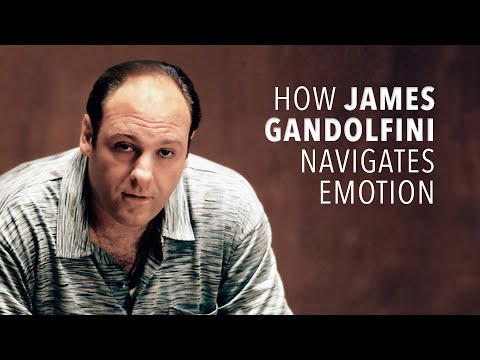
How James Gandolfini Navigates Emotion • Tony Soprano character
Physical presence as a character tool
James Gandolfini was a large man and was physically against the grain of the conventional casting of Hollywood leads. But his stature is what made Tony's physical presence so intimidating and convincingly powerful. James Gandolfini's dynamic performance resisted settling in the body of an intimidating mob boss. That physical code is visual storytelling at its most economical. Who Tony is appears in how he occupies a room. When he was at home with his family in his robe, headed for the fridge, he moved completely differently. But when he strolled through the Bing, his posture and swagger shifted. Gandolfini's use of his physical performance told the story of the duality in Tony's characterization.
Filmmakers who want to plan how an actor's physicality translates to the camera use a shot list to map blocking, frame size, and camera movement for each setup. StudioBinder's shot list software is built for exactly that kind of pre-production planning.
Visual storytelling begins before the camera rolls. The physical choices Gandolfini made as Tony Soprano were matched by equally deliberate decisions about how the camera framed him.
James Gandolfini's vulnerability is what separated Tony from any other television character at the time and to this day. He brought something personal to the role, which created a performance like no other, and it took a toll. In an interview with GQ, Chase said, "Some of the turmoil that's inside of Jim, that pain and sadness, is what he uses to bring that guy to the screen."
It's in his sessions with Dr. Melfi, moments with his daughter Meadow, or even in moments alone, where we see him drop the hardened facade and reveal a man exhausted and lost.
How Gandolfini used silence
Even when Gandolfini wasn't speaking, he could steal a scene. He knew that Tony was just as apparent to the audience in his reactions and moments of listening as he was in his monologues. James Gandolfini found Tony Soprano's inner life not in dialogue but in stillness. James Gandolfini's face can speak volumes while Tony says nothing. He mastered how to use his eyes to express the internal experience of the character. It's what drew audiences in and made them care about an immoral criminal.
Trusted by over 1M creatives
Shot lists that turn vision into action
From first draft to final take, plan, organize, and execute every shot with confidence.

Core Relationships
Tony Soprano's most important relationships
Tony revealed a different part of himself in each relationship. His roles as a husband, mentor, father, and patient each offered a different perspective on the same character. How the show built on each gave Tony incredible dimension and nuance.
Tony and Carmela
Tony's marriage was a battleground for his morals, ideals, and his ego. Carmela Soprano (Edie Falco) is Tony's wife of twenty years. She knows — at varying levels of acknowledgment — what Tony does and who he is. Her choice to stay is apparent and slowly eats at her throughout the series. The show is ruthlessly clear-eyed about her complicity.
The show presents Tony and Carmela Soprano as genuinely in love with each other. But they also make each other miserable. Their marriage is full of tenderness, resentment, adultery, and forgiveness. It has a flux that makes it sympathetic, if not relatable, for many viewers.
Tony's marriage to Carmela Soprano reveals another complexity within him — a man capable of true love who lacks the willpower or moral principles to remain faithful or honest.
Tony and Christopher Moltisanti
The father-son, mentor-mentee relationship between Tony and Christopher is one of the most complicated and tragic in the show. Chris is Tony's nephew by marriage and is quietly chosen as Tony's successor, being the closest thing Tony has to real family. Tony treats him like a son, bringing him into his personal life and business equally. He grooms him for more responsibility, yet is continually disappointed and repeatedly betrays him. The push and pull ultimately lead to Tony killing Christopher Moltisanti in Season 6.
Tony Kills Christopher • Tony Soprano character
Through it all, we see Tony's tragic manipulation at work, constantly building Chris up and tearing him down so that he can keep control over him and retain him in his orbit.
Christopher Moltisanti's drug addiction is the wedge that creates an irreparable rift between the two. Tony becomes unable to accept Christopher's humanity and sees it as a weakness, deeming him unfit for what Tony needs him to be.
Tony and Dr. Melfi
The doctor-patient relationship between Tony and Dr. Melfi (Lorraine Bracco) is the show's most unusual. After initially having doubts about therapy, Tony regularly goes to his appointments and soon becomes attracted to Melfi. In these sessions, Tony finds the limitations of his power as he sometimes tries to manipulate her the way he manipulates everyone else, yet she resists. The show uses their dynamic to show what Tony is like when his usual power doesn't work.
In each session, Tony reveals something by what he says or through what he doesn't say, both intentionally and accidentally. They often act as asides, like in a Shakespearean play, where we can gain insight into the internal conflict of a central character.
But as the show progresses, this relationship becomes more complicated as Tony shows no signs of moral improvement — the panic attacks subside for a while, but that's about it. Melfi is convinced that the therapy may simply be making him a more emotionally grounded criminal without affecting his views on morality. The therapy ends in the final season when Melfi, confronted with research showing therapy can make sociopaths more dangerous, ends their sessions.See how Tony and Melfi's final therapy session unfolded below:

Dr. Melfi and Tony final session • Tony Soprano character
The Character Arc
Tony Soprano's arc across six seasons
Tony is complex because he does not exist within the binaries of archetypal characters. He's both a dynamic and static character. He's a hero and an antihero. His character arc is essentially a flat one in terms of moral growth, but the world around him changes, and his position within it degrades.
He starts the show as a man in ascent and ends it in paranoid isolation, having destroyed or outlasted nearly everyone he cared about. The inevitability of Tony Soprano's death hangs over the show from the pilot.
Tony's arc is structurally unusual in prestige drama — it's flat morally but set against escalating external chaos.
Related Posts
Tony Soprano is one of television's best examples of a character who resists conventional arc structure — making his six seasons a useful reference for anyone studying long-form character work.
Season 1
Tony establishes control of the DiMeo family, positioning Junior as the figurehead while he pulls all the strings. His panic attacks push him into therapy, further revealing who he is to the audience, while his family life mirrors the same power struggles he's managing in his crew.
Seasons 2–3
Tony is antagonized — first by Richie Aprile, then by rising tension with Ralph Cifaretto — while he also manages Christopher Moltisanti's ambition and his sister Janice's chaos. Tony has the power, but it costs him daily.
Season 4
Tony's marriage nearly ends after he's repeatedly caught cheating and lying to Carmela Soprano. He holds on to his business with a tighter grip — killing Ralph Cifaretto — and becomes more violent and authoritative while his personal life implodes.
Season 5
Tony's cousin Tony Blundetto (Steve Buscemi) is released from prison and sets off a chain of events that forces Tony to kill him, which is the last thing he wants to do. It eats Tony alive with guilt. Meanwhile, Adriana is killed after the FBI exposes her as an informant — a moment the show never lets the audience recover from.
Season 6
Tony is shot by Junior during an incident caused by Junior's dementia. He nearly dies, but ultimately survives. After Christopher Moltisanti relapses, they get into a car accident and Tony decides to kill him and cover it up. The New York/New Jersey war decimates both families. By the finale, Tony is on the run, and the final episode ends with the darkness of a man whose past has caught up with him.
Throughout the season, you watch the Tony Soprano character slowly descend into darkness.
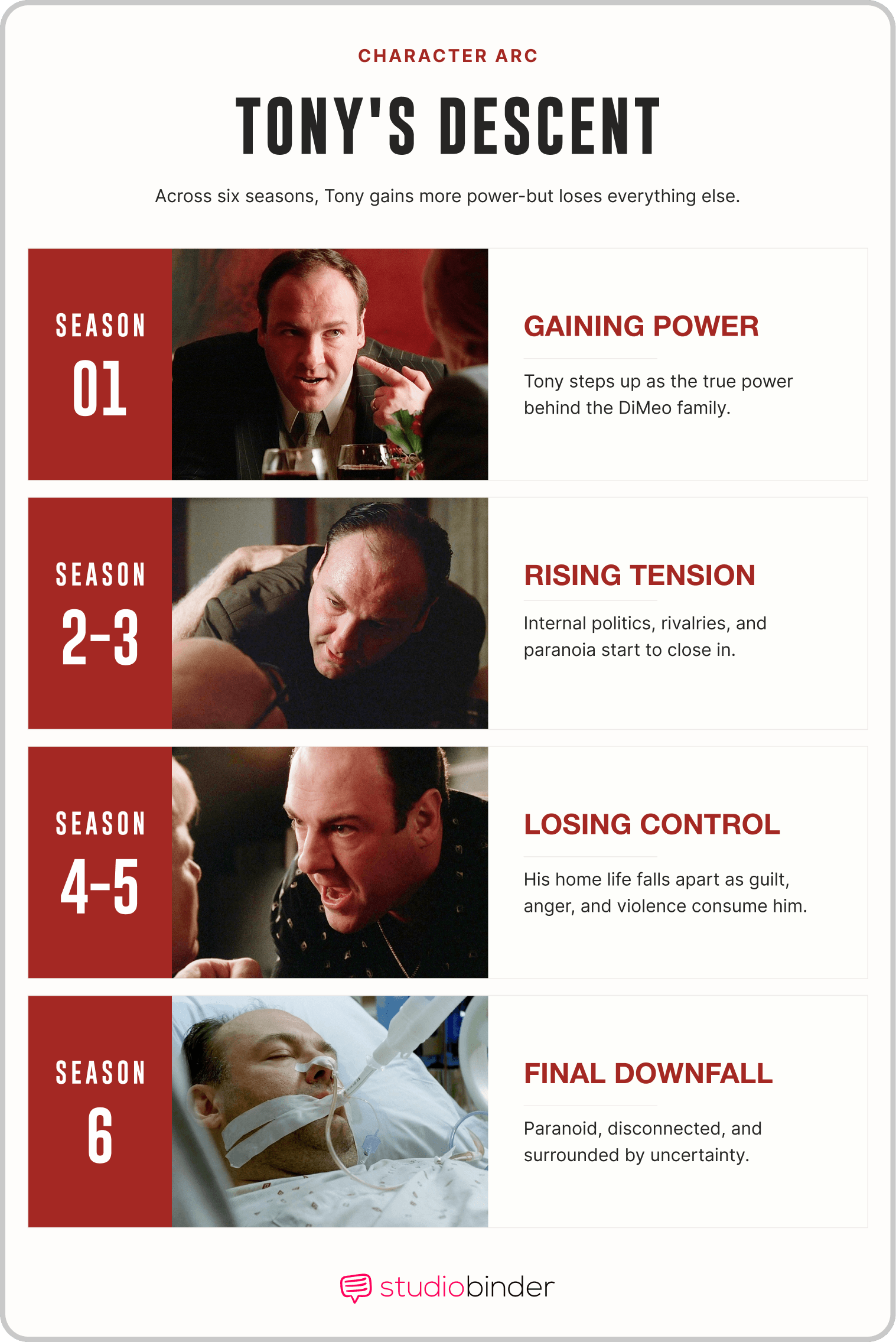
Tony’s Descent Across Six Seasons • Tony Soprano
The question of Tony Soprano's death remains one of the most debated finales in television history.
Iconic Dialogue
Tony Soprano quotes
Tony is a man who must balance the power of a mob boss, the adoration of an ally, and the tenderness of a family man. That contradiction is at the core of his complexity, and it comes through in some of his most memorable lines. Studying Tony Soprano quotes is one of the better ways to understand why the character resonates so strongly decades after the show first aired. The Tony Soprano quotes below are ranked from honorable mention to most essential.
5. "All due respect, you got no fuckin' idea what it's like to be Number One."
(Season 5, Episode 13 — "All Due Respect.") Said to Silvio after Silvio questions Tony's decision making. It's a response that lands on the loneliness of power and the self-pity Tony uses to justify everything he does. He frames himself as the victim of his own authority.4. "Those who want respect, give respect."
(Season 2, Episode 12 — "The Knight in White Satin Armor.") When Richie Aprile consistently goes against Tony's orders, Tony puts it as bluntly as he can. This line is his clearest articulation of the mob's ethical code, which sounds reasonable until you realize it's enforced through murder.
"Those who want respect, give respect" • Tony Soprano
3. "I'm like King Midas in reverse. Everything I touch turns to shit."
(Season 1, Episode 12 — "Isabella.") After Tony is forced to kill Pussy Bonpensiero upon realizing he's a snitch, he spirals into depression. He surveys the pattern of events that led him here. It's both hilarious and poignant — enough self-awareness to see the cycle, not enough to break it.
I'm like King Midas in reverse, everything I touch turns to s ** t • Tony Soprano
2. "What ever happened to Gary Cooper? The strong, silent type. That was an American."
(Season 1, Episode 1 — Pilot.) In his first session with Melfi, Tony mourns a version of masculinity he aspires toward but never actually existed — and he's doing it in therapy, complaining about the existence of therapy. Contradiction is at the root of his character.
Whatever happened to Gary Cooper • Tony Soprano
1. "I came in at the end. The best is over."
(Season 1, Episode 1 — Pilot.) From the same first Melfi session. Before the audience even knows what Tony does for a living, he reveals a sense of historical decline — his belief that he arrived too late for greatness. David Chase said the show is really about American decay, and this line sets up its entire premise. It also reveals Tony's desire for romantic ideals he can never obtain, framing himself as a victim of forces beyond his control. Of all the Tony Soprano quotes in the show, this one carries the most weight as the author's statement of purpose.
Tony: "I came in at the end. The best is over." • Tony Soprano
Frequently Asked Questions
Here are answers to some common questions about Tony Soprano.
James Gandolfini's Tony Soprano is the role the actor is most remembered for. Gandolfini (1961–2013) won three Primetime Emmy Awards for Outstanding Lead Actor and was nominated every year the show was eligible. He died of a heart attack in Rome in 2013 at the age of 51.
Tony draws from real organized crime figures but is not directly based on any single person. David Chase has said Tony Soprano is a composite largely influenced by his own experiences growing up in New Jersey and his research into the American Mafia. Specific influences include Vincent 'Vinny Ocean' Palermo, a real New Jersey mob boss. The more personal parts of Tony, Chase has said, are partly autobiographical — Tony's contentious relationship with his mother Livia draws from Chase's own relationship with his mother.
The show deliberately leaves this open-ended. The strongest reading is that Tony Soprano's death does occur. The final scene's POV editing, Bobby Baccalieri's earlier line ('You probably don't even hear it when it happens'), and David Chase's oblique comments in interviews all support this reading. For a full breakdown, see our analysis of The Sopranos Ending.
There are a few lines Tony is known for. The most frequently quoted is probably 'Those who want respect, give respect.' More recently, 'All due respect, you got no fuckin' idea what it's like to be Number One' has been widely parodied and impersonated. Both rank among the most recognized Tony Soprano quotes in pop culture.
Tony Soprano is considered an antihero because he defies easy moral categories. He's a murderer and a manipulator, yet the show builds genuine audience attachment through his family life and therapy sessions. James Gandolfini's performance reveals the man underneath the mob boss, making viewers root for someone they know they shouldn't.
UP NEXT
The Sopranos Ending, Explained
The Tony Soprano character arc climaxes in the series finale in an ending still debated decades later. Read our full breakdown of The Sopranos Ending, then check our roundup of the best HBO shows to see the broader canon Tony Soprano belongs to.
Start Your AV Script
Start planning your next video with a structured AV script. Whether for commercials, corporate videos, or social media, our templates provide the perfect framework.