Most writers learn the classic three-act structure and stop there. But while three-act structure shows you the big picture, it leaves Act II as a massive, scary, 60-page blank space. This is where most scripts lose their energy, and it’s where the dreaded “saggy middle” ruins countless stories.
To fix this problem, professional screenwriters use a much tighter, more detailed system: the 8 Sequence Structure.
Strangely enough, this modern storytelling tool actually started because of old technology. In the early days of cinema, movies were projected from physical reels of film, each containing a limited amount of footage. A single reel could only hold about 10 to 15 minutes of footage. Every time a reel ended, the projectionist had to quickly swap it out. To keep the audience from getting bored or distracted during that pause, screenwriters had to build the story into self-contained “mini-movies,” each with its own small problem, buildup, and payoff.
Although digital projection has largely replaced traditional film reels, the idea of dividing a story into smaller dramatic units remains useful for maintaining narrative momentum. What started as a technical limit became a psychological rule. Learning this eight-part rhythm isn’t about following boring corporate rules. It’s just about understanding the natural ups and downs of suspense that keep an audience glued to their seats for a full two hours.
8 sequence structure
What is 8 sequence structure?
The 8 Sequence Structure is a screenplay sequence structure that breaks a narrative into eight scene sequences. Each sequence functions as a dramatic unit with its own tension and resolution.
The screenplays for most feature films can be broken into 8 sequences of roughly 10–15 minutes each. This is based on the 1 page/minute industry standard.
Each of the eight sequences is not a single scene but a group of scenes that achieves a single narrative goal. Think of each sequence as a mini-movie.
Trusted by Over 1M Creatives
Screenwriting from draft to set
Write, format, and share your script. Ready for production when you are.

Paul Gulino screenwriting
Origins: Frank Daniel and Paul Gulino
The Frank Daniel screenwriting methodology was developed while Daniel was teaching at AFI, USC, and Columbia. He was one of the most influential script doctors and pedagogy figures of the late 20th century. Mr. Daniel served as dean of the American Film Institute Center for Advanced Study of Motion Pictures; co-chairman of the film division of the School of Arts at Columbia University; artistic director of Robert Redford's Sundance Institute, and the first dean of the School of Cinema-Television at the University of Southern California.
Paul Gulino formalized the Frank Daniel screenwriting approach in the book "Screenwriting: The Sequence Approach" (Continuum, 2004). This is the primary text on this subject. Gulino called Daniel’s approach “a revelation” and Frank Daniel a role model in the insightful video interview below.

Paul Gulino interview - 8 sequence structure
The evolved Paul Gulino screenwriting method comes from the award-winning screenwriter and professor at Chapman University’s Dodge College of Film and Media Arts.
StudioBinder's scriptwriting software uses industry-standard slug lines. This can help writers identify sequence boundaries when formatting.
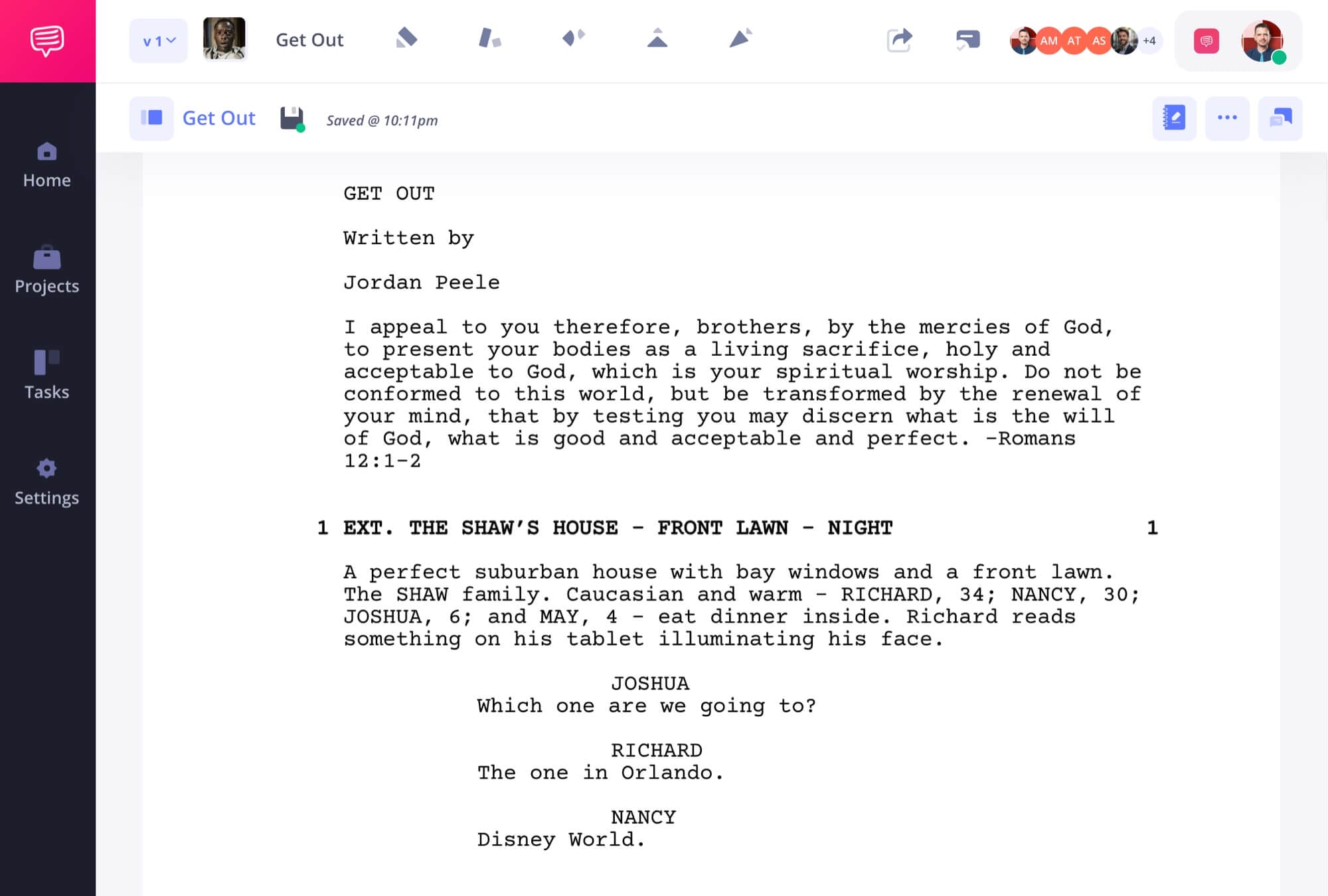
StudioBinder's Screenwriting Software - 8 sequence structure
You can also organize and track every script version you make. This way, you have a clearly organized list displaying how your 8 sequence structure is evolving with each draft.
Sequence approach screenplay
How sequences relate to the three acts
The 8 sequence structure does not replace the three act structure. The sequences are nested inside of the three acts.
Act I contains sequences 1-2; Act II has sequences 3-6 (the long middle); and Act III has sequences 7-8.
The value of the eight sequence structure gives the writer clear checkpoints within Act II, the act where most screenplays falter.
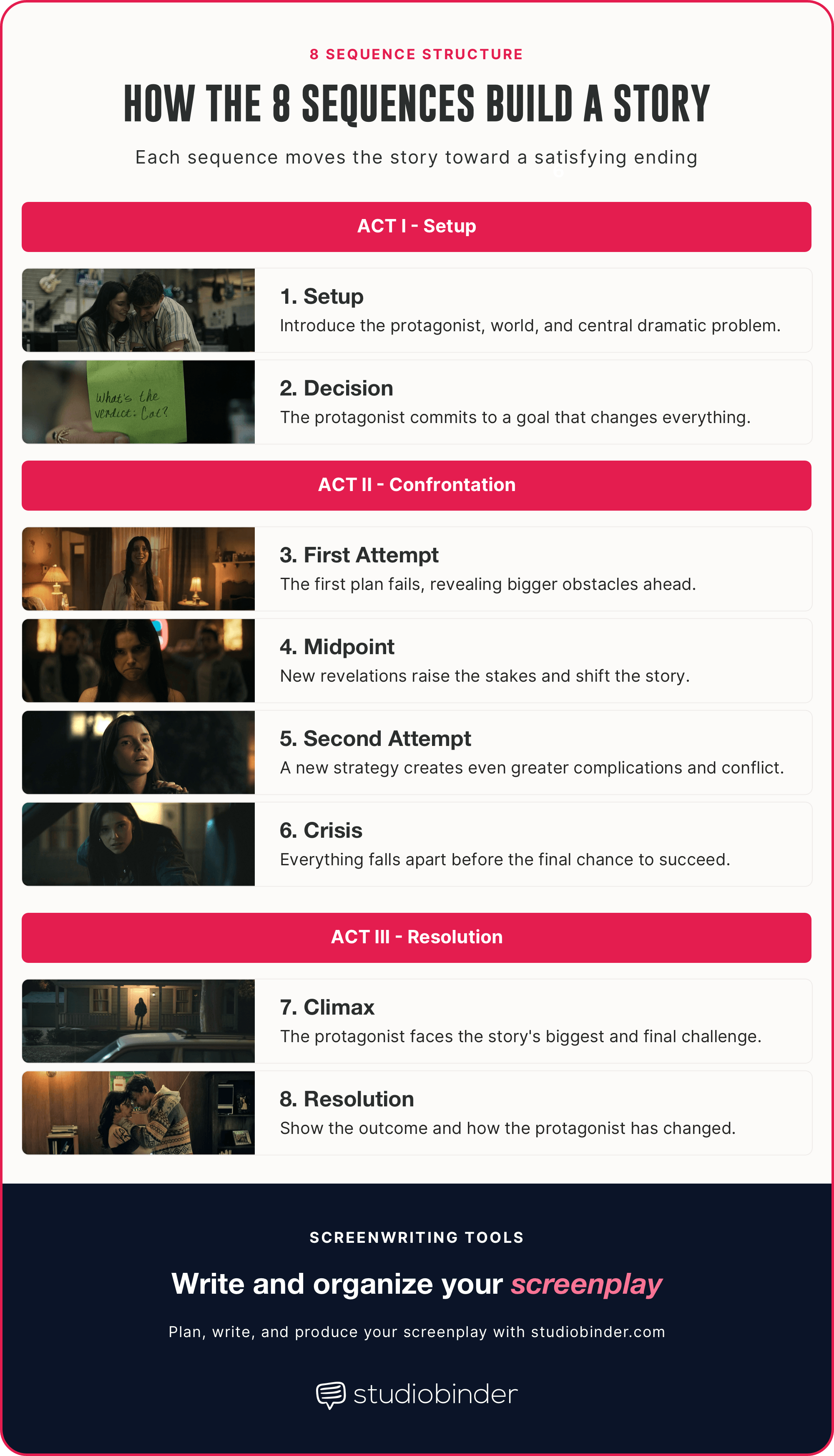
How the sequences build a story breakdown - 8 sequence structure
8 sequence structure
Breakdown of all 8 sequences
Let’s break down the 8 sequence structure and what each sequence entails, one after the other. Before diving in, watch the video below for a broad and simpler understanding of 8 sequence structure.

8 Sequence Story Structure - 8 sequence structure
Act I
Sequence 1 (pp. 1–12): The Setup establishes the protagonist's ordinary world, their flaws, and the rules of daily reality. The viewer gets an intro to the dramatic question the story will answer.
Sequence 2 (pp. 13–25): Complications arise. The protagonist tries to restore the ordinary world, but the inciting incident forces a new direction. The protagonist has a clear direction.
Act II
Sequence 3 (pp. 26–38): First Attempt. The protagonist pursues the main goal for the first time and likely fails.
Sequence 4 (pp. 39–50): Midpoint Complication. The stakes intensify and new information changes the protagonist's approach. This is now a matter of life and death, literal or metaphorical.
Sequence 5 (pp. 51–63): Second Attempt. The protagonist adjusts strategy yet something worse happens.
Sequence 6 (pp. 64–75): Crisis. The protagonist hits their lowest point, one that is catastrophic. All seems lost.
Act III
Sequence 7 (pp. 76–88): Climax setup. The protagonist finds a new resolve or strategy or secret weapon. This sets up the final confrontation.
Sequence 8 (pp. 89–110): Resolution. The climax and its aftermath reveals a new status quo and how the protagonist has changed.
Note: page ranges are approximate and vary by script. These are the structural beats, not rigid page counts.
Trusted by Over 1M Creatives
Screenwriting from draft to set
Write, format, and share your script. Ready for production when you are.
Scene vs sequence
8 sequence structure in action
Curry Barker’s 2026 psychological horror film Obsession serves as a perfect, textbook example of a modern "Monkey's Paw" narrative.
Its descent from a desperate romantic wish into a bloody nightmare maps cleanly onto Paul Gulino’s Eight-Sequence Structure, driven entirely by the Big Four tools of anticipation.
eight sequence structure
Part 1: the eight sequences of Obsession
Below is a comprehensive breakdown of Obsession through the lens of screenplay sequence structure theory.
Act I: The Illusion of Control
Sequence 1: Setup, Status Quo & Inciting Incident
We are introduced to Bear, a quiet everyman who works at a music store and harbors an intense, agonizingly unrequited crush on his friend and coworker, Nikki.
After Nikki gently pushes him on whether he has feelings for her and he nervously denies it, a frustrated Bear triggers the Inciting Incident by snapping a supernatural novelty toy called a "One Wish Willow," wishing for Nikki to love him more than anyone else in the world.

Obsession wish scene · 8 sequence structure
Sequence 2: Complications, Predicament & Choosing the Main Tension
The next morning, Bear enters a bizarre new predicament when Nikki suddenly becomes completely infatuated with him, even constructing a deeply unsettling candlelit memorial using his recently deceased cat. Bear accepts her initial excuse that she is just acting strange due to a wild night out, and by the end of Act I, he fully commits to a relationship with her. This locks in the Main Tension: Will Bear find happiness in this manufactured relationship, or will Nikki's unnatural behavior tear his life apart?
Act II: The Nightmare Realized
Sequence 3: First Attempt & Obstacle
Bear attempts to navigate a normal relationship with Nikki, but he quickly hits severe psychological obstacles when her behavior crosses into a manic, uncanny state of possession. The illusion of a dream romance shatters completely when Bear wakes up in the middle of the night to find Nikki silently weeping over him in the dark, revealing that her new "love" is rooted in deep terror and absolute codependency.
Sequence 4: Midpoint & Rising Stakes
The stakes escalate dramatically at a friend's house party during a drinking game, where Nikki reads a twisted, violent passage from her book before erupting into a violent screaming fit and shattering a glass bottle against her own face. This harrowing Midpoint shifts the entire film from an awkward psychological thriller into visceral horror, completely reversing Bear's goal: he no longer wants her affection. He needs to survive it.
Sequence 5: Second Attempt, Subplot & New Complications
The "B-Story" involving their friend group collides violently with the main plot when their friend Sarah secretly meets Bear in a park and drops a massive bomb: Nikki and their other coworker, Ian, had been secretly hooking up for two years before the wish. Before Bear can process this new complication, a jealous Nikki bursts through the window and brutally murders Sarah by smashing her head against a brick wall, forcing Bear into a state of trapped hostage compliance.
Sequence 6: Crisis, Culmination & "All is Lost"
Desperate to undo the spell, Bear buys out the remaining One Wish Willows but finds himself physically unable to snap them, leading him to confess the magic to Ian. In a tragic twist of dramatic culmination, a skeptical Ian uses one of the sticks to wish for a billion dollars instead. This triggers a cascade of reality-bending cash but exhausts Bear's chances of an easy fix, leaving Bear entirely isolated at his absolute lowest point.

Obsession billion dollars scene · 8 sequence structure
Act III: The Tragic Resolution
Sequence 7: Climax Set up & The New Strategy
Bear returns home with the last One Wish Willow, only to discover Sarah's mutilated body and Nikki dressed to resemble her. The film reaches its ultimate climax when Ian arrives and is instantly shot dead by Nikki, forcing a terrified Bear to barricade himself in the bathroom, where he decides to swallow a fatal overdose of oxycodone to escape her.
Sequence 8: Resolution & New Status Quo
As Bear is close to dying, Nikki breaks the final Willow to make her own wish, which makes Bear step out of the bathroom and kiss her one last time before dropping dead. Because Bear's death breaks the original spell, the real Nikki suddenly regains consciousness, waking up to a horrific new status quo where she is left completely alone, wailing in terror amidst a house full of her friends' mutilated corpses.
8 Sequence Structure
Part 2: tracking the big four tools
Gulino’s "ladder of anticipation" is what keeps the audience suspended in dread throughout Obsession. Let's break it down below.
1. Telegraphing (Pointing / Advertising)
Early in the film, the text explicitly sets up structural roadmaps for the audience. We see Bear cleaning up after his cat, Sandy, accidentally overdosed on his medication. This explicitly telegraphs the presence of the lethal oxycodone in the house. When Bear retreats to the bathroom in Sequence 7, the audience instantly remembers the pills, knowing exactly what deadly option he has left.
2. Dangling Cause
The entire narrative is a massive dangling cause. Bear snapping the One Wish Willow in Sequence 1 is a magical "cause" cast out into the universe. The script purposely delays the rules of how the magic works. This leaves a massive question mark hanging over Act II: What is the cosmic price of this wish, and how will it balance the scales? The tragic "effect" doesn't fully land until Ian's sudden wealth and the final horrific sequence.
3. Dramatic Irony
Barker heavily relies on a chilling "hierarchy of knowledge" to build suspense. During the park scene in Sequence 5, the audience watches Sarah reveal Nikki's secrets to Bear, but we see Nikki approaching in the background before the characters do. The dramatic irony of knowing an unpredictable, supernaturally possessed killer is closing in on an unsuspecting character turns a standard dialogue scene into an agonizingly tense sequence.
4. Dramatic Tension
The overarching drive of the film perfectly encapsulates Gulino's definition: Somebody wants something badly and is having severe difficulty getting it. See how each act break below incorporates this.
- Act I: Bear wants Nikki's love, but his own shyness stops him.
- Acts II & III: The dynamic completely flips. Bear wants his old life and safety back, but he faces severe, life-threatening difficulty obtaining it because the woman who "loves" him is tracking his every move. This structural tug-of-war is the engine that powers the film's pacing.
When applying the 8 sequence structure or the big 4 tools to your screenplay, StudioBinder’s scriptwriting software can assist. It provides industry formatting, as well as the ability to share or collaborate.
StudioBinder's Screenwriting Software · 8 sequence structure
And since keeping track of all 8 sequences within your story can get confusing, the built-in script outlining tool is made to help. It lives right next to your script. This way you won’t have to fumble through documents to make sure the payoff setup in sequence 1 still tracks with your current sequence 8 writing.
Related Posts
three act structure
The similarities: they all share the same skeleton
The Three Act Structure, Save the Cat! Format, and the 8-sequence structure share significant similarities.
The Disruption: Something breaks the main character's everyday world.
- Three-Act: Inciting Incident
- 8 Sequence: End of Sequence 1
- Save the Cat: Catalyst
- Hero's Journey: Call to Adventure
The Point of No Return: The protagonist commits to the journey and enters Act II.
- Three-Act: Plot Point 1
- 8 Sequence: End of Sequence 2 (Choosing the Main Tension)
- Save the Cat: Break into Two (usually page 25)
- Hero's Journey: Crossing the First Threshold
The Shift in Perspective: The stakes change from passive reacting to active attacking.
- Three-Act: The Midpoint
- 8 Sequence: End of Sequence 4
- Save the Cat: Midpoint (often a "False Victory" or "False Defeat")
- Hero's Journey: The Ordeal
The Rock Bottom: The darkest hour where all hope seems lost.
- Three-Act: Plot Point 2
- 8 Sequence: End of Sequence 6 (The Crisis / Culmination)
- Save the Cat: All Is Lost / Dark Night of the Soul
- Hero's Journey: The Supreme Ordeal / Resurrection
Want more examples of Save the Cat? Look no further than StudioBinder's deep dive video on the subject.

Subscribe to StudioBinder · 8 sequence structure
8 Sequence Structure
The differences: where they diverge
Just because Save the Cat! and three-act structure share the same skeleton, doesn't mean they don't also differ in significant ways. Let's investigate below.
1. Three-Act Structure vs. 8 Sequence Structure
- The Difference: Scope vs. Actionable Pieces.
- The Three-Act structure tells you what the house should look like (Foundation, Walls, Roof). But it famously leaves Act II as a massive, intimidating 60-page desert where writers get lost.
- The 8-Sequence structure fixes this by breaking those massive acts into self-contained 10-to-15-minute mini-movies. Each sequence has its own mini-beginning, middle, and end, making it much easier to sustain pacing and tension per act break.
2. Save the Cat! vs. 8 Sequence Structure
- The Difference: Formulaic Rigidity vs. Organic Rhythm.
- Save the Cat! (created by Blake Snyder) is highly prescriptive and explicitly tied to page counts. It tells you that on page 12, the Catalyst must happen, and on page 30, the B-Story must be introduced. It is tailored heavily toward high-concept, commercial Hollywood movies.
- The 8-Sequence structure is much more flexible. It cares about dramatic tension blocks, not strict page numbers. It allows the story to breathe based on character actions rather than a corporate clock.
3. The Hero's Journey vs. All of Them
- The Difference: Mythological Growth vs. Mechanical Plot.
- Joseph Campbell’s Hero’s Journey (and Christopher Vogler’s screenwriting adaptation) is about an internal, archetypal transformation. The Hero's Journey emphasizes transformation through archetypal experiences, such as encountering mentors, facing major ordeals, and returning changed. These stages are flexible and can take many forms depending on the story.
- Because it relies heavily on an isolated protagonist undergoing a massive psychological rebirth, it is incredibly difficult to map onto ongoing, ensemble-driven television or workplace comedies. You can't easily have the characters in The Office or Succession cross a mythic threshold and return with a magical elixir every Tuesday night.
The Writer's Takeaway: None of these are "rules.” They are descriptions of human psychology. Choose the tool that fixes your specific problem. If your script is boring, use Save the Cat to check your pacing. If your second act is sagging, use the 8 Sequence Structure to break it into mini-movies. If your character feels hollow, use the Hero's Journey to fix their emotional arc.
And speaking of the Hero's Journey, the below video breaks down the entire structure with more detail.

Subscribe to StudioBinder · 8 sequence structure
Remember, whether you're applying 8 sequence structure, Save the Cat!, or the hero's journey, you should think of them as guidelines rather than stringent rules to follow. It's often true that captivating an audience with a story means drawing outside of the lines, rather than simply sticking to the pre-laid train tracks every time.
That said, the below graphic showcases the importance of building dramatic tension in 4 easy to remember steps.
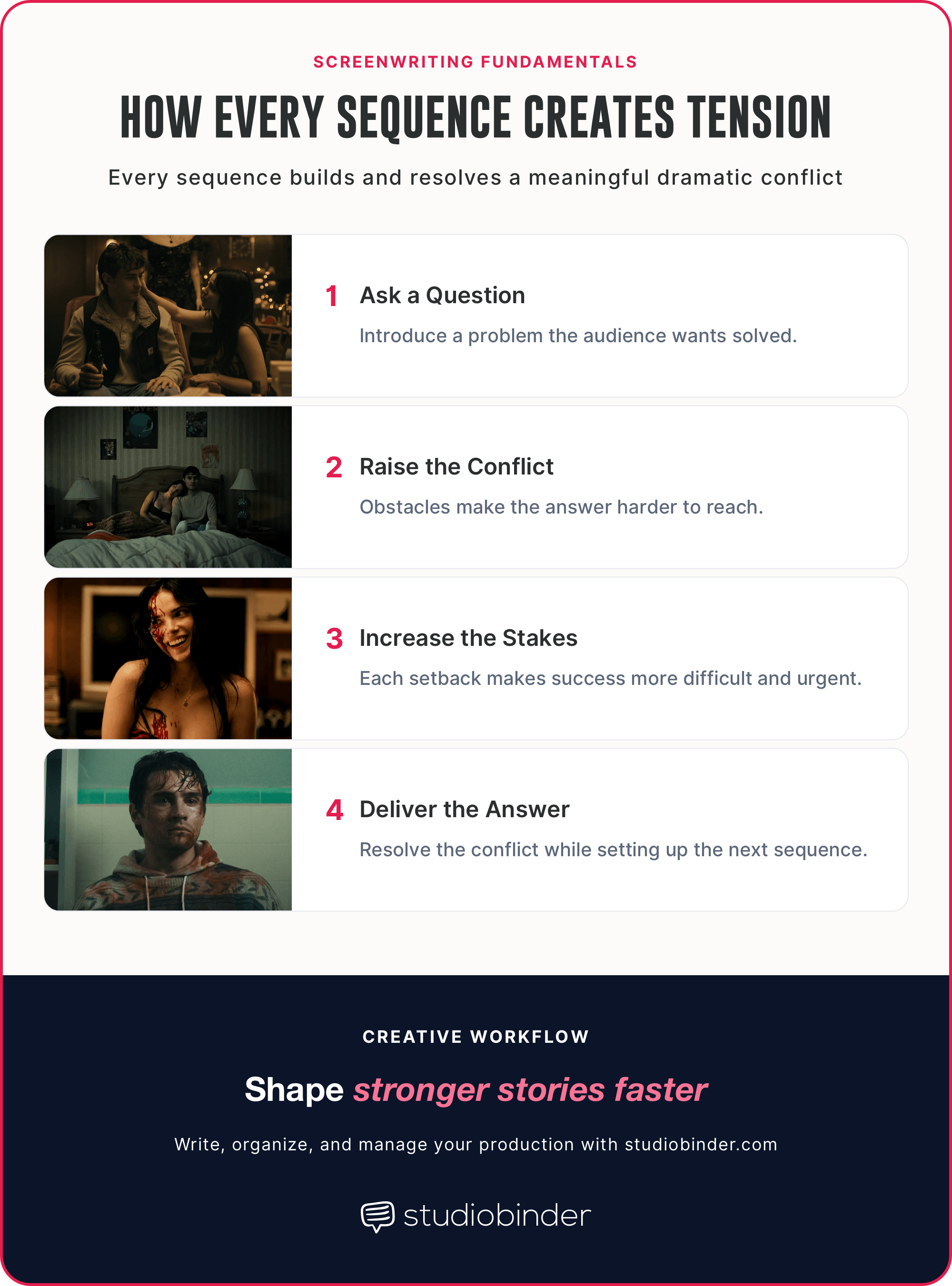
How every sequence creates tension - 8 sequence structure
8 sequence structure
Common mistakes writers make
Writers can often run into some core mistakes when jumping into 8 sequence structure, so we listed the most common ones to watch out for below.
- Treating sequences as rigid page counts rather than dramatic units. A sequence is done when its dramatic question is answered , not when you hit page 12.
- Forgetting each sequence needs its own tension. If a sequence doesn't have a question that needs answering, it's probably filler.
- Forcing three-act breaks into sequence structure (or vice versa). They coexist, not compete.
- Skipping the method on revision. 8 sequence structure is a diagnostic tool. It's most powerful when you use it to identify where a script loses steam.
Related Posts
Frequently Asked Questions
8 Sequence Structure FAQs
8 sequence structure is a screenplay structure framework that divides a feature film into 8 discrete dramatic units, each with its own tension and resolution. Developed by Frank Daniel and formalized by Paul Gulino, it provides more granular checkpoints than three-act structure while following the same underlying logic.
Frank Daniel, who taught at AFI, USC, and Columbia, developed the methodology. Paul Gulino formalized it in "Screenwriting: The Sequence Approach" (2004).
Roughly 10–15 pages (and 10–15 minutes of screen time, based on the 1 page/minute standard). Sequences 1 and 8 are often slightly shorter; the Act II sequences (3–6) tend to run longer. These are guidelines, not rules.
No. The 8 sequences map onto the three acts: Act I = sequences 1–2; Act II = sequences 3–6; Act III = sequences 7–8. Sequence structure adds granularity inside the three-act framework.
It's primarily a feature film tool. TV pilots have their own structural conventions tied to network act breaks. Some TV writers adapt the sequence concept for B-stories, but it's less standard in TV rooms.
UP NEXT
How to write a screenplay
Now that you’re familiar with 8 sequence structure, what’s next? How about another kind of screenplay structure? Lets drop the 8 and dive into 7 easy steps to writing a screenplay. Believe us when we say it’s a big help if you’re writing your own screenplay.