Most Oscar-winning films start as something else. A novel. A memoir. A short story. Adaptation is not the exception in film history. It is the norm. That makes how to adapt a book into a screenplay one of the most valuable skills in screenwriting. But it is also one of the most misunderstood. A novel and a screenplay are not the same thing at different lengths.
They are different forms. A novel lives inside a character’s thoughts. A screenplay lives in action, image, and behavior. What reads well on the page often fails on screen. This is why many book to film adaptations feel flat. They try to preserve everything. They stay too close to the source material. They translate words instead of rethinking them.
A strong screenplay adaptation does something else. It identifies what the story is really about, then rebuilds it in a visual language. It cuts what cannot be shown. It reshapes structure. It prioritizes character, conflict, and action.
This guide breaks down how to adapt a book into a screenplay step by step. Not as theory, but as a process. The same process is used in professional screenwriting. You will learn how to read source material for adaptation, how to identify what is cinematic, how to build a workable three-act structure, and how to turn internal thought into visual storytelling.
Define screenplay adaptations
First, let’s define script adaptations
Before we dive into what a screenplay adaptation is, let's look into what the exact definition and meaning is.
Adapted ScreenplayWhat is a screenplay adaptation?A screenplay adaptation is the process of transforming existing source material into a screenplay. That source material can be a novel, short story, play, memoir, or even a true event. The key is that the story already exists in another form, and the writer is reshaping it for the screen. Screenplay adaptation is not just shortening a book. It is a translation between two different storytelling languages. Prose relies on internal thought and description. Screenwriting relies on action, image, and behavior. This means the writer must decide what to keep, what to change, and what to remove. Entire subplots may be cut. Characters may be combined. Internal monologue must be externalized. |
Screenplay adaptation examples include:
- No Country for Old Men (novel to film)
- The Godfather (novel to film)
- Brokeback Mountain (short story to film)
- Hamlet (play to film)
- The Social Network (book to film)
- Oppenheimer (biography to film)
While considering how to adapt a book into a screenplay, let's also keep in mind that there are key distinctions between a book and a screenplay. Aside from some of the obvious differences, of course. Take a look at the graphic below to see what they are:
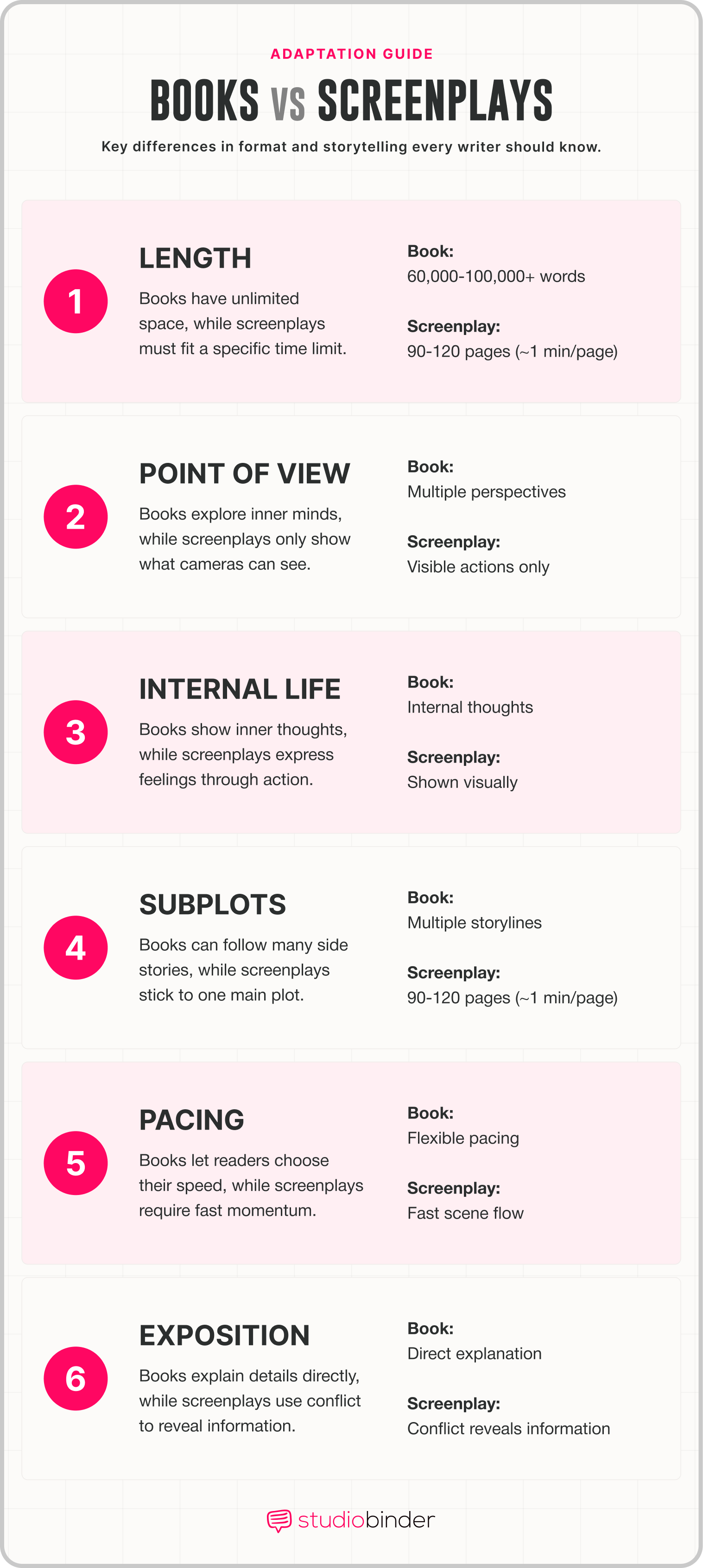
Novel Versus Screenplay Format • How to Adapt a Book into a Screenplay
Adaptation Benefits
Why adapt a book into a screenplay?
How to adapt a book into a screenplay offers distinct competitive advantages over developing an original script from scratch.
- Built-in story: source material has already been tested with an audience.
- Character and world: novels do the heavy lifting of establishing people and places that a screenwriter would otherwise have to build from scratch.
- Commercial appeal: produced films based on known IP are easier to get greenlit.
How to adapt a book into a screenplay
Before you begin: rights and source material
Before you start adapting, you need to answer one question.
Do you have the right to use this material?
It is possible to start writing without thinking about this. It is not possible to finish or sell an adapted screenplay without it.
This is the difference between a practice draft and a viable project.
Do you need the rights?
Yes, if the work is still under copyright.
Most books, especially modern ones, are protected. That means you cannot legally sell or produce a screenplay adaptation without permission from the rights holder.
This usually happens through an option agreement.
An option gives you the exclusive right to develop the material for a limited period of time. It does not mean you own the book. It means you have the chance to turn it into a screenplay and set it up.
Typical option terms:
- 12–18 months
- Renewable for a fee
- Applied toward a purchase price if the project moves forward
Writers often begin adapting without an option. That is fine for practice. It is not enough for production.
If you plan to take the project further, you need the rights in place.
Public domain vs. optioned material
Some works are free to adapt. These are in the public domain.
In general, books published before 1928 in the United States fall into this category. That includes authors like Jane Austen, Charles Dickens, and William Shakespeare.
Public domain material is widely used because it removes legal barriers. You can adapt freely. You can change structure, characters, and setting without restriction.
Everything else requires permission.
- Contacting the rights holder
- Negotiating an option
- Securing legal agreement before sale or production
Choosing the right source material
Even with the rights, not every book is worth adapting.
Strong source material for a screenplay adaptation usually has:
- Clear central conflict
- Active protagonist
- Visual moments
- Contained scope
Some books rely heavily on internal dialogue. Others are episodic. These are harder to adapt.
The goal is not to find a great book. It is to find story elements that can survive translation into a visual form.
Practical takeaway
Before you begin adapting a novel to screenplay form, make sure:
- You understand who owns the rights
- You know whether the work is public domain
- You are choosing material that works on screen
This step is not creative, but it determines whether your screenplay adaptation can exist beyond the page.
How to adapt a book into a screenplay
How to adapt a book into a screenplay in 7 steps
This is the core process of how to adapt a book into a screenplay. This is where screenwriting becomes practical. Take a look at our graphic below that breaks it down simply:
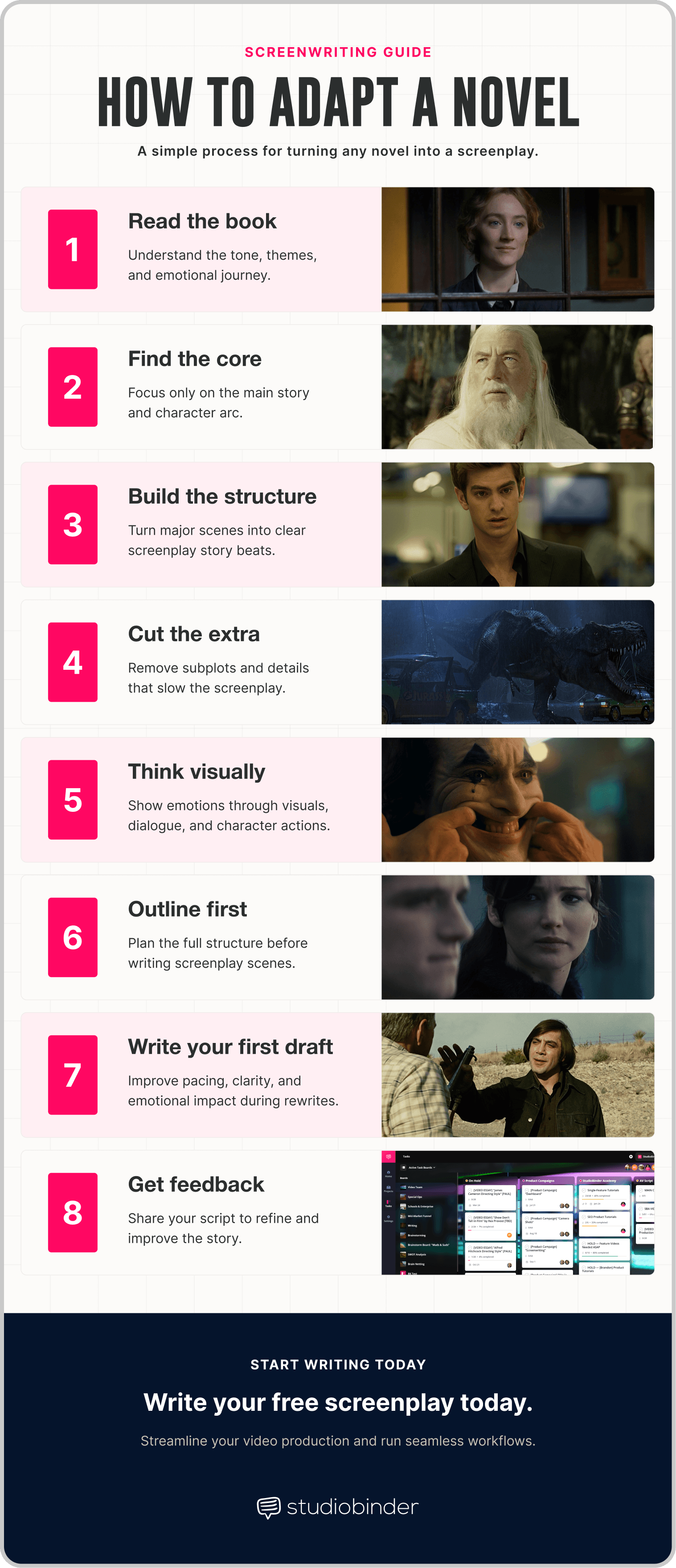
Step Novel To Screenplay Adaptation Process • How to Adapt a Book into a Screenplay
1. Read the source material deeply
You cannot adapt what you do not understand.
Read the book multiple times.
- First pass: experience the story
- Second pass: identify the central conflict
- Third pass: mark what is visual and what is internal
Your job is to break the source material down into usable parts. This is the best starting approach for how to adapt a book into a screenplay.
2. Identify what is cinematic
Not everything in a novel belongs on screen.
Ask a simple question. Can this be shown?
A scene may work in prose because of internal thought. That does not translate directly.
Look for:
- Visual moments
- Behavior
- Action
If something cannot be shown, it must be transformed. So much of how to adapt a book into a screenplay is based on your own judgment.
3. Find your protagonist's active goal
Novels can sustain passive characters. Screenplays cannot.
Your protagonist must want something. More importantly, they must act to get it.
If the character in the book is reactive, you may need to reshape them.
This is one of the biggest changes in adapting a novel to written screenplay form.
4. Build a three-act structure
Before writing, map the story onto a three-act structure.
Identify:
Most novels do not fit cleanly into this story structure. You are not finding it. You are building it. Good scene structure within each act is what drives narrative momentum.
This is where adaptation becomes design.
Outlining your structure early saves time. StudioBinder's task board software lets you map your adapted story beat by beat, organize scenes by act, and start formatting before you write a word.
3 Act Structure. • Try StudioBinder's Screenwriting Software for Free
5. Cut, compress, and combine
This is the hardest step in how to adapt a book into a screenplay.
A 300-page novel becomes a 100-page screenplay.
That means:
- Subplots are removed
- Characters are merged
- Scenes are compressed
Every decision comes back to one question.
Does this serve the protagonist's arc?
If not, it goes.
6. Write for the eye, not the page
Novels explain. Screenplays show. This distinction shapes every choice in script format.
You cannot rely on internal thought. You must externalize it through behavior, image, and action. How to adapt a book into a screenplay may as well be how to turn explanation into imagery.
Film example from Drive:
This scene from Drive shows how emotion is conveyed almost entirely without dialogue.
In a novel, the character's internal conflict would likely be explained. We would be told what he feels about Irene, about danger, about the choice he is about to make.

Drive - Elevator Scene • How to Adapt a Book into a Screenplay
The film removes all of that.
Instead, it builds meaning through:
- Eye contact
- Stillness
- The sudden shift in physical action
- Film lighting and space
The character's decision happens in silence. His emotional state is not described. It is revealed through what he does.
The violence that follows is not just plot. It is an expression. It shows who he is and what he is willing to become at that moment.
This is the core of adapting a novel to screenplay form.
You do not translate thoughts directly. You find the action that expresses them.
7. Honor the spirit, not the letter
This is the most important principle in how to adapt a book into a screenplay.
A common mistake is trying to preserve everything. Dialogue, structure, subplots. This usually weakens the screenplay.
A strong screenplay adaptation focuses on the core of the source material. Not the exact events, but the underlying meaning.
Ask a simple question.
What is this story really about?
Once you have that, you can reshape everything else.
Film example from The Lord of the Rings: The Fellowship of the Ring
The film adaptation of The Fellowship of the Ring makes significant changes to the source material.
In the novel, the opening is slow and expansive. Entire sequences, like Tom Bombadil, are removed in the film. The timeline is compressed. Events that take months are condensed.
Characters are also adjusted. Some roles are reduced. Others are combined. Dialogue is simplified.
On paper, this looks like heavy alteration.
But the film preserves the core of the story:
- The burden of the ring
- The themes of power and corruption
- Ordinary individuals facing overwhelming forces
The Council of Elrond scene shows this clearly. It distills complex world-building into a single, focused moment. The stakes are clear. How to adapt a book into a screenplay is making sure the conflict is unified.

Lord of the Rings - The Fellowship of the Ring • How to Adapt a Book into a Screenplay
The film does not replicate the book's structure. It rebuilds it into a clear cinematic arc.
Why this works:
Large sections of the novel are removed
Structure is simplified and compressed
Characters are streamlined
Core themes remain intact
This is honoring the spirit.
Practical takeaway: When adapting a novel to screenplay form — identify the core themes and conflict, remove anything that does not serve them, restructure for clarity and momentum. You are not translating the book line by line. You are recreating it in a visual language.How to adapt a book into a screenplay
Common challenges in adaptation
Every writer learning how to adapt a book into a screenplay runs into the same problems.
These challenges come from the difference between prose and screenwriting. A novel can explore thought and complexity. A screenplay must translate that into action and image.
Understanding the problem is what allows you to solve it.
Interior monologue and inner life
This is the biggest challenge in adapting a novel to screenplay form.
Prose gives direct access to thought. A screenplay does not.
If you try to replicate this directly, you get:
- Overwritten dialogue
- Excessive voice over
- Explained emotion
These weaken the screenplay.
The real task is translation. You must convert internal experience into external behavior.
Ask: What is felt? What is seen? What is done?
Replace thought with physical action, observable behavior, and character reaction.
The audience should not be told what the character feels. They should recognize it. This is show don't tell applied through behavior.
Subplots and secondary characters
Novels can sustain complexity. Screenplays require focus.
Too many subplots create narrative drift, a weak protagonist, and diluted stakes.
The issue is not length. It is clarity.
To solve this, cut aggressively. Focus on central conflict, main character arc, and narrative momentum.
Merge where needed: combined roles, fused characters, shared functions. This strengthens the story without reducing depth.
Compression of time
Novels often span long periods. Screenplays favor immediacy.
Extended timelines weaken urgency, tension, and momentum. A film works best when events feel immediate.
To solve this: remove gaps, combine events, tighten sequence.
Focus on the most active period of conflict for how to adapt a book into a screenplay. That is where the story lives.
Structure that does not translate
Many novels are not structurally clean. They may be episodic, non-linear, or loosely connected.
This works in prose. It often fails on screen. A screenplay needs progression.
To fix this, rebuild the structure using the three-act structure. Focus on a clear inciting incident, strong midpoint shift, and defined climax.
You are not copying structure. You are creating it. The more you understand this, the better you'll understand how to adapt a book into a screenplay.
Tone mismatch
Tone in writing is easy to lose in adaptation. A novel may rely on voice. Film relies on visuals and performance.
When tone fails, you get inconsistent mood, mixed signals, and audience confusion.
To maintain tone, define it early. Then express it through performance choices, visual design, and editing rhythm.
Tone must be built, not assumed.
Practical takeaway
All of these challenges come from one issue. You are not transferring a story. You are transforming it.
When adapting: show, don't tell — cut with purpose — compress time — clarify structure.
That is how strong film adaptations work
Related Posts
Movie Adaptations
Famous book-to-film adaptations
These examples show how strong screenplay adaptations solve the core challenges of how to adapt a book into a screenplay.
Each book to film adaptation makes significant changes. What matters is that they preserve the core of the source material.
1. The Silence of the Lambs
Adapted from The Silence of the Lambs. This adaptation is a model of precision.
The novel includes procedural detail and extended investigation threads. The film removes much of this and focuses tightly on Clarice Starling.

Silence of the Lambs • How to Adapt a Book into a Screenplay
Key changes: Reduced subplots / Tighter investigation / Clarice focus
The film builds tension through scene structure rather than exposition. Each encounter with Hannibal Lecter is contained. Each scene pushes the central conflict forward.
The adaptation keeps the psychological intensity while removing excess detail.
2. The Hunger Games
Adapted from The Hunger Games. The novel is written in first person. Much of its meaning comes from Katniss's internal thoughts. The film cannot use that directly.

President Snow & Plutarch Heavensbee Political Discussion • How to Adapt a Book into a Screenplay
Key changes: Externalized perspective / Expanded world view / Reduced narration
The film adds scenes outside Katniss's point of view. This shows the political system and the mechanics of the Games. It replaces internal thought with reaction shots, performance, and visual stakes.
The adaptation turns internal narration into external tension.
3. Normal People
Adapted from Normal People. This adaptation tackles one of the most difficult challenges: emotional interiority.
The novel is built on what characters think but do not say. The adaptation removes most of that internal narration.
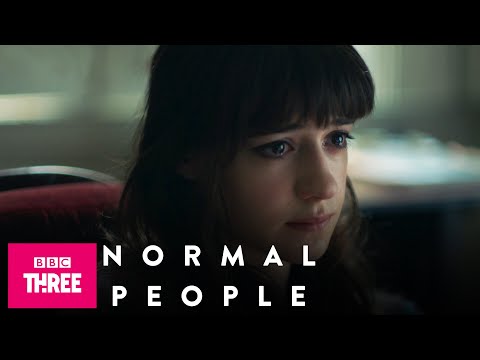
Why Connell Didn't Ask Marianne To The Debs • How to Adapt a Book into a Screenplay
Key changes: Minimal dialogue / Performance-led storytelling / Expanded visual moments
The series replaces thought with eye contact, silence, and physical distance. Scenes often hold longer than expected. The camera stays on faces. Small shifts in behavior carry meaning. The adaptation understands that the story is not about events. It is about emotional shifts. This is a great example of how to adapt a book into a screenplay.
Related Posts
- Read: How to Analyze a Movie Scene →
- Read: Interstellar Script PDF Download — Plot & Theme Analysis →
- Read: Revenge of the Sith Script PDF Download →
Frequently Asked Questions
Book adaptation FAQs
There is no fixed rule. A strong adapted screenplay does not need to follow the source material exactly. It needs to preserve what the story is really about.
You can change plot events, character details, and narrative structure — as long as the core conflict, character arc, and theme remain intact. Fidelity is a creative choice, not a requirement.
Some types of source material are harder to translate into a film adaptation. Common challenges include heavy interiority, episodic structure, and abstract themes.
Books that rely on internal thought, loose narrative shape, or philosophical reflection require more transformation. The difficulty comes from finding a visual equivalent.
The same as any screenplay. A standard adapted screenplay is 90–120 pages, written in standard script format. The length of the source material does not change this. A 1,000-page novel still becomes a 100–110 page script. The process is compression, not expansion.
You can write a draft. You cannot sell or produce it. If the material is under copyright, you need an option agreement, rights holder approval, and legal clearance. If the work is in the public domain, you can adapt it freely.
Trying to include everything. This leads to overloaded plot, too many characters, and weak structure. A screenplay cannot hold the same level of detail as a novel. Strong adaptation requires cutting. Remove subplots, secondary characters, and any scene that does not serve the protagonist's goal.
Adaptation uses specific source material. It transforms an existing story into a new form. Inspiration takes themes, ideas, or concepts but builds something original. An adaptation is legally and creatively tied to the original work. An inspired work is not. The distinction matters in development, credits, and rights.
UP NEXT
What is an adapted screenplay?
Now you understand how to adapt a book into a screenplay. You know how to break down source material, reshape structure, and translate internal thought into visual storytelling.
The next step is understanding what an adapted screenplay is in formal terms — how it is defined within the industry, how credits are assigned, and how it differs from an original screenplay.
If you are continuing your screenwriting process, this is where your draft becomes a working document. Use StudioBinder to write in proper script format, break down scenes by category, and prepare your adapted screenplay for production from one workspace.

From script to production. Write, collaborate, and produce all in one place.
Write scripts online for free. Track versions. Share for feedback and approval. When you're done transition seamlessly to script sides, shot lists, storyboards, schedules, breakdowns, call sheets and more.