You just finished watching Arrival. You feel it in your gut. Something profound happened. Something about time. Something about memory and loss. But you’re not quite sure what. The mechanics of it all. Why Louise sees what she does. What the heptapods give to humanity, and what the ending means.
That’s okay. Denis Villeneuve’s masterpiece is designed to haunt, not to hand you answers on a silver platter. It’s a puzzle box wrapped in a tearjerker, disguised as a first‑contact thriller.
This is the definitive arrival movie explained. We’ll walk through the plot. We’ll decode the heptapod language and break down the ending. We’ll sit with the themes that make this film unforgettable and why the whole thing hits as hard as it does. Let’s dive in.
Arrival Film Overview
What is Arrival about?
On the surface, Arrival is a first contact film. Twelve alien spacecraft appear simultaneously at different locations around the world. There is no warning. The U.S. military recruits linguist Louise Banks. Her job is to establish communication with the beings inside the Montana spacecraft (which are called shells here).
Amy Adams plays Louise. It's a performance that should have won her an Oscar. Physicist Ian Donnelly, played by Jeremy Renner, joins her team. The contrast between their characters works well in how they approach the same problem. He wants to brute force hard math. Louise takes a softer approach and uses language.
Their job is simple in theory. But it’s nearly impossible in practice: figure out what the heptapods want before all of the world’s governments decide to shoot first. For a deep dive into an Arrival movie explained video essay, take a look at StudioBinder's YouTube channel analysis below.
![Arrival — How Villeneuve Balances Fear and Intrigue [Director's Playbook]](https://i.ytimg.com/vi/cJYW3-A1tbI/hqdefault.jpg)
Arrival Analysis • Arrival movie explained
What follows is not a war movie. And Denis Villeneuve’s film isn’t even really about aliens either. The film’s writer, Eric Heisserer, said this of the film: “It reminds us that grief and loss affect us so deeply because we chose to connect with someone just as deeply.
Despite the pain, it’s a good sign. And when we think of that loss, it’s noble to also think of the contributions that person gave us. Their presence in the world. Their echoes and footprints.”
The alien first-contact story is the vessel. What’s inside the film is a meditation on time. It’s a film about language, love, and the courage that it takes to say yes to something you know will hurt you.
And for Louise, that journey means rewiring her brain. It means she starts experiencing time differently. The past, the present and future all start to bleed together.
That’s the premise. The execution is something special.
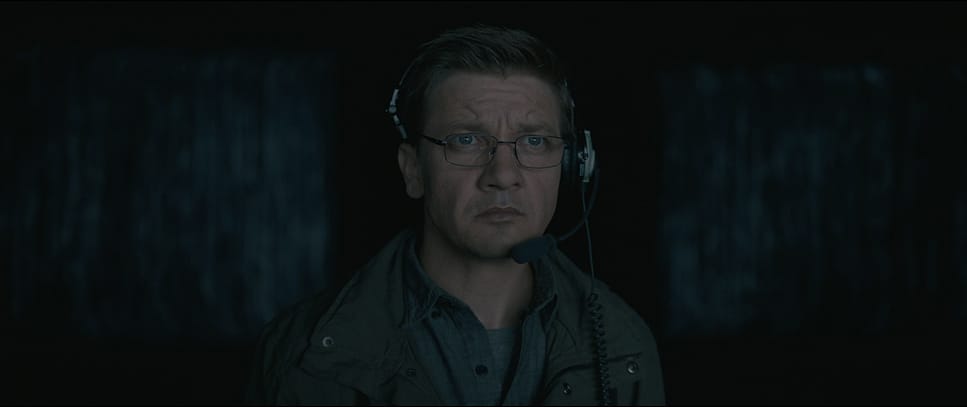
Scientific Inquiry • Arrival movie explained
This is where an Arrival movie explained video can be super helpful. Check out Logos Made Flesh's take before we go further into deconstructing the plot.

Logos Made Flesh Arrival analysis • Arrival movie explained
Arrival Plot Summary
Arrival Plot Summary
Let’s go chronologically, as Louise experiences it, to have the Arrival movie explained just right.
The film opens with Louise narrating the life and death of her daughter Hannah. From her birth to her death at age twelve. We see her marriage to Ian fall apart. We feel the grief.
Then the shells arrive. Twelve spacecraft. No explanation at all. The military checks Louise's credentials. They take her to a base in Montana. She joins a team to talk with two aliens. The soldiers have named them Abbott and Costello. Each “visit” happens through a glass barrier. The aliens write in the air - circular inkblots that look like art but are actually full sentences.
Louise starts by teaching them English words. She starts small. She holds up a whiteboard with her name written on it. “Louise.” She points to herself and speaks “Human.” “Walk.” The heptapods respond with their own symbols. Slowly, she learns that their written language has no beginning or end. Each circular glyph expresses an entire idea at once. It encompasses cause and effect, noun and verb, all together.
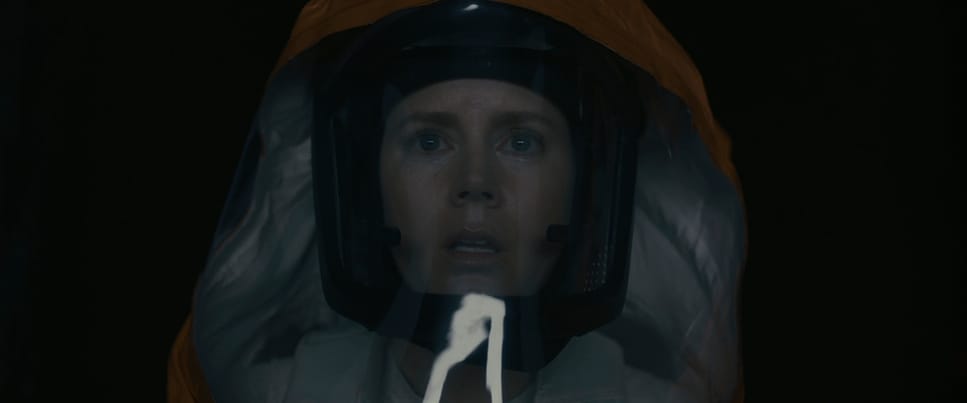
Alien Encounter • Arrival movie explained
Meanwhile, other nations panic. China’s General Shang threatens to attack his shell. Russia and Sudan go dark. The military as a whole wants Louise to ask the heptapods a specific question: “What is your purpose on Earth?” But she refuses. You can’t rush language. The ticking clock in the narrative has started and now we start to feel the pressure.
The crisis point arrives when a faction within the Montana team plants a bomb inside the shell. In the middle of their regular session, Abbott warns Louise using a symbol that means “weapon” but it might also mean “tool.” Abbott gets caught in the blast and hurt. Costello saves Louise and Ian by ejecting them both out of the shell. Then the shells leave.
Throughout this process Louise has been experiencing vivid, disorienting visions. A girl. A hospital. A life. These are “flashbacks” of her daughter. But these aren’t memories. They feel different. The girl is younger, older, crying, laughing. Louise sees moments that haven’t happened yet. The film lets her believe these aren't fragments of grief she's been suppressing. So does the audience.
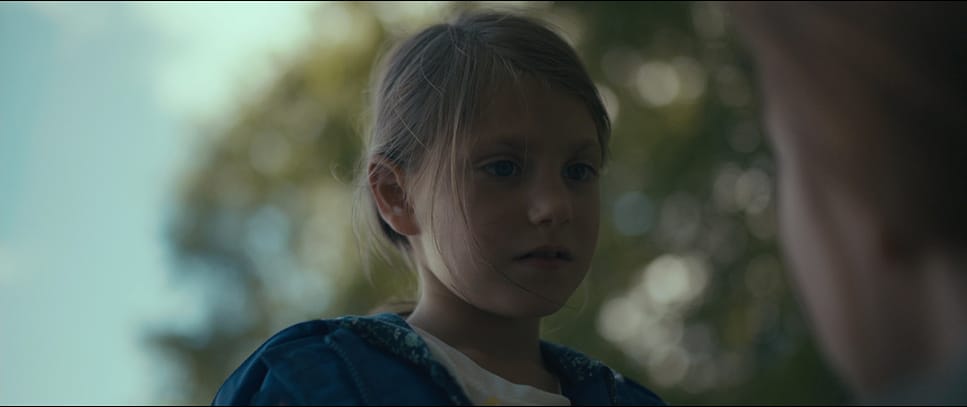
Future Memory • Arrival movie explained
This is also why watching an arrival movie explained video on YouTube could help break things down even further.
FoundFlix Arrival analysis • Arrival movie explained
That is where the plot leaves her. The clock is ticking. General Shang is about to strike. And here Louise has just begun to suspect that the heptapod language is doing something to her perception of time.
What Louise does with what she's learned, and what she's been seeing all along, is where the film becomes something else entirely.
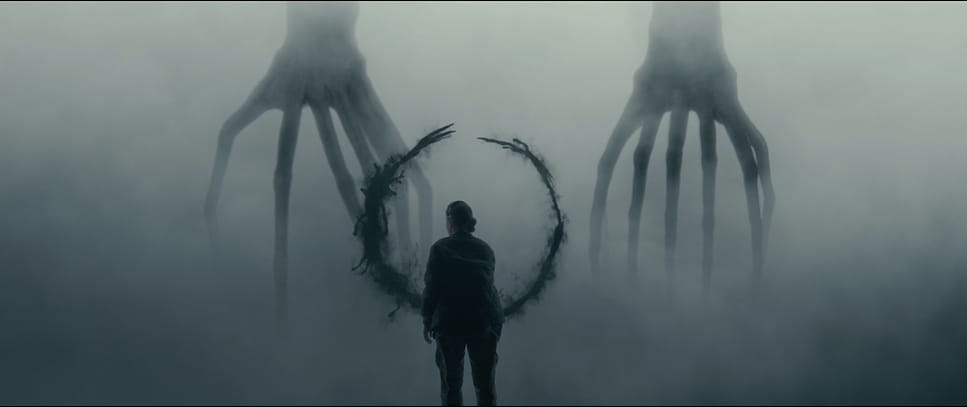
Heptapod Language • Arrival movie explained
Related Posts
Heptapod Language Explained
The Heptapod language explained
With the Arrival movie explained as far as plot goes, let's talk alien language now. Here we go. Understanding this will make everything else click.
The plot, the climax. The film's entire philosophical argument. Our Arrival movie explained breakdown is the best way to understand how the alien language rewires the brain.
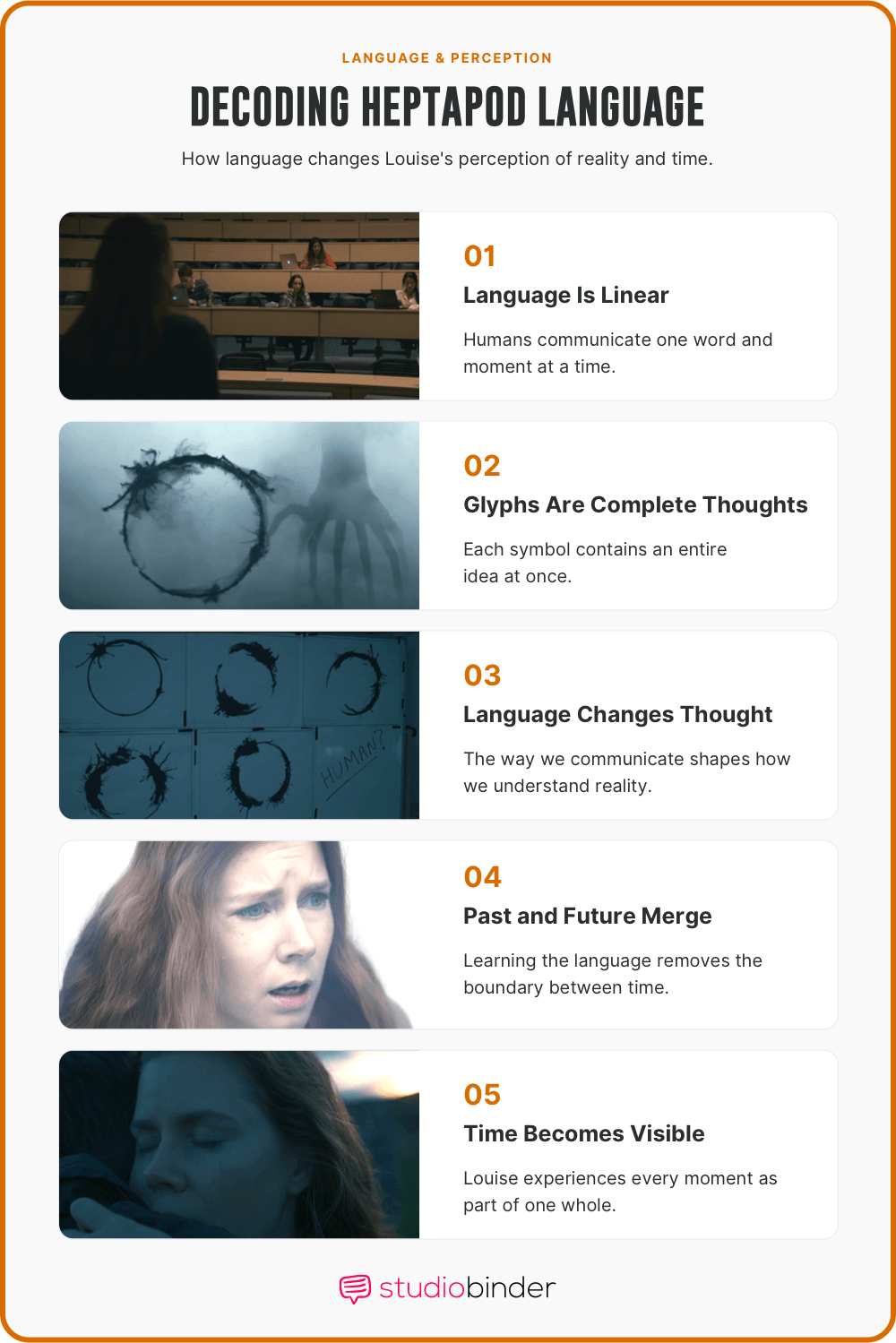
Decoding Heptapod Language and Perception • Arrival movie explained
Here's how it works.
The heptapods have two forms of communication. Their spoken language might not even be language. It's just a low rumble. Their written language however, is something else. Something, quite obviously, out of this world.
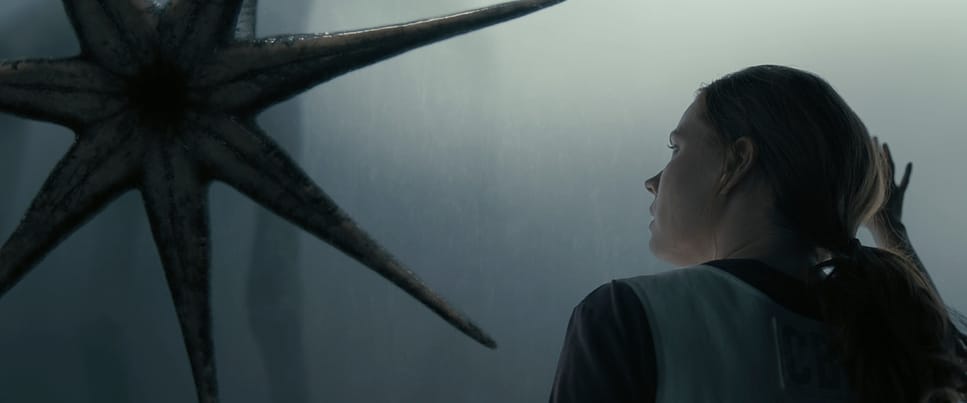
Communication • Arrival movie explained
What makes it different
Human written language is sequential. Letters form words. Words form sentences. You read left to right, or right to left, or top to bottom. But always in a direction, always through time. One thing follows another. Their symbols are a single circular glyph. No straight lines. No start or end point. It’s logographic, meaning one symbol stands for a whole idea, not a letter or a word. The heptapod glyph is simultaneous. You see the entire thought at once. You see the action, the object, the relationship, the consequence. Everything.
Think of it like a photograph of a sentence. A photograph shows you everything in the frame at the same time. That is how heptapod writing works. The best Arrival movie explained analysis focuses on the relationship between language, memory, and destiny.
The Sapir-Whorf hypothesis
The Sapir‑Whorf hypothesis? That’s the fancy term for linguistic relativity. The basic idea: the language you speak shapes how you think. If your language has no word for “future,” you might not plan ahead. If your language encodes direction differently, you might always know where north is.
Arrival takes that idea literally. She learns the heptapod written language. A language with no linear sequence. That rewires Louise’s brain to perceive time non‑linearly. She stops experiencing moments one after another like the rest of us - past behind her, future ahead.
Instead, she experiences them all at once, like one giant glyph. The film then takes this idea and extends it to its logical extreme. It asks what that does to your own experience of time and the choices you make.
That is the Arrival heptapod language in a nutshell. It’s neurology, and pushed to sci‑fi extremes.
Linguist Lera Boroditsky's research at Stanford found real evidence for this. Language affects how people perceive color. It can alter spatial reasoning, and even the direction they imagine time moving.
Check out the fascinating scientific discovery on language in the video below.

How Language Shapes the Way We Think • Arrival movie explained
Arrival Ending Explained
Arrival Ending Explained
You can decipher what the meaning of the ending is by watching any YouTube video essay that features the Arrival movie explained, or follow Reddit subreddits. But that can get you only so far. The film deliberately obscures the sequence until the final moments, so let’s walk through this step-by-step.
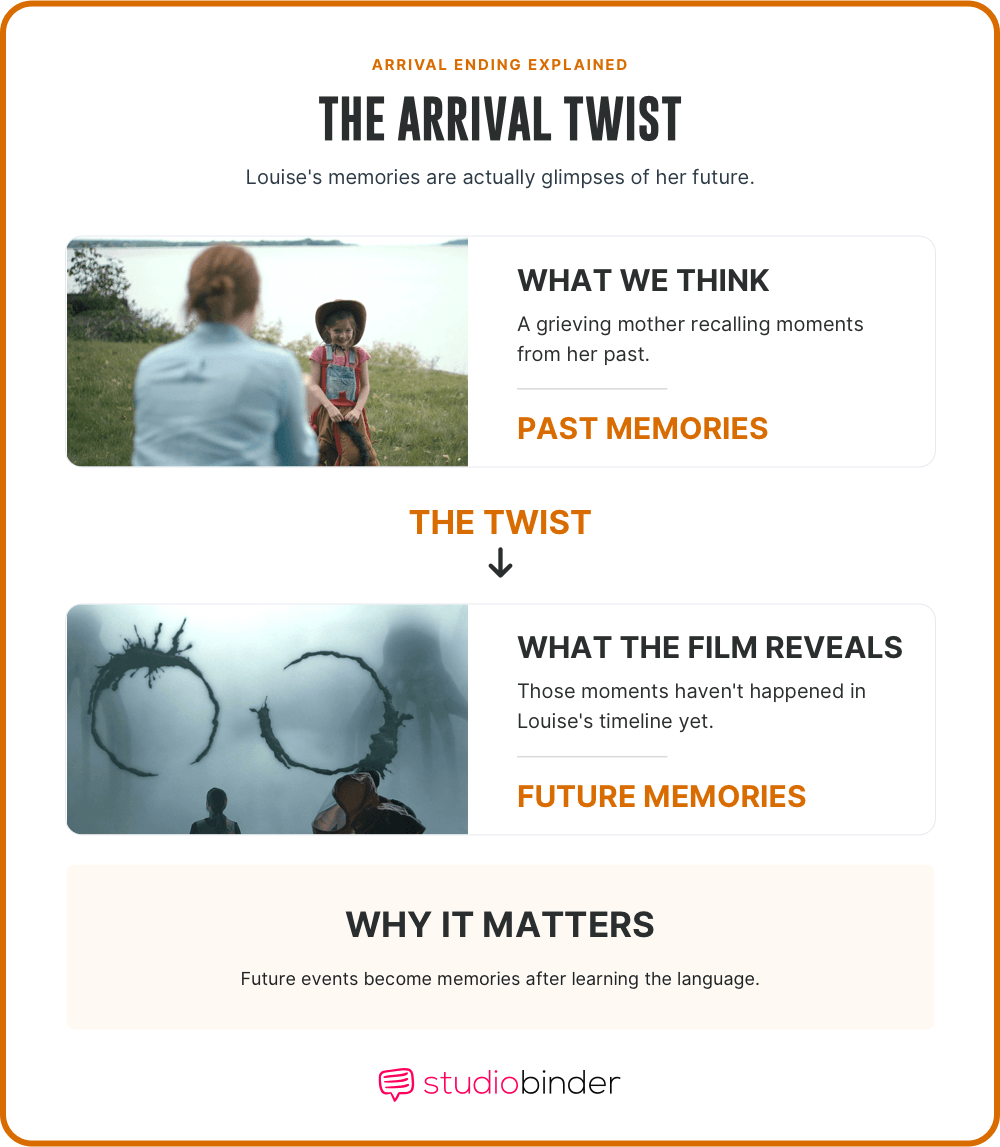
The Meaning Behind the Narrative Twist • Arrival movie explained
- The scenes of Louise's daughter Hannah? Those were not flashbacks as we were originally led to believe. They are flash-forwards. The daughter hasn't been born yet at the point Louise is experiencing them. The film opens with what appears to be a prologue of grief - a child born, a child lost. It is actually a preview of a future Louise can now perceive.
- How does she access them? Because she has learned the heptapod written language. Now she perceives her entire life - past, present, and future - as one continuous now. Those “visions” are actually memories. Just memories of things that will happen.
- The phone call: Louise needs to stop General Shang from attacking the Chinese shell. She cannot do it with logic or math. So she uses her new perception to “remember” a future. One moment. A gala years from now, where Shang tells her his wife’s dying words. She calls Shang in the present, speaks those words in his wife’s voice. He stops the attack. The military strike is called off. The shells leave. Then the film returns to Hannah.
- The personal choice: After the crisis ends, Ian asks Louise if she wants to start a family. She already knows everything. She knows she will have a daughter named Hannah. She knows Hannah will die of a rare disease at twelve. She knows Ian will eventually leave her when he learns she knew the future and chose it anyway.
- The gift: The heptapods did not come to give humanity a weapon. They came to give their language. That language, once learned, allows humans to perceive time as they do - as a landscape, not a line. The film’s final question is the same one Louise faces. If you could see your whole life from start to finish, would you change it? Or would you live it exactly as you saw it?
We'll let the Channel Heavy Spoilers take on the Arrival ending from here.

Arrival Ending Explained by heavy Spoilers • Arrival movie explained
Related Posts
Arrival movie explained
What Does "Non-Linear Time" Mean in Arrival?
Let’s get clear on this concept so we can have the Arrival movie explained just right. It’s the film’s philosophical bedrock. Humans experience time as a line. The past is behind us. The future is ahead. Present is a moving dot that goes from left to right. Always arriving, always becoming the past. That is linear time.
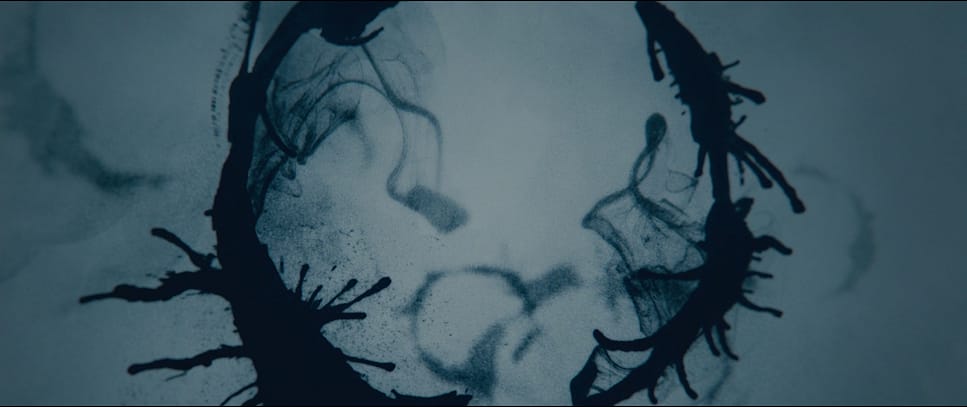
Heptapod Glyph • Arrival movie explained
The heptapods don't experience time this way. The heptapods experience time as a landscape. For them, all moments exist simultaneously. Everything exists at once. The mountain, the valley, the river, the tree, all present, all the time. There is no “before” or “after.” There is only “is.” It's a landscape they can see all at once.
When Louise learns the heptapod language, she acquires a version of that perception. She can “see” her daughter’s birth and her daughter’s death in the same moment. She can feel the joy of first steps and the grief of a hospital room at the same time. She can't change events. She can't go back. She simply perceives what is already true, that her future exists as surely as her past, and that she can access it.
The film’s emotional stakes rest on this question. There is no loop. Events don't repeat. Louise isn't trapped. She has simply lost the limitation that made the future invisible. Given the choice to know everything, every joy and every loss, would you still say yes to life? Louise does. That's the film's emotional argument. Not that non-linear time is a gift without cost. But the cost doesn't change the answer.
Arrival's time perception explained comes down to a single idea. Time is not a river. It is a book you can flip through all at once. Louise learns to flip. And through that, we have the Arrival movie explained like we're Louise learning a new language.
Now let's watch Twin Flicks' video to have the timeline angle explained with further detail.

Arrival Ending Explained by Twin Flicks • Arrival movie explained
Arrival movie explained
Arrival Themes and Meaning
Now we step back. This is the Arrival 2016 film analysis at its most rewarding. From here, let's have the Arrival movie explained through categories to make it all more digestible.
- Language and Cognition. The Sapir-Whorf hypothesis isn't just a plot device here. It's the film's central argument. That language shapes how we experience reality. When Louise learns a language with no sequence, her brain physically changes. That is the movie’s literal claim. That's exactly how Ted Chiang, the writer of the short story it's adapted from, described it in interviews about "Story of Your Life."
- Free Will vs. Determinism. If you already know the future, do you have a choice? Is that freedom? Louise sees Hannah’s death and chooses to have her anyway. Is that free will? The act of choosing despite knowledge? Or is it determinism - the future was always going to happen, and her “choice” was just part of the script? The film refuses to answer and holds both possibilities open. That’s the point. It leaves you in the same paradox as Louise. That ambiguity is intentional and it's one of the things that makes it last.
- Grief and love: Arrival is secretly a film about mourning. This is what Eric Heisserer meant when he said the film is about grief. Louise grieves for a daughter who hasn’t died yet. The entire structure of Arrival is built around a simple and devastating question. Would you love someone you knew you would lose? The story structure of the movie - those “flashbacks” that aren’t flashbacks, forces us to sit with that question. Louise's answer is yes. Not in spite of knowing. But because of it. The film argues that love and loss are not opposites - that the grief is part of what makes the love real. That's the arrival movie meaning at its most human. It is the willingness to be destroyed.
- Global cooperation vs. militarism: The subplot with twelve nations is not filler. It’s a dark mirror. China, Russia, Sudan, they all default to fear. They treat language as a weapon to be extracted and used. Louise treats it as a relationship to be built. She moves toward understanding. The heptapods gave humanity a tool. Whether humanity uses it or shoots at it first is the question the film leaves open. The film argues that communication, not force, is the only path to survival. That message landed hard in 2016. It hasn’t aged a day.
- The nature of time: This is the big one. Arrival proposes that linear time is not a feature of the universe. It is a limitation of human cognition. The heptapods see reality as it is, everything at once. We see a tiny sliver. Learning their language expands that sliver. The film ends with a palindrome. Hannah. Same forwards and backwards. That is the thesis statement. Whether that gift is something humans can handle, that's another question. The film declines to answer that cleanly.
One of the great analysis videos on the themes and deeper meaning of Arrival comes from the channel, Like Stories of Old. Get swept away in the impressive analysis below.

Like Stories of Old Arrival analysis • Arrival movie explained
We hope this Arrival movie explained breakdown answered the biggest questions you have after watching the film.
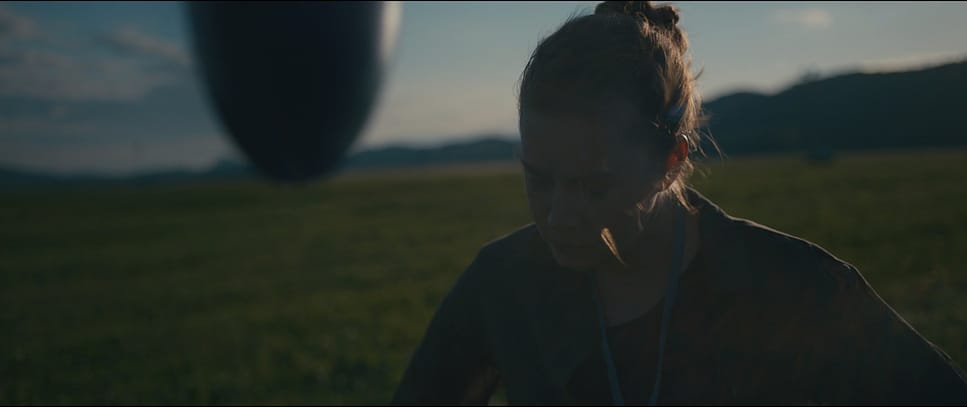
First Contact • Arrival movie explained
Frequently Asked Questions
Arrival FAQs
The twist is that Louise’s visions of her daughter are not memories of the past, they are memories of her future. By learning the heptapod language, Louise has acquired non‑linear time perception. That allows her to experience future events as if she has already lived them. Her daughter hasn't even been born yet at the point the visions begin.
The heptapod written language is logographic and non‑linear. Each glyph is a complete circular symbol. They express a full idea simultaneously, with no start or end point. Unlike spoken human language, it doesn’t unfold in sequence. Learning to read and write it rewires the brain to perceive time differently. It dissolves the distinction between the past and the future.
Hannah is a palindrome. It reads the same forwards and backwards. Ted Chiang chose it deliberately to mirror the film’s theme of non‑linear time in "Story of Your Life". A palindrome has no fixed direction. That reflects Louise’s new perception of her own life as a whole rather than a straight line.
Arrival is not based on a true story. It is an adaptation of “Story of Your Life,” a 1998 novella by Ted Chiang. Ted Chiang's story won the Nebula Award for Best Novella in 2000. The film was written by Eric Heisserer and directed by Denis Villeneuve. The film stays remarkably faithful to the source material's central ideas. It does, however, expand the global political stakes.
In the film’s timeline, Ian does not know during the events depicted. The ending implies that he eventually learns the truth. He learns that Louise knew their daughter would die young, and leaves her. We hear him say, “I don’t understand why she made the choices she did.” That is the film’s quiet devastation.
UP NEXT
Lost Ending Explained
With the Arrival movie explained in full, now let's talk about the classic television series, Lost. The Lost finale remains one of television's most debated endings. Explore what really happened, what the flash-sideways timeline meant, and why the ending still sparks discussion years later.

Create production calendars with a drag-and-drop timeline
Create customizable production calendars for your next video or photoshoot. Add events, tasks, and dependencies. Invite your team and share calendars with clients.