
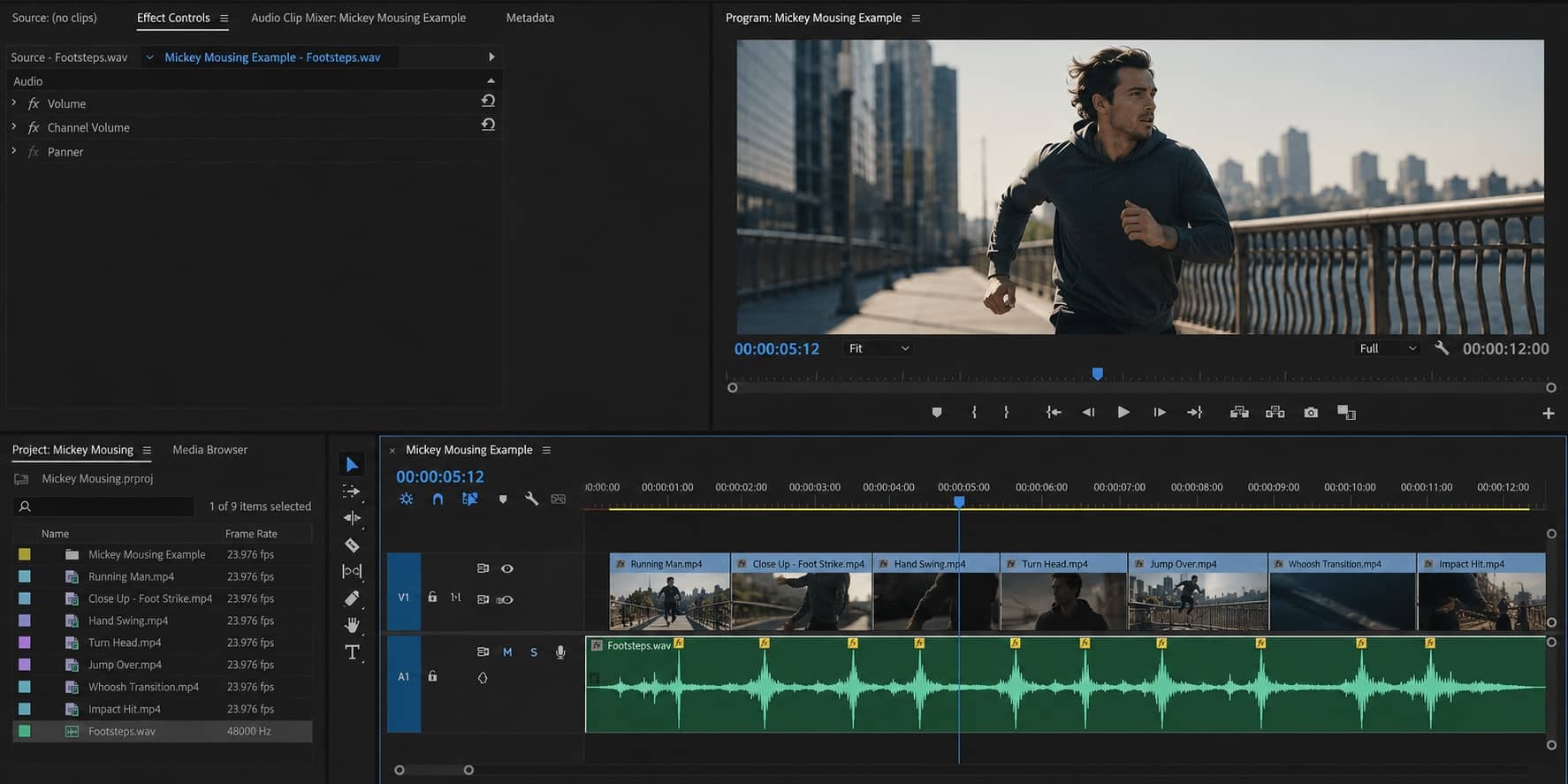
Mickey mousing is a technique used in film scoring where the physical movement occuring on screen is tracked by the music beat for beat. Such tight syncing gives film composers a direct connection to the audience’s emotions, making every punch seem harder or pratfall funnier without using a single word of dialogue. There are potential downsides though. It can come off as mechanical when it mirrors action that already reads clearly on its own. Kind of like a hat on a hat. But understanding when to use it and when to not is one of the most useful skills a filmmaker or film composer can develop.

Watch: What is Mickey Mousing


Subscribe for more filmmaking videos like this.
Film music techniques
Let's define what this music film technique is
Before we dive into this article, it's critical to understand what a mickey mousing actually means. Let's get into it below for a full definition and meaning:
Film music sync
What is Mickey Mousing?
Mickey mousing is a technique used in both filmmaking and animation where the music matches the action on screen almost exactly. If a character jumps, the melody jumps in sync. When an object falls, the music sounds like it's falling with it. Every movement gets its own musical moment.
The term originated from early Disney shorts. Films like Steamboat Willie (1928), had orchestras playing music that tracked every single motion happening on screen. If a duck waddled, the tuba wobbled. If a door slammed, the brass hit a hard note. The sync was so recognizable that the technique ended up being named after the studio.
The core idea is simple: musical hits line up with whatever action is occuring on screen. A "hit" means a strong beat or accent in the music. When that accent lands at the exact frame where something happens on screen, the two read as lone cause and effect action. Watch any classic Road Runner cartoon and you will feel it instantly.
Today the technique shows up in a lot more than just cartoons. Action movies willl sometimes sync a punch to a drum hit. Commercial directors use it to match a product reveal to a musical swell. Even reality TV uses it for comic effect. The label "mickey mousing" may sound a bit infantile, but as a tool, it's no joke. Use it right and it will pull the audience right into the moment.
Mickey Mousing at a glance:
- Music mirrors on-screen movement
- Synchronizes visual actions with musical beats
- Most common in animation, action, and comedy
- Makes scenes feel more dynamic and engaging
Origin and history
Where Mickey Mousing came from
The name comes straight from Mickey Mouse himself. Around the late 1920s to early 1930s, Disney animators and composers began matching musical hits, swooshes, and accents to all physical gags occurring on screen. If a character slipped, the orchestra would slip with them. Or if a foot stomped, a drum hit accompanied it. The music was a part of the picture in a unique sense.
Carl Stalling became well-known for this visual/music style. He composed for Warner Bros. cartoons from 1936 through 1958, writing music that deliberately tracked on-screen actions with serious precision. His scores for Bugs Bunny and Daffy Duck shorts are still beloved today because every pratfall or leap had its own musical accompaniment. Stalling may not have invented the approach, but he pushed it further than almost anyone else. He is largely credited for making it the defining sound of American animation for decades.
Over time, live-action directors and composers started using the label to describe the same technique in live-action films. A thriller score that hits hard every time a jump scare occurs, or a comedy track that adds a boing when someone falls. Both of these are referred to as mickey mousing.
The phrase moved from a studio-specific reference to a general term used throughout the industry. Eventually though, some composers and critics began pointing criticism toward Mickey Mousing. The idea being that spelling out every action in music treats the audience like they need some guide to how they should feel. That tension between successful artistic use of the idea and over-illustration is still part of how the term gets discussed to this day.
What is Mickey Mousing? - Subscribe to StudioBinder's Academy Channel
Scoring mechanics
How mickey mousing works technically
Mickey mousing may sound straightforward on the surface, but pulling it off just right takes careful calculation, a good ear, and real coordination between the composer, the editor, and sometimes even the sound designer.
Hit points and how composers find them
A hit point is a frame where something happens on screen that the music aims to match. This could be a character falling, a door slamming, or anything along those lines. Composers work inside a digital audio work station (DAW) like Pro Tools or Logic to mark these frames.
The process may sometimes be referred to as spotting. During a spotting session, the director and composer watch the cut together and decide which moments need Mickey Mousing. Then the composer builds the cue around them.
Tempo mapping to picture
Once the hit points are locked, the composer creates a tempo map. A tempo map refers to choosing a BPM (beat per minute) that lands exactly on each target frame. Sometimes one tempo works for the whole cue. More often, the composer has to write tempo changes into the map so the music stretches or compresses to hit every mark.
Carl Stalling did this constantly for Looney Tunes, sometimes shifting tempo several times within a single ten-second gag. Modern tools like Beat Detective in Pro Tools make the arithmetic faster, but the creative judgment still comes from the composer.
The role of sound design versus score
Not every on-screen action needs the orchestra to follow it. Sound designers handle many hits with pre-made effects, like the sound of a cartoon boing or a crash. The composer and sound designer have to agree on who owns each moment, or the track gets cluttered.
On a big studio animated film, that conversation happens early. On a smaller sized production, one person often does both jobs. The key question is always the same: does this moment need a musical accent, a sound effect accent, or both working together?
Famous examples
What are classic examples of mickey mousing in film and animation?
Mickey mousing has a long history of showing up across film and animation history. The below examples will help us better understand how the technique works and why directors keep going back to it.
Early Disney shorts
The name itself comes from Walt Disney's earliest sound cartoons. In Steamboat Willie (1928), nearly every move Mickey makes lines up with the score's beat. When he plays a cow's teeth like a xylophone, the notes are lined up with where his hands move.
The music and the action are in perfect sync. They may not have known it at the time, but this would come to define how audiences consume animation for many years to come.
Looney Tunes and Carl Stalling
Carl Stalling composed most of the classic Looney Tunes shorts. This man pushed mickey mousing further than almost anyone in film history. Watch any Road Runner cartoon and you will hear the orchestra line up with every single step, fall, and explosion.
Stalling was also known for subtly layering in famous song beats too. When a character tip-toes, you might hear a few bars of Sneaky Pete accompanying. The music almost comments on the on-screen action in a way.
Live-action films that use it
Live-action film directors use Mickey Mousing more than most people know. Take Home Alone (1990) for example. John Hughes and composer John Williams use short musical stings that punch right on pratfalls and physical gags, giving the film a cartoonish energy that fits the tone.
Horror films are well-known for it too. A harsh orchestral hit to make the audience jump is mickey mousing in all its glory. The technique works in any genre really. Anytime a filmmaker wants to make an audience feel a moment in their bones, mickey mousing is there to help.
Related Posts
Effective uses
When mickey mousing enhances a scene
Mickey mousing gets a bad reputation sometimes. But when a director uses it with purpose, it can be exactly the right tool. The key word is intentional. Stylized sync tells the audience that what they are watching is heightened, artificial, and meant to feel that way. And it all depends on the movie and moment.
Comedy and slapstick
This is where mickey mousing was practically invented. Think of the classic Looney Tunes shorts again, the music is not trying to be invisible. Rather, it's part of the joke. The same logic applies in live-action comedy too. In The Pink Panther, Henry Mancini's score follows Clouseau's bumbling body almost like another character.
The tight sync is funny because it exposes how absurd the character's movements are. And that extra hit only heightens the comedy that's already there. When a filmmaker wants the audience to laugh at physical action, musical punctuation speeds that reaction up.
Children's content
For young viewers still learning how storytelling works, musical syncing acts as a sort of guide. It can guide a child on when exactly to feel scared, surprised, or relieved.
Films like Fantasia or almost any classic Disney feature use this constantly. The score effectively labels the moment. That kind of clarity is a feature, not a flaw, when the audience will enjoy that extra layer of information.
Fantasy sequences and dream logic
Whenever a film steps outside of reality, the normal rules loosen up some. A dream sequence, a musical number, or a fantasy cutaway already signals to the audience that logic has been turned on its head.
Mickey mousing fits right in with these moments. Think of Eternal Sunshine of the Spotless Mind, where Jon Brion's score often syncs tightly to strange visual cues, which makes the memory sequences feel equal parts playful and disorienting.
The artifice is the point. A composer who locks music to a surreal image is not making a mistake. They are choosing to signal to the unreality of the moment and give the audience permission to feel it fully. If the audience is in step, they'll respond well.
Common pitfalls
When does mickey mousing hurt a scene?
Mickey mousing works beautifully in the right context, but what happens when you lean into it a little too hard? The same quality that can make a scene feel playful and clear can also make a scene feel cheap and unearned.
It can feel manipulative
When a score tracks every emotional beat of a serious scene, it force feeds a feeling onto an audience. That removes something important from the audience: the chance to discover the feeling on their own. Think about a quiet grief scene where strings swell on every tear and drop on every silence. The music is doing too much of the emotional work, so the performance almost becomes irrelevant.
Audiences pick up on this, even if they can't articulate it. The scene starts to feel like it's forcing you to feel a certain way, like a big bear hug you didn't ask for. Some early 2000s dramas were criticized for leaving no moment unscored, rather than daring to let it speak for itself.
Constant tracking exhausts the viewer
Pacing is the other problem. If the music physically follows every cut, every step, every glance across a two-hour film, the score can never just breathe. As a result, the viewer never gets to breathe. Silence and near-silence are tools, and tools can of course be used in the wrong way.
Films like No Country for Old Men use this idea deliberately, allowing plenty of quiet, meditative moments to unfold naturally so that the moments with sound hit harder. Mickey mousing too much in drama works against that kind of balanced contrast.
It can make a score sound generic
Heavy mickey mousing also flattens a composer's voice. When the music is only reacting to picture, it becomes beholden to a certain visual beat, becoming generic. It may come off as functional, but it also becomes forgettable.
Great film composers like Bernard Herrmann or Ennio Morricone will often work against the image in subtle ways. Creating tension between what the audience sees and what they hear is part of what makes the score memorable. If you over-syn, you're removing that tension entirely.
Related Posts
Sync comparison
Mickey mousing versus other sync techniques
Mickey mousing is one tool in a much bigger kit. Knowing how it sits next to other sync techniques helps you choose the right one for any scene.
Underscoring
Underscoring is the broad term for any music that plays beneath dialogue or action. It sets mood and supports emotion, but it does not chase every movement on screen.
A quiet string pad under a conversation in Lost in Translation, for example, is known as underscoring. Mickey mousing, by contrast, is directly tied to physical actions. Underscoring is the ocean, mickey mousing is a wave that breaks at exactly the right frame.
Stingers and accents
A stinger is a single sharp musical hit, usually one or two beats, used to punctuate a moment. When a villain appears on screen, a quick bass jab can be heard.
Stingers are closely linked to mickey mousing because both are synced to a visual beat. The difference though is scale. A stinger will land once and then get out.
Mickey mousing sustains that note-by-note choreography across a longer piece of action. The best example being the way Carl Stalling tracked Bugs Bunny through an entire chase sequence.
Source music and diegetic sound
Source music (also called diegetic music) is music that occurs within the story world. A band playing in a bar, a car radio, a character singing are all examples. Because the characters can hear it too, it carries different dramatic weight than a scored cue that the characters can't hear.
Mickey mousing almost always lives in the non-diegetic score, the music only the audience can hear. You can break that rule as a meta gag, but mixing mickey mousing with diegetic sound tends to feel jarring unless the scene is already heightened or comedic.
Related Posts
Practical guidance
What filmmakers and composers should know before using it
Mickey mousing works best when it is a deliberate artistic choice, not a something to fall back onto. Before a single note is written, the director and composer will sit down for a spotting session. This is a meeting where they watch the cut together and decide exactly where music should accentuate a moment and where it shouldn't be used.
If you're entering into a spotting session, keep specific about intent. If a character trips and you want the strings to swoosh downward with them, say that out loud. If you want the music to ignore a pratfall and let the sound design carry it, say that too. Composers are not mind readers. Much like the Warner Bros. cartoons scored by Carl Stalling or the exaggerated hits in a Chaplin restoration, a director with clear examples gives the composer a real target to aim for, rather than a vague mood.
Restraint is the most practical tool either of you can use. Even in a broad comedy or an animated short where heavy sync feels appropriate, wall-to-wall mickey mousing quickly turns into unwatned noise. The audience will eventually stop noticing the clever hits if every moment packed with them. Pick two or three gags per scene where tight music-to-action sync will land hardest, and let the rest of the scene speak for itself. A more selective approach like this is exactly what makes a well-placed hit feel funny or surprising rather than exhausting.
And one final practical note: temp tracks can be misleading on both sides. A director may temp a scene with a cue that happens to land on a cut by accident, then assume the composer should match every beat. Flag those moments early on. Decide together whether a sync point is worth creating before the composer builds a whole cue around it.
Related Posts
Conclusion
Narrative Techniques
Mickey mousing is one of the oldest techniques in film music. To this day, you'll see it in everything from animated features to action blockbusters. Knowing what it is, where it comes from, and what it costs you in emotional space gives you a real advantage when making scoring decisions.
Use it intentionally like a tool. But don't let it become a habit. It can quietly undermine the scene you worked hard to build.
Frequently Asked Questions
Mickey mousing FAQs
Mickey mousing helps draw attention to specific on-screen actions by synchronizing music with movement. It can make scenes feel funnier, more dramatic, or more emotionally engaging
The term comes from early Disney cartoons, especially Steamboat Willie (1928), where music closely followed every movement on screen. Over time, the technique became known as "mickey mousing."
No. While it originated in animation, mickey mousing is also used in action films, commercials, comedies, video games, and television whenever filmmakers want music to closely match the action.
Not at all. Some critics view it as overly obvious, but many filmmakers use it intentionally. When applied thoughtfully, it can enhance comedy, action, suspense, or fantasy sequences.
A film score provides the overall musical backdrop for a scene, while mickey mousing is a specific scoring technique where musical cues are synchronized to individual on-screen actions.
Classic Disney cartoons like Steamboat Willie and Fantasia are iconic examples. The technique also appears in Looney Tunes, The Pink Panther, and many modern action films and commercials.
UP NEXT
Narrative techniques
Mickey mousing is one tool in a much larger storytelling toolkit. This piece breaks down the broader narrative techniques that shape how a film communicates with its audience.
