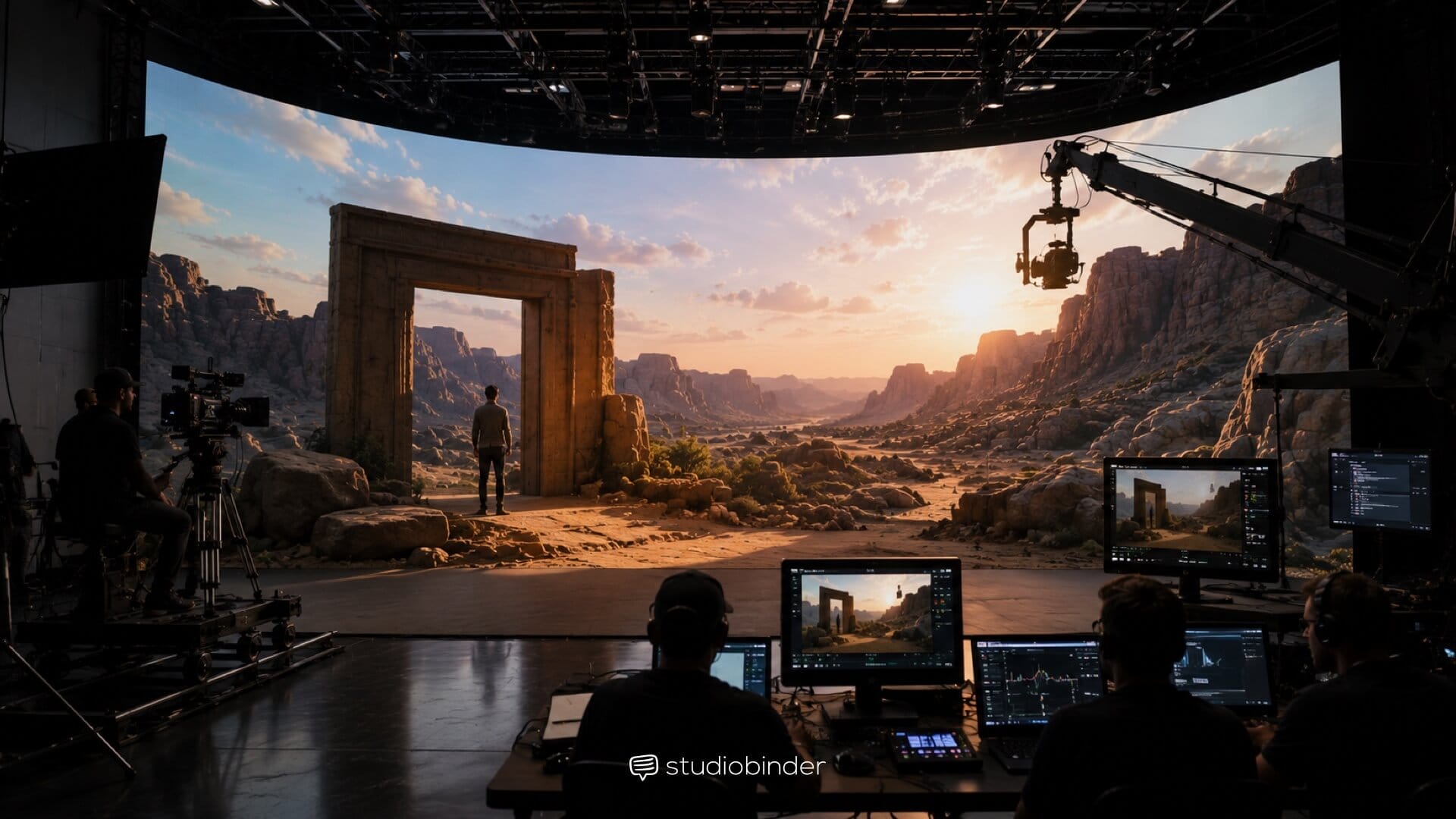
Adirector calls action. The actors are standing on a physical set, but behind them is a massive wall of LEDs showing a photoreal alien landscape, a city at dusk, or a desert that would have taken a plane ride and a full company move to reach.
It can look like magic from the outside, but it is not magic. It is a process. And like any production process, the virtual production stages only work when every stage is planned well before the shoot begins.
Virtual production stages
First, let's define virtual production
There are several stages to virtual production, but before we start breaking them down, let's establish a basic definition.
VIRTUAL PRODUCTION BASICS
What is a virtual production?
Virtual productions combine live-action filmmaking with real-time rendered digital environments, usually displayed on an LED stage. Instead of shooting actors against a green screen and adding the background later, filmmakers can photograph the environment on camera while seeing it live on set.
When most people ask what virtual production is, they are usually thinking of The Volume from The Mandalorian, which helped bring this workflow into the mainstream. But the real takeaway is not the hardware. It is the process. The virtual production process starts long before cameras roll and continues after principal photography wraps.
Virtual production combines:
- Live-action filmmaking with real-time digital environments
- LED walls instead of traditional green screen backgrounds
- Physical sets matched with virtual environments
- In-camera visual effects captured during production
- Real-time creative decisions directly on set
We're going to break the virtual production process into 4 virtual production stages throughout this article. So, before we get into it, go through the chart and the video below to familiarize yourself with the general stages.
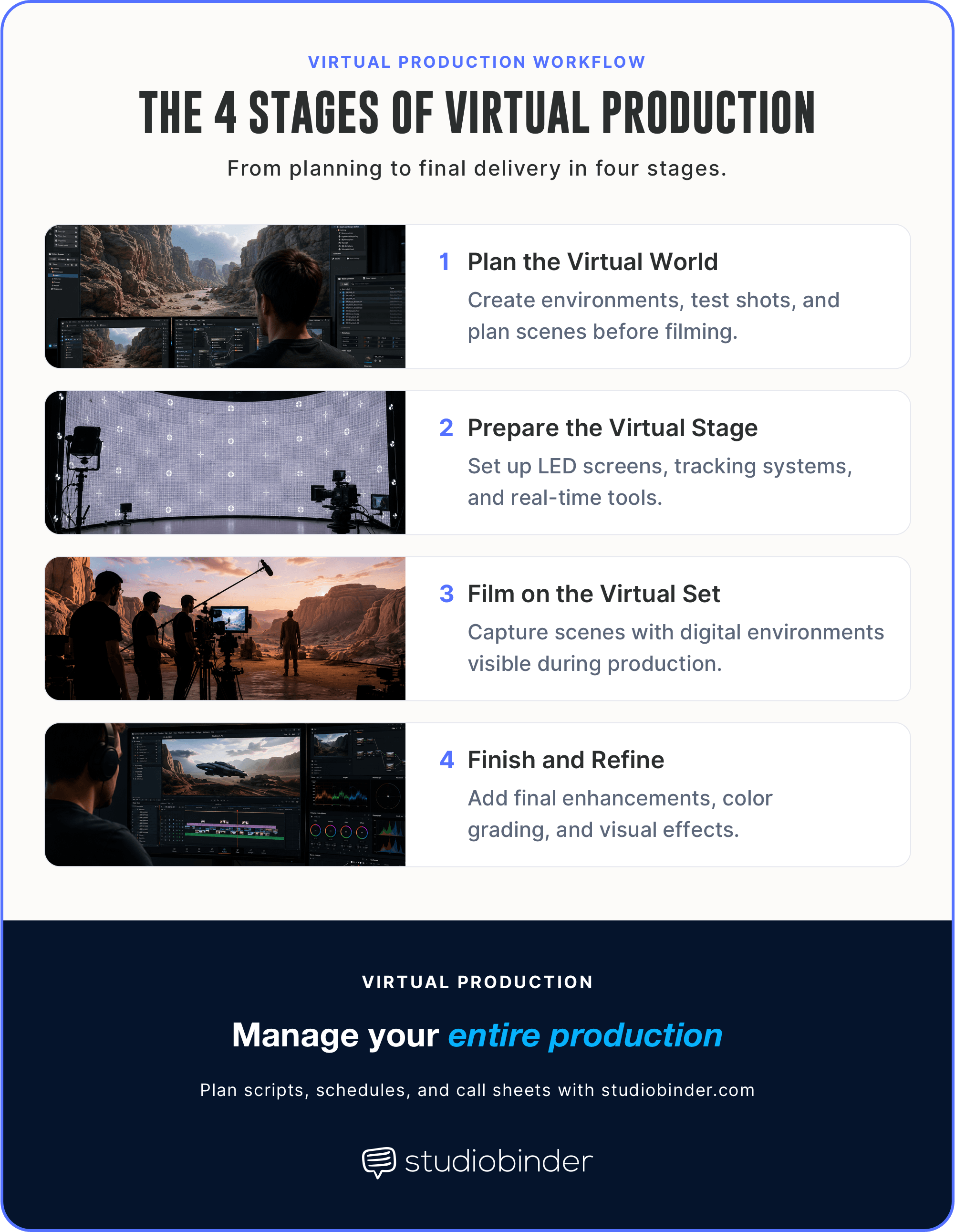
The Stages of Virtual Production • Virtual production stages
Virtual production succeeds when every stage is planned before cameras roll. From pre-visualization to post-production, each phase builds on the one before it to create a seamless final image.

Subscribe to StudioBinder on YouTube · Virtual production stages
Virtual production stages
Stage 1: Development and pre-visualization
The first of the virtual production stages happens in pre-production. This is where the digital world gets built and the creative plan gets tested before anyone steps onto an LED stage.
Traditional prep still matters here — shot lists, storyboards, call sheets, tech scouts, and creative meetings are all still essential — but virtual production adds another layer. You are not just planning a shoot. You are building the world that the shoot will take place in.
If this stage is rushed, the rest of the virtual production process becomes harder. The LED wall can only display what has already been designed, built, and approved. That means decisions that might normally wait until post-production now have to happen much earlier.
StudioBinder's scriptwriting software can help you in the early virtual production stages, or any kind of pre-production stage. It provides automatic industry-formatting for your screenplay so you can focus on what matters most: characters and story.
Write your virtual production screenplay in StudioBinder · Virtual production stages
It's also linked to your entire pre-production suite, including storyboards, schedules, sides, and call sheets. Best of all, you can organize and track every version of your script with WGA-standard color-coding, and a complete control over revision history.
Digital asset and environment creation
This is where the virtual world starts to become real. Environments, backgrounds, textures, lighting references, and atmosphere are built in a real-time engine like Unreal Engine. Mountains, skies, architecture, roads, interiors, alien planets, city streets — whatever the story needs has to be created or adapted before the shoot.
This is not just a VFX task. The art department, production designer, VFX supervisor, and director all need to be aligned. If the physical set includes a floor, doorway, staircase, or practical prop, the digital environment has to match it. The virtual world and the physical set cannot feel like two separate ideas. They have to feel like one location.
This is also where a lot of tone gets decided. Color, weather, time of day, background detail, and scale all shape how the final environment feels. In traditional filmmaking, some of these choices are made on location or adjusted later. In the volume filmmaking workflow, many of them have to be locked in earlier because they affect everything downstream.
Pre-visualization inside the virtual world
Once the environment exists, filmmakers can start blocking scenes inside it. This is one of the biggest strengths of virtual production. Directors, DPs, and producers can test framing, camera movement, and staging before the actual shoot day.
That saves time, but more importantly, it makes decisions clearer. You can figure out whether a background angle works, whether a digital horizon sits too high in frame, or whether the scene needs a different scale. You are not walking onto the stage blind. You are showing up with a stronger plan.
This is also where regular prep tools still matter. Shot lists, storyboards, overheads, and schedule planning remain part of the process. Virtual production does not replace production planning. It makes good planning even more important.
Create your free shot list in StudioBinder · Virtual production stages
The first of the stages of virtual production is really about alignment — creative, technical, and logistical. The chart below condenses the process into 6 steps.
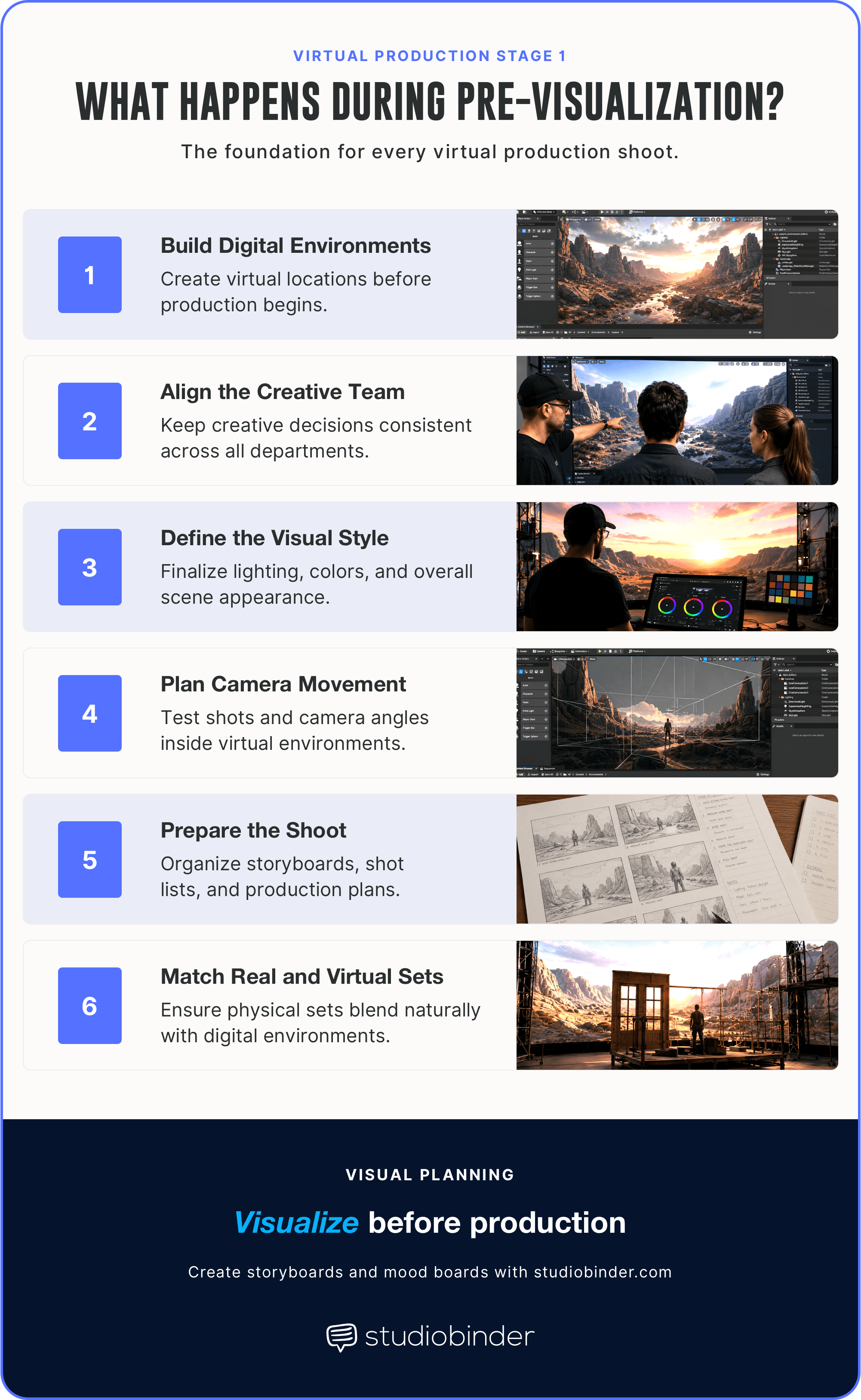
What Happens During Pre-Visualization? • Virtual production stages
Virtual production stages
Stage 2: Technical prep and LED volume setup
The second of the virtual production stages happens right before principal photography. This is the stage where the digital plan gets translated into an actual shooting environment. Before talent walks onto the stage, the tech team needs to make sure the system is working the way the production expects it to.
This is where the LED volume stops being an abstract concept and becomes a set. It also tends to be the stage first-time virtual productions underestimate. The wall does not just turn on and work perfectly. It has to be calibrated, tracked, and synchronized with the camera and the engine driving the content.
LED wall calibration
The LED volume has to be calibrated for color, brightness, contrast, and consistency. If the wall is too bright, too dim, or not matching the camera settings, the image will not hold up the way it should. The DP, gaffer, and real-time tech team all need to be on the same page here.
There are also technical issues to manage, like moiré patterns, color shifts, and brightness uniformity across panels. What looks fine to the eye may not look fine on camera. That is why calibration is not optional. It is one of the most important technical steps in the entire virtual production process.
This is also where the wall starts becoming more than a background. In virtual production, the LEDs are often a light source too. That means calibration affects not only the image behind the actors, but the way the actors and practical set are lit in the scene.
Camera tracking and real-time engine configuration
This is the part that makes the illusion work. Camera tracking systems feed the real camera’s position and movement into the virtual camera inside the engine. As the camera moves in physical space, the digital perspective shifts with it. That is what creates the parallax effect that makes the environment feel real.
Without accurate tracking, the image breaks. The background may feel flat, disconnected, or wrong in motion. With accurate tracking and strong real-time rendering, the background responds like a real location.
The engine also needs to be configured to match the stage, the camera, and the output settings. Resolution, refresh rate, playback behavior, scene loading, and color management all need to be dialed in. This part of on-set virtual production depends heavily on the real-time tech director and the broader virtual production team, but it affects everyone on set.
Related Posts
Virtual production stages
Stage 3: Principal photography on the LED stage
This is the stage most people picture when they think about virtual production stages. It is the actual shoot. Actors perform on a practical set while the digital world plays live around them. This is where all the early planning either pays off or gets tested in real time.
Of all the virtual production stages, this is the most visible. But it only works because the previous stages were handled properly. If the environment is unfinished, if the tracking is unstable, or if the stage was not calibrated correctly, the problems show up here fast.
Directing on a virtual set
One of the biggest advantages of on-set virtual production is that directors can make creative decisions in the moment. Time of day can shift. The sky can change. Weather can be adjusted. A location can be re-framed or modified without packing up the company and moving somewhere else.
That does not mean anything can happen instantly with no planning. But it does mean the director has more control during principal photography than they would in a traditional green screen workflow. Instead of imagining what the scene will look like later, they can see much more of it now.
That changes how directing works. Performance, framing, environment, and mood can all be evaluated together. The real-time tech director becomes an important creative partner because they help execute those live changes while the production keeps moving.
This is the core of on-set virtual production: real-time decision-making inside a controlled environment.
How the DP works with the LED environment
For the DP, the wall is not just scenery. It is part of the image and part of the lighting. The digital world on the LEDs can cast real color and ambience onto actors, wardrobe, props, and the practical set.
That is one of the biggest differences between virtual production and green screen. With a green screen, the environment gets added later and the cinematographer has to imagine how it will all match in post. With in-camera VFX, the background is already contributing to the image while you shoot.
That said, it is not automatic. The DP still has to balance exposure, contrast, and color carefully. The LED volume can overpower a scene if it is not controlled correctly. The wall might look great, but if the actor is not separated properly, the shot still will not work.
This is why this level of the virtual production stages work best when the cinematographer and real-time team are in close communication. Real-time rendering is only part of the job. The photographed result still has to look cinematic.
Related Posts
Virtual production stages
Stage 4: Post-production and VFX finaling
One of the biggest myths about the virtual production stages is that they eliminates post. It does not. It reduces certain kinds of post work, but it does not remove the need for cleanup, grading, and finishing.
The final of the virtual production stages is still post-production. The difference is that the workload tends to shift. Instead of building every environment shot from scratch after the fact, the team is often refining, cleaning, and extending what was already captured in camera.
For a little bit more expansion on post and the VFX stage within it, check out this video:
![Post-Production Explained — Each Step of the Post-Production Process [Stages of Filmmaking, Ep 4]](https://i.ytimg.com/vi/qKPHNWEV5_o/hqdefault.jpg)
Subscribe to StudioBinder on YouTube · Virtual production stages
What still happens in post
Even with strong in-camera VFX, there is still work to do. Shots may need cleanup outside the camera-ready zone. Edges may need refinement where actors interact with digital elements. Some scenes may still need traditional VFX support, screen replacements, extensions, or fixes.
Color grading also still matters. The footage needs to feel unified, and virtual production shots still need to sit comfortably with any practical footage, pickups, or non-volume material in the project.
So yes, virtual production reduces certain post burdens. But it does not mean “shoot it once and you’re done.” It just means more creative work has been front-loaded earlier in the process.
How VP reduces post workload vs. green screen
This is where the virtual production workflow really separates itself from the green screen. In a green screen pipeline, the background is usually built and composited later. That means tracking, keying, lighting adjustments, edge work, and full environment replacement often happen in post on a large number of shots.
With virtual production, much of that background is already photographed in camera. That means the post team is not starting from zero. Instead of building every shot from the ground up, they are often doing cleanup and enhancement.
That is one of the biggest reasons productions are drawn to the volume filmmaking approach. The schedule can become more predictable, the creative team can see results earlier, and the number of heavy post shots can go down.
The virtual production process does not eliminate post. It just redistributes the work more intelligently throughout all the virtual production stages.
Virtual production stages
How virtual production stages compare to traditional filmmaking
The easiest way to understand the stages of virtual production is to compare them with a more traditional workflow.
In pre-production, traditional filmmaking may focus on location scouts, builds, and practical logistics. Virtual production adds digital asset creation and virtual environment planning much earlier.
In technical prep, a traditional production might focus on camera tests and location readiness. Virtual production adds LED volume calibration, tracking setup, and engine configuration.
In principal photography, traditional filmmaking relies on practical locations, sets, or green screen. Virtual production uses live digital environments and in-camera VFX during the shoot.
In post, traditional green screen work often requires heavier compositing. Virtual production usually reduces that workload because more of the image is already captured on set.
That is why virtual production stages are not just a fancy version of the same old workflow. They shift major decisions earlier.
Trusted by over 1M creatives
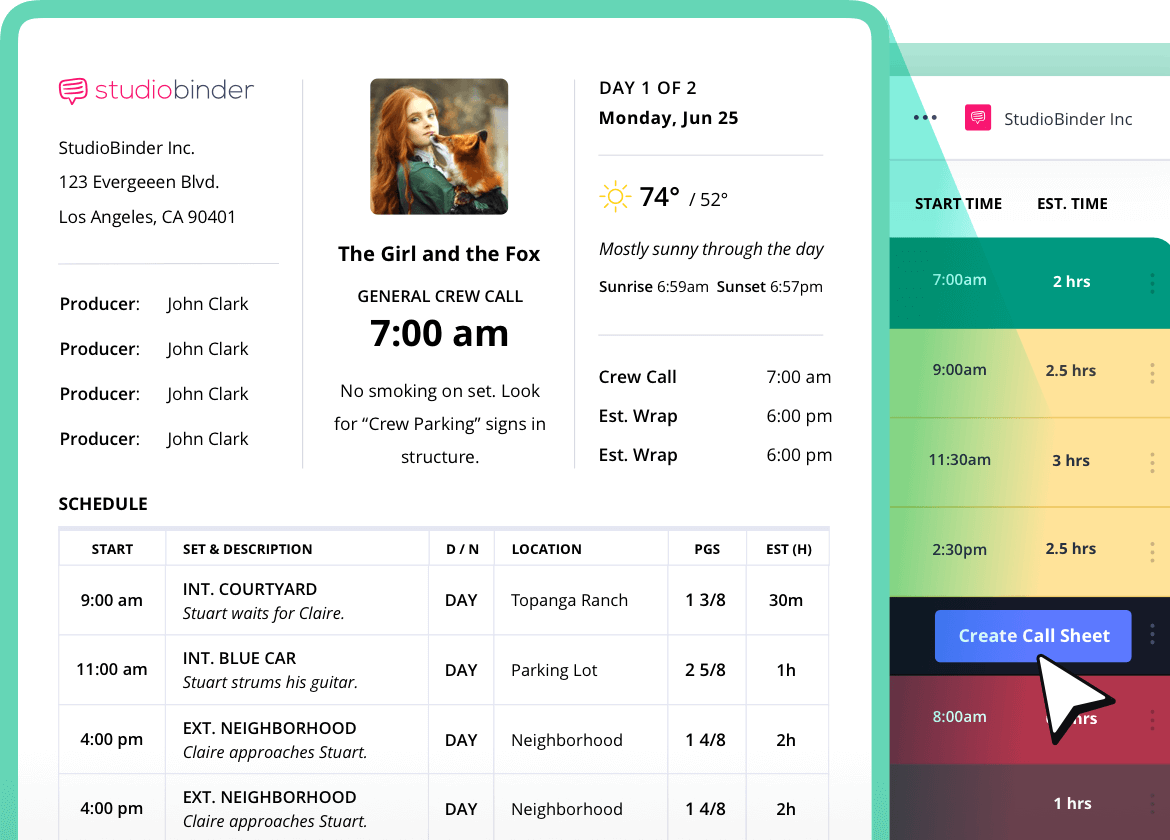
Call sheets that save you time
Create personalized call sheets, send via email and text, and track confirmations.
virtual production stages
What to plan before stepping on a virtual production stage
If you are planning your first virtual production shoot, the biggest mistake is treating the stage like a location you can just show up to and use. It is not just a facility. It is a workflow.
Tech scout the stage early. Start digital asset creation as soon as possible. Pre-viz before the shoot, not during it. Bring in a VFX supervisor and real-time tech director early enough for them to actually help shape the project. And build calibration and testing days into the schedule.
That is the real lesson behind all virtual production stages: success comes from prep. Virtual production can save time later, but only if the planning starts early enough.
Related Posts
Frequently Asked Questions
Virtual production stages FAQs
The stages of virtual production are:
- development and pre-visualization
- technical prep and LED setup
- principal photography on the LED stage
- post-production cleanup and VFX finaling
Each stage depends on the one before it, which is why compressing prep usually creates bigger problems later.
On-set virtual production refers to the live shooting phase when actors perform in front of a real-time rendered LED environment. It is the production stage most people associate with virtual production, but it is only one part of the larger workflow.
Green screen captures actors against a flat colored surface and adds the environment later in post. Virtual production displays the environment live on an LED wall during filming. The biggest difference is that virtual production gives filmmakers real-time creative control and lets the wall physically light the actors, which usually creates a more natural result.
UP NEXT
What is virtual production?
Understanding the virtual production stages is the first step. The next is understanding how departments, tools, and decisions move through the full pipeline from prep to final delivery.

Create production calendars with a drag-and-drop timeline
Create customizable production calendars for your next video or photoshoot. Add events, tasks, and dependencies. Invite your team and share calendars with clients.