

Drama is one of the oldest storytelling traditions as well as one of the hardest to write. Each scene depends on believable characters, meaningful conflict and emotional truth. That can feel intimidating when you’re writing your first drama script but it can also make the genre incredibly rewarding.
This guide will walk you through how to write a drama script. We’ll cover everything form, structure, dialogue and more. You’ll not only understand what to do, but why those choices resonate with an audience.
How to write a drama script
Defining how to write a drama script
Before we dive deep into how to write a drama script, let's establish a definition first. Below is a clear definition for a drama script.
how to write a drama script
What is a drama script?
A drama script is a written work designed for performance. It explores human conflict through character driven storytelling. It could be written for stage, film, tv or radio; but every drama script is built around the same core ideas. Emotional truth. Dramatic tension. Characters whose choices drive the story forward.
Drama can refer to both a genre and a broader form of storytelling built around characters, conflict, and action. As a genre, drama focuses on realistic characters, relationships, and personal struggles rather than spectacle or high-concept action. As a medium, it refers to any script written to be performed, including stage plays, television dramas, and dramatic screenplays. While each follows different formatting conventions, they all rely on the same storytelling principles.
One of the biggest misconceptions about drama script writing is that there are strict rules every writer must follow. In reality, there are very few. Great playwrights and screenwriters have spent centuries experimenting with structure, dialogue, and form. What matters isn’t following a formula. It’s understanding the craft well enough to make deliberate choices that serve your story.
Key Elements of Every Drama Script:
- Emotional truth: Grounding the narrative in genuine human experiences and relatable character motivations.
- Dramatic tension: Building continuous anticipation through obstacles, conflict, and unstated subtext.
- Character-driven choices: Ensuring that plot progression stems naturally from what the characters do and decide.
- Core conflict: Establishing high stakes that force characters out of their comfort zones and into active confrontation.
How to write a drama script
Drama script vs. screenplay vs. stage play
People often use these terms interchangeably, but they don’t all mean the same thing. Understanding the difference will help you choose the right format before you start writing.
Type | What it is | Typical format |
|---|---|---|
Drama script | An umbrella term for any dramatic work written for performance, regardless of medium | Varies depending on whether it’s written for stage, film, or television |
Screenplay | A drama script written specifically for film or television | Industry-standard screenplay format using Courier 12pt, scene headings (sluglines), action lines, and dialogue |
Stage play | A drama script written for live theatre performance | Character names, stage directions, and clearly marked act and scene headings |
The biggest practical difference is how each script tells its story.
A screenplay is written for the camera. It describes what the audience will see, while camera angles, editing, and cinematography shape how the story is experienced. A stage play is written for a live audience. There is no camera directing attention, so the script relies on dialogue, performance, movement, and stage directions to communicate what the audience hears and sees in real time.
The storytelling principles are the same across both formats. Strong characters, meaningful conflict, and dramatic tension matter whether your audience is sitting in a theatre or watching on a smaller screen. The difference is simply how the script communicates those ideas to the people bringing it to life.

Types of drama scripts - How to write a drama script
How to write a drama script
Drama script format
How to write a drama script when it comes to format? The exact drama script format depends on whether you’re writing for the stage or the screen, but most scripts contain the same essential building blocks. Think of formatting as a shared language.
It helps actors, directors, producers, and readers find the information they need quickly, allowing everyone to focus on the story itself.
Title page
The title page is the reader’s first introduction to your script. It doesn’t need to be elaborate, but it should look professional. Professionalism is how to write a drama script 101.
A standard title page usually includes:
- The title, centered about one-third of the way down the page
- Written by followed by the author's name
- Contact information in the bottom left or right corner
Stage plays often include a line beneath the title such as A Play in Two Acts or A Play in One Act. Screenplays typically don’t include the number of acts on the title page, using only Written by or, where appropriate, Written and Directed by.
Cast of characters
Stage plays include a cast list before the script begins. This introduces each character with a brief description, such as their age, relationship to other characters, or role in the story.
Screenplays don’t usually include a formal cast page. Instead, characters are introduced naturally as they appear in the script.
Even if no one else ever sees it, creating your own character breakdown before you start writing can be invaluable. A simple list of names, relationships, and motivations helps you keep track of who everyone is and how they fit into the story.
Act and scene structure
Acts and scenes organize your story into manageable sections for both the reader and the audience.
Stage plays use clearly labelled headings such as ACT ONE and SCENE ONE. Longer plays often have two or three acts, with act breaks providing natural points for an intermission. Each new scene usually marks a change in time, place, or dramatic action.
Television dramas also use act breaks, often labelled ACT ONE, ACT TWO, and so on. Traditionally, these corresponded to commercial breaks, which is why many hour-long dramas are divided into four to six acts.
Feature film screenplays don’t usually label acts at all. Even so, most still follow a three-act dramatic structure beneath the surface, introducing the story, escalating the conflict, and bringing it to a resolution. These are essential pillars for how to write a drama script.
Stage directions
Stage directions tell performers and readers what can be seen happening. Whether that’s on stage or on screen, competent stage direction is pivotal for how to write a drama script.
In stage plays, they’re often written in italics or parentheses:
SARAH crosses to the window.
In screenplays, the same information appears as action lines rather than italicised directions as you can see in the Studiobinder screenwriting software which automatically does the formatting for you.
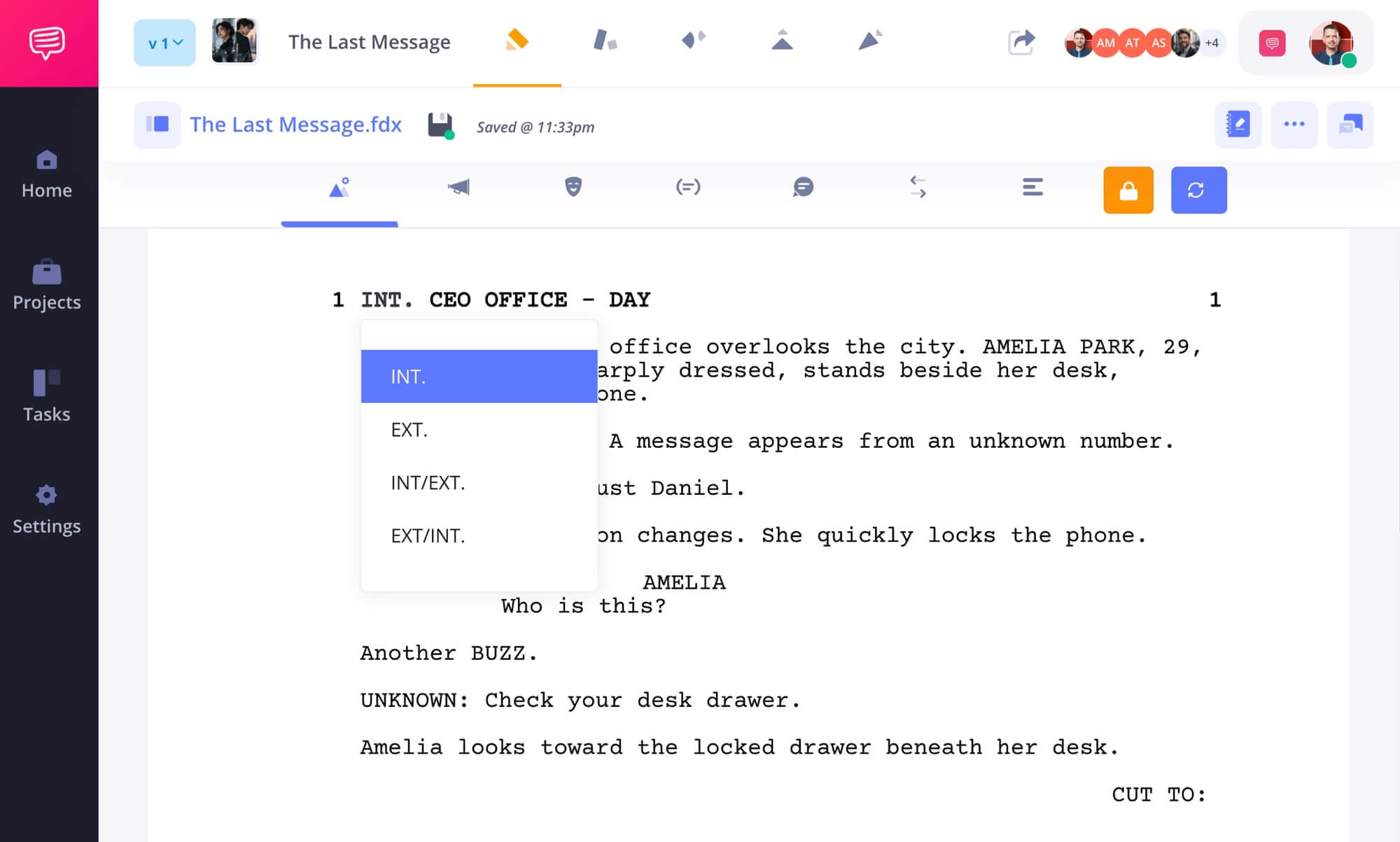
Screenplay - How to write a drama script
Whichever format you’re writing, the principle is the same: keep stage directions clear, concise, and focused on observable action. Tell actors and directors what happens, not how they should feel. Trusting the performances to communicate the emotion is an important piece of how to write a drama script.
Trusted by Over 1M Creatives
Screenwriting from draft to set
Write, format, and share your script. Ready for production when you are.

How to write a drama script
How to write stage directions in a drama
Stage directions exist to support the performance, not replace it.
Whether you're writing for stage or screen, keep your directions clear, active, and focused on what the audience can actually see.
Instead of writing:
SARAH slowly and thoughtfully crosses the room, thinking about what her mother told her.
Write:
SARAH crosses to the door. Her hand lingers on the handle.
The first tells the actor what to feel. The second gives them something to play.
Include stage directions that establish:
- Physical movement and blocking
- Significant props or actions
- Important visual details that affect the performance
Avoid filling them with:
- Camera directions in stage plays
- Psychological explanations
- Directing notes
- Technical production instructions
Stage plays often present stage directions in italics or parentheses, while screenplays use plain action lines. Regardless of format, they're usually written in the present tense.
As a general rule, trust your collaborators. The less you explain every emotion, the more freedom actors and directors have to discover it for themselves.
Drama scripts follow a distinctive format that allows directors, actors, and production teams to interpret the story consistently. Each formatting element serves a practical purpose while also shaping the dramatic experience. Scene headings establish the setting, stage directions describe only the essential action, character cues identify who is speaking, dialogue reveals conflict, parentheticals offer brief performance guidance, and subtext communicates what characters truly mean beneath their words.
The original excerpt below demonstrates how these elements work together to create a concise but dramatically effective scene. It's a great example for how to write a drama script.
INT. FAMILY KITCHEN - NIGHT
Rain taps against the window. A half-packed suitcase sits by the back door.
MAYA
(without looking up)
You're going early.
JONAH
I said I had work.
Maya folds a tea towel with unnecessary precision.
MAYA
Funny. You pack a suitcase once work stops calling.
JONAH
(forcing a smile)
You always notice the little things.
A long silence. Jonah reaches for the suitcase. Maya doesn't stop him.
MAYA
Drive safely.
JONAH
I will.
Dialogue formatting
Dialogue is where your audience gets to know your characters, so it needs to be easy to read. While the exact formatting varies between stage plays and screenplays, the basic principles stay the same.
In both formats, the character’s name appears above their dialogue.
For stage plays, character names are usually flush left or centered, depending on the publisher or theatre’s house style. The dialogue appears immediately underneath, with stage directions or parentheticals placed in parentheses when needed.
For screenplays, character names are centered and written in ALL CAPS, with dialogue directly beneath. Parentheticals sit between the character’s name and the dialogue, but they should be used sparingly. If every line needs an acting instruction, the dialogue probably isn’t doing enough work on its own.
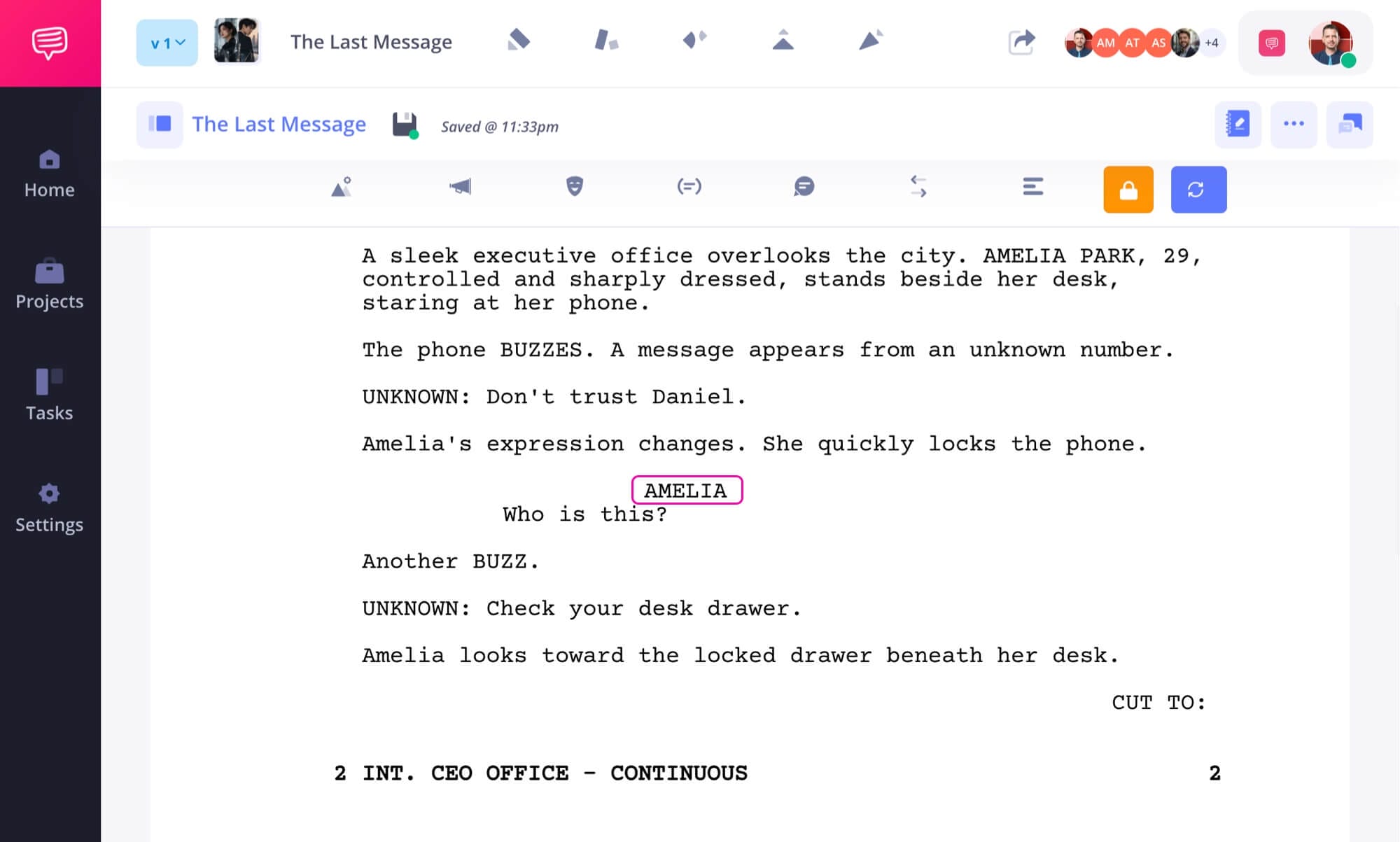
Screenplay - How to write a drama script
Good formatting disappears into the background, allowing readers, actors, and directors to focus entirely on the story. With smart formatting, you know most of what's needed for how to write a drama script.
Related Posts
How to write a drama script
Drama script structure
Every drama tells a different story, but most follow a similar dramatic shape. Writers have described that structure in different ways for more than 2,000 years, yet the underlying idea remains remarkably consistent: introduce a problem, make it worse, force a decisive confrontation, and show what changed because of it.
Think of these stages as a framework rather than a formula. They aren’t rules you have to follow for how to write a drama script, but understanding them gives you a strong foundation before you begin experimenting.
The setup: introduce the conflict
Your opening has an important job. It needs to introduce your protagonist, establish the world they live in, and give the audience a reason to keep watching.
Whenever possible, introduce your protagonist through action rather than explanation. What they do in their first scene often tells us more than pages of backstory ever could.
Just as importantly, plant the seeds of the central conflict early. The problem doesn’t have to explode immediately, but the audience should sense that something is out of balance and waiting to change.
In classical Greek drama, this opening section was known as the protasis, laying the groundwork before the central conflict unfolded. This opening section is essential to learning How to write a drama script that pulls the audience in.
For some reliable examples on how to write and escalate conflict, check out the video below.

Subscribe to the channel · How to write a drama script
Rising action: escalate the tension
The rising action is usually the longest part of the story, and it’s where drama earns its emotional payoff.
Every new scene should make your protagonist’s situation more difficult. The obstacles shouldn’t feel random or exist simply to extend the story. Instead, they should grow naturally from the characters’ decisions, relationships, and mistakes.
At its heart, rising action is driven by three simple questions:
- What does the protagonist want?
- What's stopping them from getting it?
- How far are they willing to go?
As the answers become more complicated, so does the drama. Check out the conflict ladder below to really get a full picture on how to write a drama script that sticks.
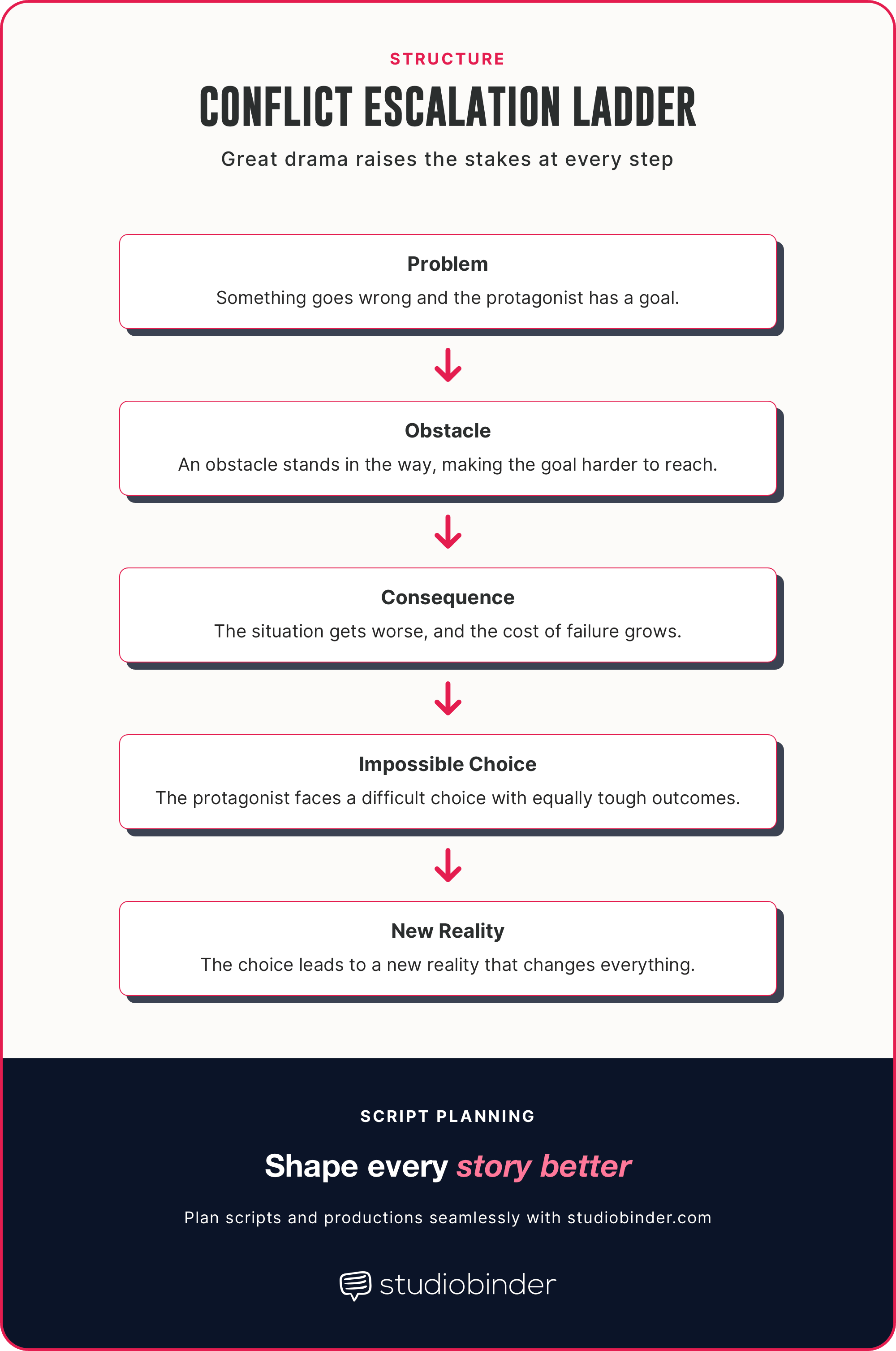
Conflict escalation ladder - How to write a drama script
Climax: the moment of maximum conflict
Every scene before the climax should be preparing the audience for this moment.
Here, the central conflict reaches its highest point. Your protagonist faces their greatest challenge and must make the decision they’ve been avoiding throughout the story.
A satisfying climax is rarely just an emotional revelation. It’s a choice that changes something. Someone acts, someone sacrifices something, or someone accepts a truth they can no longer escape.
Classical drama referred to this turning point as the catastrophe. Despite the name, it doesn’t have to end in tragedy. It simply marks the moment after which nothing can return to the way it was.
Falling action and resolution
A strong climax answers your story's biggest question. The falling action answers another: what did that decision change?
This section explores the consequences of the climax when establishing how to write a drama script. Relationships have shifted, victories have come at a cost, and your characters must live with the choices they've made. Sometimes those consequences are immediate. Sometimes they're quiet. Either way, they help the audience process everything that has happened.
Finally comes the resolution, sometimes called the denouement. This closes the world of the drama by establishing a new normal. It doesn't have to be a happy ending, but it should feel complete. The audience should understand where the characters have arrived, even if they don't know exactly what comes next.
The best endings feel both surprising and inevitable. You may not predict them while you're watching, but afterwards they seem like the only conclusion these characters could ever have reached.
Trusted by Over 1M Creatives
Screenwriting from draft to set
Write, format, and share your script. Ready for production when you are.
How to write a drama script
How to write drama dialogue
Many first-time writers learning how to write a drama script ask the same question: How do I make my dialogue sound realistic?
The answer is surprisingly simple: you don't.
Real conversations are full of greetings, repetition, unfinished thoughts, and small talk. Dramatic dialogue strips those things away, leaving only what serves the story. Every line should reveal character, create conflict, or move the scene forward.
Think less about writing realistic conversations and more about writing purposeful ones. Every character should enter a scene wanting something, and every line they speak should become a tactic for getting it.
Write what characters won't say
One of the defining features of how to write a drama script is subtext: the gap between what a character says and what they really mean.
Imagine a character has just received devastating news.
If they say, "I'm devastated," there's very little left for the audience to discover.
If they smile and say, "I'm fine," while avoiding eye contact, the audience immediately senses something beneath the surface. The dialogue isn't carrying the emotion alone. The performance, the context, and what's left unsaid all work together.
This is why writers like Chekhov and Harold Pinter are so often studied. Their dialogue creates tension not through explanation, but through omission.
Before writing a scene, ask yourself one simple question:
What does each character want?
Once you know the answer, every line becomes an attempt to persuade, threaten, comfort, manipulate, distract, or protect themselves. Dialogue stops becoming conversation and starts becoming action.
Give each character a distinct voice
Every character sees the world differently, so they shouldn't all sound the same.
Voice isn't about giving someone a catchphrase or an accent. It's the result of who they are. Their age, background, confidence, education, relationships, and emotional state all influence how they speak and, just as importantly, what they choose not to say.
A useful editing exercise is to cover the character names and read the dialogue aloud. If you can't immediately tell who's speaking, their voices probably aren't distinct enough.
Another common trap is exposition. If a line only exists to tell the audience information, ask yourself whether the character has a genuine reason to say it. Dialogue feels most natural when information emerges because it helps the character achieve their goal, not because the writer needs the audience to know it.
For more on writing conversations for your characters, watch the below video on how to make character voices more distinct.

Subscribe to the channel · How to write a drama script
Use silence and pauses intentionally
Sometimes the most powerful line in a scene isn't spoken at all.
On stage, pauses are often written directly into the script. A beat gives the audience a brief moment to absorb what's happened. A pause creates hesitation or uncertainty. A silence can become a dramatic event in itself.
Like dialogue, every pause should have a purpose. Is the character choosing not to answer? Building the courage to tell the truth? Waiting for the other person to speak first?
Use silence as carefully as you use dialogue. Too many pauses slow the pace and reduce their impact. Used at the right moment, however, they can communicate more than an entire speech.
Trusted by over 1M creatives
Schedule your production, visually
Plan shoot days with a stripboard, and generate auto-filled call sheets.

How to write a drama script
How StudioBinder helps drama writers
Finishing your script isn't the end of the process. It's the beginning of bringing it to life.
StudioBinder's screenwriting software helps you write and format stage plays or screenplays using professional formatting conventions. Once your draft is ready, you can generate character breakdowns to see where each character appears, helping you prepare for casting and rehearsals.
As your project moves into production, StudioBinder keeps everything connected. You can organize auditions, schedule table reads, attach the latest script, build call sheets, create shot lists, and manage production from one place.

Calendar - How to write a drama script
Instead of juggling multiple documents and spreadsheets, your script becomes the foundation for every stage of the filmmaking process, letting you spend less time on logistics and more time developing your story.
Related Posts
Frequently Asked Questions
Drama Script FAQs
A drama script is a written work created for performance that centres on serious human conflict. It can be written for the stage, film, or television, but every drama script uses character-driven storytelling, structured conflict, and emotional truth to move the audience through a complete dramatic journey.
Drama script format depends on the medium. Stage plays typically use act and scene headings, stage directions, and character names above dialogue. Screenplays follow industry-standard formatting with scene headings, action lines, centred character names, and dialogue. Television drama scripts generally follow screenplay conventions while including labelled act breaks.
The length of a drama script depends on what you're writing. One-act plays are often around 20–50 pages, while full-length plays usually range from 60–100 pages. Feature screenplays are typically 90–120 pages, and one-hour television dramas often run between 45–55 pages. These are industry conventions rather than fixed rules though.
A good drama script follows characters who want something urgently and face meaningful obstacles to getting it. Every scene deepens the conflict, dialogue reveals more than it says outright, and the ending feels earned because it grows naturally from the choices the characters make throughout the story.
UP NEXT
Acting Scripts: Types, Formats, and How to Read Them
How to write a drama script is only part of the process. Next, learn how actors break down dialogue, objectives, beats, and character choices in Acting Scripts.

From script to production. Write, collaborate, and produce all in one place.
Write scripts online for free. Track versions. Share for feedback and approval. When you're done transition seamlessly to script sides, shot lists, storyboards, schedules, breakdowns, call sheets and more.


