Television drama is often mistaken for prestige. But great drama is not defined by budget or reputation. It is defined by consequence. The best TV dramas sustain tension across years without losing psychological truth. Characters change in ways that feel irreversible.
Relationships evolve under pressure instead of resetting for the next episode. Television became uniquely suited to this form because of time. A film has two hours. A television drama can spend sixty hours watching somebody slowly become unrecognizable to themselves.
Best tv dramas
Ingredients for the best TV dramas
Many different elements go into creating what are widely considered to be the best TV dramas of all time.
Before we officially jump into our list, scan through the thematic ingredients in the chart below. This showcases the core series concepts we considered while putting our list together.
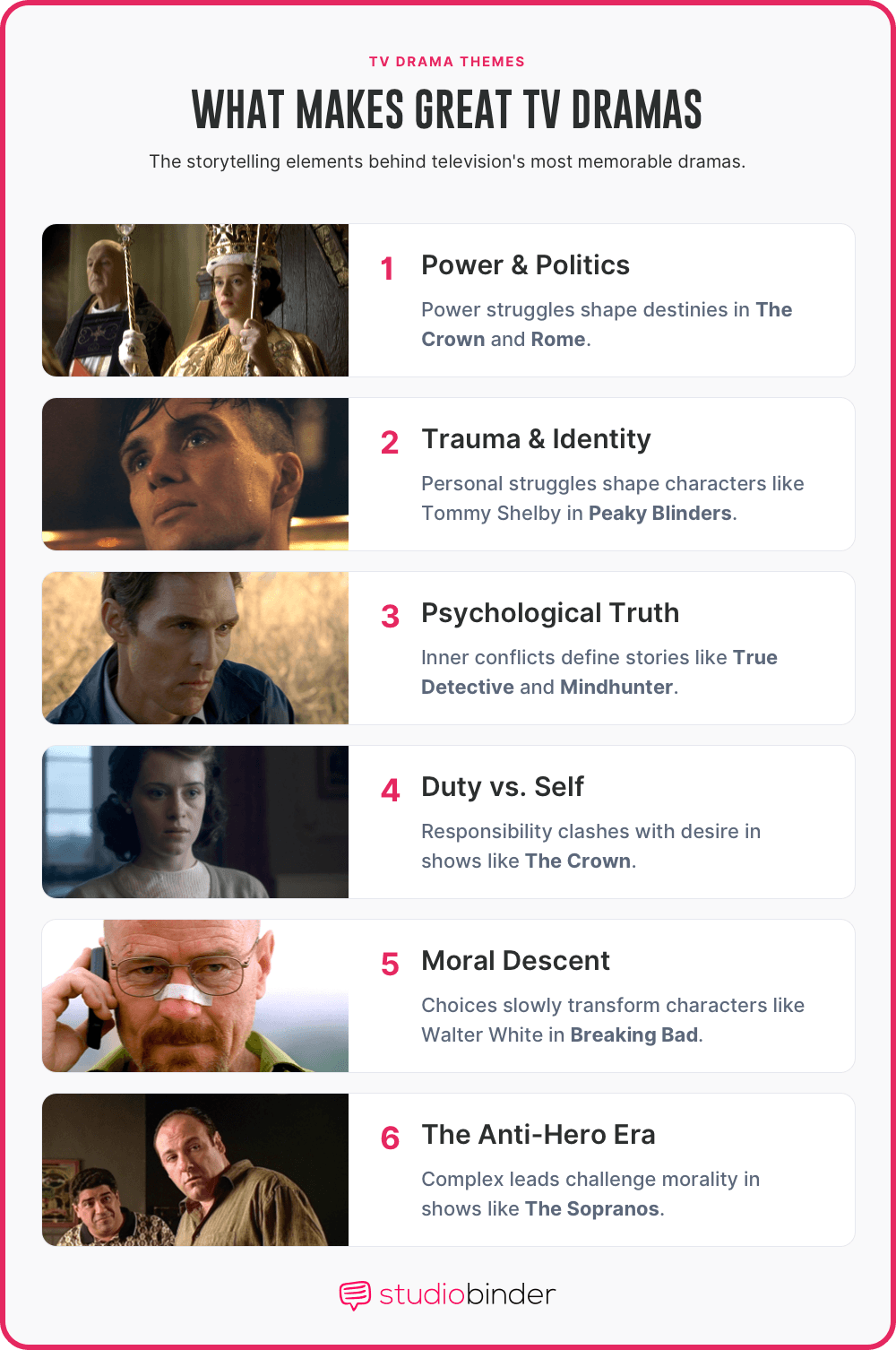
Defining Storytelling Elements Behind Memorable Dramas • Best tv dramas of all time
Now that we've established what defines the criteria for this list of the best TV dramas, let's jump in and start at #20.
Best tv dramas
20. Rome
First on our list of all-time best TV dramas, Rome. Many historical epics collapse under their own scale. Rome avoided that problem by anchoring enormous political events through two ordinary soldiers trying to survive history as it happened around them.
Lucius Vorenus and Titus Pullo are the show’s anchor. They function as structural glue between senate politics and street-level violence. Without them, the series risks losing any sense of itself. With them, Julius Caesar’s rise feels immediate and unstable.
Rome Trailer • Best tv dramas of all time
Bruno Heller understood that political systems become dramatically legible only when filtered through personal relationships. The senate debates matter because they alter marriages, friendships, loyalties, and survival.
The production design was staggering for television at the time, but what still holds up is the grime. Ancient Rome feels sweaty, crowded, transactional, and deeply superstitious. The show resists the polished marble version of antiquity most historical dramas default to.
Its cancellation remains frustrating because the series had only just figured out its full dramatic range by Season 2. Even so, what it accomplished in two seasons shaped nearly every large-scale prestige historical drama that followed.
Best tv dramas
19. Peaky Blinders
The early seasons of Peaky Blinders easily rank in the best TV dramas because Steven Knight treats Tommy Shelby’s trauma as active machinery rather than decorative backstory.
Tommy is not haunted by World War I in abstract terms. The war fundamentally changed him. It shaped how he experiences power, intimacy, sleep, violence, and control. His calmness is often dissociation masquerading as intelligence.
That psychological foundation prevents the show’s style from drifting into parody during its best years.

Peaky Blinders The Immortal Man Trailer • Best tv dramas of all time
Season 1 and Season 2 remain the strongest because the series still feels grounded in material survival. Birmingham is economically wounded. Criminality emerges from industrial collapse. Once the series expands internationally, some of that pressure dissipates.
Cillian Murphy’s performance carries much of the show’s credibility. He understands that Tommy rarely raises his voice because he is constantly calculating social threat levels. The stillness becomes intimidating.
The production’s use of modern music should not work on paper. Yet the series occasionally achieves something strange and effective through that collision between contemporary sound and postwar decay. The result is inherited trauma echoing forward through time.
Best tv dramas
18. Battlestar Galactica (2004)
Ronald D. Moore’s reboot arrived during the post-9/11 era and absorbed that anxiety into nearly every aspect of its storytelling.
Underneath the science fiction framework is a drama about paranoia, militarization, religious extremism, occupation, and collective fear. The series repeatedly asks whether survival inevitably corrodes morality.
Battlestar Galactica Trailer • Best tv dramas of all time
What separates the early seasons from most genre television is dramatic discipline. Episodes are structured around ethical dilemmas rather than mythology dumping. Characters make decisions under impossible pressure and then continue living with the consequences several episodes later.
The Cylons work because the show refuses easy binaries. The central question gradually becomes less “Are the machines human?” and more “What actually qualifies humanity morally?”
Season 1 and much of Season 2 are remarkably controlled television. The writing trusts silence. Political disagreements unfold through characters and relationships rather than exposition.
The later seasons undeniably lose structural focus. Storylines multiply faster than the series can resolve them coherently. Mysticism begins replacing dramatic causality. Even so, the early run remains one of the most ambitious uses of science fiction television as political drama.
Best tv dramas
17. The Crown
Peter Morgan’s central insight is deceptively simple: monarchy is dramatically useful because it prevents honesty.
Every season of The Crown returns to the same pressure point. Public duty and private identity cannot peacefully coexist. The institution survives specifically because individual emotional needs are suppressed. That tension gives the series its shape.
The historical detail matters, but not as decoration. The political structure creates the emotional constraints. A state dinner turns into a marital dispute. A constitutional crisis becomes a personal identity crisis unfolding behind closed doors.
What made the series culturally significant was the way it reshaped audience perception of the royal family itself. The show encouraged viewers to interpret figures like Elizabeth, Margaret, Philip, and Charles psychologically rather than ceremonially.
The Crown Trailer • Best tv dramas of all time
As BBC Culture observed in 2019, The Crown fundamentally altered how many people emotionally understood the monarchy, particularly younger audiences encountering these figures primarily through the series rather than traditional royal coverage.
Most major moments occur quietly in rooms where nobody is allowed to fully say what they mean. That suppression becomes the drama.
Claire Foy remains the series’ emotional center because she understands Elizabeth not as coldness, but as somebody gradually erasing visible traces of herself in order to function. Her character is a large piece of what makes The Crown one of the best TV dramas of all time.
Related Posts
Best tv dramas
16. Ozark
Marty Byrde is one of television’s strangest anti-heroes because he rarely behaves like one.
He is not charismatic in the traditional sense. He is not dominant. He is not even especially brave. Marty survives because he understands systems better than people do.
That makes Ozark feel different from most crime dramas descended from The Sopranos or Breaking Bad. Marty’s primary weapon is administrative intelligence. He approaches catastrophe like an exhausted accountant trying to spreadsheet his way out of moral collapse.
![Ozark | Official Trailer [HD] | Netflix](https://i.ytimg.com/vi/5hAXVqrljbs/hqdefault.jpg)
Ozark Trailer • Best tv dramas of all time
Jason Bateman’s performance is key to this balance. He plays Marty like somebody permanently stuck between panic and calculation.
The show’s greatest strength is escalation. Every attempt to stabilize the family creates wider instability. The writing understands that laundering money is dramatically interesting only when domestic life begins absorbing criminal logic.
Wendy eventually becomes the more compelling character because the series allows ambition to transform her openly instead of disguising it beneath reluctant survival. Laura Linney recognizes that Wendy increasingly enjoys power long before she admits it to herself.
The final season loses some precision because the series begins protecting its characters from consequences it previously embraced. Earlier seasons felt genuinely dangerous. Later episodes occasionally mistake shock for inevitability.
Still, at its best, Ozark understood something many of even the best TV dramas forget: intelligence without morality eventually becomes indistinguishable from cowardice.
Best tv dramas
15. Mindhunter
Most crime procedurals are built around resolution. Joe Penhall understood that a genuinely disturbing and intriguing question is not whether the FBI would catch killers. It was whether prolonged exposure to violent psychology slowly reshapes the people studying it.
Holden Ford begins as intellectually curious and emotionally confident. Over time, the distinction between empathy and absorption starts collapsing. His interviews with serial killers are structured almost like seductions. The tension comes from watching him mistake proximity to darkness as mastery over it.
MINDHUNTER Season 2 Trailer • Best tv dramas of all time
David Fincher’s direction goes a long way. Conversations unfold with eerie stillness. Emotion is rarely pushed.The discomfort comes from duration. The series forces viewers to sit inside manipulative conversations long enough to understand why these men can be psychologically compelling to investigators.
What makes the show unusually unsettling is that the killers are not written as criminal masterminds. Many are pathetic, insecure, lonely, and deeply ordinary. A lot of the horror comes from how banal they can appear while describing monstrous acts.
The procedural framework is almost misleading. Cases matter less than psychological erosion. Everyone involved in the work begins carrying traces of it home. Studying violence does not leave people untouched.
Best tv dramas
14. True Detective
Season 1 of True Detective remains one of the best tv dramas and tightest single-season runs television has produced. It understands that the murder mystery is not the point. The real subject is Rust Cohle.
Nic Pizzolatto structures the investigation as a long-form argument between two worldviews. Rust’s nihilism dominates the early episodes because Matthew McConaughey plays him with complete conviction. He does not sound like a man performing intelligence. He sounds like somebody who has spent years thinking himself into isolation.
The Louisiana setting means that the landscape itself begins reflecting the show’s moral decay. Industrial ruins, abandoned churches, flooded roads and empty schools. The environment is spiritually exhausted before the investigation even begins.

True Detective Season 1 Trailer • Best tv dramas of all time
What elevates the season is its patience. Scenes are allowed to breathe long enough for psychological contradictions to emerge. Marty Hart initially appears more emotionally stable than Rust, but gradually reveals himself to be equally fractured in quieter, more recognizable ways.
The eight-episode structure is crucial. There is no narrative bloat. Every episode deepens either the central relationship or the thematic argument underneath it.
Importantly, the show eventually pushes back against Rust’s worldview. The ending does not suddenly become optimistic, but it rejects total nihilism. Rust’s final realization lands because the writing spends eight episodes earning his collapse first.
The later seasons struggled partly because they misunderstood what made the first one work. Audiences remembered the occult imagery, philosophical monologues, and atmosphere. But the actual achievement was dramatic architecture. Season 1 was fundamentally a character study disguised as a detective story.
Related Posts
best tv dramas of all time
13. Six Feet Under
Every episode of Six Feet Under begins with a death.
That structural decision sounds gimmicky until you realize what Alan Ball is actually doing. The deaths create thematic accountability. The series constantly reminds its characters, and the audience, that avoidance has a deadline.
Six Feet Under Season 5 Trailer • Best tv dramas of all time
The show is less interested in mortality itself than in the strange ways people delay living honestly. The Fisher family are surrounded by death professionally, yet remain emotionally evasive in almost every area of their lives. Conversations trail off. Resentments calcify. Desires are hidden beneath politeness or self-preservation.
What makes the series endure is its refusal to divide people into heroes and villains. Everyone on the show is selfish sometimes. Everyone is frightened sometimes. Even moments of cruelty usually emerge from emotional paralysis rather than malice. In short, they’re tragically human.
The fantasy sequences remain one of the show’s smartest devices because they externalize emotional conversations characters cannot have directly. Dead people appear not as supernatural elements, but as psychological manifestations of guilt, fear, memory, or longing.
The finale became legendary because the writing earned it structurally over five seasons. The ending works precisely because the show spent years teaching viewers to think about mortality not as abstraction, but as inevitability attached to ordinary life.
With that groundwork, the series finale montage is devastatingly honest.
Best tv dramas
12. Deadwood
David Milch wrote dialogue unlike anybody else in television. Deadwood sounds Shakespearean, vulgar, philosophical, theatrical, and strangely modern all at once. Characters speak in elaborate rhythms before collapsing into profanity. The language should feel artificial. Instead, it creates one of the most immersive dramatic worlds television has produced.

Deadwood Series trailer • Best tv dramas of all time
Milch understood that realism is not always literal accuracy. The partially anachronistic dialogue exists because exact historical speech would not communicate the psychological violence of the setting to modern audiences with the same force.
Al Swearengen remains one of television’s greatest dramatic creations because the series allows him full humanity without softening his brutality. Ian McShane plays him as both terrifying and unexpectedly vulnerable. Swearengen understands systems before anyone else does. He sees civilization arriving long before the town fully recognizes it.
The series is fundamentally about institutions forming in real time. Businesses, governments, law enforcement, and capitalism emerge simultaneously out of chaos.
What makes the show remarkable is that it never romanticizes the process. Community formation is messy, transactional, and frequently violent. Even the tenderness is hard-earned.
Best tv dramas
11. Fargo
Fargo proved an anthology series did not require continuity to feel coherent. Noah Hawley built each season around the same moral universe. It contains ordinary people colliding with violence they barely understand, while forces larger than them quietly reshape the outcome.
Fargo Trailer • Best tv dramas of all time
The tonal balance is extraordinarily difficult to sustain. The series moves between absurd comedy and genuine menace without collapsing into parody. Characters in Fargo often make catastrophically bad decisions for painfully human reasons: greed, embarrassment, loneliness, panic, ego. The show understands that tragedy frequently begins with small acts of self-justification rather than grand corruption.
Season 1 remains the strongest because of Billy Bob Thornton’s performance as Lorne Malvo. Malvo functions less like a traditional villain and more like chaos entering a morally passive environment. He exposes weaknesses already present in people around him.
The Coen brothers’ influence is obvious, but Hawley gradually developed his own dramatic identity through the anthology structure. The series became less interested in imitation and more interested in American mythology. It features crime stories, Midwestern politeness, capitalism, folklore, and random chance colliding together.
But even at its most surreal, Fargo never loses interest in frightened ordinary people trying to convince themselves they still control events long after control has disappeared.
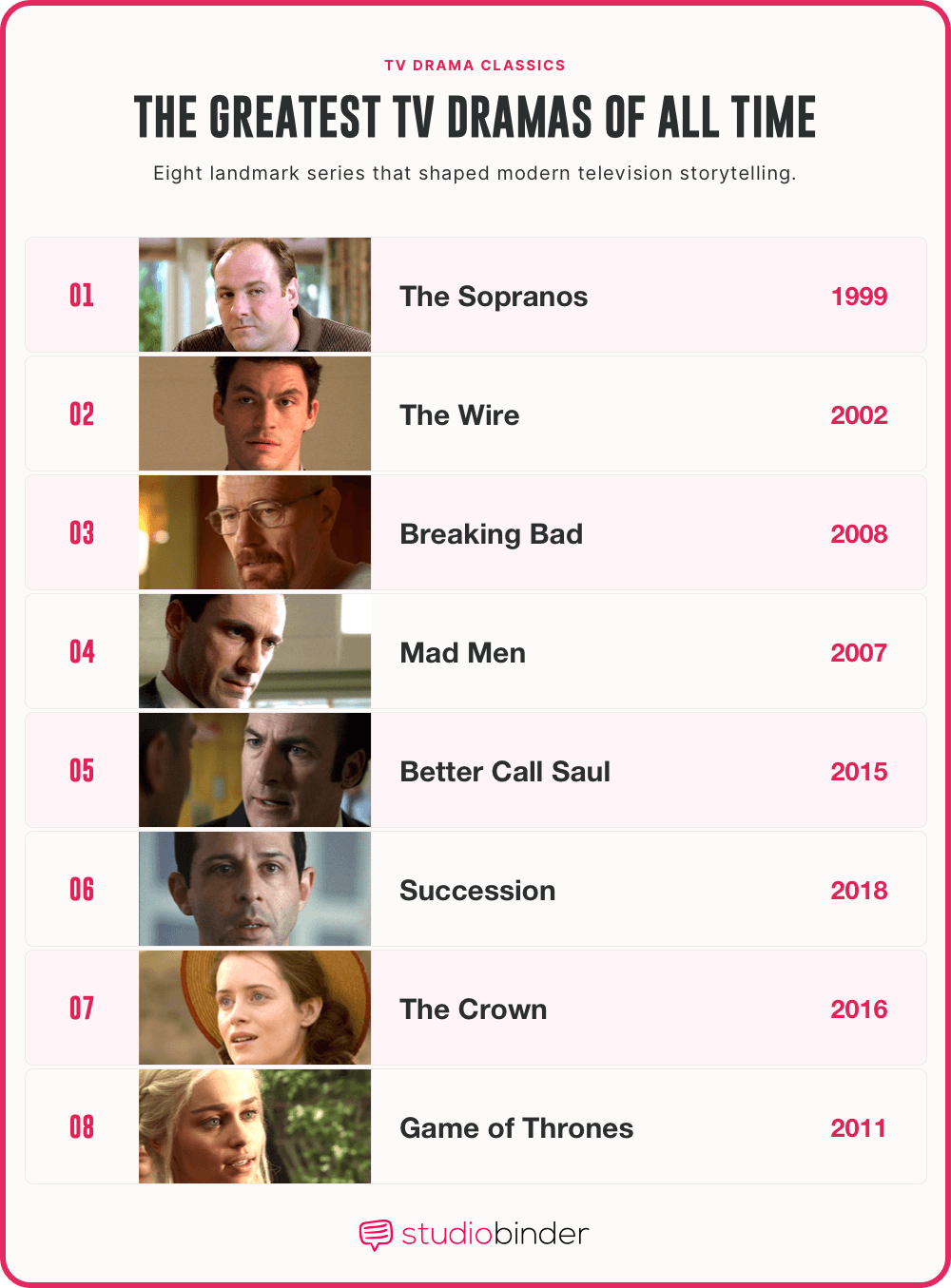
Iconic Series That Shaped Modern Television • Best tv dramas of all time
Best tv dramas
10. Game of Thrones
For four seasons, Game of Thrones achieved something television had never really managed before, which is fantasy written with the structural discipline of political tragedy. George R. R. Martin’s storytelling rejected the comforting logic fantasy often relies on.
Moral importance did not guarantee survival. Intelligence did not guarantee power. Violence created ripples that permanently reshaped the political landscape. David Benioff and D. B. Weiss translated that ruthlessness remarkably faithfully during the show’s first four seasons.

Game Of Thrones Season 1 Trailer • Best tv dramas of all time
As Aristotle wrote in Poetics, “Poetry tends to express the universal, history the particular.” Game of Thrones works because it understands this instinctively. Westeros is fictional, but the emotional dynamics are not. Characters become stand-ins for recognizable human desires: survival, revenge, love, status, belonging, justice. Their needs become ours.
That is why viewers reacted so intensely to the show’s victories, betrayals, and eventual ending. The series did not succeed because audiences cared about maps or lore. It succeeded because people became emotionally attached to Sansa Stark, Tyrion Lannister, Jon Snow, Arya Stark, Cersei, The Hound, Daenerys, and dozens of others. The political game mattered because the characters inside it mattered.
One of Martin’s smartest structural choices is the central question underlying the entire narrative: who deserves power?
The Iron Throne is an object that corrupts everyone orbiting around it. The story turns leadership into a universal moral question rather than a fantasy abstraction. Who should govern? Who can be trusted with authority? What qualities actually make somebody fit to lead?
The brilliance of the series is that it makes those questions emotionally active through underdogs and outcasts. A ‘bastard’. A dwarf. An exiled woman sold into marriage. A disfigured fighter. A woman dismissed because she wants power openly instead of indirectly. We instinctively root for them because the writing positions them against rigid social structures designed to diminish them.
Martin and the television writers constantly subvert familiar fantasy archetypes. Noble knights fail morally. Kings are pathetic and weak. Warriors become caretakers. Victims become conquerors. The series repeatedly isolates characters from the roles society expects them to play, which makes audiences identify with them even more strongly.
The early seasons are also exceptional at handling backstory. Information about the Mad King or the Targaryen dynasty never arrives as exposition for its own sake. It alters how viewers interpret Daenerys in the present and plants future fears in the audience’s imagination. Backstory becomes dramatic foreshadowing rather than biography. Even the scripts themselves reflect this efficiency. For such an immense fantasy world, the scene description is famously sparse, direct, and playable.
After Season 4, cracks gradually began appearing as the series moved beyond Martin’s published material. Plot increasingly overtook psychology. Characters started arriving at emotional conclusions without sufficient dramatic groundwork. Earlier seasons asked, “What would this person realistically do under these pressures?” Later seasons often asked, “What outcome does the story require?”
That shift revealed where much of the dramatic architecture had originally come from. The first four seasons remain extraordinary because they fused fantasy with deeply human dramatic logic. They understood that audiences do not emotionally invest in mythology alone. They invest in people struggling inside systems larger than themselves.
Best tv dramas
9. The Americans
At first glance, The Americans looks like a Cold War espionage thriller. In reality, it is a marriage drama disguised as one.
Joe Weisberg understood that spycraft is only dramatically interesting when it puts pressure on identity. Philip and Elizabeth Jennings spend six seasons performing roles so constantly that they begin losing track of where performance ends and selfhood begins.
Every lie told professionally bleeds into domestic life. Every mission destabilizes intimacy a little further.

The Americans Series Trailer • Best tv dramas of all time
Television often panics midway through long runs and accelerates story conflict artificially. The Americans refuses shortcuts. Emotional shifts happen gradually, often invisibly at first. Resentment accumulates over years. Loyalty is lost in increments.
Matthew Rhys gives one of the great television performances because Philip increasingly looks exhausted by the effort required to maintain ideological certainty. Keri Russell plays Elizabeth with terrifying discipline. Her emotional repression is not coldness. It is survival training internalized so deeply it has become personality.
The series also understands the loneliness of belief systems collapsing privately. Philip and Elizabeth are not simply spies hiding from America. They are people slowly becoming strangers to the worldview that once organized their entire lives.
The finale works because the writing remains structurally honest to every relationship involved. Nobody receives easy catharsis. The damage cannot be undone cleanly.
Best tv dramas
8. Mad Men
One of the most common criticisms of Mad Men is that “nothing happens.” In reality, most of what's happening is set in internal conflict. And it's subtly what makes it one of the most enduring and downright best TV dramas ever.
Matthew Weiner built a drama where subtext carries the majority of the narrative weight. Conversations are rarely about what characters are actually feeling. Desire, shame, ambition, attraction, fear, class anxiety, and loneliness sit underneath scenes without being spoken.
The 1960s setting is not aesthetic wallpaper. It externalizes Don Draper’s psychology. America is constructing a glossy image of itself while quietly collapsing underneath the surface. Don functions the same way. He is branding himself constantly.

Mad Men Trailer • Best tv dramas of all time
As Don understands better than anyone, advertising is fundamentally about selling emotional solutions to existential problems. Mad Men brilliantly exposes the distance between the American Dream as branding exercise and the unhappiness underneath it. Nearly everyone in the series is attractive, professionally successful, and materially comfortable. Most of them are miserable.
The show’s fascination for modern audiences partly comes from its inverted moral world. Men smoke constantly, cheat openly, drink at work, neglect their children, weaponize gender roles, and move through offices with a level of unchecked authority that now feels both horrifying and strangely anthropological. Yet underneath that social freedom sits extraordinary repression. Nobody knows how to speak honestly about themselves.
Peggy Olson becomes the series’ most important structural figure because she represents transition. She belongs neither fully to the old world nor the emerging one. Her ambition carries real cost precisely because the culture around her has not caught up yet.
What makes the series great is that personal psychology and national mythology become indistinguishable from one another. The collapse of traditional American identity is happening simultaneously inside living rooms, offices, marriages, and ad campaigns.
Even the ending understands this contradiction perfectly. Don’s apparent spiritual breakthrough immediately transforms into advertising inspiration. Self-discovery instantly becomes brand strategy.
Best tv dramas
7. Band of Brothers
War dramas often struggle with scale. Either the battles overwhelm character arcs, or the character work shrinks the historical reality surrounding it.
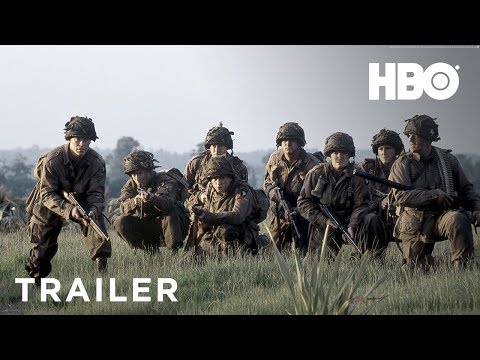
Band of Brothers Trailer • Best tv dramas of all time
Band of Brothers somehow manages both. Steven Spielberg and Tom Hanks approached Easy Company with unusual restraint for a series this large. The writing never treats the soldiers as mythic heroes. It treats them as young men adapting to impossible circumstances one mission at a time.
The “true story” framework changes the emotional stakes immediately. These people existed. Many died young. The interviews with surviving veterans create an unusual dramatic pressure because viewers understand the series is carrying memory rather than simply inventing narrative.
The structure solves this by constantly rotating perspective. Different episodes foreground different emotional experiences within the company. Fear, leadership, cowardice, exhaustion, grief, resentment, trauma, and loyalty all emerge from different characters organically instead of reducing the ensemble to basic character archetypes.
Importantly, the series allows soldiers to be frightened, petty, angry, and emotionally drained without framing that as weakness. Heroism becomes endurance rather than spectacle.
The combat scenes remain effective because confusion dominates them. Characters frequently do not understand the full situation around them. Orders collapse. Violence interrupts conversations mid-sentence.
The series honors these men specifically by refusing reverence. It understands that idealization would flatten them into symbols.
Best tv dramas
6. Chernobyl
Chernobyl is not fundamentally about nuclear disaster. Craig Mazin structures the series around a simple but devastating idea. That systems built on denial eventually force reality to collect its debt. The reactor explosion is the event. The cover-up is the engine.
Beginning the series with Valery Legasov’s suicide is one of the show’s smartest decisions because it transforms the narrative immediately. The audience already knows where the story ends. The tension becomes psychological and moral instead.
What could possibly drive somebody toward this conclusion?
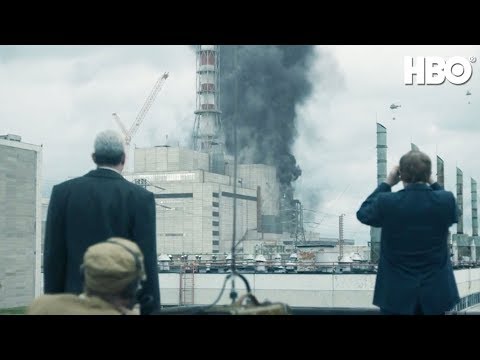
Chernobyl Trailer • Best tv dramas of all time
Legasov emerges as one of television’s great tragic figures precisely because he is not introduced as heroic. Jared Harris plays him as a man slowly realizing that truth itself has become politically dangerous. The series repeatedly shows how bureaucratic systems force denial at every level. Nobody wants to report bad news upward. Nobody wants to appear responsible. Nobody wants to contradict authority publicly. The disaster escalates because preserving institutional image becomes more important than confronting reality.
The miniseries format is crucial here. Five episodes force a trim narrative. There is no room for drifting. Every scene advances either technical understanding, political tension, or emotional deterioration.
What makes the show especially effective is its refusal to sensationalize suffering unnecessarily. The horror comes from process. Meetings. Delays. Miscommunication. Human beings rationalizing catastrophe in real time because accepting reality would be devastating. Legasov ultimately understands the true cost of lies. They don’t just distort truth abstractly. They reshape what people are willing to sacrifice to protect systems already failing around them.
Best tv dramas
5. Better Call Saul
Prequels are often trapped by inevitability. We already know how the story ends. It’s easy for there to be no suspense. Characters survive because continuity requires them to survive. Better Call Saul turns inevitability into dramatic advantage.
What Vince Gilligan and Peter Gould realized was that the real question was never whether Jimmy McGill would become Saul Goodman. The real question was how many chances he would receive not to, and what he lost in the process.

Better Call Saul Trailer • Best tv dramas of all time
Jimmy’s transformation unfolds with no fake “breaking bad” moment designed to shock audiences. Tiny moral evasions slowly harden into identity. The show becomes a slow-motion tragedy, a car crash unfolding so gradually that viewers briefly convince themselves it might still be avoidable.
Bob Odenkirk plays Jimmy with enough warmth and improvisational charm. The Kim Wexler storyline is what elevates the series from excellent to devastating. Rhea Seehorn plays Kim as somebody split between discipline and appetite. Her attraction to Jimmy is not naïveté. It is recognition. He awakens impulses she normally suppresses beneath competence and professionalism. That is why their relationship hurts so much to watch.
The Gene Takavic flash-forwards remain one of the boldest choices in recent television. From the opening episode, viewers are shown the endpoint waiting for Saul after Breaking Bad: loneliness, paranoia, spiritual collapse, anonymity beneath fluorescent lighting in an Omaha Cinnabon.
The irony becomes unbearable because audiences understand consequences long before Jimmy accepts them himself. Like Breaking Bad, the series leans into silent moments. Mike’s scenes in particular are almost almost meditative in pacing. The calmness becomes its own source of dread.
By the end, Breaking Bad itself becomes richer retroactively. Saul Goodman is no longer comic relief hiding inside another genre. He’s tragedy hiding in plain sight.
Best tv dramas
4. Succession
Jesse Armstrong writes humiliation with almost surgical precision. The genius of Succession is that it presents devastation as comedy without weakening the pain underneath it. Insults become power plays. Jokes become evasions. The Roy family are tragic figures incapable of recognizing their own tragedy. That contradiction powers the entire show.
The dialogue sounds chaotic at first, but it is meticulously shaped underneath. Interruptions are tactical. Even filler language carries information. Pay attention to who says “uh-huh” like Logan Roy and suddenly the family psychology becomes visible.
The closer characters remain to Logan’s gravitational pull, the more they unconsciously mimic his cadence. Armstrong turns tiny speech habits into evidence of inherited trauma.
Succession Season 1 Trailer • Best tv dramas of all time
The Roys live in a world where the sky should theoretically be the limit, yet their lives feel claustrophobic. The same rooms. The same resentments. The same humiliations recycled endlessly. The writing mirrors this too, constantly returning to old wounds and remembered phrases. Each sibling develops a different survival mechanism around him. Kendall fights. Connor disappears into fantasy. Roman freezes and can’t take anything seriously. Shiv placates and performs competence. Armstrong writes trauma in real time.
Even the production design reinforces this emotional barrenness. Beige penthouses. Grey conference rooms. Expensive spaces drained of individuality. Nobody in this world seems capable of making a genuinely expressive choice defined by a sense of self.
The sitcom influence is also crucial. Armstrong has spoken about wanting episodes with enough “protein” to stand alone structurally, and you can feel that discipline constantly. Every episode has its own shape while still feeding the larger tragedy.
The Roys repeatedly attempt escape or reinvention only to snap back into the same destructive patterns. Kendall rebels, then returns. Shiv distances herself, then circles back. Roman seeks approval despite understanding the damage approval costs him.
Nobody really changes because nobody escapes the family system. The finale lands because of this. Succession was always about one question: who inherits Logan Roy’s empire? Once that question is answered, extending the story further would dilute the shape that gave the series its force.
The ending is not tragic because the wrong person wins. It is tragic because the emotional cycle continues.
Best tv dramas
3. Breaking Bad
Vince Gilligan famously described Breaking Bad as the process of “turning Mr. Chips into Scarface.” The series commits to that transformation from the opening episode onward.
It’s all there in the pilot. Walter White’s humiliation. His pride. His resentment. His incredible intelligence . Even before the criminal escalation begins, the foundation is there. The writers'room have said that their guiding question throughout the series was deceptively simple: “Where is the character’s head at?”
That focus is what gave Breaking Bad its unusual dramatic honesty. Plot never feels imposed externally because character psychology drives every major turn. The writers frequently abandoned exciting ideas once they realized the characters would not plausibly behave that way.
The Drew Sharp murder in Season 5 is a perfect example. Originally, Jesse was meant to remain embedded in the criminal world longer. But once Todd kills the child on the motorbike, the writers understood Jesse could not continue forward unchanged. The story bends around character rather than forcing character to obey plot.
The famous index-card plotting system in the writers’ room gave episodes rigor. Every beat was mapped extensively before scripts were drafted. Yet Gilligan and his team never treated structure as more important than emotional truth.
Bryan Cranston’s performance remains astonishing because he understands Walt’s ego as the true engine of the series. Money stops mattering relatively early. Success becomes the addiction. Like the psychology of Tony Soprano before him, Walt occasionally achieves flashes of self-awareness, but those realizations never fully stick. He keeps rationalizing himself into monstrosity.

Breaking Bad Full Series Trailer • Best tv dramas of all time
The show’s visual storytelling deserves equal credit. Gilligan has spoken about color evolution mattering more than specific symbolism. Characters visually shift as they psychologically shift. Marie’s constant purple becomes notable precisely because she remains comparatively stable while everyone else mutates around her.
The layering throughout the series is remarkable without ever becoming self-consciously clever. Walter’s different names reflect different identities depending on who is speaking to him. The crawl-space shot practically functions as a visual death and rebirth. Even Hank obsessing over minerals while recovering quietly echoes the crystal meth empire destroying his family.
Music and cinematography deepen that emotional layering constantly. Cook montages change tone depending on Walt’s mental state. Michael Slovis’ cinematography turns ordinary locations into expressions of paranoia, ego, or By the finale, Walt finally tells the truth in the simplest possible sentence: “I liked it.”
The series had been moving toward that admission from the very beginning.
Best tv dramas
2. The Wire
Baltimore in The Wire feels tired before the story even starts.
Everybody thinks they can beat the system for a while. McNulty thinks being smarter than everyone else will save him. Stringer Bell thinks professionalism will save him. Carcetti thinks ambition wrapped in reform language will save him. Bunny Colvin thinks one good idea might crack the whole thing open.
That is what makes the show hit differently from most crime dramas. There is no master villain hiding behind the curtain. Problems survive because institutions survive. Police departments protect statistics. Newspapers chase narratives. Schools teach survival before curiosity. Politics rewards optics over change. People adjust themselves accordingly.
The Wire Season 5 Trailer • Best tv dramas of all time
The series never turns this into a lecture. That is part of why it works. Simon trusts viewers to notice patterns without somebody spelling them out every episode. Conversations start halfway through. Characters disappear for stretches. Entire episodes drift through dockyards, classrooms, campaign offices, vacant houses.
By the end, Baltimore feels less like a backdrop than gravity. Everybody moves inside its pull whether they want to or not.
Best tv dramas
1. The Sopranos
Tony Soprano spends years talking about himself.
Every therapy session becomes a performance, a confession, an excuse, a manipulation tactic, and occasionally something close to honesty. Tony walks into Dr. Melfi’s office trying to arrange his own soul into a story he can live with.
The audience ends up doing what Melfi does: listening carefully for the gaps.
David Chase’s breakthrough was realizing a mob boss could carry a drama not because he was powerful, but because he was emotionally impossible to pin down. James Gandolfini never plays him like a criminal mastermind. He plays him warm, cruel, self-aware, childish, observant, pathetic, generous, vicious, funny, and frightening. Sometimes all within a single conversation. That changed television.

The Sopranos Trailer • Best tv dramas of all time
Tony does not fully understand himself from one moment to the next. That unpredictability keeps the character alive. The domestic material matters just as much as the mob material. Maybe more.
Arguments about college applications sit beside panic attacks and murders. Kids complain about homework while adults discuss betrayal and death a few feet away.
Related Posts
Frequently Asked Questions
Best TV Drama FAQs
Most critics still point to The Sopranos. Not because it was the biggest or most expensive series, but because it changed how television drama behaved. David Chase proved audiences would follow a violent, contradictory protagonist for years as long as the writing stayed observant, funny, uncomfortable, and recognizably human.
They’re trying to do different things. The Sopranos stays close to one man’s inner life and the damage he causes around him. The Wire keeps widening outward until an entire city becomes the subject.
The best dramas make characters feel difficult to summarize. People contradict themselves, make bad decisions for understandable reasons, and carry the consequences forward instead of resetting the next episode. Strong television also trusts viewers. It does not explain every feeling, underline every idea, or rush constantly toward spectacle.
The Sopranos shifted television away from tidy heroes and episodic storytelling. It’s the show that shed light on morally unstable protagonists, slower pacing, psychological messiness, and season-long character study. Without it, shows like Breaking Bad, Mad Men, Succession, and Better Call Saul probably would not exist in the form we know them now.
UP NEXT
Best Spike Lee Movies and TV Shows
Now that we're done covering the best TV dramas of all time, let's move over to film. From groundbreaking dramas to powerful documentaries, Spike Lee has built one of the most influential careers in film and television.
Explore the best Spike Lee movies and TV shows, and discover the stories, themes, and filmmaking techniques that define his work.