Episode 4 of Adolescence ends without the release most crime dramas build toward. Nobody breaks down screaming. Nobody delivers a speech that suddenly explains everything. A father sits across from his son and slowly realizes the boy he thought he understood has been living inside a world he never fully saw.
The series leaves viewers with questions, but not the kind people usually expect from a murder mystery. By the end, the issue is no longer whether Jamie killed Katie. The harder question is how somebody so young drifted into violence while still looking, at times, painfully ordinary. To have the Adolescence ending explained, we’ll have to dive deep into the impressively shot show.
Adolescence ending explained
What happens in the Adolescence finale?
Let's go through the story beats of the finale to really have the Adolescence ending explained. The finale centers on the conversation between Jamie and his father inside a therapy and interview setting. Almost nothing distracts from it. No major action sequences. No cross-cutting to other characters. The episode strips the story down to faces, pauses, and shifting expressions.
Jamie spends much of the conversation trying to sound detached. Sometimes he answers questions with flat indifference. Sometimes he becomes defensive. His father watches him carefully the entire time. Not aggressively. More like somebody searching for familiar ground and failing to find it.
The confession arrives without dramatic build up. Jamie admits responsibility for Katie’s death in a way that feels disturbingly plain. The scene does not pause to underline the moment.
What changes is his father’s expression. Stephen Graham plays the aftermath almost entirely through silence. You see him trying to hold himself together. At one point he looks down for several seconds because eye contact has become difficult. The camera remains on a close up, making every small reaction matter.
It is a long scene. You are left watching a man realize that loving somebody deeply does not guarantee understanding them, or helping them. The episode ends without offering relief because the series has no interest in pretending a confession solves anything.
Adolescence topped Netflix’s English TV chart in its second week with 42 million views. Netflix also says it became the most-watched limited series and most-watched UK title ever through its first two weeks.
Related Posts
Adolescence ending explained
Did Jamie actually do it?
Yes. By the end of the series, Adolescence makes it clear that Jamie killed Katie. The uncertainty surrounding the finale comes from the show asking how a thirteen-year-old reaches that point while the adults around him continue believing everything is fine.
That distinction is important because Adolescence is not structured like a traditional whodunit. The mystery is social and psychological rather than factual.
The series suggests Jamie spent time inside online spaces shaped by resentment, humiliation, misogyny, and status anxiety. It never presents this as a sudden transformation. The process is gradual. Language changes first. Then attitude. Then the way he talks about girls, rejection, and himself.
Developmental psychologists writing about the series have pointed out that adolescence is already a period filled with identity confusion, shame, and a desperate need for belonging. The show understands that. Jamie does not come across as somebody driven by ideology alone. He looks like a boy searching for certainty wherever he can find it.
That is partly why the series feels so disturbing. Jamie still behaves like a child in many scenes. He sulks. He withdraws. He struggles to explain himself. The violence exists alongside that immaturity rather than replacing it.
Adolescence ending explained
What the ending of Adolescence really means
The finale is less interested in solving Katie’s murder than examining the environment surrounding it. It is about the conditions that make violence possible.
Rather than providing a single cause, the series argues that tragedies like this emerge from a web of influences that no one person can fully control. By leaving the emotional aftermath unresolved, Adolescence asks viewers to consider how families, schools, communities, and online spaces all shape the lives of young people.
The ending lingers because it shifts the conversation away from who is to blame and toward what must change to prevent the next tragedy.
Related Posts
Adolescence ending explained
The show's thesis about radicalization
One of the smartest choices the series makes is not sensationalising spectacle. There is no master villain manipulating Jamie from the shadows. No dramatic montage showing him becoming “corrupted.” The process happens quietly.
The show hints at forums, videos, and online spaces built around grievance and humiliation. Jamie absorbs harmful ideas about masculinity, rejection, power, and status long before anybody around him notices the pattern forming.
The series does not suggest the internet alone caused the violence. The point is more uncomfortable than that. Jamie already feels isolated before those ideas fully take hold. He struggles socially. He has difficulty expressing vulnerability directly. Shame keeps curdling into anger because anger is easier to handle. The online world provides that frustration with direction.
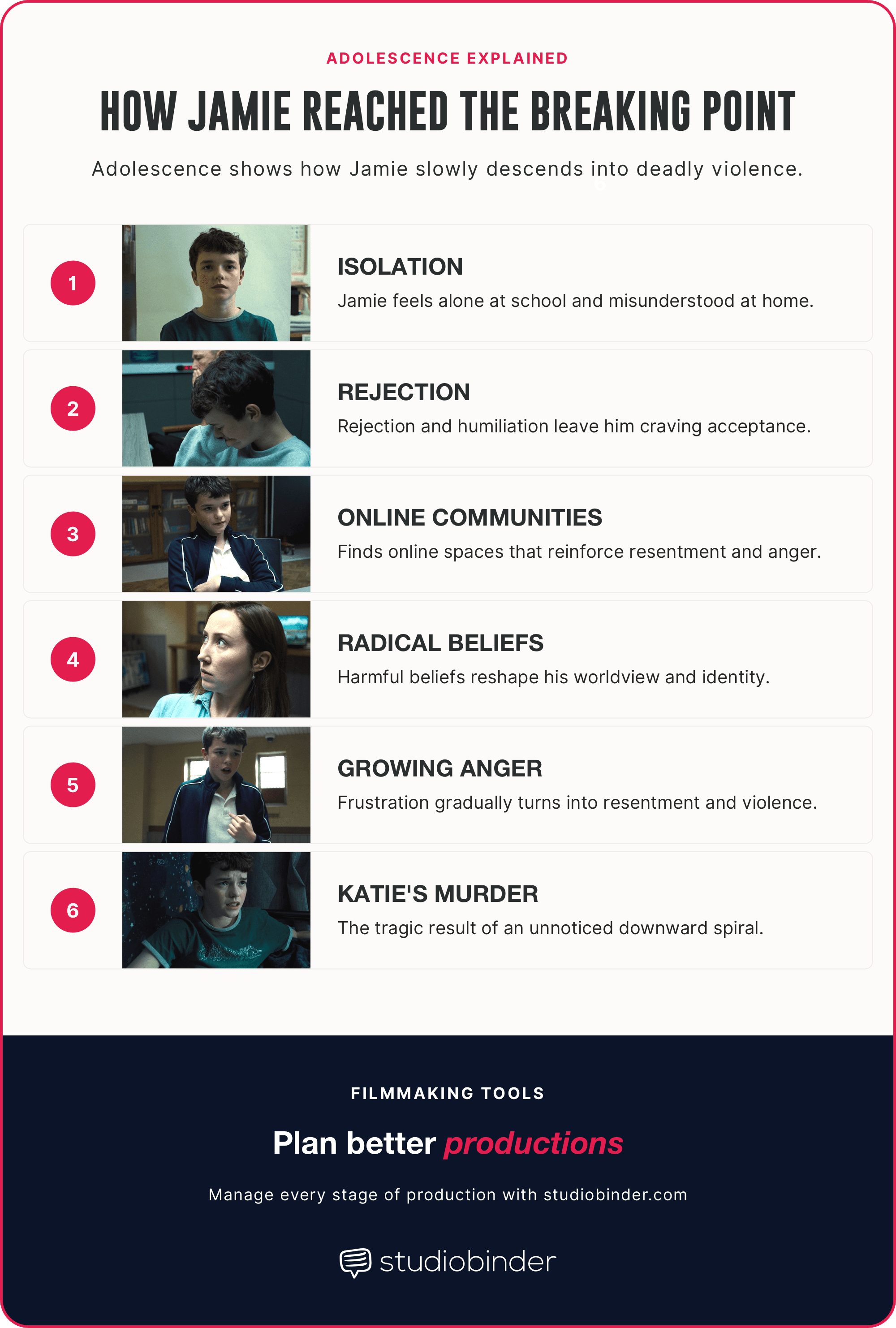
Character development breaking point • Adolescence ending explained
A lot of commentary around the show focuses on the word “incel,” but Adolescence is more observant than that label alone. The series is interested in the conditions that make certain boys vulnerable to those communities in the first place.
The adults around Jamie notice pieces of the problem separately. Mood swings. Withdrawal. Hostility. Nobody sees the full picture until it is too late.
Adolescence ending explained
Why the father's reaction is the emotional climax
The most painful part of the ending is not the confession itself. It is watching Jamie’s father realize he cannot reconcile the boy in front of him with the child he thought he raised.
Stephen Graham avoids turning the scene into a dramatic breakdown. He spends much of the finale trying to maintain composure and failing in tiny increments. His breathing changes. His eyes keep drifting away from his wife and daughter. Several times he looks as though he wants to interrupt but doesn’t know what to say.

Adolescence Ending Scene • Adolescence ending explained
By this point the show has already established him as a loving and involved parent. Adolescence never turns him into a caricature of bad parenting. If anything, that makes the episode harder to watch. The family is ordinary and recognizable. Ordinary routines still exist around the horror of what happened.
The series keeps returning to one painful idea: you can live beside somebody every day and still miss entire parts of their inner life. And that hard fact really helps with having the Adolescence ending explained.
Adolescence ending explained
Why the show refuses catharsis
Most crime dramas eventually provide emotional release. The truth comes out. Somebody gets punished. The audience leaves feeling the situation has been contained. Adolescence goes in a different direction.
Jamie admitting guilt does not restore anything. Katie is still gone. Jamie is still thirteen. His father still loves him despite now knowing what he did. None of those facts sit comfortably together.
The series understands that real violence rarely produces neat emotional conclusions. Families do not suddenly gain clarity because a confession happened. If anything, the truth often makes the situation harder to process.
That is why the finale stops where it does. The show is not withholding catharsis to seem clever or bleak. It is refusing to pretend this kind of tragedy can be emotionally resolved in a single conversation.
Adolescence ending explained
How the one-take format shapes the finale
The technical approach of Adolescence is not separate from its themes, it brings the themes to life. By refusing to cut away, the series denies viewers the emotional distance that traditional editing often provides. The uninterrupted camera movement makes every conversation, silence, and revelation feel immediate, reinforcing the weight of the family's grief and the consequences of Jamie's actions.
As a result, the finale feels less like a neatly resolved ending and more like an experience that continues to linger after the credits roll.
Adolescence ending explained
What filming each episode as a single take actually requires
Each episode unfolds as one continuous shot directed by Philip Barantini, who previously used the same technique in Boiling Point. Pulling that off requires an enormous amount of planning before filming even begins.
Actors have to sustain performances for entire episodes without relying on editing to reshape scenes later. Camera operators need to move through spaces while staying synchronized with actors, focus pullers, lighting changes, and sound teams. One missed cue can ruin a take thirty minutes in.
The process ends up closer to live theatre than traditional television production. Shows like this depend heavily on pre-production planning. Blocking diagrams, rehearsal schedules, camera paths, and shot lists become essential because every department has to move together precisely. A series built around long takes leaves very little room for improvising technical decisions on the day.
That level of coordination is one reason the camera movement in Adolescence is so seamless. The choreography is extremely complex and the audience is fully immersed. Netflix released a documentary on the making of Adolescence. Check it out below to get the Adolescence ending explained on the filmmaking side.

The Making Of Adolescence • Adolescence ending explained
Cinematographer Matthew Lewis and director Philip Barantini put together a true work of art in this series. The show is worth watching for the cinematography alone.
Related Posts
Adolescence ending explained
Why you can't look away
Editing usually controls emotional distance. A cut tells the audience where to focus and when to leave a moment behind. Adolescence removes that protection.
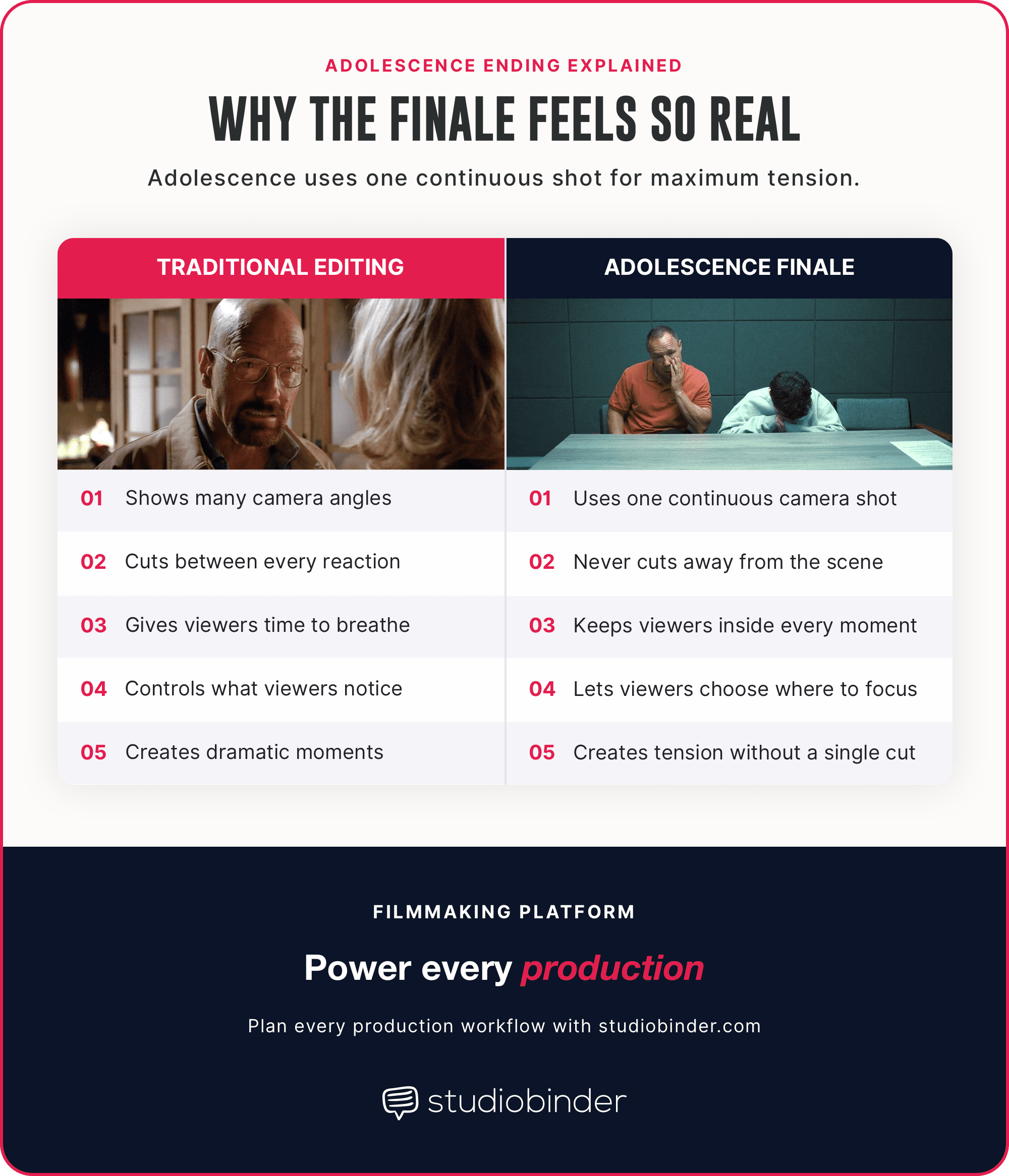
Finale cinematic techniques • Adolescence ending explained
When Jamie confesses to changing his plea, the camera stays in the room. It does not cut away to soften the silence or create dramatic punctuation. The audience is forced to sit inside the father’s reaction for far longer than most television would allow.

All I did was - Her weakness made her more gettable • Adolescence ending explained
That duration changes the feeling of the scene completely.
In a traditionally edited series, the moment might feel dramatic. Here, it feels invasive. The camera becomes impossible to escape. That is why the finale leaves such a strong physical impression after it ends. The audience hasn’t simply watched grief. They’ve been locked beside it.
From a filmmaking perspective, this is where the one-take structure becomes most effective. The form and the subject finally become inseparable.
Related Posts
Frequently Asked Questions
Adolescence ending FAQs
Yes. By the finale, Adolescence makes it clear that Jamie killed Katie. The ambiguity surrounding the ending is psychological rather than factual. The series is less interested in whether Jamie is guilty than in understanding how a thirteen-year-old boy became capable of that violence.
The ending argues that violence like this does not emerge from nowhere. The series connects online radicalisation, emotional isolation, shame, misogyny, and parental blindness without reducing the tragedy to one simple cause. Its refusal of catharsis forces the audience to sit with that complexity rather than escape it.
The one-take structure inhibits the audience’s ability to look away. Without editing, scenes unfold in real time and tension cannot be released through cuts. Director Philip Barantini previously used the same technique in Boiling Point, but in Adolescence the approach becomes part of the show’s larger argument about witnessing difficult realities directly.
At the time of writing, Netflix has not officially announced a second season of Adolescence. The series functions as a complete standalone story, and its ending feels intentionally unresolved rather than sequel-oriented.
Adolescence argues that online radicalisation can develop quietly inside ordinary families and ordinary routines. The series focuses on the gap between seeing a child and truly understanding them, especially during adolescence when identity, shame, belonging, and emotional isolation become especially volatile.
UP NEXT
What is a single shot?
If the filmmaking in Adolescence stood out to you, StudioBinder’s breakdown of single-take filmmaking explores how directors coordinate long continuous shots through rehearsals, blocking, and camera choreography.