Theatre as a dramatic medium and tradition has been evolving over the last two thousand years. And across cultures and time periods, the stories told on a stage have all, in some way or another, found their way into a genre. These genres do not serve as rigid guidelines or boxes used to define art.
They can help guide the audience as they experience a story, creating anticipation and expectations. Writers and performers can use genre to subvert expectation, and thus they can also become a tool for innovation.
Understanding different types of plays, whether you are reading them, creating them, watching them, or performing in them, will help direct you on how to interact with the material. This guide will cover every major dramatic stage genre so that you can identify each type.
Define types of plays
First, let's define a stage play
Before we dive into all the types of plays, genres and key examples, let's break down what a theater play actually is. Check out a straightforward definition below.
Play Definition
What is a play?
A play is a dramatic work that is written for a live performance on a stage. Typically, they are structured around conflict, character, and/or dialogue. Plays depend on stage direction, acting, and the presence of a live audience. The main elements of a play are dialogue, characters, plot, setting, theme, stage direction, and production design.
Plays are generally defined along two axes: dramatic genre (thematic content and emotional tone) and format (length and structure). For example, a one-act comedy and a three-act comedy are the same genre but a different format. A three-act tragedy and a three-act musical are different genres but the same format.
Key elements of a play:
- Written specifically for live stage performances
- Driven by characters, dialogue, and dramatic conflict
- Guided by stage directions and production design
- Shaped by dramatic genre and play format
Types of plays
Types of plays by dramatic genre
Let’s dive into the primary genres of theatre. Each type of play carries distinct audience expectations for how characters, conflict, and plot unfold.
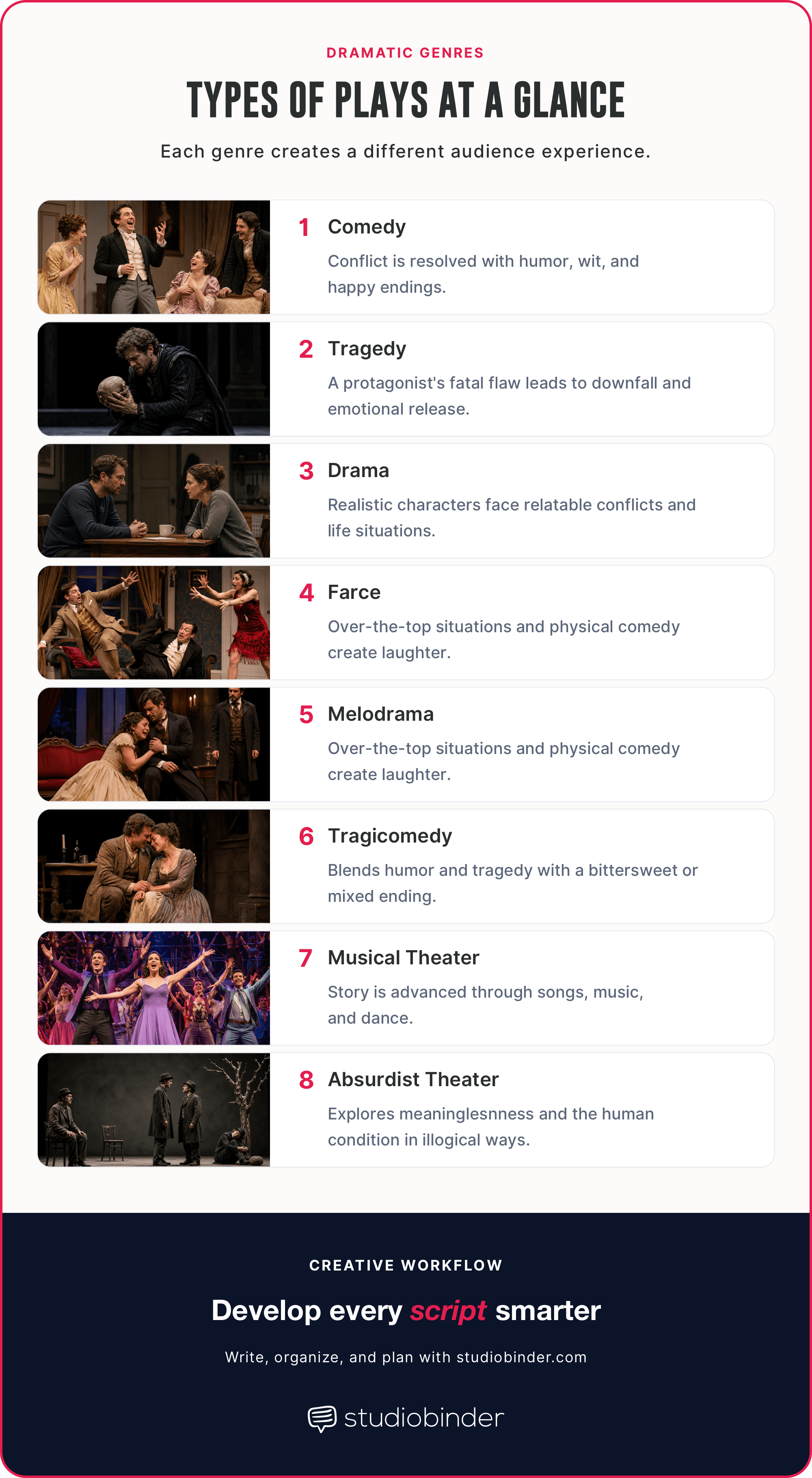
Dramatic genres at a glance • Types of plays
1. Comedy
In comedic types of plays, conflict is created and resolved through wit, misunderstanding, and irony. Characters are largely flawed yet relatable and therefore redeemable. The endings of comedies are typically restorative — they opt for the happily ever after or at least some closure. But comedies aren’t only trying to achieve just the laugh. They are used to comment on society, politics, and other concepts through a specific lens.
Comedies are different from a farce. Comedies rely on the wit of characters, while a farce relies on the escalation of physical chaos and unlikely situations.
Examples: A Midsummer Night's Dream by William Shakespeare, The Importance of Being Earnest by Oscar Wilde, The Book of Mormon by Trey Parker and Matt Stone
2. Tragedy
Tragedy follows a protagonist’s downfall through their fatal flaw, which Aristotle defined as hamartia. A character’s fatal flaw is introduced early on in a tragedy, and as the story unfolds, it becomes the source of their not achieving what they want or worse.
Tragedies push the audience experience toward suspense and high emotion by establishing a sense of sympathy while also creating a plot that tests the limits of the protagonist, ultimately breaking them. The classic arc moves from prosperity to ruin, and for the audience, the fall feels inevitable in hindsight.
The great build-up of emotions often leads to tragedies ending in catharsis, or emotional release, as the ending gives the audience a new perspective about loss.
Examples: Hamlet (William Shakespeare), Oedipus Rex (Sophocles), Death of a Salesman (Arthur Miller)
3. Tragicomedy
Now that we’ve covered the comedy and tragedy types of plays, it’s easier to understand the tragicomedy — a genre that combines both comedic and tragic elements without fully resolving either. The tone of a tragicomedy continuously shifts, keeping audiences on their toes of whether they will laugh or cry.
The stakes are usually high, and therefore the tragedy of loss is very real. But unlike pure tragedies, the tension is relieved through humor, allowing audiences and characters to recognize the irony in a circumstance.
The tragicomedy is different than the dark comedy, which uses the tragedy as the comedic material itself. Tragicomedies hold comedy and tragedy side by side in balance while leaning into the tonal complexity of it all.
Examples: The Cherry Orchard (Chekhov — who insisted it was a comedy, though critics called it tragic), Waiting for Godot (Beckett), The Rover (Behn)
4. Drama
Drama as one of the types of plays, is different than drama as a medium. Let’s focus on drama as a genre here. Dramatic plays are serious works based on realism and usually explore conflict without the extremity of tragedy.
Dramas still have high stakes, but the emotional consequences are different and less catastrophic than those of a tragedy. Dramatic endings leave room for interpretation and ambiguity, inviting the audience to discuss and find different meanings.
The drama genre is quite broad, and the boundaries are grey. Critics and audiences have different definitions of it, with critics folding dramas into the tragedy genre while others make the distinction clear. The boundaries are flexible, which is why it's become such a central part of contemporary theatre, as it allows playwrights the wiggle room for exploration.
Examples: A Streetcar Named Desire (Williams), Long Day's Journey into Night (O'Neill), Top Girls (Churchill)
5. Melodrama
If someone calls something a melodrama, it's usually used pejoratively. But it’s a legitimate dramatic genre with clear distinctions. Melodramas heighten emotion through clear stakes, hero and villain dynamics, and plot-driven drama.
These types of plays are written and designed to elicit visceral responses in an audience. It’s not subtle, but that’s also what attracts specific audiences to it.
Examples: East Lynne (Wood), The Octoroon (Boucicault)
6. Farce
Farce types of plays get folded in with comedies, but they generate their humor more specifically. Farces use unlikely situations, escalating chaos, misunderstandings, mistaken identities, and physical comedy to tell a comedic story. It's situation-based and doesn’t look for satisfying character arcs, but precise plots.
Examples: The Comedy of Errors (Shakespeare), What the Butler Saw (Orton), Boeing Boeing (Camoletti)
7. Musical theater
Musical theatre is the most recognizable among all the types of plays. It integrates song, dance, and movement as its primary storytelling tools. Character arcs, plot points, and narrative themes are all expressed through music and dance rather than dialogue.
Musicals layer a genre over another but are defined by their musical expression. West Side Story is a tragedy. Grease is a comedy. Into the Woods is a tragicomedy. All of them are musicals.
Examples: West Side Story (Bernstein/Sondheim), Hamilton (Miranda), Company (Sondheim), Sweeney Todd (Sondheim)
8. Absurdist theater
Absurdist theater places its characters in illogical, often meaningless worlds where conventional storytelling breaks down. Language scrambles, time loops, action leads nowhere, and purpose is entirely absent. The form enacts the very meaninglessness it depicts.
Absurdist plays can feel meaningless because they are about meaninglessness. Like more abstract art, they are meant to be a mirror, acting as a source material for interpretation and introspection.
Absurdist theatre emerged out of post-war existentialist philosophy, particularly the school of Albert Camus’ concept of the absurd.
The genre is different than surrealism because it has a philosophical thesis, whereas surrealism focuses on aesthetics and imagery.
Examples: Waiting for Godot (Beckett), Rhinoceros (Ionesco), The Bald Soprano (Ionesco)
Related Posts
types of plays
Types of plays by format
The other defining characteristic of a play is its format. Dramatic genres tell you how a play will register tonally. But format tells you how a play operates structurally as a container. Two primary formats define how a play is built and therefore experienced by an audience.
One-act play
A one-act play unfolds in a single continuous act without an intermission. It can last anywhere from 10 to 45 minutes and usually takes place in one location. With these location and time restrictions, they rely on compressed conflict and efficient, economic storytelling. They are streamlined with minimal or no subplots and refined casts.
While they are shorter, they can actually be more difficult to write and construct. The compression is restrictive and pushes writers to tell a complete story within a short amount of time.
Examples: A Marriage Proposal (Chekhov), Krapp's Last Tape (Beckett), Trifles (Glaspell)
Full-length play
Full-length plays are structured in two or three acts. They usually run anywhere from 90 to 180 minutes. The multiple-act structure allows for developed character arcs and layered narrative structures that include subplots, intermissions, and larger casts.
Standard plays unfold in a full-length structure and are what most audiences think of when they think of going to see a play.
Three-act structures follow classic dramatic structures with a setup, confrontation, and resolution. Two-act plays split the story at a mid-point.
Three-act structure: Death of a Salesman (Miller), The Crucible (Miller), Long Day's Journey into Night (O'Neill), Hamlet (Shakespeare)
Two-act structure: A Streetcar Named Desire (Williams), Who's Afraid of Virginia Woolf? (Albee), Fences (Wilson), Top Girls (Churchill)

Famous plays genre examples • Types of plays
Taking the information you know about stage play genres and format, you can now begin the process of writing your stage play.

How to write a play • Types of plays
After watching the video above, you'll have a solid understanding of the process and structure of writing stage plays.
Use StudioBinder's Stage Play Screenwriting Software to automatically format your script, write character lines, organize based on your act structure, and collaborate with your entire team in one place.
Types of plays • StudioBinder's Free Screenwriting Software
The best part is after you've completed writing your first version of your script, you can create new versions and ask for feedback from co-writers or other key department heads.
Trusted by Over 1M Creatives
Screenwriting from draft to set
Write, format, and share your script. Ready for production when you are.

types of plays
How to break down all types of plays
Once you understand how all the types of plays are defined, you can properly break down a play for production. Genre tells you what audiences will expect from your play, while format tells them the logistical structure of how it will all unfold.
First, identify the genre. Ask yourself — what is the emotional tone of this play? How will it end? Who will the audience connect with and how? What emotions or experiences will audiences walk away with after it ends?
Second, map the dramatic structure. How many acts will the play have? How many scenes? What is the inciting incident, and in which direction does the decided genre push the central conflict?
Third, break down the play scene by scene. Define each scene by its core elements: characters, setting, props, costumes, and narrative. You can start refining your play scene by scene through each one’s details.
StudioBinder’s Script Breakdown tool makes that third step fast. Tag every element directly inside the script — cast, props, costumes, locations — and the platform generates your breakdown reports automatically.
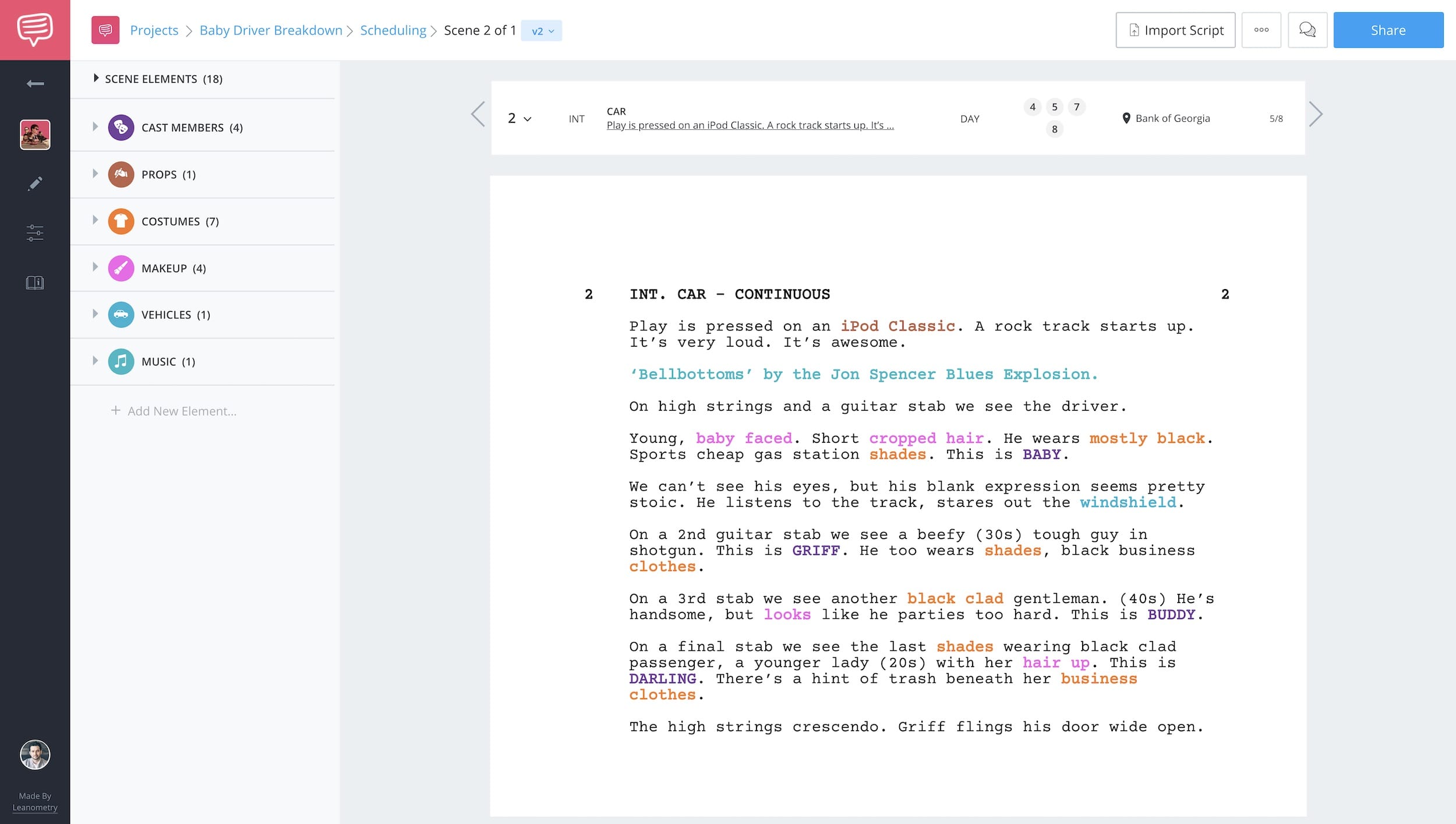
How to break down all types of plays • StudioBinder's Script Breakdown Software
Understanding the different types of plays is the foundation of working with dramatic material at any level. Whether you’re analyzing a script, directing a stage production, or writing your own play, genre and format shape every decision that follows.
Comedy tells you to resolve.
Tragedy tells you to fall.
Absurdism tells you to embrace the inexplicable. Format tells you how much time and space you have to do it. Start there, and the rest of the breakdown follows naturally.
Trusted by over 1M creatives
All your elements, organized
Manage cast, wardrobe, props, set design, and more in one searchable database.

Related Posts
Frequently Asked Questions
Types of plays FAQs
Comedy, tragedy, tragicomedy, drama, melodrama, farce, musical theatre, and absurdist theatre. Different types of plays and genres carry different tonal registers with story and character expectations. Plays are also defined by their format. They can be a one-act play or a full-length play (two-act and three-act).
Shakespeare’s 7 types of genres (specifically Polonius's speech in Hamlet) are “tragedy, comedy, history, pastoral, pastoral-comical, historical-pastoral, and tragical-comical-historical-pastoral.” The quote was written as a joke, but became a framework for contemporary theatre genres.
The main contrast lies in the resolution of each type of play. Comedies end restoratively. Marriages, forgiveness, and reintegration are common endings in comedies. Tragedies, however, end in the protagonists' downfall, death, or irredeemable loss. Tone can overlap in both — tragedies can have dark humor, and comedies can be painful. The genres are defined by how they resolve a story.
A tragicomedy allows tragic and comedic elements to live side by side in a play. By not fully committing to either, they form a new tone that resists clear categorization. They are usually layered and complex in experience, with ambiguity being a large part of the audience’s takeaway.
UP NEXT
Script Breakdown
Knowing all the types of plays is step one. But for anyone approaching a script for stage or screen, it’s important to learn how to break it down for production. That's where the practical work starts.

From script to production. Write, collaborate, and produce all in one place.
Write scripts online for free. Track versions. Share for feedback and approval. When you're done transition seamlessly to script sides, shot lists, storyboards, schedules, breakdowns, call sheets and more.