Everyone can name a play they’ve enjoyed on stage, but does everyone know how play script writing format works on the page? We’re going to dive deep into each and every essential formatting element, contrast stage play vs screenplay formatting, as well as provide an easy-to-follow playwriting guide. If you can master formatting, your writing will have the best chance possible of connecting with its collaborators and audience.
play script writing format
How a Play Script Is Structured
Let’s start by going over how a theater script is structured. Typically, the act structure of a full-length play is two acts, divided into scenes, then separated by an intermission.
Preceding the actual content of the play, every script opens with a title page, along with a description of the characters and setting. Once these major elements are established, the action and dialogue are formatted specifically.
Each act should be started on a new page. The act line should be centered, capitalized, and underlined. For example, ACT I.
A new scene also merits a new page. Like a new act, the scene line should be centered and underlined. However, the text should be sentence case, and conventional numbers are used to number the scenes, like Scene 5.
While a play script may resemble a screenplay, there are a few fundamental differences beyond act structure. Since a play takes more time to set up its characters, setting, and the initial action, a theater script may have less direction of movement during its scenes, also called “blocking”.
This is because unlike in movies, theater budgets much more time for rehearsal for the actors and director to develop movement within scenes. However, essential movements or sequences are described in plays too, much like a screenplay.
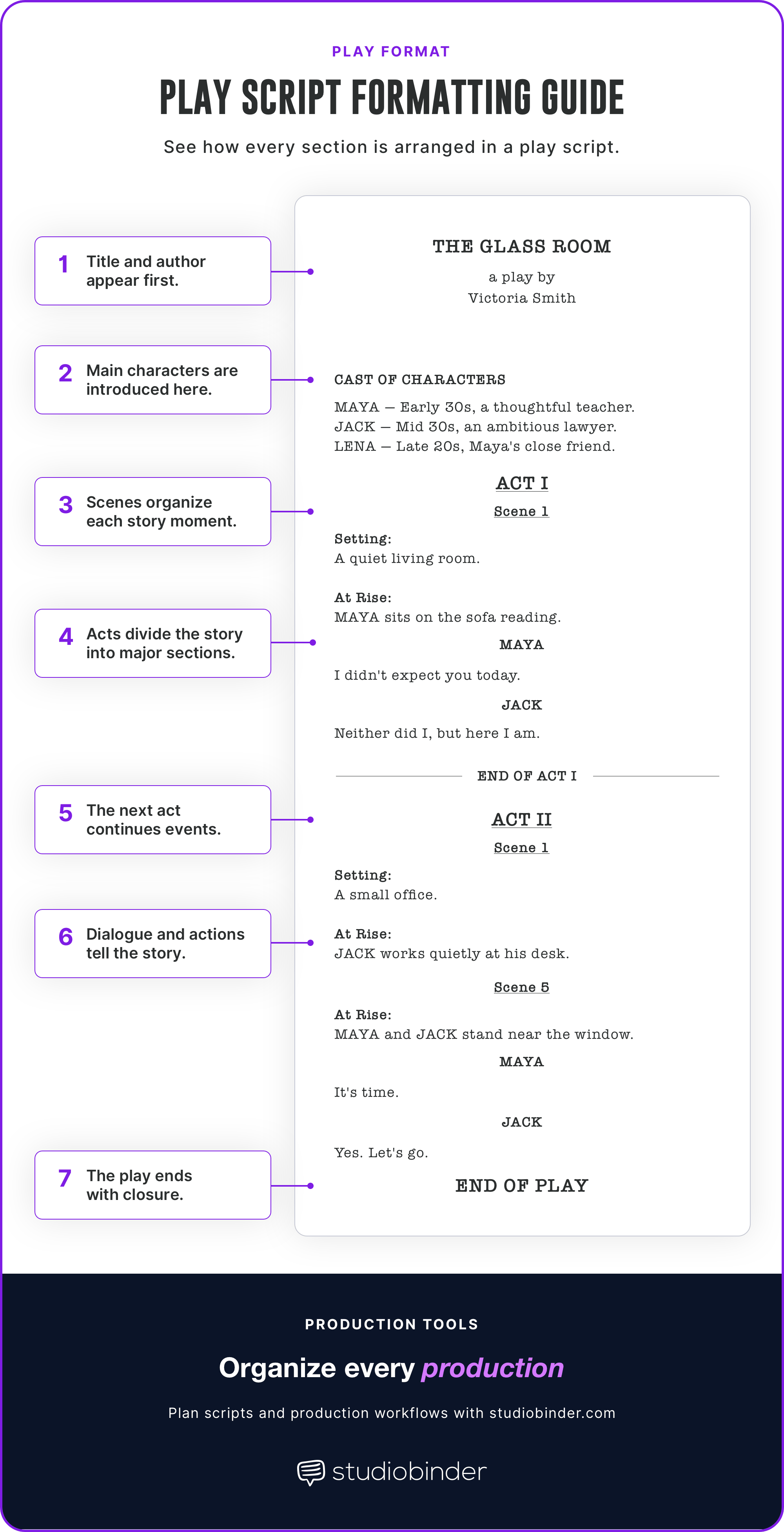
Play Script Formatting Guide - Play script writing format
Check out this deep dive into the difference between stage play and screenplay scripts:

Biggest Difference Between Screenplays And Stage Plays - Play script writing format
play script format
Title Page and Cast of Characters
Script formatting begins before the lights go up or anyone walks on stage, with the title and character page. Both of these pages set up your play for success and demonstrate your grasp of the medium.
On the title page, the play’s name should be centered, capitalized and underlined about a third of the way down the page. Under the title, there should be a line break, followed by a brief description of the play’s length distinguishing if it is “A one-act play” or “A full length play”. “A play in X acts” is typically used for older, classical works.
Next comes the playwright’s name. Capitalize the “B” in By and the writer’s name. It should be centered on the page.
The draft’s date and contact information should take up the bottom quarter of the page. The date of the draft should be on the left side of the page, while contact information should be on the right. For contact information, you should put your phone, email, and/or address, or the corresponding information for a representative of the work.
Check out the play script writing format example below:
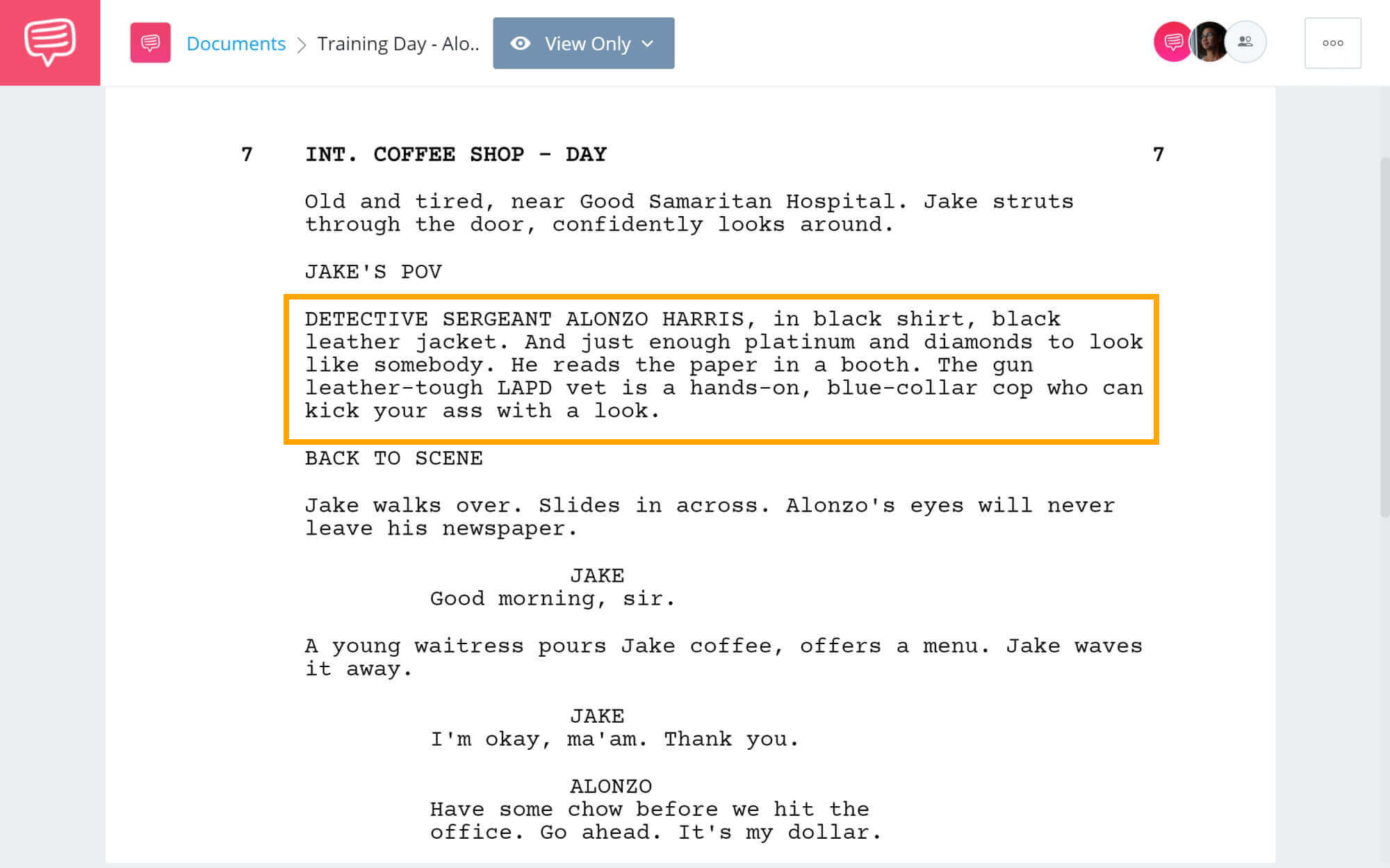
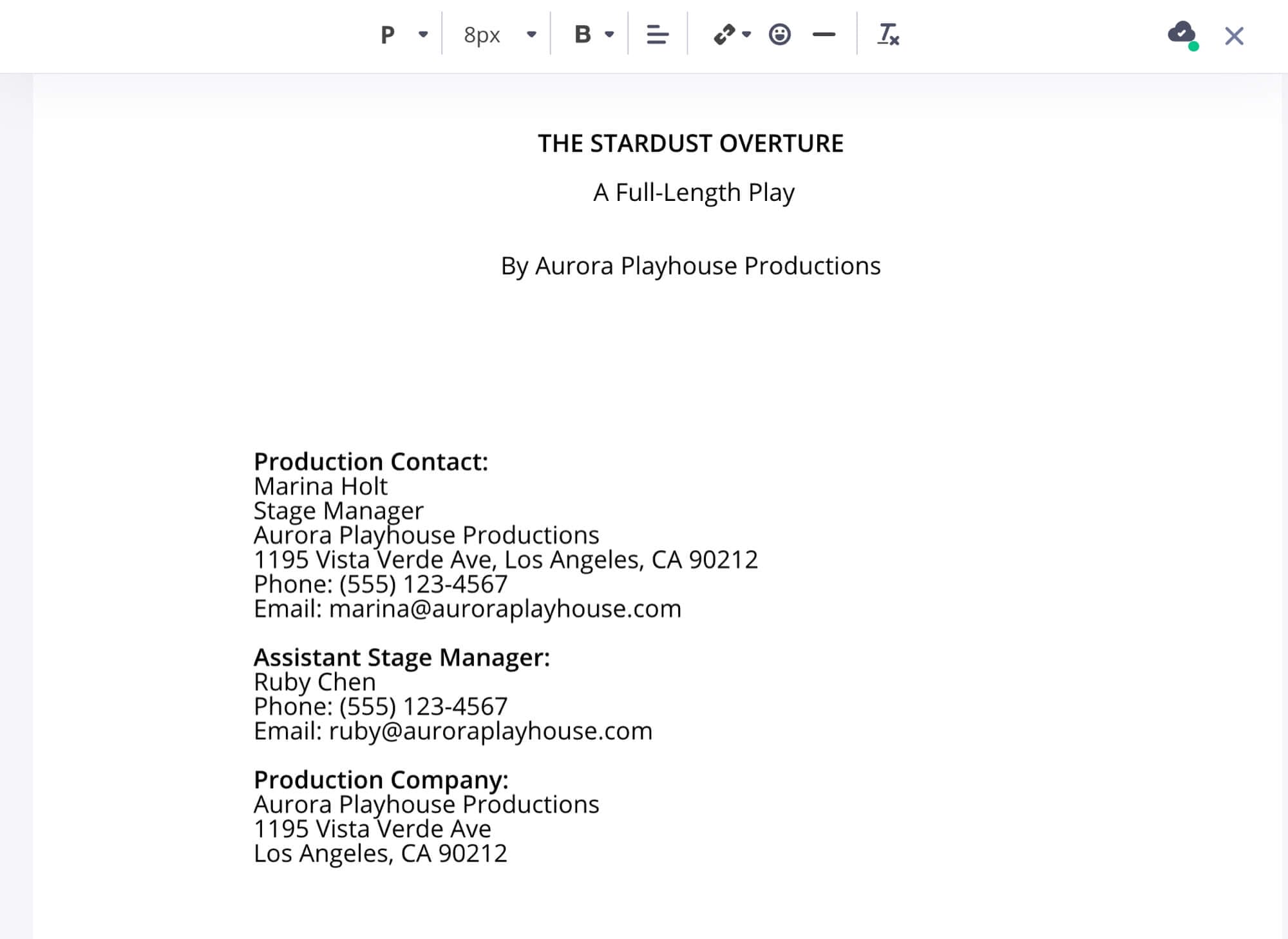
AV Script - Play script writing format
After the title page comes the play’s cast of characters page, sometimes referred to as the dramatis personae. The cast of characters serves as a glossary of the story’s players.
This doesn’t need to be anything in depth. All this list needs to contain is each character’s name, starting with the play’s protagonist, and a very short description.
Another feature of this page is a note on the play’s time and place. These descriptions can range anywhere from one sentence to a few paragraphs on the setting and period in which the play will take place.
Take a look at how the award-winning Slave Play structures their cast of characters page:
AV Script - Play script writing format
how to write a play script
Scene Headings in Stage Plays
One of the biggest differences between stage and screenplays’ script formatting is how they begin a scene. In addition to starting each scene on a new page unlike a screenplay, a play script also doesn’t use slug lines or scene headings with INT./EXT.
So how does a playwright format setting the scene? The start of a scene in a play is designated by the terms “Setting” and “At Rise”, and plainly states the time of day at the top. Then, there’s a description of the space and activity that may already be happening on stage when the lights go up. These descriptions are written in italicized text.
Check out how legendary playwright Neil Simon sets the stage in his famous play The Odd Couple:
AV Script - Play script writing format
The end of an act and/or scene should also be noted with the terms “Blackout”, “Fade Out/Fade to Black” or “Curtain” at the end of an act or the show. For the end of an act, END OF ACT X is written on its own line in all caps.
Scene transitions may also use lighting cues like a blackout for the stage crew or the actors themselves to change a scene’s setting. The playwright again will often state at the start of a new scene how much time has passed, and describe how the space or characters have changed in addition to dialogue.
Trusted by Over 1M Creatives
Screenwriting from draft to set
Write, format, and share your script. Ready for production when you are.

stage play format
How to Format Character Names
Much of how to write a play script is knowing how to write interesting, complex characters. Therefore, knowing how to format their names is essential, and it’s another area where play scripts and screenplays diverge.
In conventional play script writing format, each time a character speaks, their name should be centered on the page in ALL CAPS. Then their dialogue follows on a new line.
A character who is referred to by their description often only functions in an anonymous or observational capacity. Naming a character is an easy way to denote a character’s significance in the play, whereas describing them by way of their profession or appearance denotes a smaller role.
Take a look at Act V, Scene 1 of Hamlet. Hamlet, the play’s protagonist, converses with a pair of characters only referred to as Gravediggers:
HAMLET
I think it be thine indeed, for thou liest in ’t.
GRAVEDIGGER
You lie out on ’t, sir, and therefore ’tis not yours. For my part, I do not lie in ’t, yet it is mine.
The Gravediggers only appear for a single scene in the five-act tragedy. Even though they serve an important purpose in the play, revealing the death of Hamlet’s love Ophelia, they’re not properly named due to their supporting nature in Hamlet’s story.
Play script writing format
Dialogue Formatting Rules
A play is only as good as its dialogue. The major difference between dialogue formatting in a play script versus a screenplay comes down to indentation. In play script writing format, the dialogue is aligned on the left side of the page and spans the entire width of the page. In a screenplay, the dialogue is indented and has slimmer margins.
Play scripts tend to utilize monologues more than screenplays do. Thankfully, there aren’t any major differences in formatting when writing a longer speech in your play. Center the character's name in ALL CAPS, format the dialogue left-aligned across the full page width.
As an example, let’s take a look at a famous monologue that originated in a play before it was adapted for the screen: A Few Good Men.
AV Script - Play script writing format
Here, playwright Aaron Sorkin strategically uses dialogue to craft Jessep's unforgettable confession.
Related Posts
playwright format
Stage Directions - How to Write Them
Stage directions are direct instructions for the actors on stage. They are put in parentheses, italicized, and indented on the page. They should include essential information for actors and crew members like blocking along with lighting and sound cues.
However, avoid directing the actor emotionally in the stage directions. That's not necessary for play script writing format. Think of it this way, you want to describe what the actor is doing (‘He puts down the phone’), rather than how they’re feeling (‘He says sadly’).
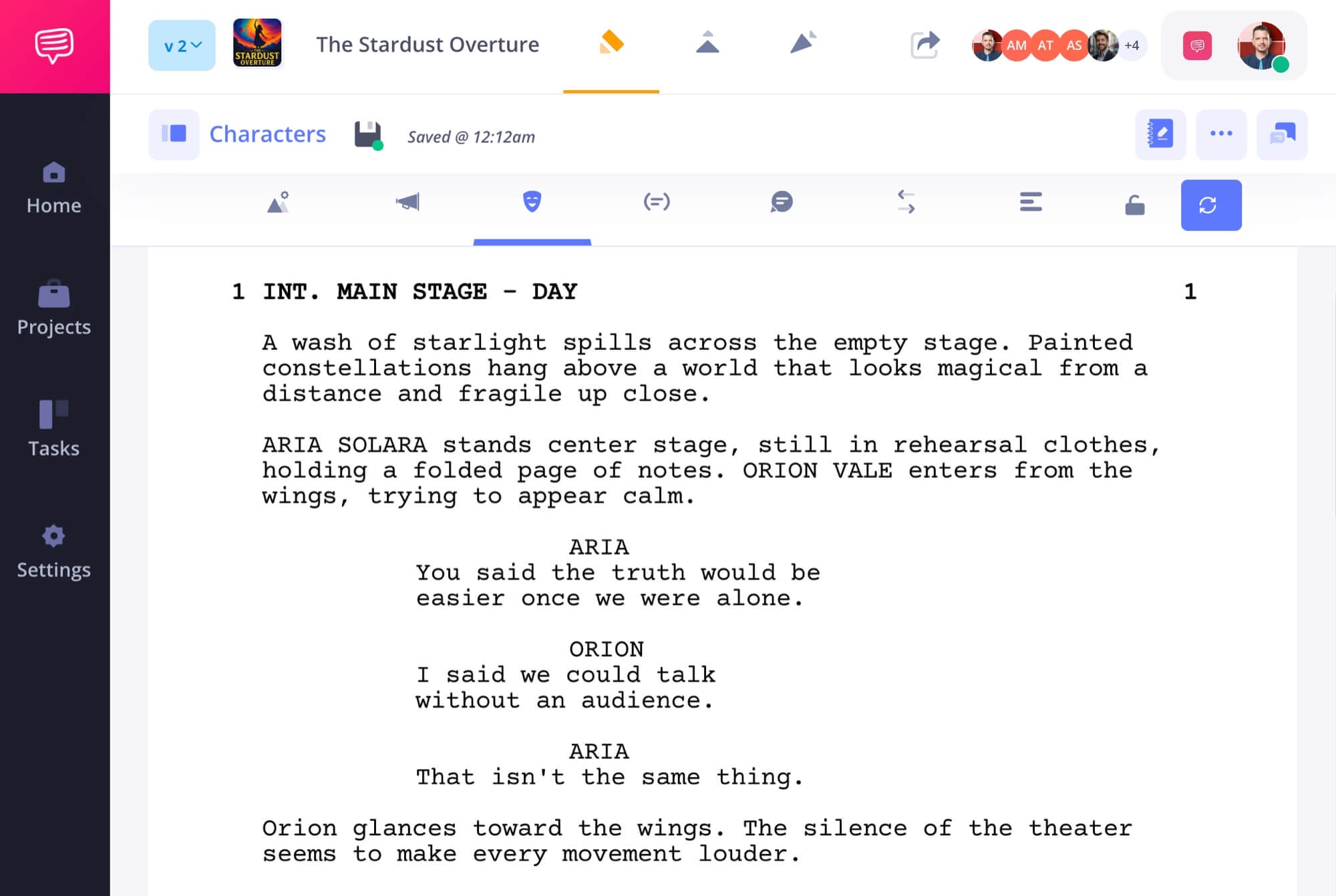
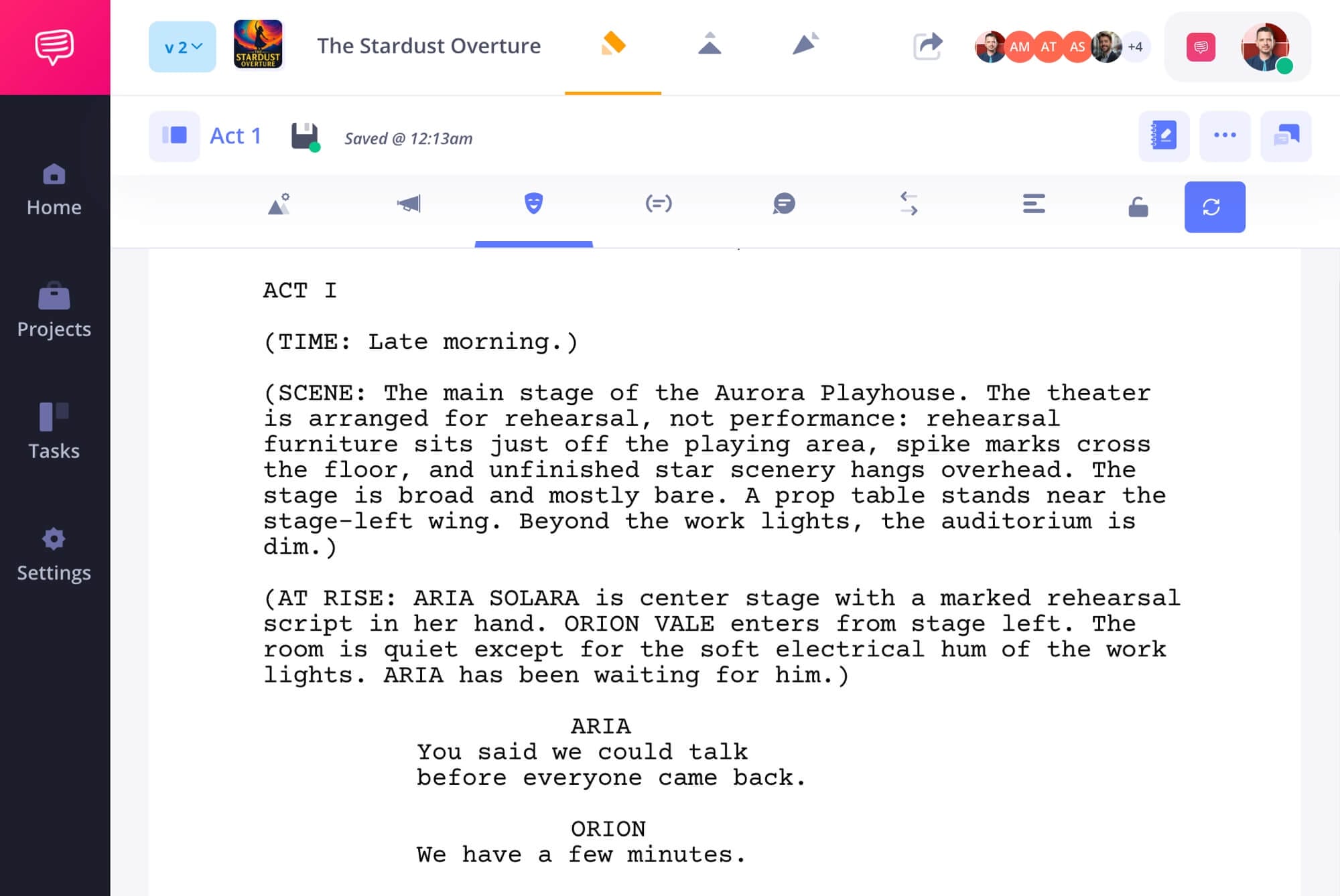
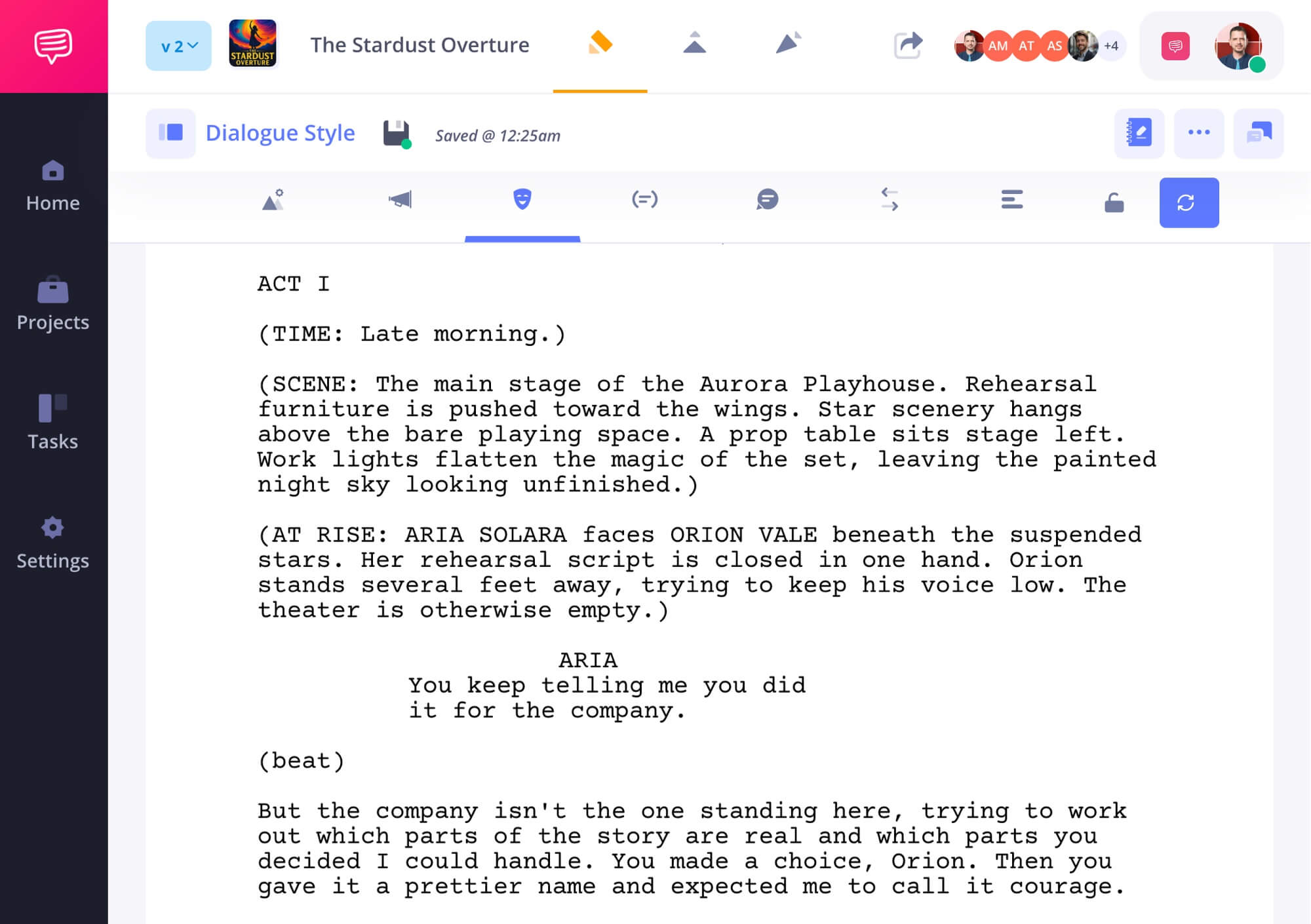
StudioBinder has the ability to auto-format character names, stage directions, parentheticals and dialogue blocks. Let's take a look at an example of proper stage direction formatting using StudioBinder’s script writing software:
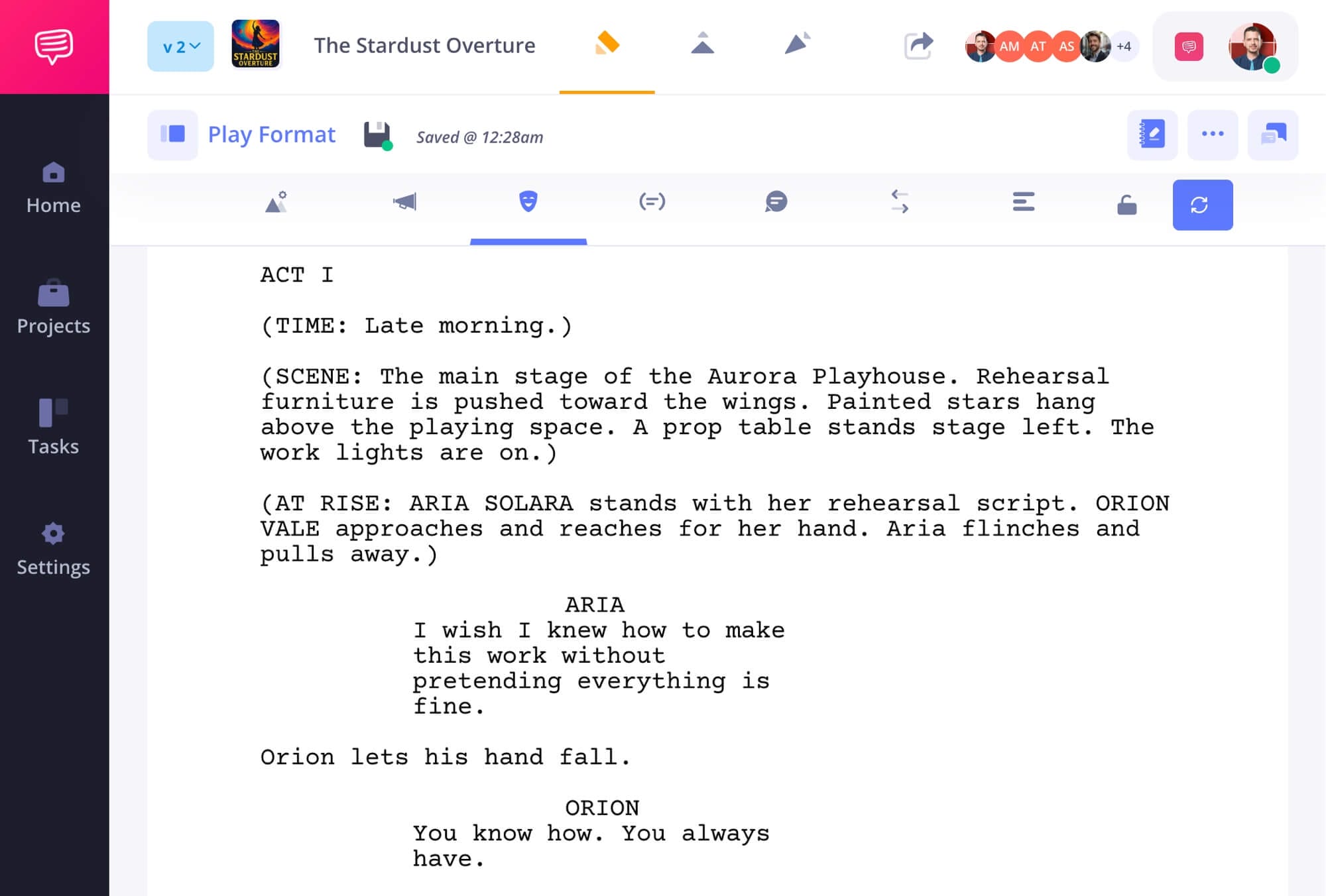
AV Script - Play script writing format
While, like screenwriters, playwrights use parentheticals to indicate tone, direct a specific action, specify who is being addressed, and insert a pause or beat. But they format them differently.
A parenthetical or a stage direction occurring within dialogue is single spaced below the dialogue. Then the dialogue resumes, single spaced below the internal stage direction. Like in screenwriting, parentheticals should only be used when absolutely necessary in a play script. Here’s an example:
DONALD
No! Please don't leave! If you leave me, I'll-
(to Jane)
I’ll drown in my own tears!
Yet if a stage direction takes place between two character’s dialogue, the stage direction is double spaced in its own separate area between the spoken words. Here’s another example:
DONALD
I can't believe you want to break up!
(Jane slaps Donald across the face).
JANE
I can! You cheated on me!
Trusted by Over 1M Creatives
Screenwriting from draft to set
Write, format, and share your script. Ready for production when you are.
Play script writing format
Play Script Format vs. Screenplay Format
Sometimes the easiest way to understand where two formats differ is to see them side-by-side. Both formats are supported in StudioBinder, which we’ve used to show you how the same scene can look significantly different depending on the medium you’re writing for.
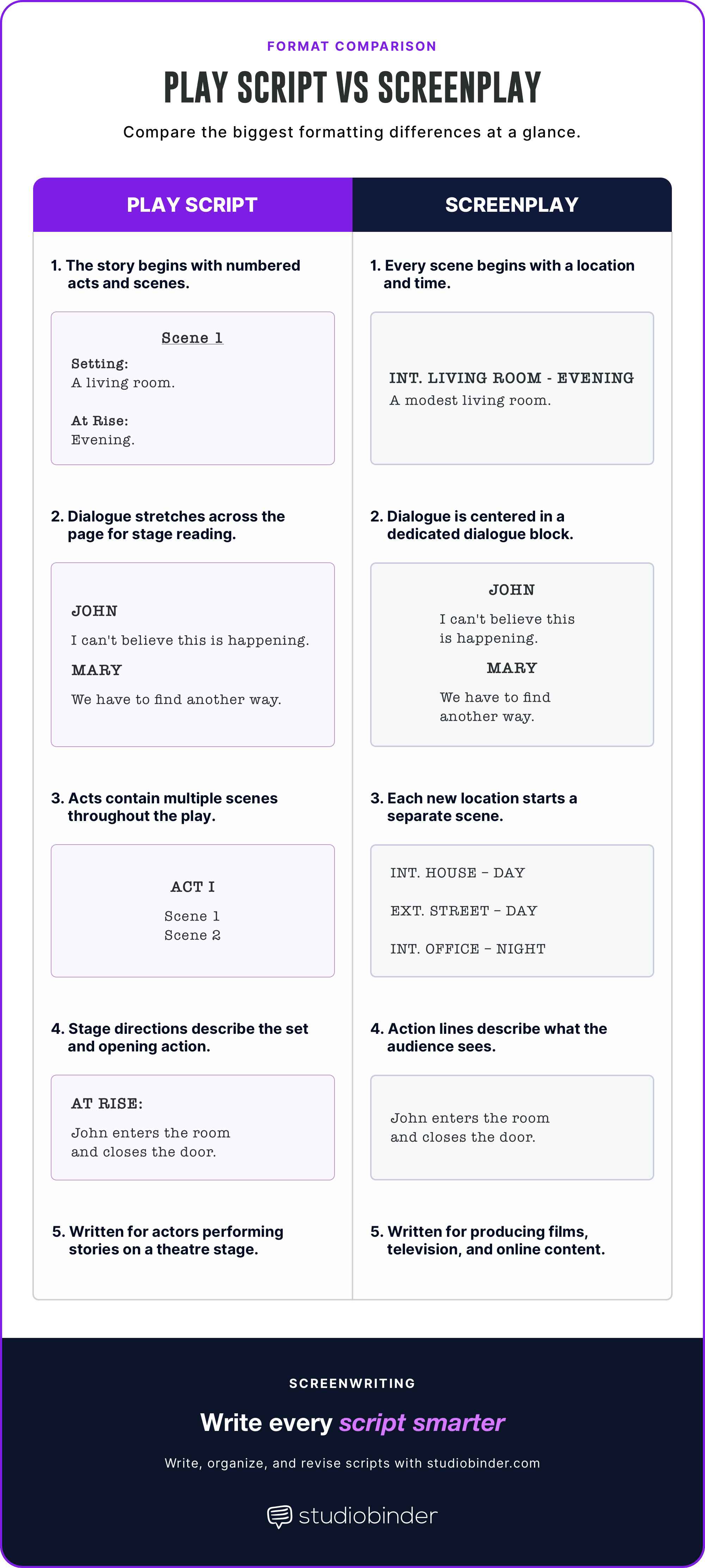
Play Script vs. Screenplay - Play script writing format
Using an early scene from Zach Cregger’s Barbarian, let’s see how the two formats compare:
PLAY SCRIPT:
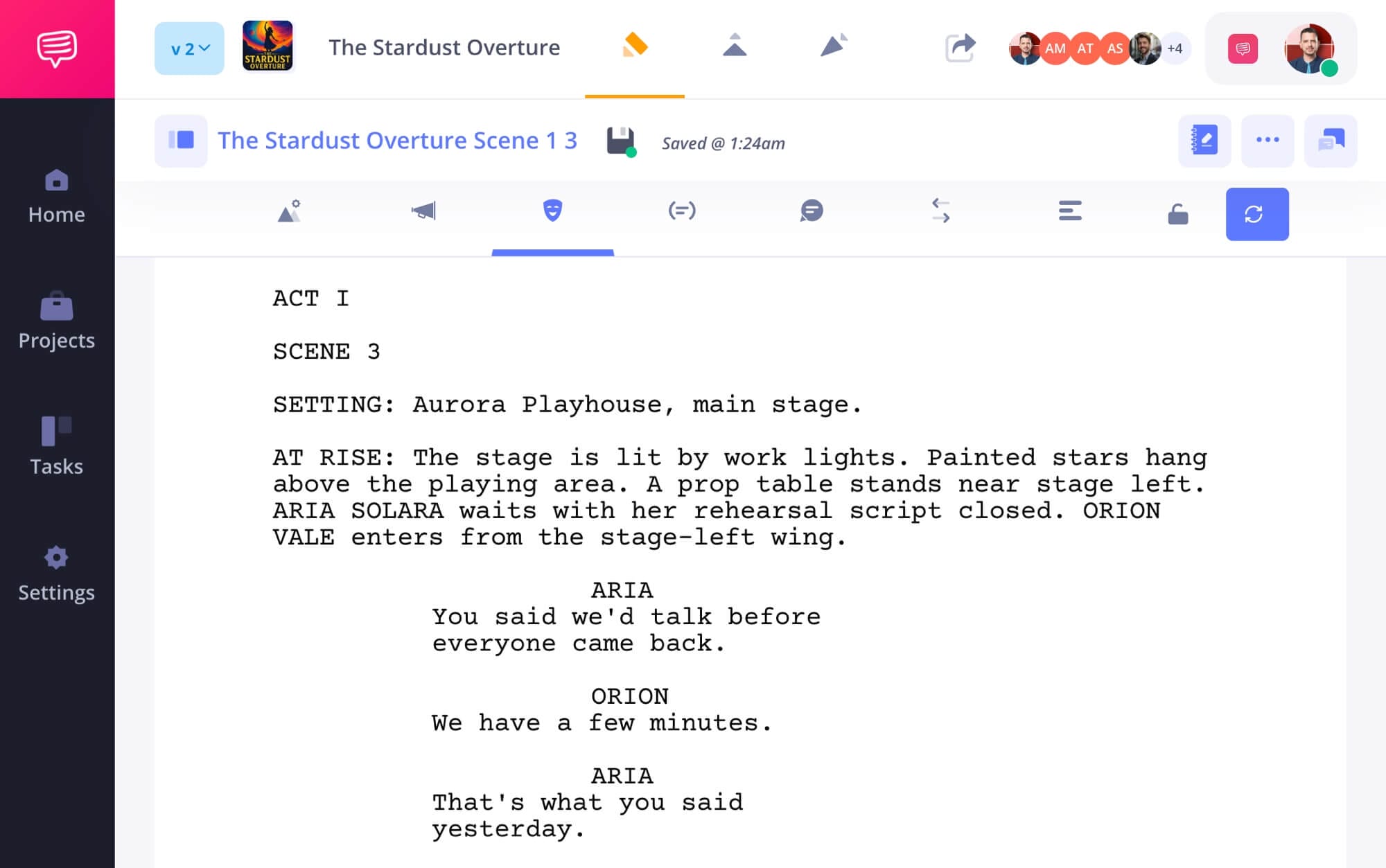
AV Script - Play script writing format
SCREENPLAY:
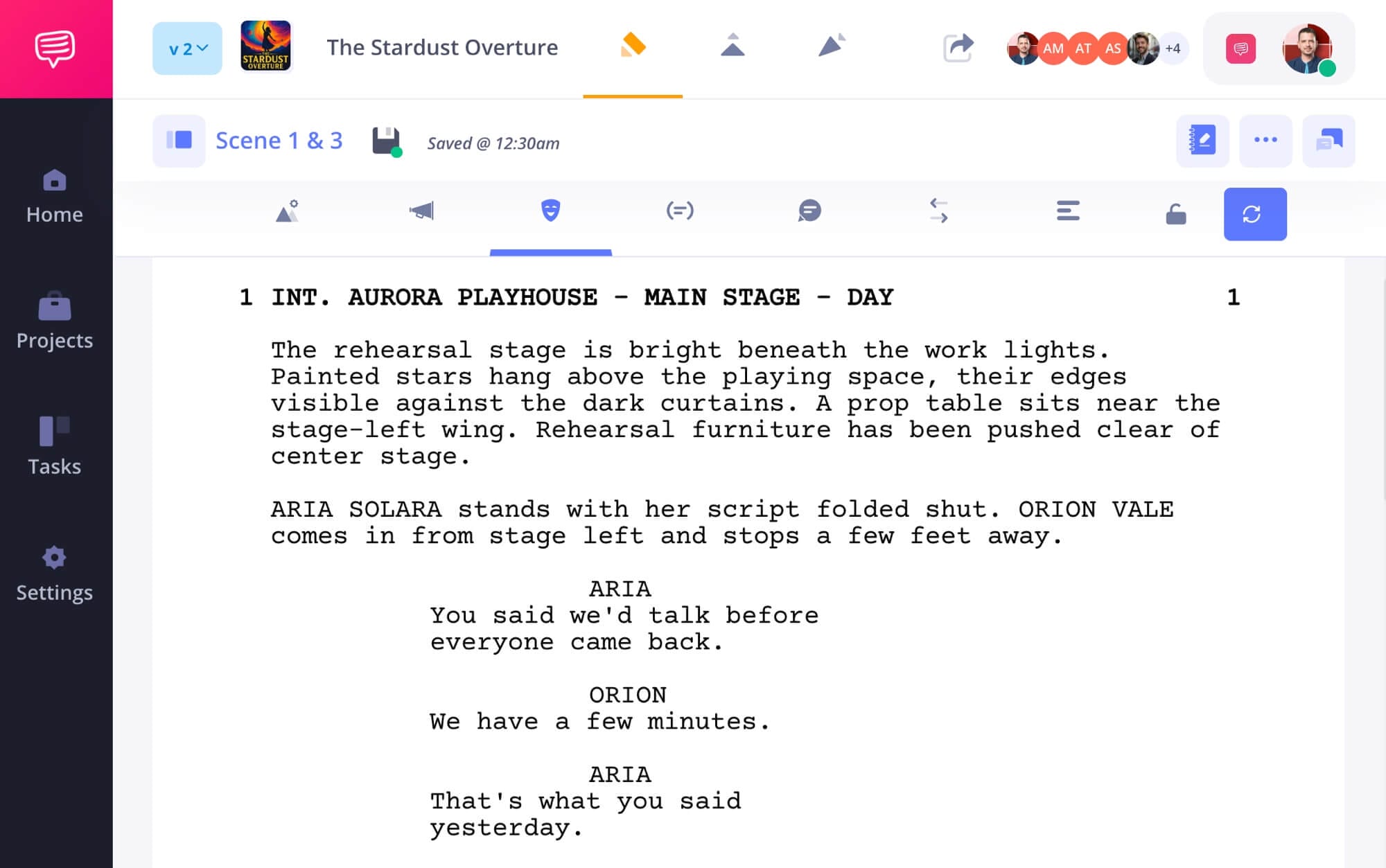
AV Script - Play script writing format
The key differences are how a stage play uses act and scene numbers centered instead of left-justified slug lines. Also note that although the character names are centered in both formats, the dialogue in a stage play has a wider margin and starts on the left hand side of the page.
Stage directions also differ greatly. The setting and initial blocking for the scene is described in the AT RISE section of the play script, while all following stage directions are italicized, indented, and in parentheses.
Struggling to decide whether your script idea best suits the screen or the stage? Two major deciding factors are location and dialogue. Plays tend to be more dialogue-driven than movies, and use limited or contained locations. For instance, August: Osage County takes place entirely in a country house outside Pawhuska, Oklahoma.
Conversely, a movie tends to use more locations and offers a broader scope of visual storytelling. If your script goes “narrow and deep” on a character, a relationship, or an abstract concept, it would make a great play. A movie allows one to explore a story, time period, or aesthetic with a wider and broader lens.
Related Posts
Play script writing format
Play Script Software and Templates
Now that you know how to format a play, and what makes a good one, it’s time to start writing! But where to actually write?
StudioBinder’s scriptwriting tool supports the stage play format natively with its auto-formatting character names, stage directions, and dialogue blocks.
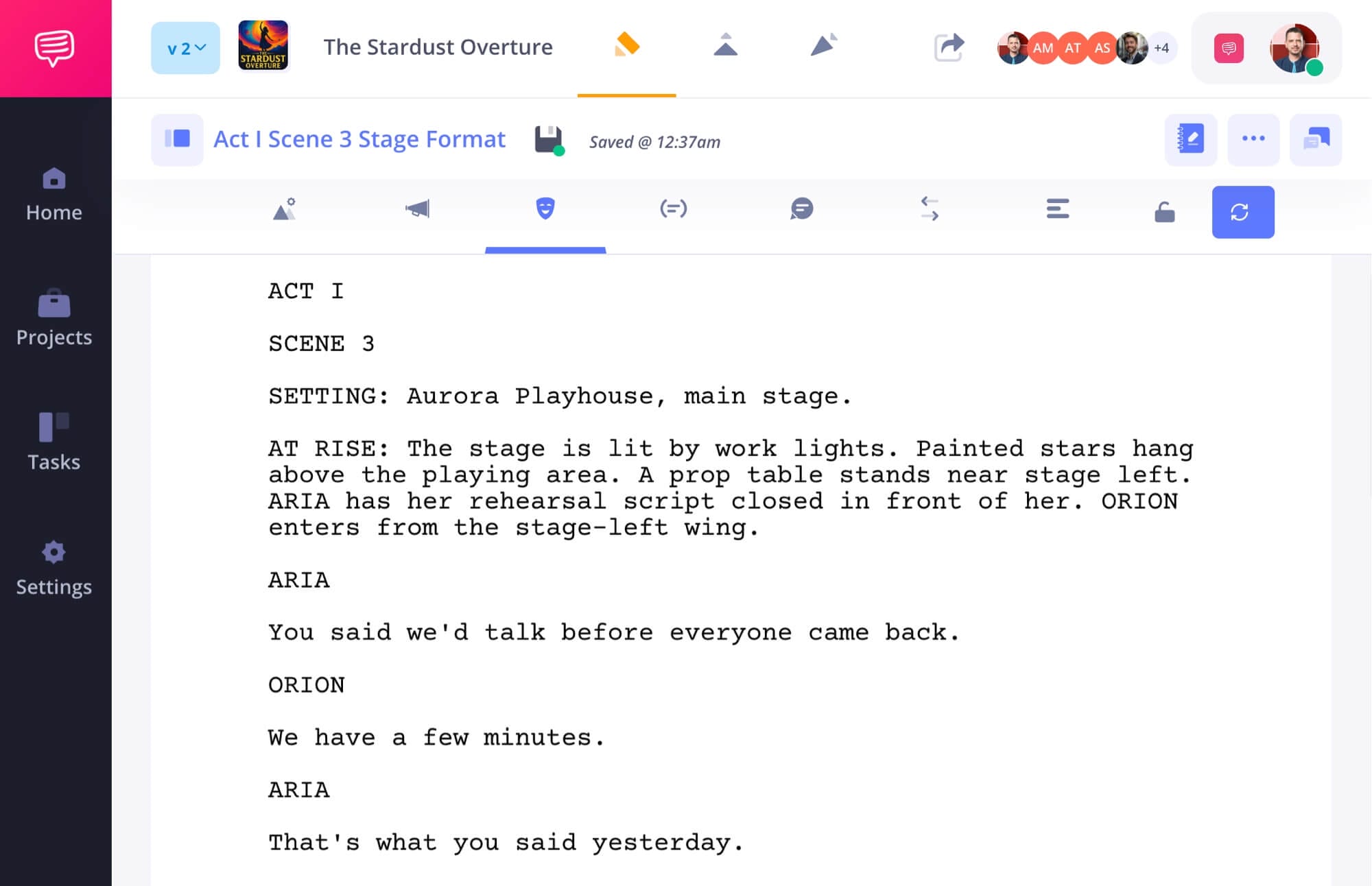
AV Script - Play script writing format
Best of all, the built-in notepad feature lives right next to your script as you write. This way you're not fumbling through multiple documents as you use your notes to guide you on proper play script writing format and story structure.
If you subscribe to Final Draft, Highland 2, or Fade In, they offer basic templates for writing stage plays and screenplays as well. Budget-friendly options include Celtx’s free tier and BBC Writers also has templates for UK and US stage plays you can follow on any software or word processor.
Frequently Asked Questions
Play Script FAQs
No, play script format is not the same as screenplay format. While they share some similarities, a play script differs greatly from a screenplay in how the characters and setting are introduced. A play script also has different formatting conventions when it comes to dialogue and stage directions.
To format a stage direction in a play script, italicize and indent the direction on a new line in the script. Stage directions should include blocking, physical action, as well as sound and light cues.
Playwrights use StudioBinder’s software since it handles play script formatting natively. Elements such as character names, stage directions, and dialogue blocks all auto-format, all inside StudioBinder’s script writing tool. Other options include FinalDraft, Celtx, and FadeIn.
Begin numbering the pages of your script with the first page of actual action and dialogue, basically, the beginning of Act I, Scene 1. Use Arabic numerals (1, 2, 3) in the upper right hand header. Do not number the title page or character list.
UP NEXT
Screenplay Format
Every medium has its own unique formatting quirks. Now that you know play script writing format, why not brush up on formatting for the screen? StudioBinder has the ultimate guide for screenplay formatting like a pro too.