Based on Cormac McCarthy’s novel, the 2007 Coen Brothers film No Country for Old Men is full of dynamic, unforgettable No Country for Old Men characters. Protagonist Llewelyn Moss (Josh Brolin) is one of the most compelling. Moss’ actions begin the plot and much of the story is presented from his perspective. However, an unconventional plot twist changes everything. Spoilers for No Country for Old Men follow:
Llewelyn Moss character profile
Who is Llewelyn Moss?
Llewelyn Moss is a Vietnam War veteran. He lives in a Texas trailer park with his wife, Carla Jean (Kelly Macdonald).
What does Llewelyn Moss do for a living?
Llewelyn has worked as a welder for a long time. His military history and occupation explain his practical and physical skills. This is key to making his survival through portions of the crime plot believable.
Llewelyn is not a criminal. His decision to take $2.4 million in cash from the site of a disastrous drug deal is one many regular people would make. Llewelyn's only special qualities are determination and the ability to remain methodical and calm during danger. These qualities, and his sympathetic humanity, are what get audiences invested in his attempt to survive and escape with the money.
Llewelyn's military history is mentioned enough for audiences to keep it in mind, but it is not a focus of the story. His Vietnam service is simply a necessary bit of backstory that helps explain his skills and lack of panic.
How old is Llewelyn Moss?
Llewelyn is presumably in his mid-to-late 30s. Neither the film nor the novel state his exact age. But the story takes place in 1980. Given this and his Vietnam service, one estimates he's in his 30s. Josh Brolin's appearance in the movie supports this, as the actor was 38 when the film was shot.

No Country For Old Men (2007) Official Trailer • Llewelyn Moss
Drug deal aftermath discovery
How does Llewelyn Moss find the money?
Llewelyn comes across the aftermath of a drug deal turned gunfight while hunting in a desert. He also finds one badly injured survivor in a car. The dying man begs for water but Llewelyn repeatedly notes that he doesn't have any.
Under a tree at the edge of the large crime scene, Llewelyn finds another dead man, who has a briefcase containing the $2.4 million. Llewelyn seems to know taking the money could be dangerous. However, the film's realistic context emphasizes the point that most regular people would at least be tempted to do so. Ultimately, taking the money is a mostly pragmatic choice, and pragmatism is one of Llewelyn's defining character traits.
One can also argue that taking the money isn't the choice that most directly puts Llewelyn in danger. After hiding the briefcase in his trailer, Llewelyn lies in bed sleepless before returning to the scene with water for the survivor. When he does so, other members of one of the gangs — mostly Mexican cartel members — notice and begin chasing and shooting at him. It's only after that point that Llewelyn faces constant danger, which creates an interesting ambiguity. The viewer must choose whether they think Llewelyn's fate is more so the result of taking the money or returning with the water.
Llewelyn's speed in reading that crime scene — and deciding on a course of action — is part of what makes him so compelling to watch. Filmmakers who adapt novels like McCarthy's require the same discipline: cataloguing every element before production begins.
Protagonist fatal flaw analysis
What drives Llewelyn Moss?
Llewelyn's decisions are almost always understandable. But it's also ambiguous what specific motivations drive some of them.
Going back with the water
Moss' choice to return with the water is a particularly frequent topic of debate.
Before he leaves the trailer with the water, Carla Jean asks Llewelyn what he's doing. He replies, 'I'm fixin to do something dumber than hell, but I'm goin anyways.' This demonstrates his relatable, sympathetic level of morality. Greed is a powerful enough motivator to make him take the money despite the moral implications and safety risks. But ultimately, Llewelyn can't live with the idea of the living gang member dying when he could at least try to help him.
This forces the audience to consider the dark irony that Llewelyn's kind choice could be the one that dooms him. But neither version of the story suggests that is definitely the 'correct' interpretation of events.
Llewelyn is not only in danger because he goes back to the scene, as doing so is not what alerts assassin Anton Chigurh (Javier Bardem) to his involvement. Chigurh instead follows a tracking device hidden in the stack of money, which Llewelyn does not discover until much later. Going back to the dying man could have led to the Mexicans learning of Llewelyn sooner than they otherwise would have. But he almost certainly would have still wound up in danger from Chigurh at some point.
Viewing the choice to bring the water as what dooms Llewelyn is also a very pessimistic interpretation. And, while it's a perfectly legitimate one to make, there are other views that are supported as much, if not more, by the story.
The most important theme of No Country for Old Men is its reflection on the idea of an evolution in the depravity of crime. The viewer is made to wonder if Chigurh represents a new, more ruthlessly evil brand of lawlessness. His incredibly frightening nature and the plot's bleak outcomes are powerful evidence in favor of this idea. However, both versions, but especially the film, also challenge the notion in significant ways.
Chigurh's random car accident and his encounters with Carla Jean and other characters support the opposing view. They argue that Chigurh and the savage criminals he exemplifies are not new or unique, nor are they impervious to defeat or other kinds of harm. This interpretation would not accept that Llewelyn's merciful act of bringing the water leads to his downfall.
Why he doesn't just walk away
That said, there are other points in the film in which Moss' choices undeniably contribute to sealing his fate. These moments are frustrating for the viewer, but rooted in consistent character traits.
Llewelyn Moss is stubborn. Which isn't an inherently bad thing. Indeed, Llewelyn's stubbornness is key to allowing the story to function. The choice to take the money despite his hesitation is stubborn. And his subsequent refusal to give it up is what sets and keeps most of the plot in motion.
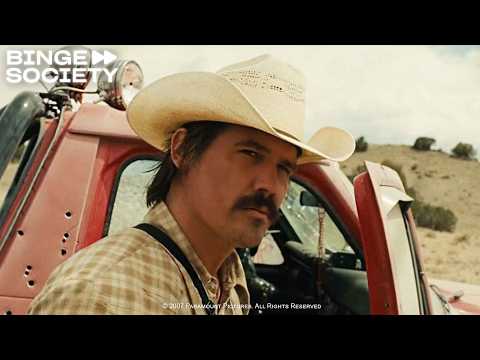
Llewelyn Finds the Money • Llewelyn Moss
His stubbornness is also what gives Llewelyn the persistence and willpower to take on Chigurh and endure everything else. This is why he is a compelling figure in his own right, rather than a human plot device meant to initiate the hunts for the money and Chigurh. But by trying to take on Chigurh and the Mexicans and get away with the money, he overestimated his own capabilities. And his stubborn refusal to acknowledge this is what dooms him.
Llewelyn's stubbornness also contrasts him against the story's other protagonist, Sheriff Ed Tom Bell (Tommy Lee Jones). After investigating the case, Ed Tom chooses to retire from the police force, believing he's not equipped to deal with modern criminals. It's the opposite choice from Llewelyn's stubborn refusal to give up. But true to its complex nature, the story does not portray Ed Tom's decision as clearly 'right' either.
Llewelyn's stubbornness defines his arc. But it's Anton Chigurh's total absence of recognizable logic that makes running from him so hopeless. Understanding Chigurh is essential to understanding why Llewelyn's odds were never as good as he thought.
Related Posts
Hunter versus prey dynamic
What the chase reveals about Llewelyn Moss and Anton Chigurh
Chigurh's pursuit of Llewelyn is arguably the most famous portion of No Country for Old Men. The chase is a masterpiece of cinematic suspense with huge significance for the development of both characters.
The mantra l,' is especially applicable tom. But there are occasions when breaking this rule and not directly showing a dramatic event can be the best choice. Llewelyn's death is one such example, with the way it's revealed being crucial to the story's effects.
Breaking Down the Moment Everything Changed • Llewelyn Moss
Why Moss can't escape Chigurh
It's immediately obvious that, as resourceful as Llewelyn is, he and Chigurh are not evenly matched opponents.
Still, Llewelyn's careful planning and calm under pressure allow him to survive their early encounters. In fact, one could argue that he completely outmaneuvers Chigurh on some occasions. But the ever-increasing sense of dread and the ways Chigurh is portrayed make it clear that he is too much for Llewelyn to handle long-term.
This is the portion of the story that best supports the interpretation of Chigurh as representing a unique kind of evil. This idea is implied by the qualities that make him an eccentric, unusual assassin. His distinctive bolt gun is the most consistent visual depiction of this eccentricity. But it is also conveyed in plenty of other ways.
Chigurh's insanity also makes him almost completely unpredictable. While deliberate, Chigurh does not have the kinds of concerns that make more traditional criminals cautious. He doesn't think twice before attacking rival gang members or police, as long as doing so seems the most direct way of accomplishing his current task.
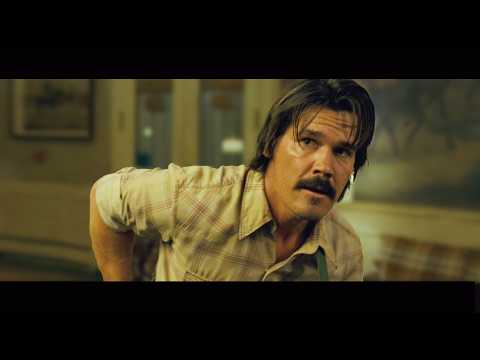
When the scene is Impossible to watch • Llewelyn Moss
He even kills members of the gang who hired him once they give him the tracking device. This, like his threatening conversations with minor characters, doesn't serve a tactical purpose. These acts suggest Chigurh is motivated by something other than common criminal greed — most likely a sadistic love of violence.
Llewelyn has no reason to prepare for this kind of opponent. He likely assumed that any criminal tracking him would be intent on getting the money and evading law enforcement and the opposing gang. But Chigurh is largely unconcerned with these priorities. Llewelyn is outmatched not because of a lack of confidence, but simply because he doesn't understand the unusual nature of his opponent.
The gap between Llewelyn and Chigurh isn't just a character dynamic — it's the film's central argument about fate and agency.
What separates Moss from other thriller protagonists
Llewelyn is also quite distinct from many characters who play similar roles to his across various media.
The protagonists of most thrillers either achieve a kind of victory in whatever their main conflict is, or die in the effort to do so (or both). None of these things happen to Moss.
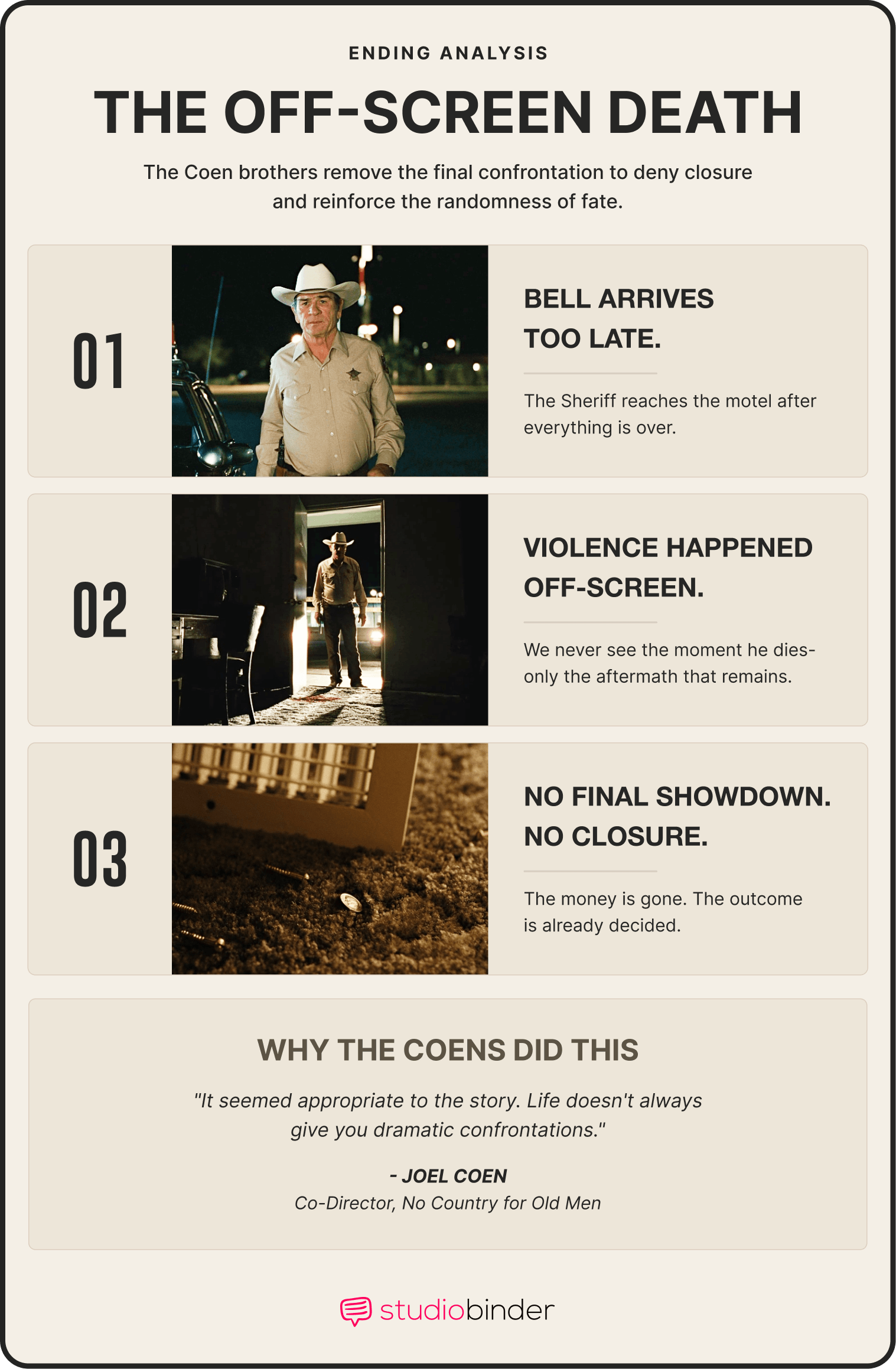
Llewelyn eventually prepares for a final confrontation with Chigurh. Such a confrontation would likely be the central focus of a conventional narrative's conclusion. But before such a meeting can happen, Llewelyn dies off-screen. The viewer only learns this has happened when Ed Tom finds his body. This adheres to the storytelling of the novel, which also foregoes describing the actual moment of Llewelyn's death.
By depicting the events in this way, McCarthy and the Coens subvert the audience's expectations. It's an extremely risky creative choice, especially for the film.

Where Are Your Clothes, Son ? • Llewelyn Moss
Off-screen death meaning
How does Llewelyn Moss die — and why off-screen?
A main protagonist dying before the story's conclusion is surprising enough. But the Llewelyn Moss death scene — or rather, the deliberate absence of one — is what makes No Country for Old Men so distinctive. The fact that his death occurs off-screen is particularly unusual.
The audience discovering Llewelyn is dead at the same time as Bell also more closely aligns their perspective with the sheriff's. Like the viewer, Bell technically knew from the beginning that the case could end with this kind of tragic catastrophe. But he didn't actually expect it. He seemingly believed — and clearly hoped — he could ensure Llewelyn's safety.
The motel scene shocks the viewer by highlighting that the story they're watching is not the kind they expected. This creates a similar emotional experience to Bell's. At the end of the story, Bell comes to believe that modern crimes are different from past ones and he's not prepared to deal with them, and Llewelyn Moss's death is at the center of every serious reading of it.
Why His Death Happens Off-Screen? • Llewelyn Moss
Who killed Llewelyn Moss?
It's never confirmed who killed Llewelyn, although the Mexican gang is heavily implied to be responsible.
In both the novel and film, Sheriff Bell arrives at the El Paso motel Llewelyn was staying at. The motel is the scene of a recent gunfight and Bell sees Llewelyn's body and those of several Mexican gang members.
The most intuitive implication is that a contingent of the Mexican gang found Llewelyn and the two parties shot each other to death. The questions of what Chigurh's role in the slaughter was, and if he even had one at all, are left open.
The Llewelyn Moss death being revealed like this both maintains the story's realism and supports its main points. For anyone studying the No Country for Old Men ending, this is the scene that reframes everything that came before.
Why the Coens don't show it
Despite being faithful to Cormac McCarthy's novel, the choice to keep Llewelyn's death off-screen has become one of the most hotly debated decisions in modern film. But most viewers ultimately agree it was the right choice for various reasons.
As in the novel, Llewelyn's death not being directly shown is key to the film's effects. Excluding the expected confrontation between Llewelyn and Chigurh denies the viewer closure. It also acknowledges that reality does not always follow the carefully plotted arcs found in fiction. In the real world, the kinds of crimes the plot deals with tend to end in ways that are devastating and in no way satisfying for most involved.
Best Llewelyn Moss quotes
5 meaningful Llewelyn Moss quotes
No Country for Old Men uses dialogue sparingly, especially in Llewelyn's scenes. However, the character delivers several memorable lines. These Llewelyn Moss quotes reveal more about his character than pages of exposition ever could. Each one is a window into his stubbornness, his dark humor, and his fatalistic sense of morality. Studying Llewelyn Moss quotes is one of the better ways to understand why the character resonates so strongly.
1. "You keep runnin that mouth I'm gonna take you in the back and screw you…"
The type of humor Llewelyn uses with Carla Jean suggests he has questionable views on gender roles. However, she is amused or at least unbothered by it, showing that their views on their relationship are similar. This allows the viewer to cautiously begin investing in the couple. The chemistry between the actors also helps make the exchange somewhat endearing.
2. 'I'm fixin to do something dumber than hell, but I'm goin anyways'
This line perfectly encapsulates Llewelyn's specific moral code. It also explains why he goes back to the scene of the shootout with the water, despite the risks. The gang member getting injured in the fight wasn't Llewelyn's fault. But now that he's aware of the other man's situation, Llewelyn believes him dying of thirst would be, and he refuses to live with that guilt.
3. 'If I don't come back, tell mother I love her'
From earlier in the same scene. Carla Jean's confused reminder that his mother's dead, to which Llewelyn replies 'then I'll tell her myself,' highlights the character's dark humor. It's also one of many indications of his stubbornness. Llewelyn acknowledges that his chosen course of action could very well result in death, only to continue on regardless.
4. 'Maybe he's the one who needs to be worried. About me'
Llewelyn's reply to Carson Wells (Woody Harrelson) when the latter asks why he isn't worried Chigurh will track Carla Jean to Odessa and kill her. Llewelyn refusing to give up the money despite Wells' warnings and the obvious risks to Carla Jean highlights his arrogance and greed.
5. 'You ain't gonna have to come look for me at all'
During a phone conversation late in the film, Chigurh confirms he's going to hunt down Carla Jean. He tells Llewelyn if he gives himself up, he will not do so. Llewelyn instead states that he is going after Chigurh himself before slamming down the phone. His choosing, yet again, to continue risking Carla Jean's life makes him appear much more morally ambiguous than before.
Josh Brolin delivers these lines with a physical stillness that makes each one land harder than dialogue usually does. Watching the scenes in sequence reveals how much the performance communicates without exposition.

No Country for Old Men (2007) - Carson Wells & Moss | Hospital Scene • Llewelyn Moss
Josh Brolin performance analysis
Josh Brolin as Llewelyn Moss
Josh Brolin in No Country for Old Men was not the Coen Brothers' first choice. The role had been envisioned for other high-profile actors, including Heath Ledger. But it is now hard to imagine the film without him, and Llewelyn Moss remains one of the roles Josh Brolin is most famous for.
Llewelyn has very little dialogue. The film often depicts him wordlessly carrying out various tasks. But Josh Brolin's No Country for Old Men performance is nonetheless remarkable for how much it conveys through expressions and body language alone. His large physicality and confident movements often make the character visually imposing. This in turn makes Chigurh seem all the more dangerous when he begins to put Llewelyn on the defensive.Frequently Asked Questions
Here are answers to some common questions about Llewelyn Moss.
Josh Brolin plays Llewelyn Moss in the Coen Brothers' film adaptation of No Country for Old Men — one of the most acclaimed thrillers of the 2000s. Brolin was not the filmmakers' original choice — Heath Ledger was considered for the role — but his performance is now considered definitive. Brolin was 38 during filming, which aligns with the character's estimated age.
Neither version of No Country for Old Men explicitly states who kills Llewelyn Moss. His body is found alongside members of the Mexican cartel in the aftermath of what appears to be a gunfight at an El Paso motel. Whether Anton Chigurh was directly involved in the killings is left deliberately ambiguous.
Llewelyn is one of two protagonists of No Country for Old Men. The other is Sheriff Ed Tom Bell. Throughout the first two acts Llewelyn is treated as the traditional singular protagonist. But when he is killed off-screen, Bell becomes more prominent — a structural choice that deliberately subverts audience expectations.
At the beginning of the movie, Llewelyn discovers the aftermath of a drug deal turned gang shootout in a Texas desert. Among the carnage he finds a briefcase containing $2.4 million in cash and a badly injured survivor who begs him for water. Llewelyn leaves with the money, but returns that night to bring the other man water — a decision that accelerates the danger he faces.
Llewelyn Moss's fatal flaw is stubbornness. He refuses to give up the money even when confronted with evidence that doing so would save his life and protect his wife Carla Jean. This same stubbornness makes him compelling as a protagonist, but it ultimately leads to his death. His overconfidence in his ability to outlast both Anton Chigurh and the Mexican cartel is what seals his fate.
UP NEXT
Anton Chigurh: Characterization of an Iconic Villain
We've covered what makes Llewelyn Moss and his role in No Country for Old Men unique — his fatal flaw, the No Country for Old Men ending that shocked audiences, and why the Coen Brothers kept his death off-screen. For deeper dives into the characters and story that surround him, these articles go further.
Up Next: Anton Chigurh — Characterization of an Iconic Villain →

From script to production. Write, collaborate, and produce all in one place.
Write scripts online for free. Track versions. Share for feedback and approval. When you're done transition seamlessly to script sides, shot lists, storyboards, schedules, breakdowns, call sheets and more.