
You may have heard the term “call sheet” many times. But if you’ve never sent one out yourself, you may not know everything they need and why they are so essential to every production. So what is a call sheet and what goes on it?
In this post, we’ll walk you through the document, and provide a call sheet template and example. If you’re now at a point in your career where it’s time to make one, and you don’t know the basics, then you may not be fully prepared for shoot day.

How to Make a Call Sheet in StudioBinder

The call sheet explained
Why use a call sheet?
The call sheet is the lifeline of any film production, so it’s critical you know the fundamentals and understand how each section supports clear communication and an organized shoot day.
Call Sheet Definition
What is a call sheet?
A call sheet is a daily outline for a shoot, typically distributed by the first assistant director. It includes all the most important information about your shoot day, sourced from pre-production documents like the shooting schedule, script breakdowns, and shot list.
Elements of a callsheet:
- Call Times
- Weather details
- Schedule
- Locations
- Cast and crew list
- etc
For an in-depth step-by-step guide of what goes on a call sheet within StudioBinder’s Call Sheet Software, watch the video below:

What goes on a call sheet | View Call Sheets Made in StudioBinder
Actor call sheet
Who receives a call sheet?
The call sheet is sent both to the cast and crew members of a film, TV show, or other type of production. The actor call sheets include details about when they need to be on set, along with any specific instructions or details relevant to their scenes. Crew members, including production department heads, also need a call sheet to ensure that they are aware of the daily schedule and the shooting locations, ensuring coordinated communication and smooth execution across all departments.
Trusted by over 1M creatives
Call sheets that save you time
Create personalized call sheets, send via email and text, and track confirmations.
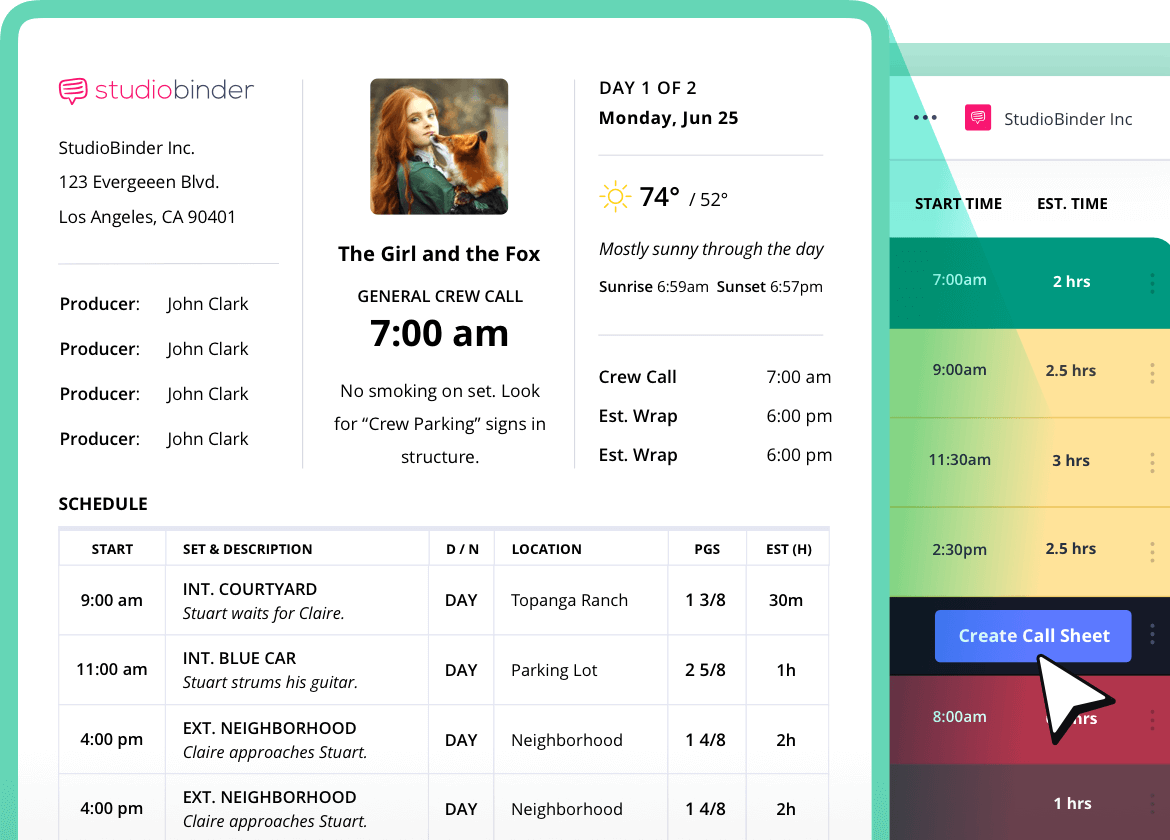
Simple call sheet
Who sends out call sheets?
A daily call sheet is typically created and sent out by a member of the production department, such as the first assistant director, producer, or production coordinator. On a larger set, the 2nd assistant director will make the call sheets and have it approved by the 1st assistant director and the production team.
Sending a Production call sheet
When should a call sheet be sent?
Ideally, callsheets will only be sent out once, so it is best practice to leave room for any last minute modifications. You can expect a callsheet the night before a shoot day. Once you receive it, read it carefully and triple check where you need to be the next day.
Call sheets sent via email and text, and personalized | Explore StudioBinder Call Sheet
Call sheet template
What does a call sheet look like?
First things first, what does a call sheet look like? There is a lot of information that needs to be fit into a lot of different sections, so it can be a little overwhelming at first. To help, StudioBinder has a call sheet builder that lays out everything in a template so that all you have to worry about is filling in the relevant shoot information.
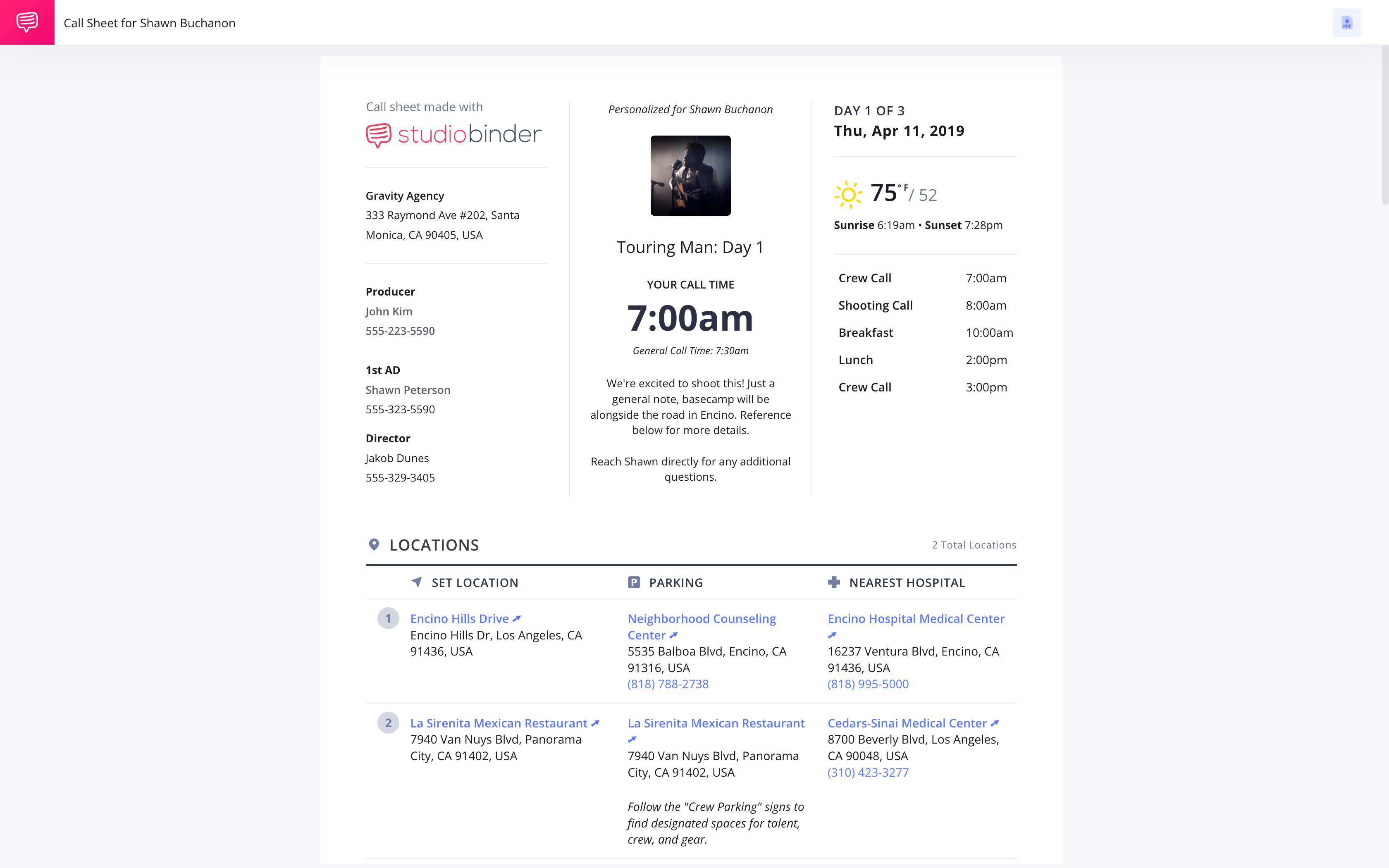
Video production call sheet example | View call sheet sample made in StudioBinder
Look at a few call sheet examples, and you’ll see that there are several pieces of information nearly every sheet includes. Here are some of the key elements of a call sheet.
Top of the callsheet
- Call times (general, cast, crew)
- Weather summary (with sunrise and sunset)
- Nearest hospital (must be a 24h ER)
- Special announcements
- Key contacts such as the UPM, 1st AD, director, etc.
- Production company or agency (Universal, Apple TV, etc.)
Below the header
- Set locations
- Schedule for the day
- Cast list and contact information
- Crew list and contact information
- Department notes
Depending on the type and scale of production, a call sheet may have additional details, but these are the most common requirements.
Now that we know the essentials, let’s look at what you have to do when you receive one.
Related Posts
Getting a call sheet
How to read a call sheet
Like we said, call sheets contain an overwhelming amount of information. Fear not, however; callsheets are built to be easy to read and understand. For more on the anatomy of a call sheet, you can check out our video:

Anatomy of a call sheet | StudioBinder Youtube Channel
1. Title of Shoot and Company Name
This may seem obvious, but don’t forget to put the name of the show, episode, film, or commercial title. Include the production company’s name, or any other ad agency, (if applicable). This ensures proper identification and clarity for all parties involved.
2. Date and Time
Self-explanatory, it’s what tells your team when they need to be somewhere, but do not forget it. Also, useful later for paperwork.
3. Key Personnel
The top of the sheet will always include the key persons, usually those creating the sheet. The producer’s contact info, production coordinator, and director are usually the first.
Trusted by over 1M creatives
Call sheets that save you time
Create personalized call sheets, send via email and text, and track confirmations.
4. Weather Forecast
If you’re going to be outside on a day that’s raining, it’s important your team knows this.
This isn’t just useful to please talent, but for your camera equipment as well. If you know ahead of time you may not get the shot you need because of weather conditions, you have more time to plan an alternative.
Or it could be as simple as a crew member not complaining every two seconds because they didn’t bring a raincoat. If you put it on the call sheet, you’ve covered your bases.
5. Nearest Hospital
If anything happens on set (hopefully it doesn’t), time won’t be wasted searching for the nearest hospital. The information will already be readily available to everyone who needs it.
6. Parking Regulations
Signify street parking or an area where parking is permitted.
7. Crew/Cast Contact Info w/ Location
Certain cast and crew members may need to report to different locations at different times. This is the main chunk of the sheet.
To see exactly how to add cast and crew members in StudioBinder, watch the tutorial below:

Add Recipients to a Call Sheet | Watch more on StudioBinder Academy
8. Daily Schedule
An overview of the shooting schedule also takes up another portion of the document. Scene breakdowns, meal breaks, and company moves are usually indicated here.
This applies to all kinds of productions. Photoshoot call sheets and even documentary call sheets all have schedules.
Watch the tutorial below to learn how to create shooting schedules and customize shooting schedules for any type of production in StudioBinder.

Find out how to populate a call sheet step-by-step | Watch more on StudioBinder Academy
9. Walkie Talkie Channels
Most call sheets have this, but not all of them do. If you’re on a smaller production you may not see this.
Even though film call sheets and photoshoot call sheets are similar, photoshoots are usually smaller. I personally have been on many photoshoots that did not include this. Feel free to use our photoshoot call sheet template and film call sheet templates.
But as long as you have walkies on set, ideally you should inform the crew of the channels. Learn even more about walkie talkie lingo.
10. Additional Notes
Always leave space for any other notes you might have. These notes could be anything from noting extra time for special equipment, to special shuttle transportation during a company move, helping the production stay organized and always on schedule.
There is quite a bit to remember when building one, so StudioBinder has decided to make your life easy with its call sheet template.
Even if you forget everything I just told you, (hopefully you won’t), don’t worry! Your only job is to type in your specific information and adjust any details to fit the needs of your particular production.
Related Posts
Call sheet terminology
Call sheet abbreviations
Like with everything in film, call sheets can contain lingo that seems like total gibberish to anyone who hasn’t been on set before. Let’s go through a few of the most common abbreviations you may run into.
Abbreviation | Translation | Meaning |
|---|---|---|
SW | Start Work | This indicates that it is an actor’s first day on the project’s set. |
W | Work | An actor is working and it is neither their first nor last day. |
WF | Work Finish | This marks an actor’s last day on a production set. |
SWF | Start Work Finish | This is used when it is an actor’s only day on set (both their first and last day). |
O/C | On Call | This is used for members of the shoot who are working on the project that day, but don’t need to be on set. |
N/C | No Call | This is put next to a member who is not working that day. |
PU | Pick Up | This is paired with a time when an actor should expect to be picked up and driven to set. |
H/M/W | Hair/Makeup/Wardrobe | A few related abbreviations you should know: HMU for Hair and Makeup, MUA for Makeup Artist, and WD for Wardrobe. |
BG | Background | This is used to describe actors who are in a scene, but not necessarily the focus. |
D/N | Day/Night | This is when the scene takes place. Remember: a scene may take place at a certain time, but shoot at a completely different time of day (like day for night). |
I/E | Interior/Exterior | This refers to if the scene is shot inside or outside. |
What are some more call sheet terms?
Now that you have the important call sheet abbreviations down, let’s dive into some commonly used terms on a call sheet everyone should know:
Crew Call: The term refers to the exact time production crew workers are expected to arrive on set and do their job.
First Team: The principal cast members (usually the lead actors) needed for a scene being shot. These are the performers whose presence is essential for completing the scheduled work that day. Number one on the call sheet usually refers to the lead actor of the production.
DOOD (Day Out of Days): DOOD (Day Out of Days) is a grid that tracks when cast members are working, holding, or off, offering a clear visual overview of availability that helps streamline scheduling and prevent conflicts during production.
Shoot Day: Refers to the numbered production day taking place on the call sheet’s filming day. This helps the crew track progress across the overall shooting schedule.
Meal Penalty: Meal penalty is the money owed to cast or crew when production doesn’t break during the contractually agreed upon meal break window.
Trusted by over 1M creatives
Call sheets that save you time
Create personalized call sheets, send via email and text, and track confirmations.
Production call sheets
Why call sheets are critical to production
Any kind of filmmaking production practically takes an army to get through just one day, which is why there needs to be a well-communicated map that establishes everyone’s contribution for that day. That’s where call sheets come in. They consolidate schedules, locations, crew calls, cast requirements, and department notes into a single, straightforward document. Below are the most critical components to consider while building a call sheet:
- Organization: A call sheet centralizes all essential information for the day, from scene numbers to weather forecasts, ensuring every department works from the same plan. This prevents any confusion and keeps production moving and on schedule.
- Legal/Compliance: Properly structured call sheets help productions stay compliant with union rules and labor laws by tracking call times, turnaround, meal breaks, and potential meal penalties. They also document safety notes and emergency contacts, reinforcing on-set safety standards and ensuring that critical information is clearly communicated to all parties.
- Communication Efficiency: Instead of relying on scattered emails or last-minute texts, the call sheet delivers clear, standardized communication to cast and crew in one authoritative update.
- Production Risk Reduction: By outlining contingencies, special equipment needs, and logistical details in advance, call sheets reduce costly or unexpected surprises. They should create transparency across departments, helping productions anticipate issues before they disrupt the schedule or budget.
Remember, the clearer you are in the call sheet, the more chances you have for a smooth shoot day. With all of this said, the successful delivery of a call sheet is critical. Following up with every recipient is a standard procedure when sending call sheets. Online services like StudioBinder automate this process:
Track call sheet delivery status | Create a free call sheet with StudioBinder
This article was for the purpose of educating those less familiar with the document in question. Now if you want a deeper dive into how to make a call sheet for TV and film, read our next article.
RELATED POSTS
Wrapping Up
FAQs about call sheets
A call sheet in film production terms is specifically organized around script scene numbers and page counts, since films are shot out of order and must track story continuity. They also tend to include more detailed union, cast, and departmental information due to the larger crew size and regulatory requirements.
In contrast, call sheets for photography, commercials, branded content, or corporate video are typically simpler and organized around shot lists or setups rather than script scenes, with fewer continuity and union-driven details.
A call sheet should include the most essential information about a production day at the top, including the date, a general call time, and the name of the film studio. From there, the call sheet should list the location, schedule, and cast/crew information.
The difference between a call sheet and a shooting schedule is that a call sheet provides the details for a single shooting day, while a shooting schedule is a much broader, long-term plan for the entire production schedule. Another way to think about it is that call sheets provide a schedule for the people working on set for a day, and a shooting schedule organizes all the days to shoot every scene in a script.
DOOD on a call sheet stands for "Day Out of Days.” This abbreviation essentially acts as a tally of the number of paid days for each individual cast member.
Up Next
Make your own call sheet
We’ve been hinting at the StudioBinder Call Sheet Builder; now it’s time to use it. If you have a shoot coming up, look no further. The app’s intuitive layout will let you hit the ground running and focus on what’s important.


